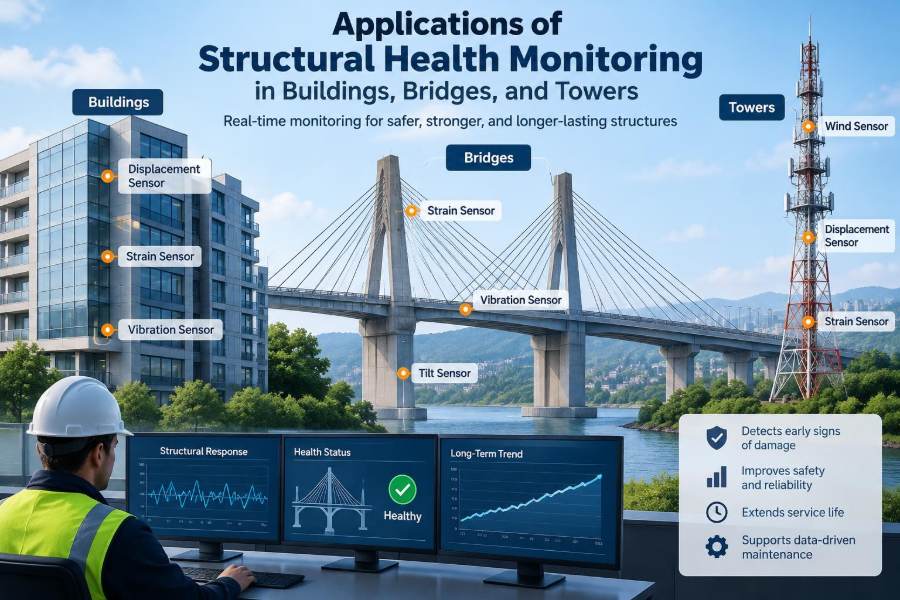

A bridge may look unchanged to the people driving across it each morning, even while its bearings wear, its deck joints leak, or a fatigue-prone connection accumulates damage beneath the traffic. A high-rise can sway slightly in wind without anyone noticing. An older building may experience repeated vibration from trains, construction, or nearby traffic long before a visible crack raises concern.
Engineers have always inspected structures, but periodic visual inspection provides only snapshots. Many conditions develop between visits, inside concrete, beneath cladding, or at locations that are difficult and risky to access.
Structural health monitoring (SHM) uses sensors, data acquisition systems, and engineering interpretation to observe how a structure behaves over time. It does not make a bridge or tower “self-diagnosing,” but it can turn otherwise invisible behavior into evidence for better decisions.
For students, SHM connects structural analysis to real measurements. For practicing engineers and asset owners, it offers a way to focus inspections, verify assumptions, manage uncertainty, and respond intelligently when a structure experiences unusual loading.
🔎 What Structural Health Monitoring Means
Structural health monitoring is the systematic measurement and assessment of a structure’s condition or response. The monitored quantity may be strain, acceleration, displacement, tilt, temperature, crack movement, corrosion-related indicators, or another parameter linked to performance.
A useful distinction is that SHM observes evidence, not health directly. A strain sensor does not announce that a beam is safe; it records deformation at one location. Engineers interpret that measurement alongside drawings, loading history, material behavior, inspections, and analytical models.
🧭 The Questions an SHM System Can Answer
A well-designed system starts with a decision question rather than a sensor catalogue. Common questions include whether traffic loading is producing unexpected stress ranges, whether a settlement trend is continuing, or whether a tower’s measured wind response matches design expectations.
- Is the response within the expected range for the current load and temperature?
- Has the baseline behavior changed over months or years?
- Did an earthquake, impact, fire, or major storm justify an immediate inspection?
- Which locations deserve detailed investigation first?
Questions such as “Is the entire structure safe?” are usually too broad for sensors alone. Safety remains an engineering judgment.
🧩 Monitoring Versus Inspection and Testing
SHM complements rather than replaces inspection. Visual surveys can identify spalling, leakage, loose bolts, blocked drains, and surface cracking that a sensor network may miss. Nondestructive testing can investigate a suspected local defect in greater detail.
Monitoring adds continuity. An inspector might find a crack; a crack gauge can show whether it is stable, temperature-related, or growing under repeated loading. Together, these tools create a more defensible condition assessment.
📡 The Basic Architecture of an SHM System
Most systems have four linked layers: sensors, data acquisition, communications and storage, and interpretation. Weakness in any layer can undermine the whole effort. Accurate sensors are not useful if clocks drift, data are lost, or no one reviews the results.
| Layer | Role | Typical concern |
|---|---|---|
| Sensing | Measures structural or environmental response | Placement, calibration, durability |
| Acquisition | Samples and timestamps signals | Sampling rate, synchronization |
| Data management | Transfers, stores, and protects records | Connectivity, retention, cybersecurity |
| Interpretation | Converts data into decisions | Thresholds, engineering review |
📏 Strain: Measuring Local Structural Demand
Strain is the change in length divided by original length. It is small, but it is highly informative because it relates to stress through material behavior under appropriate assumptions. Strain gauges are often installed on steel members, reinforcing bars, stay cables, composite sections, or critical connections.
In a bridge girder, measured strain under a controlled truck passage can help verify load distribution. In a steel tower, it can reveal how forces redistribute among members during wind or maintenance loading. Local strain is powerful, but it should not automatically be treated as the demand everywhere else.
📈 Acceleration and Vibration Response
Accelerometers measure changes in velocity over time. They are widely used because a structure’s vibration response carries information about its stiffness, mass distribution, damping, and excitation.
Engineers may derive natural frequencies and mode shapes—the characteristic ways a structure tends to vibrate. A meaningful shift can warrant investigation, but it can also arise from temperature, occupancy, traffic, or operational conditions. Interpretation requires a baseline built across changing environments.
↔️ Displacement, Deflection, and Movement
Displacement monitoring records movement relative to a reference. Methods include linear displacement transducers at joints, laser-based systems, global navigation satellite system receivers for large-scale movement, and surveying for periodic checks.
Excessive deflection can affect serviceability even when strength is not immediately threatened. On a long-span bridge, movement is expected as temperature changes. The engineering issue is whether the measured movement has the expected magnitude, direction, timing, and recoverability.
🌡️ Why Temperature Sensors Are Essential
Temperature changes influence nearly every structural measurement. Steel expands and contracts, concrete experiences thermal gradients, bearings move, and material stiffness may vary with temperature. A strain record without temperature context can easily be misread.
Temperature sensors should be placed where they represent relevant conditions: ambient air, shaded and sun-exposed surfaces, interior concrete, or steel members. Thermal effects are not nuisance data to discard; they are part of the structure’s normal behavior.
🧭 Tilt, Rotation, and Settlement Monitoring
Tiltmeters measure angular change, while settlement is commonly assessed using precise leveling, total stations, or other survey methods. These measurements are especially valuable where foundation movement could alter load paths or create serviceability problems.
For a building beside deep excavation, monitoring may track wall movement, column settlement, and floor level changes. A single reading rarely tells the story. Engineers examine trend, spatial pattern, construction stage, and the relationship between ground movement and structural response.
🧱 Crack and Joint Movement Sensors
Crack gauges and displacement transducers can record opening, closing, or sliding across a crack or movement joint. This is useful when a crack’s cause is uncertain or when an existing crack lies near a critical detail.
A measured opening that repeats with daily temperature may indicate a different mechanism from one that steadily increases after heavy loading. The instrument describes motion; determining whether that motion is benign, repairable, or urgent depends on structural context.
🛡️ Corrosion and Durability Indicators
Durability monitoring is particularly relevant for reinforced concrete and steel exposed to moisture, chlorides, pollutants, or aggressive industrial environments. Potential measurements, resistivity, humidity, and embedded corrosion sensors may support an assessment of corrosion risk or activity.
These tools require caution. Concrete is variable, moisture-sensitive, and electrically complex. Monitoring should be paired with condition surveys, material sampling where appropriate, cover-depth information, and knowledge of drainage and exposure conditions.
🌉 SHM Applications in Highway Bridges
Bridges combine repeated live loading, weather exposure, moving components, and difficult access. Monitoring can concentrate on fatigue-sensitive details, bearings, expansion joints, cable systems, scour-prone foundations, or locations altered by rehabilitation.
For example, a bridge owner may instrument a repaired steel detail to compare measured stress cycles with expectations under normal traffic. The goal is not merely to collect thousands of truck events, but to determine whether the repair is experiencing the stress range it was intended to reduce.
🚆 Rail Bridges and Repeated Dynamic Loading
Rail bridges face regular, often predictable axle loads and dynamic effects that depend on train speed, track condition, and bridge stiffness. Accelerations, strains, and displacement can help identify unusual response patterns or support maintenance planning.
The train itself is part of the loading system. Changes in wheel condition, track geometry, or vehicle type can change measured response without indicating bridge damage. Good monitoring programs therefore document operational conditions as carefully as structural signals.
🌊 Long-Span Bridges in Wind and Weather
Long-span bridges are sensitive to wind, temperature, and cable forces. SHM can measure deck acceleration, wind speed and direction, cable vibration, bearing movement, and tower response during ordinary and severe weather.
Wind monitoring supports operational understanding, but not every high reading is a danger signal. Aerodynamic behavior depends on turbulence, wind angle, structural configuration, and response amplitude. Engineers compare measurements with established operating criteria and the bridge’s known behavior.
🏢 Applications in Buildings
In buildings, monitoring often supports construction-stage control, settlement assessment, vibration serviceability, post-event evaluation, or investigation of unusual cracking. It can be especially valuable for complex transfers, deep basements, long cantilevers, and structures adjacent to excavation.
Occupant comfort is a common application. A floor may be structurally strong yet feel uncomfortable when people walk, dance, or use rhythmic equipment. Accelerometers can quantify response and help engineers evaluate practical mitigation options.
🏙️ Tall Towers and Wind-Induced Motion
Slender towers are designed to move under wind; some use tuned mass dampers or other damping devices to control acceleration and improve occupant comfort. SHM allows designers and owners to compare real motion with expected behavior after occupancy begins.
The distinction between displacement and acceleration matters here. A noticeable but slow drift can feel different from smaller, faster vibration. Monitoring helps describe both, but occupant perception also depends on duration, direction, activity, and individual sensitivity.
🏗️ Construction-Stage Monitoring
A structure is often most vulnerable or least familiar during construction, when its final load paths, bracing, and stiffness are incomplete. Monitoring can track temporary works, shoring loads, formwork deflection, cable forces, settlement, and geometry during critical lifts.
Construction monitoring is effective when it is tied to action plans. If a reading reaches an alert level, the team must know who receives the notification, who has authority to pause work, and what confirmatory checks are required.
🌍 Earthquake and Extreme-Event Assessment
After an earthquake, impact, blast, fire, flood, or severe storm, monitored records can show the intensity and character of structural response. This may assist engineers in prioritizing inspections and identifying areas for closer review.
However, an absence of an alarm is not proof of absence of damage. Sensors cover limited locations and may not capture local damage. Post-event decisions should follow established emergency procedures and include qualified structural assessment.
🧮 Baselines: The Reference That Makes Data Useful
A baseline is the record of normal behavior under known or typical conditions. Without it, a measured frequency, strain, or displacement may have little meaning. Baselines should ideally cover changing temperatures, occupancy patterns, traffic levels, and seasonal conditions.
For a newly instrumented building, the first weeks of data may mainly reveal commissioning issues and ordinary thermal cycles. Patience matters: a single “normal” day is rarely an adequate reference for a structure that experiences changing environmental loads.
⚖️ Setting Alerts Without Creating False Alarms
Alert limits should be based on engineering reasoning, not simply on whatever value appears unusual on a graph. Different levels can distinguish data-quality issues, conditions requiring review, and conditions needing prompt site action.
- Informational alerts flag missing data, battery problems, or sensor drift.
- Review alerts identify departures from expected trends that need engineering assessment.
- Action alerts trigger predefined inspection, operational, or emergency steps.
Thresholds should be revised carefully as the baseline improves. Overly sensitive alerts cause alarm fatigue; overly broad limits can hide meaningful change.
🧠 From Raw Data to Engineering Judgment
Raw time histories can be noisy, incomplete, and affected by operational changes. Data processing may include filtering, temperature normalization, event detection, modal analysis, and comparison with finite-element models or simplified calculations.
Automation can highlight patterns, but it cannot reliably supply context on its own. A change in measured response may reflect sensor aging, maintenance activity, a new façade component, changed traffic, or actual structural deterioration. Engineering judgment connects signal to cause.
🤖 Analytics and Machine Learning: Useful, Not Magical
Pattern-recognition tools can help sort large datasets, detect anomalies, classify events, and identify relationships that would be difficult to spot manually. They are particularly useful when a system produces continuous high-frequency data.
Yet an algorithm trained on normal historical data may struggle with rare events or conditions never represented in that history. Transparent features, independent validation, and review by engineers remain essential, particularly when results influence safety-related decisions.
🔌 Data Quality, Calibration, and Sensor Drift
Bad data can look convincing. Loose mounting, electrical noise, water ingress, failed power supplies, communication dropouts, poor clock synchronization, and calibration drift can all create misleading records.
A monitoring plan should include installation records, calibration information, routine health checks, redundancy at selected critical locations, and procedures for identifying implausible values. Treating sensors as permanent and maintenance-free is a common and costly mistake.
📍 Sensor Placement Is an Engineering Design Task
More sensors do not automatically produce better insight. Placement should be informed by expected behavior, structural analysis, likely damage mechanisms, accessibility, environmental exposure, and the decision the data will support.
Consider a girder with a suspected fatigue detail: a sensor beside the detail may quantify local strain, while another at a representative section helps distinguish global loading changes from localized behavior. Strategic comparison is often more valuable than dense but unplanned instrumentation.
💰 Balancing Cost, Risk, and Value
SHM involves upfront installation costs and continuing expenses for power, communications, inspection, software, data storage, maintenance, and engineering review. A low initial price can become poor value if the data are unreliable or unused.
Monitoring tends to offer the strongest value where failure consequences are high, access is difficult, uncertainty affects expensive decisions, loading is unusual, or a specific condition needs observation over time. It is not automatically justified for every ordinary structure.
🧾 Documentation and Ownership of the Data
Monitoring data should have clear ownership, naming conventions, metadata, retention rules, and access controls. Future engineers need to know what each channel measures, where it is installed, its orientation, units, sampling interval, calibration history, and any changes made during operation.
Without this context, a long data archive can become an unreadable collection of numbers. Data governance is therefore part of structural stewardship, not merely an information-technology task.
👷 Roles Across the Project Team
Effective SHM requires collaboration. Structural engineers define questions and interpret response; instrumentation specialists address sensors and acquisition; contractors manage installation realities; owners set operational priorities; and facilities teams help maintain the system.
Responsibilities should be explicit. In particular, every alert pathway needs an identified recipient and a practical response process. A dashboard no one owns is not a monitoring program.
🚫 Common Mistakes in Monitoring Projects
Several mistakes recur: installing sensors before defining decisions, ignoring environmental effects, using unvalidated thresholds, failing to budget for maintenance, and assuming remote data eliminate field inspections.
Another frequent error is collecting far more data than the team can review. A smaller system that reliably answers a high-value question is often preferable to a large system that produces unattended charts.
🛠️ A Practical Workflow for Planning SHM
A disciplined workflow keeps the system focused on structural need rather than technology enthusiasm.
- Define the structural concern, asset consequence, and decisions to be supported.
- Review drawings, inspection history, analytical models, loading, and environmental exposure.
- Select measurable indicators and suitable sensor locations.
- Design acquisition, power, communications, quality checks, and cybersecurity provisions.
- Establish baseline collection, alert logic, reporting, and response responsibilities.
- Maintain, recalibrate where required, and periodically reassess whether the system still answers the original question.
🎓 Skills Students and Young Engineers Should Build
SHM is interdisciplinary. Strong fundamentals in mechanics, dynamics, materials, and structural analysis remain central, but engineers also benefit from knowledge of instrumentation, signal processing, statistics, programming, and data visualization.
Just as valuable is the habit of asking: “What physical mechanism could produce this pattern?” A graph is never the final answer. It is a clue that must be tested against load paths, boundary conditions, construction history, and observable condition.
🔭 Where Structural Health Monitoring Is Heading
Wireless sensing, lower-power devices, improved communications, digital models, and automated data workflows are making monitoring more practical in many settings. These developments can expand coverage and speed up the route from measurement to review.
The central challenge remains unchanged: reliable interpretation. Better hardware will not remove the need for thoughtful objectives, environmental context, validation, and qualified engineering oversight.
✅ The Core Principle: Measure to Make Better Decisions
The most successful SHM systems are not those with the most impressive dashboards. They are systems that reduce a specific uncertainty: whether a repair is working, whether movement is stabilizing, whether an extreme event changed behavior, or where to send inspectors first.
Buildings, bridges, and towers each have different load paths and risks, but the principle is consistent. Measure relevant behavior, understand what normal looks like, investigate meaningful change, and integrate the evidence with inspection and engineering analysis.
Structural health monitoring is most valuable when data are deliberately connected to real structural decisions, not when sensors are treated as a substitute for engineering judgment. Used this way, it helps professionals manage complex assets with greater clarity, traceability, and care. 🏗️📡🔍