
A structural engineer might spend one week checking the vibration of a hospital floor and the next reviewing steel connections for a distribution warehouse. Both jobs use the same mechanics, codes, and software foundations. Yet the compensation attached to them can be very different.
That difference is not simply a reward for working on the tallest building or carrying the most calculations. Pay usually follows a mix of technical scarcity, project risk, commercial pressure, location, responsibility, and the engineer’s ability to make sound decisions when the drawings are incomplete and the schedule is tight.
For students choosing electives, early-career engineers deciding whether to specialize, and experienced professionals considering a move, salary is a practical question. It influences which skills are worth building, what credentials to pursue, and when a job title represents genuine career progression.
The useful question is therefore not “Which structural engineers earn the most?” in isolation. It is: which combinations of specialty, project environment, accountability, and business role create the strongest long-term earning potential?
🧭 Start With the Right Meaning of Salary
Structural engineering compensation can include base pay, overtime or time-off arrangements, annual bonuses, profit sharing, retirement contributions, relocation assistance, and project or site allowances. Comparing only the headline salary can hide meaningful differences.
A design-office role may offer predictable hours and solid benefits, while a construction-facing role may pay more because it involves travel, irregular schedules, or difficult site conditions. Neither package is automatically better; the comparison should reflect the lifestyle and risk attached to it.
📍 Location Sets the First Pay Band
Local labor markets strongly affect structural engineer salaries. Large metropolitan areas, regions with major infrastructure investment, and places with high living costs often offer higher nominal pay than smaller markets.
However, a larger salary does not always create more purchasing power. Housing, taxation, commuting, licensing rules, and health-care costs can materially change the value of an offer. Engineers considering an international move should also examine whether their qualifications transfer and whether they can eventually sign work locally.
🎓 Experience Changes What Employers Are Buying
Early-career engineers are generally paid for potential, calculation capability, software fluency, and the capacity to learn a firm’s systems. At this stage, a broad role can be more valuable than chasing a narrowly higher starting salary.
As experience grows, employers increasingly pay for judgment. Can the engineer identify a load-path problem before it reaches construction? Can they explain a design choice to an architect, contractor, or client? Can they review others’ work efficiently without missing a critical issue?
Senior compensation rises most when an engineer becomes trusted with decisions that affect schedule, cost, safety, and client relationships.
🪪 Licensure Raises Your Ceiling
Professional licensure, chartership, or equivalent local registration is often a major compensation milestone because it expands responsibility. The exact route varies by jurisdiction, but the business reason is consistent: a licensed engineer can take formal accountability for work that an unlicensed engineer cannot independently approve.
Licensure alone does not guarantee high pay. It becomes most valuable when paired with technical competence, communication, and a role where the credential allows the firm to deliver or sign higher-value work.
🏢 Building Design Is Broad, Not One Pay Category
“Buildings” covers everything from small tenant improvements to complex high-rises, hospitals, laboratories, stadiums, and mixed-use developments. A structural engineer designing repetitive low-rise buildings faces a different workload and commercial model from one coordinating a long-span roof or a performance-based seismic tower.
Complex building work can pay well because it requires coordination across architecture, building services, fire protection, façade systems, foundations, and construction sequencing. Still, the market can be competitive, especially where many firms provide conventional building design.
🏙️ High-Rise and Tall-Building Design
Tall-building engineers work with wind behavior, lateral systems, differential shortening, foundation movement, vertical transportation interfaces, and construction-stage effects. The calculations are only part of the job; coordinating a stable, buildable structural concept across dozens of floors is the real challenge.
This specialty can command strong compensation in markets with sustained tower construction. It is also geographically concentrated and sensitive to development cycles. A portfolio built only around towers may be rewarding, but it can be less portable during a slowdown than broader building expertise.
🌉 Bridges and Heavy Civil Infrastructure
Bridge, transit, highway, and public-works structural engineering often involves long asset lives, extensive documentation, formal reviews, and demanding durability requirements. Engineers may work with staged construction, fatigue, bearings, expansion joints, foundations, rehabilitation, and traffic constraints.
Public infrastructure can offer stable project pipelines where governments maintain long-term programs. Compensation may be especially competitive for engineers who can lead complex packages, manage interfaces, or bring experience in inspection and rehabilitation as well as new design.
🚆 Rail and Transit Projects Reward Systems Thinking
Rail and transit structures sit inside a larger operational system. A bridge, station, retaining wall, platform, or maintenance facility must work alongside track geometry, electrification, signaling, passenger circulation, utilities, and operating constraints.
That interface density makes experienced transit engineers valuable. The work can involve lengthy approval processes and public-sector procurement, but it offers a path toward high-responsibility coordination roles that are difficult to fill with purely building-focused experience.
⚡ Energy Structures Can Carry a Premium
Energy projects may include substations, transmission structures, industrial facilities, offshore or coastal assets, support structures for renewable generation, and conventional generation upgrades. These projects can combine unusual loading, strict reliability expectations, remote sites, and specialized client requirements.
Pay can rise where the work demands familiarity with industry specifications, hazardous environments, or construction logistics. Project availability can fluctuate with regulation, commodity conditions, grid investment, and regional energy policy, so transferable structural fundamentals remain essential.
🏭 Industrial Facilities Favor Practical Design Judgment
Industrial structural engineering covers plants, warehouses, process buildings, pipe racks, equipment supports, cranes, platforms, and structures exposed to vibration, temperature effects, or aggressive environments. Constructability and operational access frequently matter as much as analytical elegance.
Engineers who understand equipment loads, fabrication tolerances, erection sequences, and shutdown constraints can be particularly valuable. Industrial clients often need rapid decisions because a delayed modification can affect production, which creates demand for engineers who are both technically careful and commercially responsive.
🧪 Pharmaceutical, Semiconductor, and Advanced Manufacturing Work
Facilities for advanced manufacturing, life sciences, and controlled production can involve tight vibration limits, heavy equipment, dense services, clean environments, and aggressive delivery schedules. Structural decisions may need to accommodate future equipment changes without disrupting operations.
These sectors can pay strongly during active investment cycles because schedule certainty and specialized coordination have direct commercial value. The pressure can also be intense, and engineers should ask how scope changes, overtime, and decision authority are managed before accepting an offer.
🏥 Healthcare Projects Demand Careful Coordination
Hospitals and healthcare facilities are technically demanding because they contain imaging equipment, operating rooms, emergency functions, complex service routes, and stringent resilience expectations in some regions. Renovation work can be especially difficult when facilities remain operational.
A hospital addition is not simply a larger office building. Engineers may need to sequence demolition, protect occupied areas, and identify existing conditions accurately. This combination of risk and coordination can support higher compensation for experienced project leads.
🌪️ Seismic and Resilience Engineering Create Scarce Expertise
Seismic engineering requires an understanding of dynamic behavior, ductility, detailing, irregularity, existing-building assessment, and local code provisions. Resilience work may also consider wind, flood, blast, fire, and continuity of operations after an extreme event.
Demand depends on local hazards and regulations, but engineers with credible expertise can command a premium because design errors may have serious consequences. The highest-value specialists are not merely software users; they can explain behavior, choose appropriate analysis methods, and recognize when a model is misleading.
🔥 Fire Engineering Interfaces Can Be Valuable
Structural fire design examines how members, connections, and whole structural systems behave at elevated temperatures. It may involve fire resistance, thermal expansion, compartmentation assumptions, and performance-based approaches where permitted.
This work often sits at the boundary between structural and fire disciplines. Engineers who develop genuine competence in both the structural response and the applicable approval process can become valuable on complex projects, particularly where conventional prescriptive solutions are restrictive or expensive.
🏗️ Temporary Works Are High Consequence, High Trust
Temporary works include shoring, formwork support, excavation bracing, crane foundations, erection stability, lifting frames, falsework, and demolition sequencing. These structures may exist for a short time, but failure can occur during a highly exposed stage of construction.
Strong compensation is possible because schedules are urgent, site decisions are time-sensitive, and practical experience matters greatly. The trade-off is a faster pace and the need to communicate clearly with contractors, fabricators, and field crews.
🔍 Forensic Engineering Values Investigation Skills
Forensic structural engineers investigate damage, deterioration, construction defects, water intrusion effects, failures, and disputes. Their task is not to assume a cause, but to develop and test plausible explanations using observations, records, calculations, and sometimes material testing.
Experienced forensic work can be well compensated because conclusions may affect repair scope, insurance matters, litigation, or public safety. It requires disciplined writing and impartial reasoning; an engineer whose opinion appears advocacy-driven can lose credibility quickly.
🏚️ Existing Buildings and Retrofit Work Are Often Undervalued
Existing structures rarely provide perfect drawings, complete material data, or convenient access. Engineers must infer load paths, investigate concealed conditions, and design interventions that fit within occupied spaces and realistic construction limits.
Adaptive reuse, seismic retrofit, façade support, and rehabilitation can become high-value specialties because they demand judgment rather than routine repetition. The engineer who can turn uncertain field information into a sensible, buildable scope is solving a problem clients genuinely pay to remove.
🌊 Marine and Coastal Structures Add Environmental Complexity
Piers, wharves, flood defenses, waterfront buildings, and offshore-adjacent facilities face corrosion, wave action, vessel impact, tidal access, scour, and difficult inspection conditions. Materials and details that work inland may perform poorly in a marine environment.
These projects can offer premium opportunities where coastal development, ports, and resilience investment are active. They also require a willingness to work across disciplines, since geotechnical, hydraulic, environmental, and structural decisions are closely linked.
🧱 Deep Technical Skills That Improve Earning Power
High salaries rarely come from knowing one analysis program. They follow from capabilities that reduce risk or open new work for an employer. Particularly useful technical strengths include:
- nonlinear, dynamic, or staged-construction analysis used with sound engineering judgment;
- advanced steel, concrete, timber, masonry, or composite detailing knowledge;
- foundation-structure interaction and close coordination with geotechnical engineers;
- condition assessment, repair design, and materials deterioration knowledge; and
- computational tools that automate repeatable checks without obscuring assumptions.
A specialist should still be able to perform basic reasonableness checks by hand. Software output is not a substitute for understanding how forces travel through a structure.
💻 Digital Delivery Helps When It Solves Real Problems
Building information modeling, parametric design, automated drawing production, data management, and scripting can increase an engineer’s value when they improve coordination or reduce repetitive errors. A well-built workflow can save a team many hours across a program of similar projects.
Digital skills have less salary impact when they are detached from design responsibility. The engineer who can automate a task and identify the structural assumptions that must be reviewed is far more valuable than someone who only operates a tool.
🗣️ Client-Facing Engineers Often Earn More
Firms can grow only when clients trust them with repeat work. Engineers who lead meetings, clarify scope, write persuasive technical proposals, and explain risk without jargon contribute directly to that trust.
This does not mean every technically strong engineer must become a salesperson. It means that communication is a professional multiplier. A client-facing engineer can turn expertise into project opportunities, which is why compensation often increases as relationship responsibility grows.
📊 Project Management Is a Different Value Proposition
Project managers control scope, budget, schedule, staffing, quality reviews, and client expectations. In many firms, successful project management is a direct route to higher pay because it protects fee, reduces write-offs, and supports repeat business.
The role is not automatically a promotion for every engineer. Moving too early can reduce time spent developing technical depth. The strongest long-term path is often to build enough technical authority that management decisions remain grounded in how structures are actually designed and built.
🤝 Contractor-Side Roles Can Pay Differently
Structural engineers working for contractors, fabricators, specialist subcontractors, or design-build teams may earn more than traditional consulting roles in certain markets. Their work is closely connected to procurement, fabrication, means and methods, change management, and construction speed.
These roles can provide unusually practical experience. They may also involve travel, site pressure, and shorter decision cycles. An engineer should distinguish between a genuinely broader role and one that transfers significant responsibility without adequate authority or support.
💼 Ownership, Business Development, and Profit Sharing
The largest compensation outcomes in consulting are often connected to ownership, senior leadership, or the ability to bring in and deliver profitable work. This is not simply a reward for years served; it reflects exposure to business risk and responsibility for people, client relationships, and financial performance.
Profit sharing and equity can be valuable, but they should be understood carefully. Ask how profit is calculated, whether the arrangement is discretionary, what happens if employment ends, and whether ownership requires a capital contribution.
⚖️ Higher Pay Usually Has a Trade-Off
A higher-paying specialty may involve remote projects, irregular hours, tight deadlines, greater liability exposure, public scrutiny, or a narrower job market. A lower-paying position may provide better mentorship, more design variety, or a healthier schedule.
Compensation should be assessed as a whole package. A useful comparison includes the type of work, expected hours, travel, quality of technical supervision, path to licensure, training budget, bonus reliability, and opportunities to lead.
🚫 Common Salary Comparison Mistakes
Engineers can make poor moves when they compare titles rather than responsibilities. “Senior engineer” can mean a technical reviewer in one firm and a lightly supervised designer in another.
- Assuming a prestigious project type always pays more at every employer.
- Ignoring unpaid overtime or travel time when comparing offers.
- Choosing a narrow specialty before gaining fundamental design competence.
- Accepting vague promises of promotion without defined responsibilities or review timing.
- Overlooking the quality of mentorship, especially before professional registration.
Salary matters, but an early role that develops strong judgment can produce more options than a slightly higher offer with weak supervision.
🧾 Questions to Ask Before Accepting an Offer
Good questions reveal the actual role behind the compensation number. Ask what proportion of time is spent in analysis, drawing production, site work, coordination, and project management. Ask who reviews your work and what level of responsibility you will hold after the first year.
It is also reasonable to ask how overtime is handled, whether bonuses follow a documented approach, which sectors are growing, and what successful engineers in the firm did to progress. The answers reveal whether the employer has a deliberate development model or only immediate staffing needs.
🛠️ A Practical Plan for Early-Career Engineers
In the first few years, prioritize skills that travel across sectors: load paths, lateral systems, member and connection behavior, drawings, specifications, site observations, and clear calculations. Learn to notice the assumptions hidden inside a model.
Then choose a direction based on the work you can sustain interest in. An engineer who enjoys investigation may thrive in existing structures or forensics; someone who likes fast field decisions may prefer temporary works or contractor-side design; another may be drawn to infrastructure systems.
Specialize deliberately, but retain enough breadth to understand adjacent disciplines and changing markets.
📈 A Practical Plan for Mid-Career Engineers
Mid-career is the point to convert experience into a recognizable value proposition. That may mean becoming the person who leads seismic assessments, resolves steel-fabrication problems, manages healthcare renovations, or delivers bridge rehabilitation packages.
Document outcomes, not just project names. Examples include reducing redesign through early coordination, leading a difficult site solution, mentoring junior staff, improving a workflow, or winning a repeat client’s confidence. These are the achievements that support a compensation conversation.
🧠 Negotiate From Evidence, Not Assumptions
A strong salary discussion connects your request to the value you create. Describe your licenses, technical niche, project responsibility, client relationships, and the work you can lead with limited supervision. Be specific about the market alternatives you are considering without making threats.
If base salary flexibility is limited, discuss the full package: review timing, bonus structure, title, training support, hybrid arrangements, additional leave, overtime policy, and a defined path to greater responsibility. Get material commitments clarified in writing where possible.
🔑 The Core Principle: Scarcity Plus Responsibility Drives Pay
The best-paid structural engineering paths usually combine three elements: a skill that is not easy to replace, work with meaningful technical or commercial consequences, and the trust to make decisions independently. A niche alone is not enough; it must solve a problem that clients and employers consistently need solved.
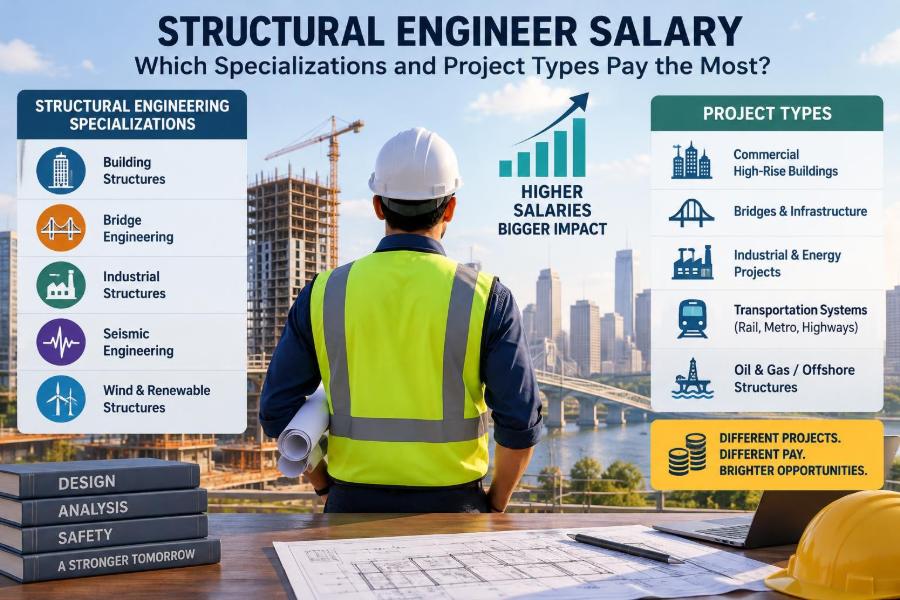
High-rise design, infrastructure, energy, industrial facilities, seismic work, temporary works, forensics, and advanced manufacturing can all create strong earning opportunities. But each path has different cycles, pressures, and lifestyle demands. The most durable career is built on sound fundamentals first, followed by specialization, communication, and increasing accountability.
The structural engineers with the strongest long-term earning potential are usually those who pair reliable technical judgment with the ability to reduce project risk, lead decisions, and earn client trust. Choose the problems you want to become known for, then build the evidence that you can solve them well. 🏗️📐💼