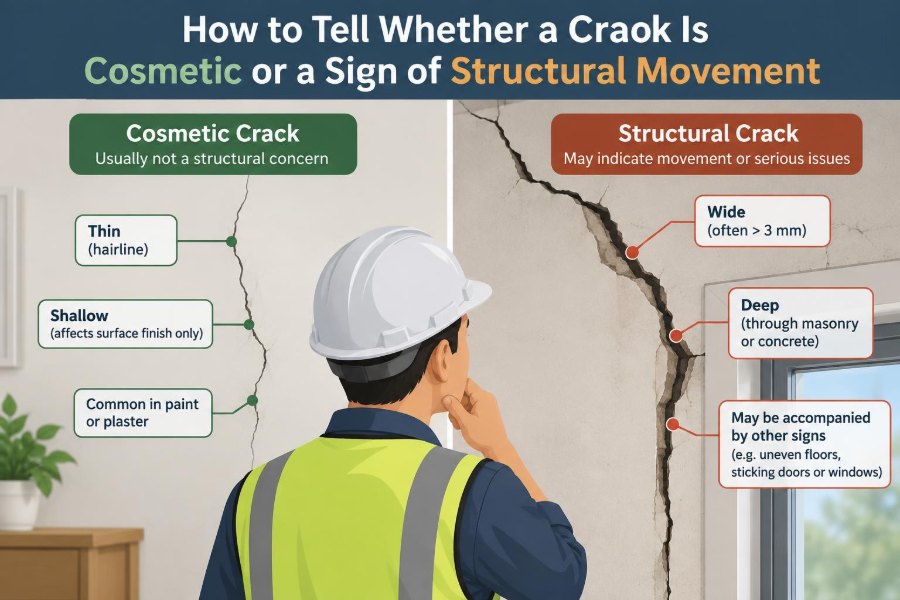

A hairline crack appears above a bedroom door. A diagonal line runs from the corner of a living-room window. In a concrete parking structure, a new crack traces the underside of a beam. The first instinct is often either to ignore it or to assume the worst.
Neither response is especially useful. Cracks are common in buildings because concrete shrinks, plaster ages, timber responds to moisture, and materials meet at joints. Yet a crack can also be visible evidence that parts of a structure are moving differently than intended.
The practical question is not simply, “Is there a crack?” It is: what is cracking, where is it located, what pattern does it follow, and is it changing? Those observations help distinguish a finish defect from a condition that deserves structural investigation.
This guide provides a method for reading cracks carefully. It cannot diagnose a specific building remotely; when safety, rapid movement, or major distortion is involved, assessment by a qualified structural professional is the appropriate next step.
🧭 Start With the Right Question
A crack is a separation within a material or along an interface between materials. It tells us that strain exceeded the material’s ability to deform without separating, but it does not automatically reveal the cause.
“Cosmetic” usually means the crack is confined to a non-structural finish, such as paint, gypsum board joint compound, or plaster. “Structural movement” means the crack may reflect movement in load-bearing elements, supports, foundations, or the connections between them. The distinction is about mechanism, not appearance alone.
🏠 Buildings Move More Than They Seem
Even a sound building moves. Concrete shortens as it dries and shrinks, steel expands and contracts with temperature, timber changes dimension with moisture, and floors deflect slightly under normal occupancy loads.
Good design anticipates these movements through reinforcement, control joints, slip details, and expansion joints. Cracks become informative when the movement is restrained, concentrated, uneven, or greater than the surrounding construction can accommodate.
🧱 Identify the Material Before Interpreting the Crack
The same visible width means different things in different materials. A fine crack in a skim coat may be superficial, while a crack through a reinforced-concrete beam needs a different level of attention because the beam carries load.
First establish whether the crack is in paint, plaster, drywall, masonry, concrete, a tile finish, or a structural member. A crack that continues through multiple layers or appears on both sides of a wall is generally more significant than one limited to a surface coating.
📍 Location Is Evidence, Not Decoration
Where a crack occurs often narrows the possible causes. Cracks at door and window corners commonly form where openings interrupt a wall and concentrate stress. Cracks at wall-ceiling junctions can result from roof or floor movement relative to partitions.
A crack in the middle of a plain wall may be related to finish shrinkage, while a crack at the base of a load-bearing wall, across a beam, or beside a foundation opening deserves closer scrutiny. Context gives geometry meaning.
📐 Read the Direction and Shape
Crack patterns are clues to the direction in which a material has been pulled, bent, sheared, or restrained. Vertical, horizontal, diagonal, stepped, and curved cracks each suggest different mechanisms, though no pattern alone provides a final diagnosis.
| Pattern | Common interpretation to investigate |
|---|---|
| Fine random surface network | Finish or concrete surface shrinkage |
| Diagonal from an opening corner | Stress concentration, differential movement, or settlement |
| Stepped along masonry joints | Movement through weaker mortar joints; possible foundation or wall movement |
| Horizontal in masonry | Lateral pressure, corrosion expansion, or support-related movement |
| Across a concrete member | Flexure, shrinkage, thermal restraint, or other member-specific action |
The table is a screening tool, not a substitute for examining loading, reinforcement, drainage, soil conditions, and construction details.
📏 Width Matters, but It Is Not a Verdict
Wide cracks are easier to notice, but width alone is an unreliable severity scale. A stable, older crack may be wider than a newly developing crack that is actively opening. A narrow crack in a critical location can also matter more than a wider crack in decorative plaster.
Measure width at several points and record the location. A crack gauge is useful, but a clear photograph with a ruler or scale beside the crack can provide a practical record when used consistently.
⏳ Change Over Time Is One of the Strongest Clues
A stable crack may need repair for weather resistance, appearance, or durability, but it does not necessarily indicate ongoing structural distress. A crack that lengthens, widens, reopens after repair, or changes seasonally deserves investigation.
Mark the date, photograph the crack from the same position, and note nearby conditions such as heavy rain, excavation, a leak, a renovation, or unusual loading. Monitoring converts a single observation into evidence about movement.
🪟 Look for Cracks Around Openings
Doors and windows create unavoidable discontinuities in walls. Their corners are natural stress raisers, much like a notch in a piece of cardboard that makes tearing easier.
A small, stable diagonal finish crack at an opening can be common. Concern increases if cracks are pronounced on several levels, form matching patterns inside and outside, accompany masonry displacement, or coincide with doors and windows becoming difficult to operate.
🚪 Test Doors and Windows as Supporting Evidence
Sticking doors are not proof of foundation movement. Seasonal humidity can swell timber doors, and worn hinges can cause misalignment. But changes in operation can support a crack assessment when they occur in the same area and at the same time.
- Note whether the issue is new or long-standing.
- Check for uneven gaps around frames.
- Look for racked, out-of-square frames rather than simple hinge problems.
- Compare nearby openings for a repeated pattern.
Several related symptoms carry more weight than one isolated inconvenience.
🧩 Distinguish Surface Cracks From Through-Cracks
A finish crack often stops at a joint, changes direction at a material boundary, or can be seen only on one face. A through-crack may be visible on both sides of a wall, continue through masonry units and mortar, or appear in a structural element beneath removed finishes.
Do not aggressively probe or remove finishes from potentially hazardous materials. Where safe and appropriate, inspection openings should be planned so that the actual substrate—not only the painted surface—can be evaluated.
🪨 Understand Differential Settlement
Settlement is downward movement of a foundation or supporting ground. Buildings can tolerate some broadly uniform settlement; differential settlement, where one area moves more than another, is more likely to distort walls, frames, and finishes.
Potential contributors include variable soil stiffness, poorly controlled fill, changes in groundwater, leaking drains, tree-related moisture variation, or localized foundation support problems. The crack pattern is only one part of evaluating these possibilities.
🌧️ Water Often Changes the Investigation
Water does not have to enter a room to affect structural performance. Persistent roof leaks can decay timber, plumbing leaks can soften or erode supporting soil in some situations, and poor drainage can alter moisture conditions around foundations.
Look for staining, efflorescence (white mineral deposits), dampness, rust staining, blocked gutters, downpipe discharge near walls, and ground that slopes toward the building. Repairing the crack without correcting moisture can leave the underlying driver untouched.
🌡️ Account for Thermal and Moisture Movement
Long walls and slabs change length with temperature. Timber framing and wood floors respond strongly to moisture. Different materials do not move at the same rate, so cracks often appear where concrete meets masonry, where a ceiling meets a partition, or where a rigid finish spans a joint.
Seasonal opening and closing may indicate environmental movement. That does not automatically make the crack harmless, but it can point toward joint detailing or material compatibility rather than progressive foundation distress.
🧱 Recognize Concrete Shrinkage Cracking
Concrete can crack as it loses moisture and shrinks, especially when movement is restrained or control joints are absent, delayed, or ineffective. Fine irregular cracking near the surface is often associated with early-age behavior or finishing conditions.
More meaningful assessment considers crack depth, orientation, exposure, loading, reinforcement, joint layout, and whether water or chlorides can reach reinforcement. In reinforced concrete, durability can be as important as immediate strength.
🧱 Read Masonry Cracks Differently
Masonry is made of units and mortar joints, and cracks often follow the weaker or more accommodating mortar path. A stepped crack may therefore look dramatic while still requiring careful interpretation of displacement and progression.
Check whether brick or block faces are fractured, whether joints have opened, whether one side is offset from the other, and whether the wall is leaning or bulging. A crack with visible relative displacement is more concerning than a fine line with no offset.
🪵 Do Not Overlook Timber Movement and Decay
Timber-framed buildings commonly develop finish cracks as wood shrinks or responds to changing humidity. Trusses can also move differently from interior partitions, producing recurring cracks at ceiling-wall lines.
However, soft wood, fungal growth, persistent wetting, insect damage, or sagging members change the situation. A crack paired with evidence of timber deterioration requires prompt evaluation because the issue may involve loss of section or connection capacity.
🏗️ Consider Deflection in Floors and Beams
Deflection is the change in shape of a member under load. Some deflection is expected; excessive or newly increasing deflection can crack brittle finishes, separate partitions, and cause floors to feel uneven.
Clues include cracks parallel to a floor line, gaps above partitions, a visibly sagging ceiling, or cracks on the tension side of a beam. The load path, span, support conditions, and any change of use must be assessed together.
⚙️ Check for Recent Load or Layout Changes
A crack may appear after a building’s loading changes: heavy storage placed on a floor, new rooftop equipment, a removed wall, an altered opening, or construction next door. Timing does not prove causation, but it provides a valuable lead.
Never assume an interior wall is non-load-bearing because it appears thin. Load paths can be concealed, and renovation work should be reviewed before walls, beams, columns, or bracing elements are altered.
🔩 Corrosion Can Create Its Own Crack Pattern
Steel expands substantially when it corrodes. In reinforced concrete, corrosion products can force the surrounding concrete to crack and eventually spall, exposing reinforcement. Rust staining and cracks that run parallel to embedded bars are useful warning signs.
This mechanism is not primarily settlement, but it can reduce durability and, if advanced, affect structural capacity. Water ingress and exposure conditions should be addressed alongside repair design.
🧭 Separate Movement Joints From Failures
Control, construction, and expansion joints are intentional separations that allow movement or divide placement work. They can look like cracks, and sealant within them can age, split, or detach without the structure itself failing.
Before filling any linear gap, determine whether it is a designed joint. Rigidly patching a movement joint can simply move the crack to an adjacent, less suitable location.
🔍 Inspect the Whole Pattern, Not a Single Line
One crack is a data point. A collection of cracks, changes in level, leaking, frame distortion, and exterior wall displacement can reveal a coherent pattern. Walk both inside and outside, and compare upper and lower levels where accessible.
Pay attention to symmetry. Similar cracks at repeated drywall joints may point to finishing details; cracks concentrated near one building corner, together with drainage problems, suggest a more localized mechanism worth investigating.
📸 Create a Simple Crack Record
A useful record does not need specialized software. Give each crack an identifier, sketch its position, photograph it with scale, note its direction and approximate length, and record the date.
- Take a wide photo showing the location.
- Take a close photo with a ruler or crack gauge.
- Repeat from the same viewpoint at planned intervals.
- Record events that may affect movement, including storms, leaks, or nearby work.
Monitoring is especially valuable where immediate signs are limited but the cause is uncertain.
🚩 Know the Signs That Merit Prompt Professional Review
Some observations justify moving beyond monitoring. Seek qualified assessment promptly when cracks are rapidly changing, when walls or floors are visibly displaced, or when there is a credible concern about loss of support.
- New large cracks after impact, excavation, flooding, or a suspected ground event
- Bulging, leaning, or out-of-plumb walls
- Cracked, sagging, or visibly damaged beams, columns, or trusses
- Concrete spalling with exposed reinforcement
- Cracks accompanied by sudden sticking of multiple doors or windows
- Unusual sounds, falling material, or signs of imminent instability
If there is an immediate safety concern, keep people away from the affected area and follow local emergency or building-safety procedures.
👷 Choose the Right Type of Help
A competent builder or maintenance professional may be well suited to identify a failed paint joint, minor drywall repair, or drainage maintenance. A structural engineer is appropriate when the question involves load-bearing capacity, foundation movement, significant concrete or masonry cracking, or alteration of structural elements.
Useful information for the assessment includes building age, drawings if available, repair history, photos over time, known leaks, site changes, and the timing of symptoms. Good records reduce guesswork and make site investigation more efficient.
🛠️ Repair the Cause Before Repairing the Finish
A cosmetic repair can be entirely reasonable once active movement has stopped and the cause is understood. The repair method should suit the material: flexible joint treatment for movement interfaces, compatible mortar for masonry, and engineered repair systems for damaged concrete.
Filling an active crack with rigid compound may produce a neat result briefly, then crack again beside the patch. Recurrent cracking is often a message that the repair accommodated neither the movement nor its cause.
🚫 Avoid Common DIY Misinterpretations
Homeowners and facility teams sometimes rely on a single rule: “vertical is safe,” “diagonal means settlement,” or “thin cracks never matter.” These shortcuts overlook material, location, loading, age, and change over time.
Other mistakes include sealing moisture paths before locating leaks, painting over rust-stained concrete, removing a wall before confirming its role, and measuring a crack once without checking whether it changes. Observation should be systematic, not alarmist.
🧪 Why Investigation Has Limits
Even a site inspection may not identify one certain cause immediately. Cracks can result from several interacting effects: shrinkage plus thermal restraint, or minor settlement plus a weak finish joint, for example.
Engineers may use visual inspection, level surveys, crack monitoring, review of drawings, moisture investigation, selective opening-up, or geotechnical input depending on the evidence. The goal is a proportionate investigation that answers the actual risk question.
📚 A Practical Triage Framework
Use three categories as a first response. Observe isolated, fine, stable cracks confined to finishes with no related symptoms. Investigate cracks with uncertain cause, repeated recurrence, meaningful displacement, moisture evidence, or a pattern around openings.
Escalate promptly when movement is rapid, structural elements are visibly distressed, supports may be compromised, or people could be exposed to falling or unstable material. This framework prioritizes evidence and safety rather than fear.
✅ The Core Principle: Cracks Are Clues About Movement
The useful distinction is not “small equals cosmetic” and “large equals structural.” A crack must be read alongside its material, geometry, location, width, displacement, history, environmental conditions, and relationship to the building’s load path.
Most building cracks do not announce a crisis. But the cracks that deserve attention are often identifiable because they are changing, connected to other symptoms, located in critical elements, or accompanied by distortion and water-related deterioration. Treat the crack as evidence, then investigate the mechanism.
A crack becomes meaningful when its pattern and progression reveal how the building is moving—not merely because it is visible. Careful observation, sensible maintenance, and timely professional review turn that evidence into an appropriate response. 🏗️🔎🧱