
A bridge deck is replaced after decades of salt exposure. A high-rise team wants slimmer columns to free up rentable floor area. A homeowner asks whether a timber apartment building can really be safe. In each case, the question sounds simple: which material is strongest?
Structural engineers know that “strongest” is rarely the deciding word. A material may carry enormous compression but crack suddenly in tension. Another may be light enough to transform a long-span roof, yet lose capacity quickly in a fire unless it is protected.
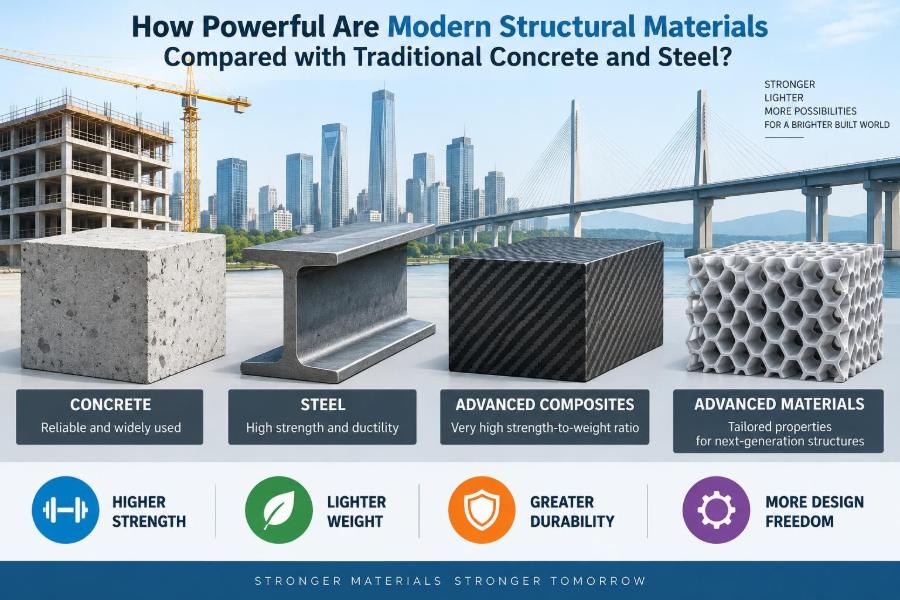
Concrete and steel remain the working foundation of much of the built environment. But engineered timber, fiber-reinforced polymers, ultra-high-performance concrete, advanced reinforcing bars, and other materials are changing what is practical in certain structures.
The useful comparison is not a contest with one winner. It is an exercise in matching material behavior, construction method, exposure, cost, and safety strategy to the job at hand.
🧭 Start by Defining “Powerful”
In structural work, power can mean several different things. It may refer to the maximum stress a material can resist, the load a member can carry, how far it can span, how long it lasts in a harsh environment, or how efficiently it uses its own weight.
A tower column, a bridge cable, and a blast-resistant façade panel do not ask for the same kind of performance. Comparing their materials using only one number, such as compressive strength, can lead to poor design choices.
Structural performance is a system property. Geometry, connections, restraint, defects, loading, construction quality, and the surrounding environment all influence the final capacity.
📏 Strength Is Not the Same as Stiffness
Strength is the stress at which a material yields, crushes, ruptures, or otherwise fails. Stiffness describes how much it deforms under a given load. A strong material can still be too flexible for a floor, façade, or bridge deck.
Elastic modulus, often called Young’s modulus, is a common measure of stiffness. Steel has a high modulus, which is one reason slender steel members can limit deflection effectively. Many fiber composites have high strength but a lower or direction-dependent stiffness, so serviceability can govern their design.
A simple analogy is a thick rubber band and a metal ruler. The rubber band may stretch a long way before breaking, but it is not stiff enough to support a shelf without visible sag.
⚖️ Strength-to-Weight Changes the Design Equation
Specific strength compares strength with density. This is where carbon-fiber-reinforced polymer and some high-performance aluminum alloys can appear exceptionally capable: they can provide substantial tensile capacity without adding much self-weight.
Lower self-weight can reduce foundation demand, seismic inertia forces, lifting requirements, and the loads on existing structures during rehabilitation. It can also make factory-built modules easier to transport.
However, lightness is not automatically an advantage. Lightweight floors may need added mass, damping, or stiffness to control vibration. Wind uplift, acoustic performance, and fire protection can also become more demanding.
🧱 Why Conventional Concrete Still Dominates Compression
Concrete is composed of cementitious binder, water, aggregates, and often supplementary cementitious materials or admixtures. It is naturally effective in compression, which makes it well suited to foundations, retaining walls, arches, columns, slabs, and cores.
Ordinary structural concrete comes in a broad range of specified strengths, selected to suit the structural role and project requirements. Higher-strength mixes can allow smaller columns, but they also require careful attention to curing, quality control, brittleness, and fire behavior.
Concrete is locally available in many regions, can be cast into almost any shape, and provides useful mass, fire resistance, and durability when designed and detailed well. Those practical qualities matter as much as laboratory strength.
🪨 Concrete’s Tension Problem Explains Reinforcement
Concrete is comparatively weak and brittle in tension. When a beam bends under gravity loads, one face is compressed and the opposite face is stretched. Without reinforcement, cracks can form at relatively low tensile stress.
Steel reinforcement is placed where tension is expected. Its bond with concrete allows the two materials to act together: concrete primarily handles compression, while steel takes tensile force after cracking.
This partnership is not accidental. Steel and concrete have reasonably compatible thermal expansion behavior, helping reinforced concrete perform through ordinary temperature changes. Good cover, crack control, drainage, and detailing are still necessary to protect the steel from corrosion.
🔩 Steel Remains the Benchmark for Ductile Strength
Structural steel is widely valued for high tensile and compressive strength, dependable manufacturing, and ductility. Ductility is the ability to deform substantially before fracture, giving a properly designed structure warning and energy-absorbing capacity.
Its consistency and high stiffness make steel valuable for long spans, tall building frames, industrial structures, towers, trusses, and bridges. Fabricated members can arrive on site ready for bolting or welding, reducing some wet-trade work.
Yet bare steel is not invulnerable. It can corrode where coatings, drainage, inspection, or maintenance are inadequate. It also loses strength and stiffness when heated significantly in a fire, so fire-resistive protection or a performance-based fire strategy may be required.
🔥 Fire Performance Is a Material-System Question
Fire design cannot be reduced to “noncombustible equals safe” or “combustible equals unsafe.” Concrete can spall under certain severe heating conditions. Steel may heat rapidly unless insulated. Timber chars, and the char layer can protect the unburned core when the member is appropriately designed.
The relevant questions include fire duration, ventilation, fuel load, compartmentation, connection protection, sprinkler reliability, and the required post-fire condition. A material’s reaction to fire and a structural assembly’s fire resistance are related but different concepts.
Engineers use tested assemblies, code provisions, and, where appropriate, specialist fire engineering. Assumptions about protection must match the details actually built.
🌊 Durability Often Controls the Real Service Life
A member may be strong on opening day and still be a poor choice if the environment degrades it rapidly. Chlorides from deicing salts or seawater can initiate reinforcing-steel corrosion. Freeze-thaw cycles, sulfate exposure, carbonation, abrasion, ultraviolet light, and moisture can each change the material decision.
Durability design begins by identifying exposure, not by selecting a fashionable material. Concrete may need low permeability and adequate cover; steel may need coatings, weathering allowances, or cathodic protection; polymers may need ultraviolet shielding.
The most durable option is usually the one whose vulnerabilities can be controlled and inspected in its actual location.
🧪 Ultra-High-Performance Concrete Raises the Ceiling
Ultra-high-performance concrete, often abbreviated UHPC, is a dense, carefully proportioned cementitious material that may include fine particles, admixtures, and steel or synthetic fibers. It can offer very high compressive strength, low permeability, and substantial post-cracking tensile behavior when fibers are used.
Its value is often found in thin bridge deck overlays, connections, precast joints, protective elements, and slender components where durability and reduced section size justify its complexity. It is not simply ordinary concrete with more cement.
Mixing, placement, curing, fiber distribution, and proprietary product requirements need close control. Cost and carbon impacts also depend on the full mix design and on how much conventional material the UHPC replaces.
🧵 Fiber-Reinforced Concrete Improves Crack Control
Short fibers dispersed through concrete can bridge developing cracks. Steel, synthetic, glass, basalt, and other fibers are used for different applications and exposure conditions.
Fibers can improve toughness, impact resistance, and crack-width control. In some systems, they can reduce or partially replace conventional reinforcement for carefully defined duties, such as slabs on ground or precast elements.
They do not remove the need for design. Fiber orientation, dosage, residual tensile performance, joint behavior, and the governing design standard determine whether fibers are appropriate for a structural role.
🌿 Mass Timber Brings a Different Kind of Efficiency
Mass timber describes large engineered wood products such as cross-laminated timber, glued laminated timber, and laminated veneer lumber. These products use smaller pieces of wood to create predictable panels and members with useful strength and stiffness.
Timber is much lighter than concrete and steel, which can reduce foundation loads and make rapid erection possible. Factory cutting can also improve fit-up for repetitive building components.
Wood is anisotropic: its properties differ along and across the grain. Moisture, connections, dimensional movement, vibration, acoustics, and biological decay all require deliberate design rather than optimistic assumptions.
🌲 Timber Is Strong, but Connections Usually Decide
A timber beam may have impressive capacity along its grain, but a building frame is only as reliable as its connections. Screws, bolts, dowels, steel plates, bearing zones, and hold-downs transfer forces between panels and members.
Connection design must account for withdrawal, splitting, local crushing, ductility, fire protection, and construction tolerances. Moisture changes can affect interfaces and fastener behavior over time.
For lateral systems, the hold-down at the base of a shear wall can be more critical than the wall panel itself. This is a reminder that material comparisons must include load paths.
🧬 Fiber-Reinforced Polymers Excel in Targeted Roles
Fiber-reinforced polymer, or FRP, combines strong fibers with a polymer resin. Carbon, glass, and aramid fibers are common reinforcement types. Their properties can be tailored by fiber direction, which is a major advantage and a design constraint.
FRP is especially attractive where corrosion resistance and low weight matter: strengthening existing beams, wrapping columns, reinforcing marine elements, or providing nonmagnetic reinforcement near sensitive equipment.
Many FRP products are linearly elastic until failure, with less yielding warning than conventional steel. Their performance can also be sensitive to temperature, ultraviolet exposure, creep, resin quality, and bond conditions.
🧲 Carbon Fiber Is Not a Universal Steel Replacement
Carbon-fiber composites can have remarkable tensile performance for their mass. In strengthening work, bonded carbon-fiber sheets or plates can add flexural or shear capacity without substantially enlarging the member.
But a thin external laminate cannot fix every problem. It may not solve inadequate support conditions, foundation settlement, severe internal corrosion, deficient anchorage, or an unstable load path. Premature debonding is also a possible failure mode if detailing is poor.
Carbon fiber is therefore best viewed as a precise tool. It is often valuable when access, added weight, corrosion resistance, or member geometry make conventional strengthening difficult.
🧊 Glass FRP Reinforcement Helps Where Corrosion Is Severe
Glass-fiber-reinforced polymer bars are used in selected concrete applications where corrosion of conventional reinforcement is a central concern. They are nonmetallic and electromagnetically transparent, which can be useful in specialized facilities.
Their lower stiffness relative to steel means crack widths and deflections can govern design. They also behave differently in fire and at elevated temperature, and bends or field modifications may be restricted by the manufacturer and design rules.
Using GFRP simply because it “will not rust” ignores the rest of the member behavior. It is most effective when its material characteristics are incorporated from the earliest design stage.
🧱 Stainless Steel and Advanced Rebar Extend Durability
Not every improvement requires replacing steel. Stainless reinforcement, epoxy-coated bars, galvanized reinforcement, and other corrosion-control approaches can extend service life in demanding exposure zones when selected and installed correctly.
These options involve different risks. Coatings can be damaged during handling, while dissimilar metals and connection details may require attention. Stainless reinforcement may be reserved for splash zones, joints, or critical repairs rather than used throughout a structure.
A targeted durability strategy can be more economical than specifying a premium material everywhere. The key is understanding where water and contaminants are most likely to enter.
🧱 Composite Construction Uses Each Material Where It Works Best
Composite construction combines materials so they share load. A familiar example is a concrete slab acting with a steel beam through shear connectors. The concrete efficiently resists compression near the top of a bending member, while steel resists tension below.
Concrete-filled steel tubes are another useful combination. The steel tube can confine the concrete and provide formwork, while the concrete supports the tube against local buckling and contributes compressive capacity.
These systems demonstrate why a “concrete versus steel” debate is incomplete. Often, the most powerful structural material is a well-detailed combination.
🏗️ Slenderness Can Defeat a Strong Material
Compression members do not fail only by crushing. A long, thin column can buckle sideways at a load far below the crushing strength of its material. This is why member length, end restraint, and cross-section shape matter.
Similarly, a thin steel plate may buckle locally, and a deep timber beam may need lateral restraint to avoid instability. High-strength material does not automatically permit unlimited slenderness.
Engineers check global buckling, local buckling, lateral-torsional buckling, and connection stability. These limit states often control efficient members before raw material strength does.
🌬️ Wind, Earthquakes, and Vibration Favor Different Traits
Seismic design often benefits from ductility, stable energy dissipation, and clear failure mechanisms. Steel and properly detailed reinforced concrete can provide these characteristics, while timber systems rely heavily on connection behavior and diaphragm design.
Wind design may be controlled by stiffness, damping, aerodynamic shape, and occupant comfort rather than ultimate strength. A tall, light building can experience noticeable motion even when it is structurally safe.
Floor vibration offers another example. Long-span lightweight floors may meet strength checks but feel lively under walking. Stiffness, mass distribution, damping, and vibration analysis then become central design issues.
🔗 Connections Are Where Material Promises Meet Reality
Bolts can slip, welds can contain defects, adhesive bonds need surface preparation, and reinforcing bars need adequate development length. Connections introduce stress concentrations, tolerances, and installation dependencies that material data sheets do not show.
For modern materials, connection design may be less familiar than member design. A composite member can be exceptionally strong in one direction but vulnerable to through-thickness forces or peeling near a connection.
Designers should ask early how forces enter and leave every member. If the connection becomes oversized, difficult to inspect, or impossible to build, a theoretically efficient material solution may not be efficient at all.
🛠️ Constructability Can Outweigh Laboratory Performance
A material must be transported, stored, lifted, cut, joined, inspected, and repaired. Congested urban sites may favor prefabricated steel or timber components. Complex curved forms may favor cast concrete. Remote locations may prioritize available skills and supply chains.
Weather affects choices too. Field welding in poor conditions, concrete placement in extreme temperatures, and adhesive application on damp surfaces each need controls. Construction sequencing can temporarily load a partially completed structure in ways the final analysis does not show.
Good structural design includes a credible erection and temporary-works plan. The safest final material is of little value if installation creates uncontrolled risk.
💰 Initial Cost and Whole-Life Value Are Different
Material price is only one component of project cost. Labor, speed, crane time, formwork, finishing, fire protection, transport, foundations, maintenance access, and expected repairs can substantially change the comparison.
A corrosion-resistant reinforcement option may have a higher initial cost but be worthwhile at hard-to-reach bridge joints. A heavier conventional material may be economical if local labor and equipment are optimized for it.
Whole-life assessment should remain honest about uncertainty. Service-life predictions depend on exposure assumptions, workmanship, inspection, and future maintenance, none of which can be perfectly known.
🌍 Embodied Carbon Requires a Project-Level View
Embodied carbon refers to greenhouse-gas emissions associated with extracting materials, manufacturing products, transport, construction, replacement, and end-of-life processes. Concrete, steel, timber, and composites each have different emissions profiles and supply-chain variables.
Reducing material quantity through efficient design can be powerful, but it should not compromise durability or increase replacement frequency. Cement replacement materials, recycled steel content, responsible timber sourcing, optimized spans, and reuse of existing structures can all matter.
Claims about a material being “green” need boundaries. A lightweight composite that prevents repeated corrosion repairs may have a different whole-life outcome from the same product used where ordinary detailing would last well.
🔍 Testing and Codes Keep Innovation Accountable
Building codes and material standards translate research and accumulated experience into practical design rules. They establish load combinations, resistance factors, detailing requirements, durability provisions, and acceptable methods of demonstrating performance.
New products may have limited long-term field history or may fall outside prescriptive provisions. In those cases, engineers may use evaluation reports, project-specific testing, peer review, or performance-based design, subject to the authority having jurisdiction.
Innovation should not mean bypassing verification. It means developing enough evidence to understand failure modes and apply appropriate safety margins.
⚠️ Common Mistakes When Comparing Materials
Several shortcuts repeatedly cause trouble in early discussions:
- Comparing a material’s coupon strength with a complete member’s capacity.
- Assuming corrosion resistance eliminates inspection and detailing needs.
- Ignoring stiffness, creep, shrinkage, or vibration because ultimate strength looks impressive.
- Treating a fire rating as a property of the raw material rather than the assembly.
- Choosing a new material before confirming that contractors can install and inspect it properly.
- Forgetting that connections, supports, and foundations must carry the altered forces.
These errors are avoidable when comparison begins with structural demands instead of product claims.
🧮 A Practical Material-Selection Workflow
A disciplined process helps teams consider modern options without losing the reliability of established materials.
- Define the load path, span, geometry, and governing loads.
- Identify serviceability limits for deflection, cracking, vibration, and movement.
- Map exposure conditions, fire scenario, inspection access, and target service life.
- Develop feasible systems, not isolated material substitutions.
- Compare member sizes, connections, construction sequence, cost, and maintenance.
- Check code pathways, testing needs, and contractor capability.
- Select the solution with balanced, verifiable performance.
This approach may still lead to conventional reinforced concrete or steel. That is not a failure of innovation; it is evidence that the material fits the problem.
🏥 Example: Upgrading an Existing Parking Structure
Consider a hypothetical parking structure with deteriorated concrete beams in areas exposed to deicing salts. Replacing every beam with a different primary material may be disruptive and unnecessary.
A team might first investigate whether corrosion is localized, whether drainage is causing the damage, and whether residual reinforcement and concrete capacity remain adequate. Repairs could include removal of unsound concrete, corrosion mitigation, improved waterproofing, and targeted strengthening.
Externally bonded FRP may be useful where added flexural capacity is needed and extra dead load must be minimal. In other areas, conventional concrete repair and new protective detailing may be more appropriate. The right answer follows diagnosis, not novelty.
🌉 Example: Choosing a Long-Span Roof System
For a hypothetical sports hall, steel trusses may offer efficient long spans and familiar connections. Glulam arches may create a warm architectural expression with lower weight, while a hybrid timber-steel system may balance geometry and connection demands.
The selection would depend on span, roof loads, fire strategy, humidity control, procurement, acoustics, erection equipment, and architectural priorities. A material’s tensile strength alone would say very little about the best system.
Long spans also magnify deflection and vibration concerns. Roof drainage slope, cladding movement, and visual perception may govern before strength does.
🧠 What Students Should Learn Beyond Material Tables
Material-property tables are essential, but they are only the starting point. Students should learn to connect stress-strain behavior with member action: tension, compression, shear, bending, torsion, buckling, fatigue, and fracture.
It is equally useful to sketch the load path before calculating. Ask where a load begins, how it reaches a connection, which member redirects it, and how it eventually enters the ground.
Field visits sharpen this understanding. Observe reinforcing congestion, weld access, drainage details, temporary bracing, fireproofing, and bolt installation. These details reveal why design is more than selecting a high-strength number.
👷 What Working Professionals Should Question Early
For practicing engineers, early coordination can prevent expensive late changes. Confirm the intended fabrication tolerances, protection systems, product availability, inspection plan, and responsibility for specialized installation.
When using an unfamiliar material, identify its brittle or time-dependent behaviors early. Ask how it behaves under sustained load, cyclic loading, high temperature, moisture, impact, and repair conditions.
Document assumptions clearly. A durable design can be undermined if a drainage detail, coating specification, adhesive preparation requirement, or fire-protection thickness disappears during procurement.
🎯 The Core Principle: Fit the Material to the Failure Modes
Modern materials are genuinely expanding structural possibilities. UHPC can make localized elements thinner and more durable. FRP can strengthen aging structures with little added mass. Mass timber can support efficient prefabricated building systems. Advanced reinforcement can help in corrosive exposure.
Traditional concrete and steel remain powerful because their behavior is deeply understood, their supply chains are mature, and they can be formed into robust systems. They also combine effectively with newer materials rather than being displaced by them.
The most useful question is not, “Which material is most powerful?” It is, “Which material system manages this structure’s likely failure modes while meeting serviceability, durability, constructability, fire, and whole-life requirements?”
Modern structural materials do not replace engineering judgment; they make good engineering judgment more valuable. The best structure is rarely made from the most impressive material in isolation, but from the most appropriate system for its real loads, environment, and life cycle. 🏗️🧱🌿