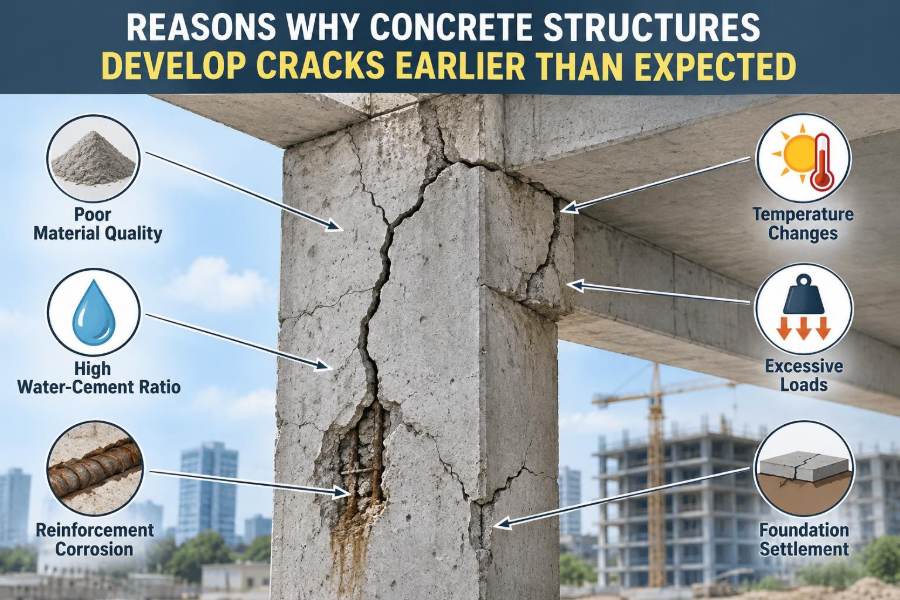

A newly cast slab can look flawless on the day the formwork comes away. Then, within weeks or months, thin lines appear across the surface, at re-entrant corners, beside columns, or along walls. Owners worry that the structure is failing; site teams wonder whether the concrete was defective.
Cracks are common in concrete because concrete is strong in compression but relatively weak in tension. The presence of a crack does not automatically mean a building is unsafe. Its timing, width, pattern, location, depth, and whether it changes over time are what give it engineering meaning.
What makes early cracking frustrating is that it is rarely caused by one dramatic error. More often, it results from small mismatches between design assumptions, material behavior, weather, construction sequencing, restraint, and maintenance.
Understanding those mismatches helps engineers investigate cracks rationally, helps contractors prevent avoidable ones, and helps building users know when observation should become a professional assessment.
🧱 Concrete Cracks When Tensile Stress Exceeds Capacity
Concrete carries compression very effectively, but its tensile capacity is modest and variable. When restrained movement, bending, settlement, temperature change, or internal volume change produces tensile stress greater than that capacity, a crack forms.
Reinforcement does not necessarily prevent cracking. In reinforced concrete, steel mainly controls crack width, distributes cracking, and preserves load-carrying behavior after cracking. A structure designed properly can therefore develop fine service cracks without being structurally deficient.
🔍 Early Cracking Is a Clue, Not a Diagnosis
“Earlier than expected” needs context. Plastic-shrinkage cracks may appear within hours, drying-shrinkage cracks within days or weeks, and cracks related to loading, corrosion, or foundation movement later in service.
A crack map is more useful than a single photograph. Record the date observed, direction, width, nearby joints, exposure conditions, and whether edges are offset. That information links the visible symptom to a plausible mechanism.
💧 Excess Mixing Water Creates a Weaker Paste
Adding water makes fresh concrete easier to place, but it raises the water-cement ratio unless the mix is redesigned. As excess water leaves the hardened concrete, it leaves a more porous cement paste that shrinks more and generally has lower strength and durability.
Water added casually at the truck is especially risky when the batch has already been proportioned. Workability problems should be addressed through approved mix adjustments, admixtures, placement planning, or controlled remixing—not unmeasured water.
🌬️ Rapid Evaporation Causes Plastic-Shrinkage Cracks
Before concrete has gained enough stiffness, water can evaporate from the surface faster than bleed water rises to replace it. The surface then contracts while the underlying concrete is still plastic, producing shallow, often roughly parallel cracks.
Hot air, low humidity, wind, and direct sun can combine to create this condition even when the ambient temperature does not seem extreme. Large exposed slabs, pavements, and decks are particularly vulnerable.
- Use windbreaks, sunshades, fogging, or evaporation reducers where appropriate.
- Begin curing promptly without damaging the fresh surface.
- Plan concrete placement around demanding weather when practical.
🌡️ Heat of Hydration Can Restrain a Young Member
Cement hydration releases heat. In thick foundations, transfer girders, heavily reinforced walls, and mass concrete placements, the core may warm substantially while the surface cools earlier.
When cooling begins, concrete contracts. If the warmer interior, reinforcement, adjoining construction, or foundation restrains that contraction, tensile stress develops. Thermal cracks often reflect temperature gradients and restraint rather than inadequate compressive strength alone.
❄️ Fast Cooling Produces Thermal Shock
Fresh or young concrete is vulnerable to abrupt temperature changes. Cold rain on a hot slab, removal of insulation too early, or a sharp overnight temperature drop can cool the surface faster than the interior.
The surface wants to contract, but the warmer material below resists it. Temperature-control plans for thick pours should consider peak temperature, temperature differential, insulation, placement temperature, and the rate of cooling.
📏 Drying Shrinkage Continues After Hardening
Hardened concrete shrinks as moisture gradually leaves its pore structure. This is normal behavior, but it becomes problematic when a long slab or wall is restrained by beams, columns, foundations, old concrete, or irregular geometry.
Drying shrinkage is not eliminated by reinforcement. It is managed through sensible mix design, curing, jointing, reinforcement detailing, pour sequencing, and realistic allowances for movement.
🪢 Restraint Turns Normal Movement Into Cracking
Movement alone is not the whole problem. A freely supported concrete strip can shorten with little stress; the same strip bonded to a rigid substrate or trapped between walls cannot move freely.
This distinction explains why cracks often occur where a new slab meets an existing frame, where a topping adheres unevenly to its base, or where walls are cast against stiff foundations. The engineer must identify both the movement and the restraint.
✂️ Poorly Timed Joints Let Slabs Choose Their Own Cracks
Control joints create planned planes of weakness so shrinkage cracks occur in predictable locations. If saw cutting is delayed, too shallow, misplaced, or interrupted by geometry, the slab may crack before the joint can guide it.
Conversely, cutting too early can ravel the edges. Timing depends on concrete strength gain, aggregate, weather, equipment, and finishing conditions, so it needs active site judgment rather than a fixed clock time.
📐 Irregular Geometry Creates Stress Concentrations
Concrete does not distribute stress evenly around openings and abrupt shape changes. Re-entrant corners at L-shaped slabs, door openings, pits, penetrations, and step-downs concentrate tensile stress.
Cracks beginning at these locations are often predictable. Good detailing uses joints, diagonal reinforcement where appropriate, smoother geometry, and planned pour boundaries to reduce the chance that a stress concentration becomes a visible crack.
🏗️ Inadequate Reinforcement Detailing Limits Crack Control
Minimum shrinkage and temperature reinforcement, bar spacing, cover, lap locations, anchorage, and continuity all influence crack distribution. Widely spaced bars may permit fewer but wider cracks, while well-distributed reinforcement tends to produce narrower cracks.
This does not mean adding steel indiscriminately solves every problem. Reinforcement must be designed for the relevant load path, movement, durability exposure, congestion, and constructability.
🧩 Congested Steel Creates Placement and Consolidation Problems
Dense reinforcement can block aggregate, restrict vibrator access, and make concrete difficult to place without voids or segregation. Weak zones around bars and embedded items may then become paths for cracking or water ingress.
Constructability reviews should check clear spacing, aggregate size, placing direction, and access for compaction. A detailed design that cannot be concreted reliably is not a robust design.
🔨 Over-Vibration and Under-Vibration Both Cause Trouble
Insufficient consolidation leaves voids and poor contact around reinforcement. Excessive vibration, especially in a highly workable mix, can promote segregation, sending coarse aggregate downward and paste upward.
Neither defect always produces an immediate surface crack, but both reduce uniformity and local strength. Consolidation should be systematic, brief, and suited to the mix and member geometry.
🪣 Segregation Changes the Concrete Inside the Member
Segregation occurs when the constituents separate during handling or placement. Long free falls, poor discharge practice, excessive water, unsuitable vibration, and repeated rehandling can leave mortar-rich zones and aggregate-rich zones.
These zones shrink and resist stress differently. Cracks may develop at interfaces or in weaker paste-rich areas, even when cube or cylinder tests from a better-controlled sample appear acceptable.
🧼 Finishing While Bleed Water Is Present Weakens the Surface
Bleed water is water that rises after placement as solid particles settle. Working it back into the surface can create a weak, porous layer that is prone to crazing, dusting, scaling, and fine cracking.
Finishing should follow the concrete’s actual setting behavior. This is especially important when supplementary cementitious materials, admixtures, cool conditions, or changing water demand alter the normal timing of operations.
🧪 Incompatible Admixture Use Alters Setting Behavior
Admixtures can improve workability, reduce water demand, control set, entrain air, or support durability. Their benefits depend on compatibility with the cement, supplementary materials, dosage, temperature, and sequence of addition.
Unexpected rapid slump loss, delayed set, unusual bleeding, or excessive air content should be treated as quality-control signals. Field adjustments require approved procedures and communication with the concrete supplier and project engineer.
🌧️ Curing Is Moisture and Temperature Management
Curing is often described simply as “keeping concrete wet,” but its purpose is broader: maintaining conditions that allow hydration while limiting harmful moisture and temperature gradients. Poor curing reduces near-surface quality and increases shrinkage-related vulnerability.
Membrane-forming curing compounds, wet coverings, water curing, and insulated coverings each have suitable applications and limitations. The selected method must match the surface finish, exposure, temperature, and subsequent bonding requirements.
⏱️ Premature Formwork Removal Changes Support Conditions
Removing forms, shores, or reshoring before the concrete and structural system can safely carry imposed loads changes stresses at a vulnerable age. Deflection cracks may follow, especially in long-span slabs, cantilevers, and transfer elements.
Safe stripping decisions depend on strength development, loading sequence, member behavior, reshoring design, and construction records. Calendar age alone is an incomplete basis for a decision.
🚚 Early Construction Loads Can Overstress Young Concrete
Material stacks, mobile equipment, masonry loads, and the next floor’s activity may impose concentrated loads before a slab has achieved the expected strength and stiffness. A slab can meet a test-strength target yet still be sensitive to localized construction loading.
Construction loading plans should specify permitted locations, load limits, support arrangements, and sequencing. Cracks near wheel paths, stacks, or temporary supports deserve close review.
🏚️ Differential Settlement Distorts the Structure
Settlement becomes damaging when one part of a structure moves more than another. Variable soil stiffness, poorly compacted fill, leaking services, inadequate drainage, excavation nearby, or changing groundwater conditions can all contribute.
Diagonal cracks near openings, cracks that widen from one end to another, and displaced finishes can be consistent with movement, but visual appearance alone cannot confirm the cause. Site investigation may need level surveys, crack monitoring, and geotechnical input.
💦 Drainage Failures Affect Both Soil and Concrete
Water is often the hidden link between external site conditions and internal cracking. Persistent ponding can soften some soils, leaking pipes can wash away fines, and blocked drains can increase hydrostatic pressure on below-grade walls.
Good drainage is therefore part of structural performance. Roof runoff, finished ground levels, subsoil drainage, waterproofing, and service-pipe testing should be coordinated rather than treated as separate maintenance issues.
🧂 Reinforcement Corrosion Expands From Within
Steel corrosion products occupy more volume than the original steel. That expansion creates radial pressure in the cover concrete, leading to longitudinal cracks along bars, rust staining, delamination, and eventually spalling.
Corrosion usually develops over time, but early onset can occur where cover is inadequate, concrete is permeable, curing is poor, chlorides are introduced, or waterproofing details fail. The visible crack is often later than the durability problem that caused it.
🧊 Freeze-Thaw Exposure Damages Saturated Concrete
Where temperatures repeatedly cross freezing, water in saturated pores can generate internal pressure. Durable concrete for such exposure requires an appropriate air-void system, low permeability, adequate strength development, and drainage that avoids sustained saturation.
Freeze-thaw distress commonly appears as scaling or surface deterioration before deeper cracking. It is exposure-specific: a mix suitable in a mild climate may not suit a cold, wet environment.
🌍 Chemical Exposure Can Change the Material Itself
Sulfates, acids, seawater-related chlorides, and certain industrial environments can attack concrete or its reinforcement system under particular conditions. The mechanism depends on concentration, wetting cycles, permeability, temperature, and cementitious composition.
Cracking attributed to “chemical attack” should not be assumed from appearance alone. Testing and exposure assessment are needed because similar patterns can arise from shrinkage, corrosion, or movement.
🔄 Alkali-Aggregate Reaction Requires Careful Investigation
Some aggregates can react with alkalis in pore solution when moisture conditions support the reaction. Alkali-silica reaction can cause expansive internal stresses and map cracking, but map cracking by itself is not proof of that diagnosis.
Petrographic examination, material history, moisture assessment, and suitable laboratory testing may be required. Prevention begins with aggregate evaluation and an appropriate low-alkali or supplementary-cementitious-material strategy where risk is identified.
📊 Crack Pattern Helps Narrow the Likely Cause
| Observed pattern | Possible mechanism | Useful first check |
|---|---|---|
| Fine, shallow, parallel surface cracks | Plastic shrinkage | Weather and curing records |
| Cracks from re-entrant corners | Restrained shrinkage or stress concentration | Joint and reinforcement layout |
| Cracks over reinforcement with staining | Corrosion-related expansion | Cover, moisture paths, corrosion assessment |
| Diagonal cracks near openings | Movement, settlement, or shear demand | Monitoring and structural review |
| Random map cracking | Surface shrinkage, crazing, or expansive reaction | Depth, exposure, and material investigation |
These associations are starting points, not conclusions. Several mechanisms can act together, and a crack pattern can change as the structure ages.
📏 Width Alone Does Not Define Severity
A narrow crack in a critical water-retaining wall may be more consequential than a wider dormant crack in a dry interior partition. Severity depends on structural role, exposure, waterproofing needs, movement, durability, appearance, and the possibility of falling concrete.
Measure representative cracks with suitable gauges or calibrated photography and observe whether they open, close, extend, or show displacement. Monitoring turns a subjective concern into engineering evidence.
🩺 Investigation Should Precede Repair
Filling a crack without understanding why it formed can hide an active problem and lead to repeated failure. Investigation should begin with drawings, construction history, weather, material tickets, loading changes, drainage conditions, and a systematic visual survey.
Depending on the concern, an engineer may recommend crack monitoring, cover measurement, sounding for delamination, moisture checks, core sampling, non-destructive testing, or structural analysis. Tests should answer defined questions, not merely generate data.
🛠️ Repairs Must Match Crack Behavior
Dormant, dry cracks may be suitable for rigid injection or sealing when structural continuity or water exclusion is required. Moving cracks often need flexible sealants, joint modifications, or correction of the movement source.
Corrosion-related cracking may require removal of damaged concrete, steel treatment or replacement, compatible repair mortar, and protection against future moisture or chloride ingress. Cosmetic coating alone is rarely a complete durability repair.
🧭 Prevention Begins Before the Concrete Truck Arrives
Early cracking prevention is a coordination task. Designers establish movement joints, detailing, cover, drainage, and realistic assumptions. Suppliers provide a compliant, workable mix; contractors control placement, finishing, curing, and loading; inspectors verify the plan in the field.
- Review weather, pour size, crew capacity, access, and curing materials before placement.
- Control added water and document field adjustments.
- Protect young concrete from rapid moisture loss and temperature change.
- Coordinate joints with geometry, reinforcement, and finish requirements.
- Keep records that make later diagnosis possible.
✅ The Core Principle: Control Movement, Restraint, and Exposure
Concrete cracks early when it changes volume or shape and something prevents that movement, when local stresses become too high, or when the material and its environment are poorly matched. Many cracks are manageable; some signal conditions requiring prompt professional attention.
The strongest response is not to assume every crack is harmless or catastrophic. It is to identify the mechanism, assess the consequences for safety and durability, and choose a repair or prevention measure that addresses the actual cause.
Concrete structures perform best when their expected movement is anticipated, their restraint is detailed intelligently, and their young age is protected as carefully as their final strength is specified. That approach turns cracking from a mystery into a controllable engineering problem. 🏗️🔎🧱