
A bridge can look perfectly ordinary on the morning of an inspection: no dramatic crack, no obvious sag, no debris below. Yet one connection may be loosening, a bearing may be restraining movement it should allow, or a fatigue crack may be growing where no one can see it.
That possibility changes the purpose of structural monitoring. The goal is not simply to find damage after it becomes visible. It is to recognize changes in structural behaviour early enough to inspect, investigate, and intervene intelligently.
For students, this is a useful way to connect mechanics, materials, sensors, and data analysis. For practicing engineers and asset owners, it is a practical question: which warning signs are meaningful, and which are simply noise?
Technology can help predict some forms of structural failure before visible damage appears. But it does not function like a crystal ball. Reliable prediction depends on sound engineering judgment, representative measurements, and a clear understanding of uncertainty.
🔍 What “Before Visible Damage” Actually Means
Visible damage is only one stage in a deterioration process. A steel member may experience millions of load cycles before a fatigue crack is large enough to be found by visual inspection. Reinforcement may corrode beneath apparently intact concrete, while a foundation may settle gradually without producing a conspicuous surface crack.
Early warning therefore usually means detecting a change in condition or behaviour, not directly seeing a future collapse. That change might be an unusual strain pattern, a shifting vibration frequency, increasing displacement, moisture reaching a sensitive location, or acoustic signals from cracking.
🏗️ Failure Is Usually a Process, Not a Single Instant
Most structural failures develop through a sequence: loading, material response, local damage, redistribution of forces, loss of capacity, and sometimes sudden instability. The sequence varies widely between a corroding reinforced-concrete beam, a fatigued crane runway, and a wind-sensitive tall building.
Monitoring is most useful when it targets the early and measurable parts of that sequence. It is less effective if it waits for one universal “failure signal,” because no such signal exists across all structures.
🧭 The Difference Between Detection, Diagnosis, and Prediction
These terms are often used interchangeably, but they describe different levels of confidence.
| Task | Core question | Example |
|---|---|---|
| Detection | Has behaviour changed? | A bridge mode frequency has shifted. |
| Diagnosis | What may explain the change? | Temperature, bearing restraint, or stiffness loss is assessed. |
| Prediction | What is likely to happen next? | A crack-growth model estimates inspection urgency. |
A sensor can support detection. Prediction requires additional evidence: loads, material properties, geometry, deterioration mechanisms, and a model that has been checked against reality.
📐 Structures Reveal Their Condition Through Response
Every structure responds to load. It deflects, vibrates, strains, heats, cools, and transfers force through connections. Engineers use these responses because they can be measured without cutting into the structure.
Think of a guitar string: changing its tension changes its tone. Similarly, a change in stiffness, mass, support condition, or internal force can alter a structure’s dynamic behaviour. The challenge is separating damage-related changes from harmless effects such as temperature or traffic variation.
📡 Structural Health Monitoring as a System
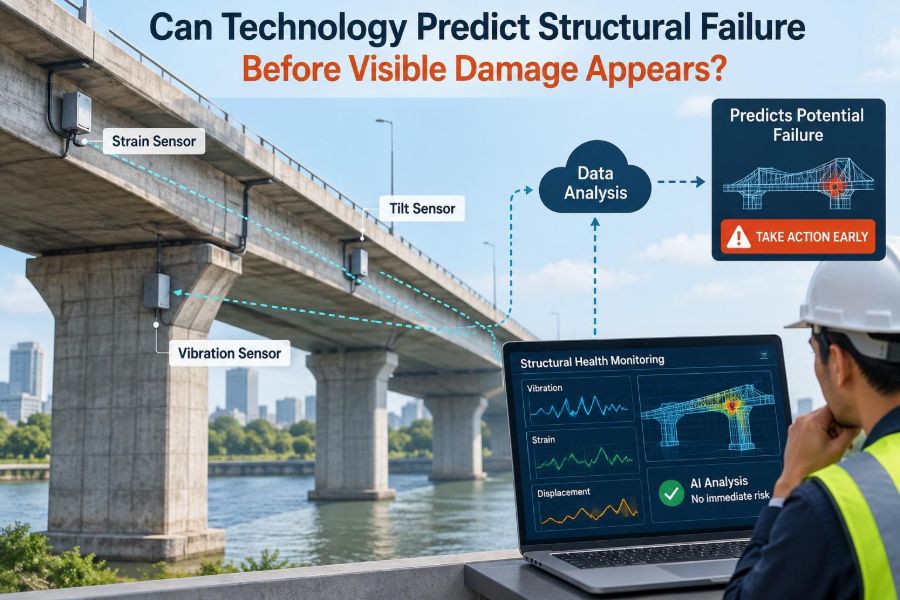
Structural health monitoring, often abbreviated SHM, is the organized use of sensors, data acquisition, communication, analysis, and engineering interpretation to assess structural condition over time.
A functioning SHM system is more than a collection of instruments. It needs a monitoring objective, a baseline condition, reliable power and data transmission, quality checks, alert rules, and people authorized to respond when results are unusual.
🧲 Strain Sensors Measure Local Demand
Strain is the very small change in length per unit length of a material. Strain gauges, vibrating-wire gauges, fibre-optic sensors, and related devices can show how strongly a member is responding at a specific location.
On a steel girder, an increasing strain range under similar truck loading may indicate a changing load path or local deterioration. But strain is highly local: a sensor placed away from the critical detail can record normal values while a nearby connection is distressed.
📏 Displacement and Tilt Expose Movement
Deflection, joint movement, settlement, rotation, and tilt often provide direct evidence of how a structure is deforming. These measurements are useful for retaining walls, excavation support, towers, long-span roofs, bridges, and buildings affected by nearby construction.
A single reading rarely tells the whole story. The trend matters: Does movement recover after unloading? Is it seasonal? Is its rate accelerating? A slowly increasing displacement can be more concerning than a larger but stable, reversible movement.
〰️ Vibration Monitoring Looks for System-Level Change
Accelerometers record vibration caused by wind, traffic, machinery, people, or controlled excitation. From the data, analysts can estimate natural frequencies, mode shapes, and damping. These are properties of the structural system rather than just one small point.
Stiffness loss can shift frequencies, but so can temperature, occupancy, water accumulation, and changes to nonstructural components. Vibration monitoring is powerful for identifying that a system deserves attention; it is not automatically a precise map of damage.
🔊 Acoustic Emission Can Hear Active Cracking
When some materials crack or when reinforcing wires slip or fracture, they release short elastic waves. Acoustic emission sensors can detect these events while loading is occurring.
This approach can be valuable during proof testing, load testing, or observation of known critical zones. It is less straightforward in noisy operating environments, where friction, impacts, electrical interference, and ordinary activity can create signals that require careful classification.
🌡️ Temperature and Humidity Are Not Background Details
Structures expand and contract with temperature. Concrete moisture changes can affect stiffness and mass; humidity can influence corrosion risk; solar heating can create temperature gradients across a bridge deck or façade.
For this reason, temperature and environmental sensors are often essential companions to structural sensors. Without them, an analyst may mistake a predictable seasonal cycle for deterioration—or normalize away a change that truly needs investigation.
💧 Corrosion Monitoring Addresses Hidden Deterioration
Corrosion can reduce steel area, disrupt bond, crack concrete cover, and weaken connections long before a serious capacity loss is apparent from a distance. Monitoring methods may track moisture, chloride exposure, electrical potentials, corrosion rate indicators, or embedded sensor response.
These methods indicate conditions associated with corrosion activity; they do not always provide a direct, complete measurement of remaining strength. Inspection and, where justified, targeted testing remain necessary to understand the actual section loss and structural consequences.
🧱 Concrete Has Its Own Warning Signs
Concrete structures are affected by cracking, creep, shrinkage, alkali-related reactions, freeze-thaw exposure, reinforcement corrosion, and local crushing or spalling. Each mechanism leaves a different pattern in measured response.
For example, widening cracks and increasing deflection under sustained load may require evaluation, but neither observation alone identifies the cause. The engineer must consider design details, restraint, age, exposure, load history, and whether the pattern matches expected service behaviour.
⚙️ Steel Fatigue Requires Attention to Repetition
Fatigue is damage caused by repeated stress cycles. A stress range that is acceptable once can become significant when repeated many times at a weld toe, bolt hole, attachment, or other stress concentration.
Technology can help track loading cycles and detect crack-related changes. Still, fatigue assessment depends heavily on detail category, stress range, fabrication quality, inspection access, and crack-growth assumptions. It is not enough to know that a member “vibrates a lot.”
🌉 Bridges Are Natural Candidates for Continuous Monitoring
Bridges experience variable traffic, environmental exposure, thermal movement, and difficult inspection access. Sensors can record traffic-induced strain, bearing movement, cable force indicators, vibration, scour-related movement, and environmental conditions.
A practical system may help prioritize inspections after an unusual vehicle crossing, flood, impact, earthquake, or progressive movement. It should complement established bridge inspection and load-rating procedures, not replace them.
🏢 Buildings Need Context for Their Signals
In buildings, changes in vibration may follow tenant fit-outs, partitions, equipment installation, occupancy changes, or renovations rather than structural damage. Excavation next door can introduce settlement concerns, while wind monitoring may matter for very slender structures.
A useful monitoring plan identifies normal operating states in advance. Data from an empty building overnight should not be compared uncritically with data from a crowded building during peak activity.
🌍 Foundations and Ground Conditions Can Control the Outcome
A structure may be sound above ground yet perform poorly because its support conditions change. Settlement, erosion, slope movement, expansive soils, rising groundwater, or scour can alter the forces and movements transmitted into the superstructure.
Inclinometers, piezometers, survey targets, settlement gauges, and groundwater instruments can provide early indications. Their interpretation belongs to geotechnical and structural engineering together: a measured movement is meaningful only in relation to soil profile, drainage, foundation type, and structural tolerance.
🧠 Digital Twins Link Data to Engineering Models
A digital twin is commonly understood as a digital representation of a physical asset that is updated using information from the real asset. In structural applications, it may combine drawings, inspection records, finite-element models, material data, operational loads, and sensor measurements.
The value is not the label. A well-maintained model can test plausible explanations for measured behaviour and compare measured response with expected response. A poorly calibrated model can create impressive graphics while giving misleading confidence.
🤖 Machine Learning Finds Patterns, Not Physical Truth by Itself
Machine-learning methods can process large streams of data, identify unusual patterns, classify operating states, and reduce routine review effort. They are particularly useful where a structure produces more data than a person can inspect manually.
However, algorithms learn from the data provided. If training data do not include relevant damage states, unusual weather, sensor drift, or changed operations, an output may be unreliable. Engineering physics and independent validation remain necessary.
📊 Baselines Make Anomalies Meaningful
An anomaly is a measurement that differs from expected behaviour. To identify one, engineers need a baseline: data from known or reasonably understood conditions across normal loads and environmental ranges.
Collecting a baseline immediately after installation is not always enough. A new concrete structure may continue changing as it dries and creeps. A bridge may need observations through seasonal temperature cycles. Baselines should be living references, not one-time snapshots.
🚨 Alarm Thresholds Should Trigger Decisions, Not Panic
A threshold is a defined value or trend that prompts an action. Useful thresholds are tied to decisions: review the data, perform a field check, restrict loading, inspect a specific component, or initiate an emergency response plan.
Simple fixed limits can be appropriate for some measurements, but rate-of-change rules and environment-adjusted thresholds are often more informative. A threshold without a response protocol creates either ignored alarms or unnecessary disruption.
🧪 Sensor Quality Can Be a Failure Point
Sensors can drift, lose calibration, detach, become water-damaged, suffer broken cables, lose power, or transmit corrupted data. Wireless systems may face communication gaps. Even a correctly functioning sensor can be poorly located.
Quality assurance should include redundant measurements where consequences justify them, timestamp checks, calibration records, plausibility limits, inspection of installations, and procedures for identifying missing or implausible readings.
🕵️ False Positives and False Negatives Need Different Defences
A false positive raises an alert when no concerning structural condition exists. It can consume resources and erode trust. A false negative misses a meaningful problem, which can be more serious where consequences are high.
Reducing both requires multiple lines of evidence. An unexpected strain change might be checked against temperature, traffic records, adjacent sensors, inspection observations, and an analytical model before conclusions are made.
🧰 Non-Destructive Testing Complements Permanent Sensors
Non-destructive testing, or NDT, examines a component without materially damaging it. Depending on the material and question, methods can include ultrasonic testing, radiography, magnetic particle inspection, dye penetrant testing, ground-penetrating radar, and impact-echo techniques.
Permanent sensors offer continuity; NDT can offer localized detail. A sensible program often uses monitoring to identify where and when closer examination is warranted, then uses targeted inspection or NDT to confirm the condition.
👷 Inspection Expertise Remains Essential
Technology does not eliminate the need for experienced inspectors. A person on site can identify drainage problems, loose connections, coating breakdown, impact damage, unusual sounds, construction changes, and access limitations that may not appear clearly in a data stream.
The strongest approach joins visual inspection, hands-on assessment, monitoring data, drawings, maintenance history, and structural analysis. Each source has blind spots; together they reduce them.
🗂️ Data Governance Is a Structural Safety Issue
Monitoring records must be traceable. Teams need to know which sensor produced a value, where it was installed, what its units are, whether its calibration is current, and whether processing has altered the raw reading.
Clear ownership matters too. If a critical alert occurs at night, who receives it, who judges urgency, and who has authority to act? A technically sophisticated system can still fail operationally if these responsibilities are unclear.
💰 Monitor According to Consequence and Uncertainty
Not every structure needs continuous monitoring. The case is strongest where inspection is difficult, loads are uncertain, deterioration is plausible but hidden, failure consequences are high, or construction activities create temporary risk.
Before selecting technology, define the decision it must support. “Install sensors” is not an objective. “Detect abnormal support movement during excavation so work can be paused and assessed” is an objective with a measurable purpose.
📝 A Practical Monitoring Plan Starts With Questions
A focused plan can follow a simple sequence:
- Define the credible failure or deterioration mechanisms.
- Identify measurements that would change before unacceptable performance occurs.
- Choose sensor locations that represent those mechanisms.
- Establish normal behaviour, including environmental effects.
- Set review routines, alert logic, and response actions.
- Validate unusual results with inspection and engineering analysis.
This sequence prevents a common mistake: gathering large amounts of data that answer no operational question.
⚠️ Common Misconceptions About Predictive Technology
- “More sensors always mean better safety.” Coverage, reliability, interpretation, and response matter more than sheer quantity.
- “An alert proves damage.” It proves that a defined condition was detected; the cause still needs assessment.
- “No alert means the structure is safe.” A system cannot report a mechanism it does not measure or a sensor that has failed.
- “Software replaces engineering judgment.” Software supports decisions but does not assume professional responsibility.
🔮 What Technology Can Realistically Predict
Technology can often identify developing anomalies, quantify trends, estimate remaining life under stated assumptions, and provide earlier warning than periodic visual inspection alone. It is especially useful when deterioration produces measurable precursors.
It cannot reliably predict every sudden event. An unexpected impact, hidden construction defect, extreme overload, rapid geotechnical failure, or unmeasured mechanism may occur outside the system’s assumptions. Prediction is therefore conditional, not absolute.
✅ The Core Principle: Measure, Interpret, Verify, Act
The most reliable early-warning systems do not depend on one sensor or one algorithm. They combine measurements with mechanics, inspection, material knowledge, environmental context, and clear action plans.
The key question is not whether technology can replace the engineer’s judgment. It is whether it can provide better evidence early enough to make a safer, better-timed engineering decision. When designed around that question, monitoring becomes a practical tool for managing structural uncertainty.
Technology can help reveal hidden structural change before visible damage appears, but only disciplined engineering interpretation turns that signal into dependable safety action. 🏗️📡🔎