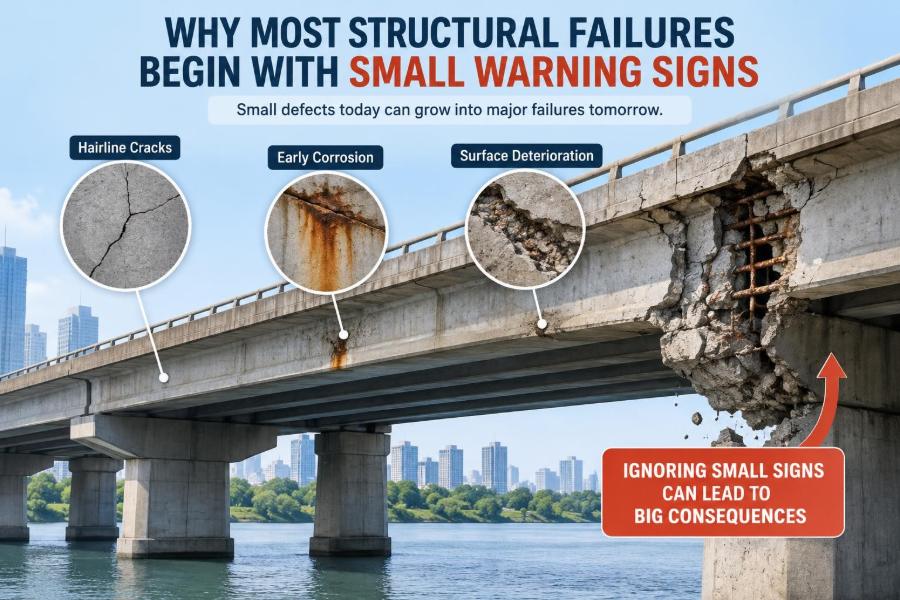

A hairline crack appears near the corner of a window. A warehouse floor seems to dip slightly beneath a loaded pallet rack. A bridge joint begins to knock a little more loudly each time a truck crosses it. None of these observations necessarily means a structure is about to fail.
But each may be evidence that the structure is changing. The practical challenge is deciding whether that change is cosmetic, expected, or a signal of a developing loss of capacity, stiffness, stability, or durability.
Structural failures rarely emerge from a single visible moment. More often, a small defect interacts with water, loading, time, poor detailing, altered use, or missed maintenance until an originally manageable condition becomes much harder to correct.
For students, this is a lesson in load paths and failure mechanisms. For working professionals, it is also a lesson in observation: the earliest warning signs are frequently found not in a calculation model, but in the ordinary behavior of a real structure.
🔎 Small Signs Are Evidence, Not Verdicts
A warning sign is an observation that deserves interpretation. Cracking, rust staining, movement, leakage, unusual noise, and door misalignment can all indicate distress, but none should be diagnosed in isolation.
The same crack width can mean very different things in a drying concrete slab, a masonry wall over a settling foundation, or a beam near a support. Its location, direction, age, change over time, and relationship to loads matter more than appearance alone.
The useful question is not simply, “Is there damage?” It is: what mechanism could produce this pattern, and is that mechanism still active?
🧭 Structural Failure Is Usually a Process
Failure is often imagined as sudden collapse. In engineering practice, it can also mean unacceptable deflection, loss of watertightness, progressive corrosion, buckling, excessive vibration, or damage that prevents safe service.
Many failures develop through stages: an initiating condition, gradual deterioration, redistribution of forces, reduced reserve capacity, and finally a triggering event. The trigger may be a heavy storm, an overloaded floor, a vehicle impact, or simply another cycle of normal use.
This progression explains why early intervention is so valuable. Repairing a drainage defect is generally simpler than repairing corroded reinforcement after years of wet exposure.
🧱 Load Paths Reveal Why Local Defects Matter
A load path is the route by which forces travel through a structure to the ground. Roof loads may move through decking, beams, columns, foundations, and soil; lateral wind loads may move through diaphragms, collectors, braced frames, shear walls, and foundations.
A small defect becomes serious when it interrupts, weakens, or redirects part of that route. A removed wall may have been intended as nonstructural, for example, yet its removal can still alter diaphragm behavior, restraint, or the distribution of stiffness.
Engineers investigate the components around a defect because structures are systems. Local damage can create demand elsewhere, especially where there is little redundancy.
📉 Stiffness Can Be Lost Before Strength Is Obvious
Strength is the ability to resist load without reaching a limiting condition. Stiffness is resistance to deformation. A member or connection may retain substantial strength while becoming more flexible because of cracking, connection slip, section loss, or loosened fasteners.
That distinction matters because excess movement can damage finishes, cladding, piping, seals, and nonstructural partitions long before a primary member reaches its nominal strength limit.
A bouncy floor is not automatically unsafe, but a change in floor vibration or deflection deserves attention. It may reflect a changed use, a weakened connection, or a condition that was not anticipated in the original design.
🪨 Cracks Need a Pattern, Not a Guess
Cracks are among the most common visible signs, particularly in concrete, masonry, plaster, and drywall. Some are associated with shrinkage, temperature movement, or finishing materials. Others reflect structural movement or concentration of stress.
Useful observations include:
- orientation: vertical, horizontal, diagonal, stepped, or map-like;
- location: near openings, supports, joints, beam ends, or changes in geometry;
- condition: clean, weathered, stained, offset, or spalled;
- activity: stable, widening, lengthening, or seasonal; and
- associated signs: leakage, settlement, sticking doors, or exposed reinforcement.
A diagonal crack at the corner of an opening, for instance, may be related to stress concentration, but the surrounding construction and loading must be understood before drawing conclusions.
💧 Water Often Turns Minor Defects Into Durable Problems
Water is not merely a maintenance nuisance. It can carry dissolved salts, freeze and expand in pores, soften soil, rot timber, corrode metals, and provide the electrolyte needed for reinforcing steel corrosion.
Small openings in sealants, roof membranes, flashings, and joints often create a pathway rather than an immediate structural defect. The danger lies in repeated wetting of materials or concealed spaces that were intended to remain dry.
Water stains should therefore be traced to their source rather than painted over. The visible stain may be several meters from the entry point, especially where water travels along framing, conduits, or sloped surfaces.
🧪 Corrosion Expands Beyond the Surface
Steel corrosion reduces effective section thickness and can weaken members, bolts, weld-adjacent areas, and connections. In reinforced concrete, corrosion products occupy more volume than the original steel, generating internal pressure that can crack and spall the concrete cover.
Rust staining is a useful clue, but it does not quantify section loss. Conversely, serious corrosion can be hidden behind coatings, insulation, fireproofing, or concrete.
Inspection should consider the exposure environment, drainage, protective coating condition, access for viewing, and likely locations where moisture is trapped. Areas near roof leaks, splash zones, crevices, and poorly drained details often deserve particular scrutiny.
🌡️ Movement From Temperature and Moisture Is Real
Materials expand and contract with temperature, while concrete, timber, masonry, and soils also respond to moisture changes. Long structures need details that accommodate expected movement without forcing it into brittle finishes or unintended connections.
When movement joints are blocked by repair materials, paving, accumulated debris, or adjacent construction, forces can build in places not designed to absorb them. Cracking, buckled finishes, and distorted seals can follow.
Seasonal movement can be normal. The warning sign is often a change from established behavior: a joint that suddenly closes, an expansion device that jams, or cracks that grow beyond a familiar seasonal pattern.
🌧️ Drainage Is a Structural Detail
Drainage affects both the building envelope and the foundation environment. Clogged roof drains can create ponding loads; overflowing gutters can wet walls and undermine adjacent soil; downspouts that discharge beside a foundation can contribute to moisture-related movement.
For retaining walls and below-grade structures, drainage is especially important because water can add lateral pressure and reduce soil strength under some conditions. A wall that was satisfactory with functioning drainage may behave very differently after outlets clog.
Good inspection asks where water arrives, where it is intended to go, and whether the route remains open.
🌍 Soil Movement Can Appear First in the Building
Foundations transfer loads into soil, so structural behavior is tied to ground conditions. Settlement occurs when soil compresses or moves; differential settlement occurs when one part of a structure moves more than another.
Warning signs can include sloping floors, cracks that follow masonry joints, gaps between walls and trim, misaligned doors, or distortion at service connections. These signs are not exclusive to foundation issues, but their combination and distribution can be informative.
Soil movement has many causes: changing groundwater, leaking utilities, poor surface drainage, nearby excavation, expansive soils, erosion, or unanticipated loads. A proper assessment may require geotechnical input rather than a visual building inspection alone.
🏢 Changes in Use Change the Loads
Structures are designed for assumed loads and patterns of occupancy. A space that once stored light office materials may later hold dense archives, machinery, liquid tanks, compact shelving, or stacked inventory.
The concern is not only the total weight. Concentrated loads, wheel loads, impact, vibration, storage height, and where loads are placed can be equally significant. A floor may be adequate for one uniformly distributed load and unsuitable for a heavy item on small supports.
Before changing occupancy or installing equipment, verify the existing structure and its load rating. “It has held it so far” is not an engineering evaluation.
🔩 Connections Are Frequent Weak Points
Connections transfer forces between members. Bolts, welds, anchors, bearing plates, reinforcing laps, and timber fasteners may occupy little physical space, yet they govern whether a load path remains continuous.
Small signs at connections include elongated bolt holes, loose hardware, fractured welds, splitting around timber fasteners, crushed bearing material, cracking near anchors, or corrosion concentrated in a crevice.
Connections can also be vulnerable to unintended restraint. A detail designed to permit sliding or rotation may become locked by later finishes, debris, corrosion, or an improvised repair.
🪵 Timber Requires Attention to Moisture and Biology
Timber is durable when kept within suitable moisture conditions and protected from decay organisms and insects. Persistent wetting, poor ventilation, unprotected end grain, and contact with wet masonry or soil can create risk over time.
Soft wood, dark staining, fungal growth, insect exit holes, sagging framing, and deteriorated connections warrant closer examination. Surface appearance alone can mislead because decay may be concealed within built-up members or behind finishes.
Repairs must address both lost capacity and the moisture source. Replacing a decayed member without correcting flashing or ventilation simply restarts the process.
🧱 Masonry Distress Often Follows Joints and Restraint
Masonry performs well in compression but has limited tensile capacity unless reinforced or otherwise detailed. Cracks often follow mortar joints, especially around openings and at locations affected by differential movement.
Bulging, bowing, displaced units, deteriorated mortar, or separated wythes are more concerning than isolated surface cracks because they can signal instability or loss of connection. Freeze-thaw cycling and water entry can accelerate deterioration where masonry remains saturated.
Repointing can be appropriate for mortar deterioration, but it is not a universal structural repair. Incompatible mortar or an unaddressed movement mechanism can create further problems.
🏗️ Concrete Can Hide Its Own Deterioration
Concrete is often perceived as permanent because it is massive and noncombustible. Yet it can crack, carbonate, be attacked by certain chemical exposures, suffer freeze-thaw damage, or allow chlorides and moisture to reach reinforcing steel.
Spalling, delamination, exposed bars, rust staining, and hollow-sounding areas can indicate a need for assessment. The visible boundary of damaged concrete may not coincide with the full extent of corrosion beneath the surface.
Repair decisions depend on cause, depth, reinforcement condition, exposure, and the compatibility of repair materials. A patch that seals only the visible symptom can sometimes shift moisture and corrosion activity to adjacent areas.
🌬️ Wind and Vibration Reveal Serviceability Problems
Wind, machinery, traffic, and footfall can expose behavior that static inspection misses. Rattling cladding, unusually perceptible sway, recurring ceiling cracks, or vibration-sensitive equipment problems may point to inadequate stiffness, loose components, resonance, or connection issues.
Resonance occurs when repeated forcing aligns with a structure’s natural tendency to vibrate, allowing movement to build. It is not limited to dramatic situations; even routine machinery can create troublesome vibration if support conditions change.
Because perception varies, observations should be documented with location, operating conditions, frequency, and whether the behavior is new. Measurements may be needed before deciding on a remedy.
🔥 Fire and Heat Can Leave Delayed Questions
After a fire, visible charring or discoloration is only part of the structural assessment. Heat can alter steel strength and stiffness during exposure, damage concrete through cracking or spalling, weaken timber sections, and compromise connections or protective systems.
The appropriate response depends on the fire’s duration, temperature, ventilation, materials, loading during the event, and observed deformation. A member that looks intact may still need a targeted evaluation.
Similarly, repeated high-temperature exposure from industrial processes can affect components over time. The service environment belongs in the maintenance record.
🚧 Accidental Damage Must Not Be Normalized
Vehicle strikes on columns, loading docks, barriers, and low beams are often treated as routine operational incidents. However, local denting, cracking, displaced base plates, fractured protective coatings, or damaged reinforcement can alter capacity or introduce a fatigue-prone detail.
Impact damage should be recorded and assessed according to its location and severity. A superficial scrape is different from a strike near a column base, connection, prestressed element, or retaining structure.
Physical protection such as bollards and wheel stops can reduce recurrence, but their placement and foundation effects should be considered rather than improvised.
🔁 Repeated Loading Creates Fatigue Risk
Fatigue is progressive damage caused by repeated stress cycles. It is especially relevant to bridges, cranes, industrial structures, rotating equipment supports, and components subject to regular vibration.
A fatigue crack may begin at a weld toe, bolt hole, abrupt geometric change, or damaged surface where stress concentrates. It can grow under loads well below a single-event ultimate capacity.
Inspection of fatigue-prone details focuses on known stress concentrations, changes in operation, and crack detection. A visible crack in a repeatedly loaded steel detail should not be assumed to be stable simply because the member has not yielded.
⚖️ Redundancy Changes the Consequences of Damage
Redundancy means there are alternative ways for loads to be redistributed if one component loses capacity. Continuous framing, multiple supports, and ductile connections can provide reserve behavior, but redundancy should never be assumed from appearance.
Some elements are disproportionately important because their failure affects many others. These may include transfer members, key bracing elements, primary connections, or supports beneath heavily loaded regions.
Understanding consequence helps prioritize inspections. A minor defect in a low-consequence finish is not assessed with the same urgency as damage at a component essential to overall stability.
🧩 Alterations Can Introduce Unintended Weaknesses
Openings cut through beams, slabs, walls, or diaphragms for new ducts and pipes can remove material at locations where shear, bending, or reinforcement demand is high. Field changes are particularly risky when drawings are incomplete or the existing structure differs from assumptions.
Other common alterations include drilling near prestressing tendons, attaching equipment to thin slabs, removing bracing, notching joists, and welding to existing steel without considering material and load effects.
A useful rule is simple: do not treat structural material as spare material. Verify before cutting, drilling, loading, or removing it.
📋 Inspection Works Best as a Repeatable System
An effective inspection program is more than an occasional walk-through. It assigns responsibilities, identifies critical areas, establishes intervals appropriate to exposure and use, and records conditions consistently.
Photographs become far more useful when they include location, date, scale, and a repeatable viewpoint. Crack gauges, level surveys, deflection measurements, and corrosion assessments may be appropriate where visual observations raise concern.
The goal is trend detection. A stable, documented condition can be managed differently from a condition that is actively changing.
📝 Good Documentation Preserves Context
Maintenance records should connect observations to events. Note when a leak began, when equipment was installed, when a crack was first seen, what weather preceded movement, and whether repairs changed the condition.
Without context, the next inspector must guess whether a mark is new or old. With context, a team can distinguish a long-standing cosmetic defect from a developing pattern.
Useful records include drawings when available, repair histories, inspection notes, photographs, material information, loading changes, and reports from qualified professionals.
🚦 Triage Helps Match the Response to the Risk
Not every defect requires emergency action, but some conditions justify restricting access or removing load until a competent evaluation occurs. The appropriate response depends on the component, observed damage, rate of change, exposure, and possible consequences.
| Observation | Typical initial response |
|---|---|
| Stable finish crack with no associated movement | Document, monitor, and investigate if it changes. |
| Active leakage near structural material | Identify and stop the water source; assess affected materials. |
| New sagging, bulging, or displaced structural element | Limit access or loading and seek prompt professional assessment. |
| Impact damage to a column, support, or connection | Document the event and obtain an evaluation before assuming continued service. |
| Rapidly growing crack, falling material, or obvious instability | Keep people clear and follow emergency procedures. |
This is a general triage framework, not a substitute for site-specific judgment. Where safety is uncertain, a licensed structural engineer or other qualified professional should evaluate the condition.
🛠️ Repairs Must Restore the Mechanism, Not Just the Appearance
A repair is successful when it addresses the underlying cause and restores the required performance. Filling a crack may improve appearance, but it will not solve ongoing settlement, corrosion, thermal restraint, or overload.
Repair design may involve strengthening, replacing damaged material, improving drainage, restoring protective coatings, adding support, relieving restraint, or changing operations. The correct option depends on the failure mechanism and future exposure.
Temporary shoring can be essential, but it must be designed and installed with care. Moving loads during shoring can itself create hazards if the support sequence is not understood.
👷 Clear Communication Prevents Small Issues From Being Lost
Facility staff, occupants, contractors, and engineers see different parts of a problem. An operator may notice a new vibration; a cleaner may see recurring water; a contractor may recognize that a crack widened after a renovation.
Reporting systems should make it easy to share observations without requiring people to diagnose them. A photo, location, date, and description of what changed are often more valuable than a confident but unsupported conclusion.
Professionals should also communicate uncertainty plainly. Saying that a condition needs investigation is not alarmist when the available evidence cannot yet establish its cause.
🎓 Students Should Learn to Read Real Structures
Design calculations teach idealized force paths, boundary conditions, and material models. Field observation teaches where water collects, where construction tolerances matter, how finishes conceal details, and why maintenance affects structural performance.
When visiting a building or bridge, practice asking practical questions: Where does water drain? Which members brace the frame? What has been altered? Which joints are intended to move? Where would an impact occur? What evidence would reveal a change?
This habit builds engineering judgment. It also discourages a common error: treating a structure as a static object rather than a changing system exposed to real use and environment.
🧠 The Core Principle: Notice, Understand, Act
Small warning signs matter because they provide an opportunity to intervene while a problem is localized. They should neither be ignored nor treated as automatic proof of impending collapse.
The disciplined approach is to observe the condition, understand the load path and exposure, identify whether the condition is active, document it, manage immediate risk, and obtain suitable expertise when needed.
Structural reliability is protected by attention to change: water where it should not be, movement that is increasing, loads that have changed, and details that no longer perform as intended.
Most serious structural problems are easier to manage when the first small sign is treated as information worth investigating, rather than an inconvenience to hide. Careful observation, clear records, and timely engineering judgment keep small defects from becoming large failures. 🏗️🔍🛠️