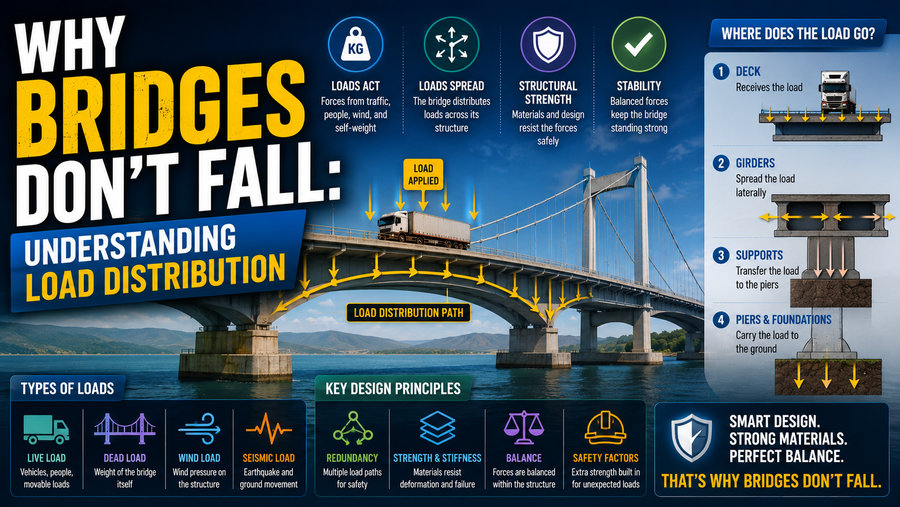

Bridges are essential structures that connect people, cities, and countries. They withstand enormous loads, from cars and trucks to strong winds and even earthquakes. But have you ever wondered why bridges don’t collapse under all that weight? The answer lies in load distribution, an engineering principle that ensures stability and safety.
In this article, we’ll explore the science behind why bridges remain standing, the forces they endure, and the innovative designs that keep them safe.
1. The Science of Load Distribution ⚙️📊
Load distribution is the process by which weight and forces are spread across a bridge’s structure. This ensures that no single part bears too much strain, preventing failure. Engineers design bridges to handle two primary types of loads:
A. Static Loads 🏋️♂️
Static loads are constant and do not change over time. These include:
- The weight of the bridge itself (self-weight or dead load).
- Permanent fixtures like lights, signs, and railings.
B. Dynamic Loads 🚗🚛
Dynamic loads change frequently and include:
- Traffic loads (cars, buses, trucks).
- Pedestrians and cyclists moving across the bridge.
- Environmental forces like wind, earthquakes, and temperature changes.
Bridges are designed to evenly distribute these loads so that no single point is overwhelmed.
2. Key Forces Acting on Bridges 💪🔄
Bridges must resist several forces to remain stable:
A. Compression 🔻
- Compression forces push materials together.
- In bridges, the upper parts of beams and arches often experience compression.
B. Tension 🔼
- Tension forces pull materials apart.
- Cables in suspension bridges, like the Golden Gate Bridge, are under tension.
C. Torsion 🔄
- Torsion is a twisting force caused by uneven weight distribution or wind.
- Engineers use diagonal bracing to counteract torsion.
D. Shear ➡️⬅️
- Shear forces occur when two parts of a structure slide in opposite directions.
- This happens when heavy loads move across a bridge.
By carefully designing bridges to manage these forces, engineers prevent failure.
3. Types of Bridges and Their Load Distribution 🌁🏗️
Different bridge designs distribute loads in unique ways. Here are some of the most common types:
A. Beam Bridges 🏞️
- Simplest bridge type, supported by piers.
- Load is transferred vertically to the piers.
- Found in highways and short crossings.
B. Arch Bridges 🌉
- Use a curved design to distribute weight to the ends.
- Strong against compression forces.
- Example: Sydney Harbour Bridge.
C. Suspension Bridges 🌉🌬️
- Use cables to distribute loads to towers and anchors.
- Excellent for long spans.
- Example: Golden Gate Bridge.
D. Truss Bridges 🔶
- Feature triangular frameworks to distribute forces efficiently.
- Common in railways and industrial areas.
E. Cable-Stayed Bridges 🚧
- Similar to suspension bridges but use direct cables to distribute weight.
- Example: Millau Viaduct, France.
4. How Engineers Prevent Bridge Failures 🏗️✅
To ensure safety, engineers use:
A. Strong Materials 🏗️
- Concrete (resistant to compression).
- Steel (strong under tension).
B. Redundancy in Design 🔄
- Multiple supports ensure one failure doesn’t cause collapse.
C. Expansion Joints & Flexibility 🔧
- Allow bridges to expand and contract with temperature changes.
D. Wind and Earthquake Resistance 🌪️🌍
- Bridges use shock absorbers and aerodynamic designs to handle extreme conditions.
E. Regular Inspections and Maintenance 🛠️
- Engineers check for cracks, corrosion, and wear to prevent failures.
5. Famous Bridges and Their Engineering Marvels 🌍🏗️
A. Golden Gate Bridge (USA) 🇺🇸
- A suspension bridge with a main span of 1,280 meters.
- Uses strong cables to distribute weight efficiently.
B. Tower Bridge (UK) 🇬🇧
- A bascule and suspension bridge that lifts to allow ships to pass.
- Uses counterweights for balance.
C. Akashi Kaikyō Bridge (Japan) 🇯🇵
- The longest suspension bridge in the world (1,991 meters).
- Designed to withstand earthquakes and typhoons.
D. Millau Viaduct (France) 🇫🇷
- The tallest bridge in the world (343 meters high).
- Uses a cable-stayed design for maximum strength.
Conclusion: The Art and Science of Bridges 🎨🔬
Bridges are incredible feats of engineering, standing strong against immense forces. By distributing loads efficiently, using strong materials, and employing smart designs, engineers ensure that bridges remain safe and reliable for generations. Next time you cross a bridge, take a moment to appreciate the science that keeps it standing!