
A new concrete floor is poured, finished carefully, and opened to traffic. A few weeks later, a thin line appears near a column, across a slab panel, or along a wall opening. The first reaction is often alarm: “Was the concrete weak?”
On many projects, the answer is no. Concrete cracking is common, including in structures that were competently designed, specified, and built. The more useful question is not simply whether a crack exists, but why it formed, how wide and active it is, and what it means for performance.
Reinforced concrete is a composite material. Concrete carries compression very effectively, while steel reinforcement carries tension after concrete reaches its limited tensile capacity. That division of work makes cracking an expected part of the behavior of most conventionally reinforced members.
Understanding this distinction helps engineers investigate cracks rationally, helps contractors prevent avoidable ones, and helps owners distinguish a cosmetic issue from a durability or safety concern.
🧱 Concrete Is Strong in Compression, Not Tension
Concrete can resist large compressive stresses, which is why it is so useful in columns, foundations, arches, and the compression zones of beams and slabs. Its tensile strength, however, is relatively low and variable.
When tensile stress from loading, restraint, temperature change, or shrinkage exceeds that tensile capacity, a crack forms. This does not automatically mean the member has failed. It means the concrete can no longer carry tension continuously across that location.
🔩 Reinforcement Is Designed to Work After Cracking
In ordinary reinforced concrete design, steel bars are placed where tension is expected. Once concrete cracks, tensile force transfers through bond into nearby reinforcement, and the steel bridges the crack.
This is a central design assumption, not an embarrassing exception. A reinforced beam can remain safe and serviceable with controlled flexural cracks because its reinforcement provides strength, ductility, and continuity after the concrete tensile zone has cracked.
📐 Cracking Is Different from Structural Failure
A crack is an observation; failure is a loss of required performance. The two can be related, but they are not interchangeable.
A hairline flexural crack in the tension face of a normally loaded slab may be anticipated. By contrast, a rapidly widening diagonal crack near a support, severe crushing, excessive deflection, or loss of reinforcement bond can indicate a much more serious condition.
Assessment therefore begins with mechanism, location, orientation, width, movement, exposure, and loading history—not with the assumption that every visible line has the same significance.
🧠 Serviceability and Strength Are Separate Checks
Structural design generally considers both ultimate strength and serviceability. Strength checks address whether a member has adequate capacity against factored actions. Serviceability checks address behavior under normal use, including deflection, vibration, and crack control.
A member may have ample ultimate strength yet develop visible cracks under service loading. Designers manage this through bar quantity, bar spacing, cover, member depth, concrete quality, and detailing, but conventional reinforcement does not normally eliminate all cracking.
📏 Why Crack Width Matters More Than Crack Count
Many fine, closely spaced cracks can be less concerning than one wide crack. Reinforcement tends to distribute strain, producing more cracks but limiting the opening of each one.
Width matters because it influences appearance, water ingress, chloride access, and the chance of reinforcement corrosion in aggressive environments. Whether a given width is acceptable depends on exposure, structural function, waterproofing requirements, and the applicable project criteria.
🌉 Flexural Cracks Follow Bending
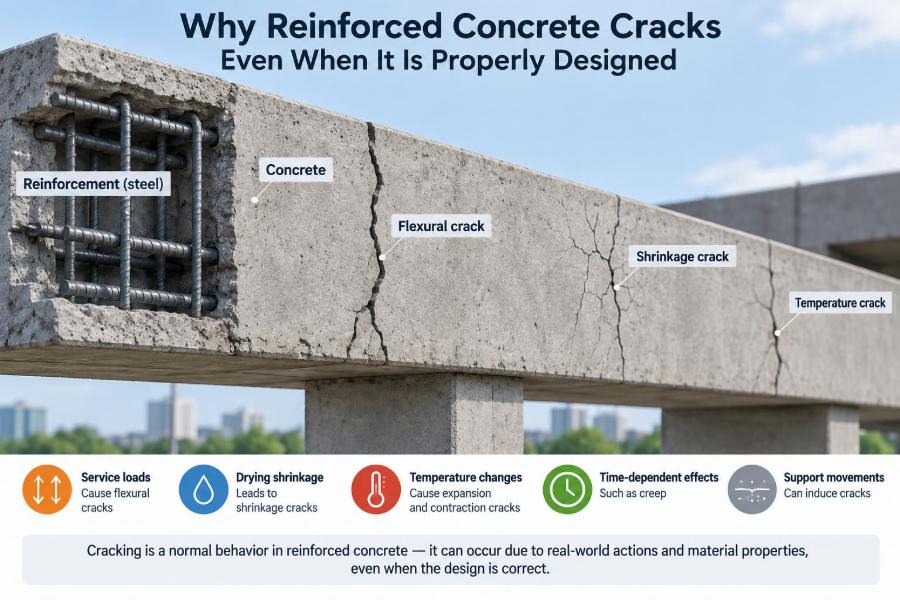
Flexural cracks occur where bending creates tension. In a simply supported beam carrying downward load, the bottom face near midspan is typically in tension, so cracks commonly begin there and extend upward.
In a cantilever balcony, the tension region is usually near the top face close to the fixed support. The crack pattern follows the moment diagram, which is why knowing the support arrangement is essential before interpreting what a crack means.
↗️ Shear Cracks Demand More Attention
Shear-related cracks often appear diagonally, especially in beam regions nearer supports where shear force is high. They may combine with flexural cracking and are not always easy to classify visually.
Because shear behavior can be less ductile than flexural behavior, prominent diagonal cracking deserves prompt engineering review. Visual pattern alone cannot establish capacity; loading, geometry, reinforcement, member condition, and any change in use must all be considered.
🧊 Plastic Shrinkage Can Crack Fresh Concrete
Plastic shrinkage occurs before concrete hardens. If water evaporates from the surface faster than bleed water can replace it, the surface contracts while the underlying concrete still resists that movement.
Fine, shallow cracks may develop within hours, often in broad exposed slabs during hot, dry, or windy conditions. Early protection—such as evaporation control, prompt curing, wind breaks, and sensible placing times—addresses the cause far better than a later surface repair.
💧 Drying Shrinkage Continues After Hardening
Hardened concrete loses moisture to its surroundings and tends to shorten. This is called drying shrinkage. If the member could move freely, shortening might occur with little stress.
Real structures are restrained by reinforcement, foundations, walls, adjacent pours, columns, or irregular geometry. That restraint converts a natural volume change into tensile stress, eventually causing cracks where the concrete is weakest or stress is concentrated.
🌡️ Temperature Change Creates Restrained Strain
Concrete expands when warmed and contracts when cooled. A long wall, a roof slab exposed to sun, or a massive foundation element may experience meaningful temperature differences through its thickness or along its length.
Thermal movement is not inherently harmful. Trouble arises when expansion or contraction is restrained. Joints, pour sequencing, reinforcement, insulation, and temperature management are ways of accommodating or controlling that movement.
🔥 Heat of Hydration Matters in Thick Elements
Cement hydration releases heat. In a thick mat, large pier, or massive wall, the interior can become much warmer than the surface. As the element cools, differential and restrained contraction can produce thermal cracking.
This is why mass-concrete planning may include low-heat mix strategies, controlled placement temperatures, monitoring, insulation, and staged pours. The goal is not merely to make strong concrete, but to limit damaging temperature gradients and restraint.
🪨 Settlement Can Crack a Sound Structure
Concrete may be properly proportioned and reinforced yet crack because its supports move. Differential foundation settlement, soil heave, erosion, inadequate bearing, or movement between old and new construction can impose distortion that the original member was not intended to accommodate.
Settlement cracks often reveal themselves through their relationship to openings, wall corners, or changes in support. Repairing the visible crack without resolving ongoing movement can produce a temporary cosmetic result and little else.
🏢 Creep Changes Load Sharing Over Time
Creep is the gradual increase in concrete strain under sustained stress. In a loaded beam or slab, creep contributes to long-term deflection and can redistribute stress within a statically indeterminate structure.
That time-dependent movement may alter crack widths or make cracks more visible years after construction. Creep is considered in design, but actual behavior still depends on loading duration, member size, humidity, concrete properties, and construction sequence.
🧩 Restraint Is Often the Hidden Cause
A useful mental model is a drying sponge glued at both ends. As it tries to shorten, the restraint creates tension. Concrete behaves similarly when shrinkage or cooling is blocked.
Common restraint sources include returns in walls, re-entrant corners, stiff columns attached to slabs, heavily reinforced zones, embedded items, and connections to older concrete. The crack is often the visible release point for accumulated strain.
📐 Re-Entrant Corners Concentrate Stress
Openings for doors, windows, ducts, and stairwells interrupt the smooth flow of stress. At an inside corner, stress concentrates, much like a tear beginning at a notch in a sheet of paper.
Cracks radiating from the corners of slab openings or wall penetrations are therefore common. Proper detailing may include additional diagonal bars, local reinforcement, sensible opening geometry, and joints placed with the expected movement pattern in mind.
🧱 Joints Are Intentional Crack Locations
Construction joints, contraction joints, isolation joints, and expansion joints serve different purposes, but all acknowledge that concrete moves. A well-located contraction joint creates a weakened plane so a slab is more likely to crack neatly there than randomly elsewhere.
Joints are not evidence of poor design. Poorly located, shallow, delayed, unsealed, or interrupted joints, however, can fail to manage movement and may create maintenance problems.
⏱️ Construction Timing Affects Crack Risk
Concrete behavior is strongly affected by when forms are stripped, when shores are removed, when upper floors are cast, and when construction loads are applied. A young slab may carry equipment, materials, or reshoring reactions before it has developed the stiffness assumed for later service.
Sequencing also matters at interfaces. A wall or slab cast against an older, already-shrunk element may be restrained from its own early-age movement. Good engineering requires a constructible plan, not only correct calculations on completed geometry.
🚿 Curing Is Part of Structural Quality
Curing supports hydration and reduces rapid moisture loss. It improves the near-surface concrete, helps develop intended strength, and reduces susceptibility to early shrinkage cracking.
Adding water to a dry surface after cracks appear is not a cure. Effective curing begins soon after finishing and must suit the mix, weather, surface, and project requirements. Premature drying is especially damaging to thin slabs and exposed horizontal work.
🧪 Mix Design Influences but Does Not Decide Everything
Water content, paste volume, aggregate characteristics, cementitious materials, admixtures, and aggregate grading all influence shrinkage, workability, strength development, and cracking tendency. A low-strength mix is not the only mix that can crack, and a high-strength mix is not automatically crack-resistant.
For example, adding uncontrolled water at the site can increase shrinkage potential while weakening the hardened concrete. At the same time, a workable, well-placed mix is necessary to avoid consolidation defects. Crack control requires balanced mix selection and field execution.
🛠️ Detailing Controls Crack Distribution
Reinforcement detailing has a major influence on crack behavior. For a given steel area, smaller bars at closer spacing can often distribute tensile strain more effectively than fewer large bars, subject to design and constructability requirements.
Cover, bar development, lap locations, anchorage, congestion, and reinforcement continuity also matter. Bars cannot control cracks effectively if they are misplaced, poorly bonded, interrupted at a critical region, or surrounded by inadequately consolidated concrete.
📍 Placement Errors Can Override Good Drawings
Design drawings specify an intended reinforcement position, not merely a total quantity of steel. If top bars in a cantilever are dropped too low, or negative-moment reinforcement over a continuous support is omitted or displaced, the actual structural behavior can differ sharply from the design.
Common field issues include insufficient cover, inadequate chairs, bars shifted around openings, excessive spacing, honeycombing, cold joints, and unapproved penetrations. Inspection before and during placement is a practical form of crack prevention.
🌧️ Exposure Turns Some Cracks into Durability Problems
Cracks can provide pathways for water, dissolved salts, and other aggressive agents. In a dry interior environment, a stable fine crack may have limited durability consequence. In a bridge deck, marine structure, water-retaining tank, parking facility, or exterior façade, the same crack may require a different response.
Corrosion is particularly important because rust products occupy greater volume than the original steel. This expansion can crack and spall surrounding concrete, reducing cover and accelerating deterioration. Exposure classification should shape both design crack-control criteria and repair decisions.
💦 Water-Retaining Structures Have Stricter Needs
Water tanks, basements, pools, tunnels, and treatment structures may need much tighter crack control than ordinary building frames. The concern is not only steel corrosion but also leakage, pressure, hygiene, and damage to finishes or adjacent spaces.
A crack that is structurally acceptable in a dry office floor may be operationally unacceptable in a reservoir wall. This is a reminder that “properly designed” always means designed for a stated function and exposure, not designed to meet one universal crack standard.
🔍 A Crack Survey Starts with Observation
A disciplined survey documents rather than guesses. Record the crack location, direction, length, approximate width, surface condition, nearby joints, moisture staining, spalls, exposed steel, and the date observed.
Photographs with a scale, marked drawings, and repeat readings can reveal whether a crack is stable or active. Crack gauges and other monitoring methods may be appropriate, but their results need interpretation in relation to temperature, humidity, loading, and building movement.
🚩 Patterns That Warrant Prompt Evaluation
Some conditions justify timely review by a qualified structural engineer, especially when they are new, growing, or accompanied by distress. Warning signs include:
- wide or visibly widening cracks;
- diagonal cracks near beam, wall, or slab supports;
- significant sagging, rotation, or uneven floors;
- spalling concrete, exposed reinforcement, or corrosion staining;
- cracks after impact, fire, earthquake, excavation, or major water damage;
- unexpected cracking after a change in occupancy or added equipment.
No visual checklist can replace an investigation where safety is uncertain. Loading may need to be reduced or access controlled while the condition is assessed.
🩹 Repair Must Match the Cause
Crack repair is not a single product choice. A dormant, dry, nonstructural crack may be routed and sealed for appearance. An active crack needs a flexible treatment or a movement solution; a leaking crack may require injection or waterproofing measures; a structural crack may require engineered strengthening or load modification.
Epoxy injection can restore continuity across certain dormant cracks when the concrete is otherwise suitable, but it is not a universal answer. Injecting an actively moving shrinkage or thermal crack without addressing movement may simply move the problem elsewhere.
⚖️ Crack Types Need Different Responses
| Likely condition | Typical clue | Primary concern | General response |
|---|---|---|---|
| Flexural service crack | In tension zone, follows bending pattern | Width, deflection, exposure | Verify behavior and monitor if needed |
| Shrinkage or thermal crack | Often restrained or panel-related pattern | Movement and durability | Address joints, curing, restraint, sealing |
| Settlement crack | Associated with support movement or openings | Ongoing distortion | Investigate foundation and movement source |
| Shear-related crack | Diagonal pattern near supports | Structural capacity | Prompt engineering evaluation |
These categories can overlap. A field crack is not a laboratory specimen, and several mechanisms may act at once.
🧰 Practical Design Measures for Crack Control
Effective crack control is a system of compatible decisions. It begins with realistic loads, support conditions, exposure requirements, and movement expectations.
- Provide reinforcement appropriate to tension regions and serviceability demands.
- Use sensible bar spacing and sound detailing around discontinuities.
- Plan joints and pour sequences before construction begins.
- Specify materials and curing practices suited to climate and member geometry.
- Coordinate penetrations, embeds, waterproofing, and architectural finishes.
- Inspect reinforcement position, consolidation, finishing, and curing in the field.
None of these measures makes concrete immune to cracking. Together, they reduce avoidable cracking and limit the consequence of cracks that do form.
🚫 The Mistake of Promising Crack-Free Concrete
“Crack-free concrete” is usually an unrealistic promise for conventional reinforced concrete. It can encourage disputes based on appearance rather than performance and may lead teams to overlook the movement mechanisms that need genuine attention.
The better objective is controlled cracking: cracks that are limited in width, distributed, compatible with service conditions, and not evidence of inadequate safety. Prestressing, special fibers, post-tensioning, carefully designed joints, or alternative systems may further reduce visible cracking in particular applications, but each introduces its own design and construction demands.
🧭 The Core Principle: Manage Tension and Movement
Reinforced concrete cracks because concrete is restrained from moving or is asked to carry tension beyond its modest tensile capacity. Reinforcement then performs its intended role by carrying tension across the cracked region and limiting crack opening.
Good design does not deny this material behavior. It anticipates loading, shrinkage, temperature, restraint, construction effects, and exposure; it provides appropriate detailing; and it evaluates observed cracks according to evidence rather than fear.
The key question is not “Does it crack?” but “Is the cracking consistent with the structure’s expected behavior and required performance?”
Properly designed reinforced concrete can crack and still perform safely, durably, and predictably—provided its cracks are understood, controlled, and addressed in the context of the whole structure. 🏗️🔍🧱