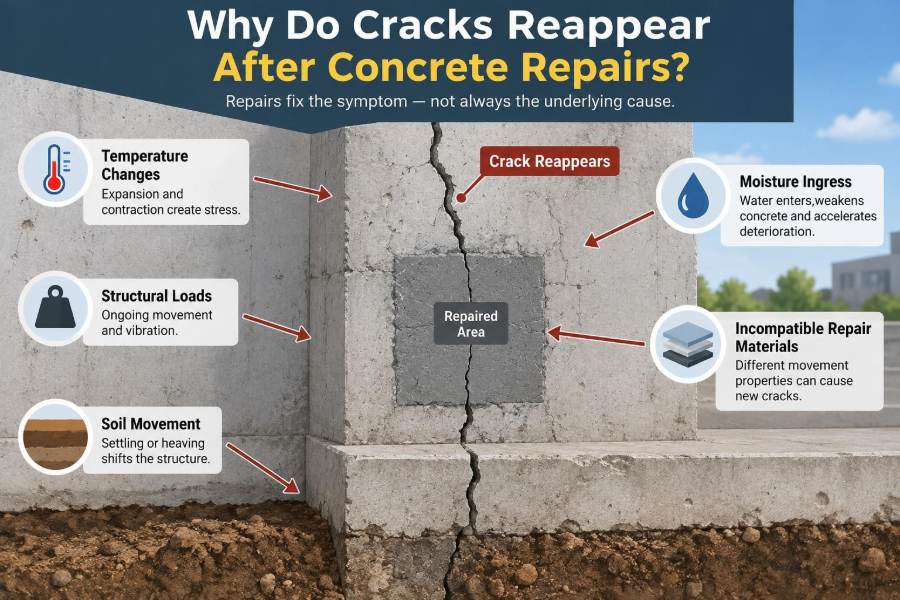

A repaired concrete wall, slab, beam, or bridge deck can look excellent when the crew leaves. The failed material has been removed, the patch is neatly finished, and the surface may even be repainted. Then, months later, a thin line appears beside the repair. Sometimes the same crack opens again in almost the same location.
This is frustrating for owners, contractors, and engineers because a returning crack can make a repair seem unsuccessful. But the visible crack is usually not the original problem. It is evidence that movement, stress, moisture, corrosion, or weakness remains active somewhere in the system.
Concrete repair is therefore not simply a matter of filling a gap. It is a diagnosis-and-treatment task. The repair material must be suitable, but it must also be applied to a substrate and structural condition that have been properly understood.
Knowing why cracks reappear helps students read distress more carefully and helps practitioners choose repairs that address causes rather than symptoms. The goal is not always a perfectly crack-free surface; it is a safe, durable, and appropriately performing structure.
🧩 A Reappearing Crack Is a Clue, Not a Diagnosis
A crack that returns after repair does not automatically mean the repair mortar was poor. It may indicate continuing thermal movement, settlement, overloading, restrained shrinkage, corrosion, or water entry. A crack is a path created when tensile demand exceeds the material’s capacity to resist it.
Concrete is strong in compression but comparatively weak in tension. Reinforcement helps carry tensile forces, yet cracking remains normal in many reinforced concrete members. The key question is whether a crack is expected and controlled, or whether it signals an active durability or structural problem.
🔍 Start by Identifying the Crack’s Behavior
Before selecting a material, determine whether the crack is dormant or active. A dormant crack has stopped moving under normal service conditions. An active crack changes width, length, or displacement because the cause remains.
Monitoring can include dated crack maps, simple crack gauges, calibrated photographs, or more formal instrumentation where the risk warrants it. A crack that opens on hot afternoons, closes overnight, or varies with moisture and loading cannot reliably be treated as a stationary defect.
Repairing an active crack with a rigid filler often produces a familiar result: the crack reforms through the repair, beside it, or at another nearby weak location.
📍 The Original Crack Location Still Matters
Cracks form where the structure is most likely to release stress. This may be at a re-entrant corner, an abrupt change in section depth, a construction joint, a restraint point, or the end of reinforcing steel. Covering that line does not remove the reason stress concentrated there.
For example, a slab crack beginning at the inside corner of an opening may be driven by stress concentration. If the geometry and reinforcement details remain unchanged, a surface patch may conceal the line temporarily but cannot eliminate the local tensile demand.
🌡️ Thermal Expansion and Contraction Keep Moving Concrete
Concrete expands when heated and contracts when cooled. In a long slab, façade panel, or roof element, even ordinary daily and seasonal temperature changes can create meaningful movement when the member is restrained by supports, walls, adjacent bays, or rigid finishes.
If a crack crosses a movement joint or lies in a location intended to accommodate movement, a rigid cementitious patch is usually the wrong response. The joint may need to be restored with a correctly selected flexible sealant system, while preserving its designed width and shape.
Dark roof surfaces, direct sun, and exposed bridge decks can experience especially large temperature gradients. The top and bottom of a member may not be at the same temperature, producing curvature as well as overall expansion.
💧 Drying Shrinkage Can Create New Tensile Stress
Fresh concrete and cement-based repair materials lose moisture over time. As they dry, they tend to shrink. When shrinkage is restrained by reinforcement, substrate concrete, adjacent construction, or internal aggregate, tensile stresses develop.
A repair patch is especially vulnerable because it is bonded to older concrete that has already undergone much of its own shrinkage. If the patch wants to shorten but the surrounding substrate holds it in place, cracking may occur within the patch or along its perimeter.
High water content, inadequate curing, hot windy conditions, and unsuitable material selection can all increase shrinkage risk. This is why “just add water until it spreads easily” can be a costly field decision.
🧱 Repair Material Shrinkage May Differ from the Substrate
Not all cementitious materials shrink at the same rate. A thin polymer-modified repair mortar, a conventional concrete patch, and an existing dense structural concrete may respond differently to drying, temperature, and moisture exposure.
Compatibility does not mean the new material must match every property exactly. It means the combination should work together without generating damaging stresses. Important properties include elastic modulus, shrinkage, thermal movement, bond strength, permeability, and compressive strength.
A very stiff, very strong repair can sometimes transfer stress to weaker adjacent old concrete. The next crack may then appear just outside the patch boundary, creating the misleading impression that the repaired area “pushed” the problem outward.
🪢 Restraint Turns Natural Movement Into Cracking
Movement becomes harmful when it is restrained. A slab-on-ground may shrink toward its center, but friction against the base, connections to columns, walls, and thickened edges limit that movement. The resulting restraint can cause cracking.
Similarly, a patch bonded on all sides is restrained by the parent concrete. The smaller and thinner the repair, the greater the influence of bond and boundary restraint relative to the patch volume.
Design details such as contraction joints, isolation joints, reinforcement placement, and pour sequencing are intended to manage this reality. Repair work must respect those movement paths rather than accidentally locking them up.
🏋️ Continued Loading Can Reopen a Structural Crack
If a crack formed because a member is overstressed, a cosmetic repair cannot increase its flexural, shear, punching, or axial capacity. Once the same loading returns, the repaired line may reopen.
Consider a hypothetical parking slab with a crack at midspan caused by excessive deflection under repeated vehicle loading. Filling the crack may improve appearance and limit water entry, but it does not reduce bending moment or restore inadequate reinforcement. Structural strengthening, load control, or support modification may be needed.
Visible cracking should be assessed in context: member type, crack orientation, deflection, loading history, reinforcement details, and signs of distress all matter.
↔️ Differential Movement Between Connected Elements
Many cracks occur where different parts of a building move differently. A masonry infill wall and a reinforced concrete frame, for instance, do not necessarily expand, shrink, creep, or deflect at the same rate.
Connections between new and old construction are another common interface. An extension may settle or shrink differently from the original building. A rigid patch spanning that interface may crack because it is bridging a movement boundary rather than repairing a damaged monolithic element.
Flexible details are not inferior details. Where differential movement is expected, they can be the correct engineering response.
🌍 Foundation Settlement and Ground Movement Remain Active
Cracks caused by differential settlement will often return if ground movement continues. Settlement can result from variable soil stiffness, moisture changes in expansive soils, erosion, leaking services, poorly compacted fill, or changes in groundwater conditions.
Wall crack patterns may offer clues, but pattern recognition alone is not proof of a cause. A diagonal crack near an opening, for example, can be associated with settlement, yet it may also relate to local stress concentration or movement between materials.
When settlement is suspected, repairing finishes before understanding the foundation condition can produce repeated repair cycles. The underlying ground, drainage, and load path deserve investigation first.
🌧️ Water Finds and Sustains Weaknesses
Water is often the reason a minor crack becomes a persistent durability problem. It can carry chlorides, sulfates, contaminants, and oxygen to embedded reinforcement, while repeated wetting and drying can affect concrete and coating performance.
A surface repair may look watertight while water continues entering from an unsealed joint, failed flashing, leaking drain, cracked coping, or the reverse face of a wall. The damaged zone may remain wet even after the visible face has been patched.
Effective concrete repair frequently begins above the defect: restore drainage, slopes, waterproofing, joint seals, and discharge paths so water no longer feeds the mechanism.
⚙️ Reinforcement Corrosion Expands From Within
Steel reinforcement corrodes when conditions allow the protective environment around the steel to break down, commonly through carbonation or chloride ingress combined with moisture and oxygen. Corrosion products occupy more volume than the original steel, generating expansive pressure in the surrounding concrete.
This pressure can cause longitudinal cracking, delamination, and spalling. Removing loose concrete and placing a patch repairs the immediate void, but it may not stop corrosion in adjacent contaminated or carbonated concrete.
Where corrosion is the driver, the repair scope must consider the condition around the exposed bar, the remaining cover concrete, electrical continuity where relevant, and the source of moisture or contaminants.
🧂 Chlorides Can Extend Beyond the Visible Damage
In marine exposure, de-icing salt exposure, or some industrial environments, chlorides may penetrate well beyond a spalled patch. The concrete can look sound while reinforcement nearby is approaching corrosion conditions.
A small localized patch in a chloride-contaminated member may create a more durable area beside less durable surrounding concrete. This does not make patching wrong, but it means the repair strategy should be based on the extent and severity of contamination, not only on what is visibly broken.
Depending on the asset and exposure, an engineer may evaluate broader concrete removal, protective coatings, corrosion mitigation systems, or planned monitoring. The appropriate choice depends on inspection evidence and service requirements.
🧪 Carbonation Reduces Reinforcement Protection
Carbonation is a process in which carbon dioxide from air reacts with hydrated cement products and lowers the alkalinity of concrete. When the carbonation front reaches reinforcement depth, the steel’s normally protective passive condition can be reduced.
Carbonation itself does not guarantee active corrosion; moisture availability is also significant. However, a repair that addresses only a rust stain without considering surrounding carbonated concrete may leave the steel environment unchanged.
Depth testing and condition assessment help define whether a local repair is reasonable or whether a wider protection strategy is required.
🧼 Weak Surface Preparation Causes Bond Failure
A repair material can only transfer stress effectively if it is bonded to sound, clean substrate. Dust, laitance, oil, curing compounds, loose material, corrosion residue, and weak surface concrete can prevent reliable adhesion.
Laitance is a weak, cement-rich layer that can form at concrete surfaces. Applying repair mortar over it is like gluing to a layer of chalk: the new material may initially appear attached but can later debond or crack at the interface.
Preparation usually requires removing unsound concrete, roughening the surface as specified, cleaning thoroughly, and bringing the substrate to the required moisture condition. The exact sequence depends on the repair system.
🔨 Feather Edges Are Fragile Repair Boundaries
A feather edge occurs when a patch tapers to nearly zero thickness at its perimeter. Cementitious repair mortars generally cannot perform well in an extremely thin edge because the material dries quickly, has little confinement, and is easily damaged.
As the edge cracks or breaks away, water can enter and the patch boundary becomes more visible. Proper repair geometry commonly involves saw-cut or otherwise defined edges and removal to a depth appropriate for the material system.
Good geometry is not merely an aesthetic detail. It gives the repair enough thickness and a durable edge to resist service stresses.
🧹 Incomplete Removal Leaves a Failed Zone Behind
Stopping concrete removal at the first apparently solid surface can leave microcracked, delaminated, contaminated, or corrosion-affected concrete in place. The repair then bonds to material that is already on its way to failure.
Sounding methods, visual assessment, cover measurements, and other suitable investigation techniques can help define repair boundaries. No single method is perfect, so experienced assessment combines observations rather than relying on one quick test.
Over-removal also has consequences: it may expose more reinforcement, increase repair volume, or affect structural behavior. The aim is a defensible boundary of sound concrete, not the largest possible patch.
🧯 Poor Curing Can Crack Even a Well-Designed Patch
Curing controls early moisture and temperature conditions so cement hydration can progress and rapid shrinkage is limited. If a fresh repair dries too quickly, plastic shrinkage or early-age cracking can develop before the repair has gained sufficient tensile capacity.
Wind, low humidity, sun, heated substrates, and absorbent old concrete can all pull water from a repair. Conversely, very cold conditions can slow strength gain and may create other placement concerns.
Specified curing compounds, wet curing methods, protective coverings, and temperature controls should be selected to suit the repair product and site conditions. Following the product data alone is not enough if site exposure contradicts the intended application conditions.
💦 Incorrect Substrate Moisture Changes Bond and Hydration
Many cementitious repairs require a saturated-surface-dry substrate: the concrete pores are damp, but there is no free water sheen. This condition reduces suction from the old concrete without creating a watery interface.
A dry substrate can draw mixing water out of the repair mortar, weakening hydration near the bond line. A surface with standing water can dilute or disrupt some bonding systems. Epoxy and other resin-based materials may have entirely different moisture tolerances.
“Wet” is therefore not a sufficient instruction. The required moisture condition must match the selected repair material and bonding method.
🧰 Wrong Material for the Crack’s Job
Crack treatments serve different purposes. A low-viscosity epoxy injection may restore continuity across a dormant structural crack when conditions are suitable. A flexible sealant may accommodate movement at an active crack or joint. A cementitious patch replaces missing cover concrete but does not necessarily seal a moving crack.
| Condition | Typical repair objective | Why a crack may return |
|---|---|---|
| Dormant bonded crack | Restore continuity or limit ingress | Hidden movement or poor injection bond |
| Active crack or movement joint | Accommodate movement and control water entry | Rigid filler restrains movement |
| Corrosion-related spall | Remove unsound concrete and manage corrosion drivers | Corrosion remains beyond repair boundary |
| Overloaded member | Restore and, if needed, strengthen capacity | Original stress demand remains |
Material selection should follow diagnosis, not habit. A product that works well for one failure mechanism can be unsuitable for another.
🧱 Cracks at Joints Need Joint Solutions
Construction, control, expansion, and isolation joints exist because concrete construction is not a single uninterrupted block. Each joint has a purpose, and treating it as an accidental crack can prevent it from performing that purpose.
A common mistake is bridging a movement joint with rigid mortar, tile adhesive, topping, coating, or reinforcement without a designed detail. The joint then forces movement into nearby concrete, often producing parallel cracks or edge damage.
Before filling any linear opening, confirm whether it is a crack in concrete or an intentional joint whose sealant, backing material, or edge protection has failed.
🧭 Crack Orientation Helps Narrow the Investigation
Pattern and direction provide useful clues. Flexural cracks commonly develop roughly perpendicular to the direction of principal tension; corrosion cracks often follow reinforcement; shrinkage cracks can form irregular maps; and settlement-related cracks may be diagonal or stepped in masonry.
These are starting points, not conclusions. Real structures have combined effects: a restrained slab may shrink, curl, and carry vehicle loads while also receiving water through a failed joint.
Good investigation asks: Where does the crack start and stop? Does it change at openings or supports? Is there offset, rust staining, dampness, deflection, or hollow-sounding concrete nearby?
📐 Movement Width Is Not the Same as Crack Width
A crack may be narrow at the time of inspection yet experience substantial opening and closing over a year. Conversely, a wider crack may be old and stable. Measuring one width once does not establish movement behavior.
For sealants and flexible systems, expected movement range influences joint dimensions, sealant selection, and detailing. For structural evaluation, width is only one observation among many, alongside location, depth, load response, reinforcement condition, and deflection.
This distinction explains why treating every “hairline crack” as harmless, or every visible crack as structurally serious, can lead to poor decisions.
🚧 Construction Sequence Can Create the Problem
Repairs can fail because work is done in the wrong order. Patching a soffit before fixing a leaking deck above it, for example, leaves the repair exposed to the same moisture pathway. Recoating before allowing a cementitious repair to cure can similarly trap or disrupt moisture behavior.
Sequence also matters when reinforcement is exposed. Steel preparation, corrosion protection where specified, bonding procedures, mortar placement, finishing, and curing should occur in a controlled sequence without long unprotected delays.
A repair plan should identify prerequisites, not just products: access, drainage correction, substrate preparation, environmental controls, inspection hold points, and protection from early loading.
👷 Workmanship Variability Is a Real Engineering Variable
Even a sound specification can fail in execution. Common site errors include inaccurate mixing, adding excess water, insufficient mixing time, placing outside temperature limits, poor consolidation, over-troweling, inadequate cover around bars, and skipping curing steps.
These issues are not merely “contractor problems.” Designers and asset managers influence them through realistic detailing, accessible repair zones, clear acceptance criteria, and enough time for preparation and curing.
Quality control should focus on the steps that control performance, especially substrate condition, material batch handling, repair thickness, reinforcement preparation, and curing protection.
🧱 Existing Cracks May Extend Deeper Than the Surface
A visible crack may continue through the full depth of a wall or slab, or it may be shallow and limited to a cover zone. A surface seal can reduce water entry but cannot restore through-depth continuity where that is structurally required.
Conversely, aggressively chasing out every shallow surface crack can cause unnecessary damage. The required investigation depth should be proportionate to the structure’s role, exposure, distress pattern, and consequences of failure.
When uncertainty is material to safety or durability, it is appropriate to involve a qualified structural or repair engineer rather than treating the issue as routine cosmetic maintenance.
🛡️ Coatings Can Help, but They Cannot Correct Movement
Protective coatings can reduce water, carbon dioxide, or chloride ingress when properly selected and applied. Some crack-bridging coatings can tolerate limited movement, especially for fine surface cracks within their stated capability.
However, a coating is not a substitute for repairing an active structural crack, relieving a moving joint, or resolving ongoing corrosion. If movement exceeds the coating’s capacity, it may split, debond, or allow moisture behind the film.
Coating performance also depends on surface preparation, concrete moisture, film thickness, edge details, and future maintenance. It is part of a system, not a cure-all.
📋 A Practical Investigation Sequence
A disciplined sequence reduces the risk of repeating unsuccessful repairs. The level of detail should match the asset’s importance and the apparent severity of distress.
- Document the crack pattern, location, width, nearby defects, and exposure conditions.
- Establish whether the crack is active through observation, monitoring, loading behavior, or history.
- Identify likely mechanisms: movement, restraint, corrosion, water, settlement, overload, or a combination.
- Inspect the substrate and reinforcement condition to define sound repair boundaries.
- Correct the source of moisture, movement, loading, or deterioration where feasible.
- Select a repair detail compatible with the condition, then specify preparation, placement, curing, and inspection.
This sequence may seem slower than immediate patching, but it usually prevents the more expensive cycle of patch, crack, patch again.
⚠️ Common Decisions That Lead to Repeat Repairs
- Filling before investigating: The visible opening is treated while the driver remains active.
- Using rigid mortar at a moving location: The repair cannot accommodate expected movement.
- Ignoring water paths: Moisture continues entering from above, behind, or beside the patch.
- Matching strength only: High compressive strength is mistaken for overall compatibility.
- Repairing to a thin edge: The perimeter quickly cracks or debonds.
- Skipping curing: Early shrinkage and weak bond compromise an otherwise suitable repair.
- Assuming no rust means no corrosion risk: Deterioration can extend beyond obvious staining or spalls.
🧠 When a Repaired Crack Is Acceptable and When It Is Not
Not every reappearing crack means immediate structural danger. Fine, stable cracking in a noncritical finish may be primarily an appearance or moisture-control issue. The appropriate response may be monitoring, sealing, or scheduled maintenance.
Urgency increases when cracking is accompanied by displacement, increasing deflection, exposed or corroding reinforcement, spalling, water leakage into occupied spaces, unusual sounds, loss of support, or a change in loading conditions. Structures with public-safety implications deserve particularly cautious assessment.
The decision should be based on function and risk. A crack in a garden path and a crack in a prestressed beam are not comparable maintenance problems.
🔄 Design for Repairability and Future Maintenance
Durability improves when structures can be inspected, drained, sealed, and repaired without creating new defects. Clear water-shedding details, accessible joints, adequate concrete cover, sensible drainage routes, and avoidable stress concentrations all reduce future repair difficulty.
For existing assets, maintenance records are valuable. Knowing when a crack first appeared, what repair material was used, whether leaks occurred, and how the crack changed over time can reveal more than a single inspection photograph.
Concrete repair is rarely a one-product decision. It is part of managing the structure’s movement, exposure, load path, and service life.
🎯 The Core Principle: Repair the Mechanism, Not Just the Mark
Cracks reappear because concrete repairs are often asked to do more than they were designed to do. A patch cannot stop foundation movement. A sealant cannot restore lost flexural capacity. An epoxy injection cannot solve active corrosion without managing the surrounding environment.
The most reliable repair begins by identifying what created the crack and whether that cause is still active. It then combines an appropriate material with sound preparation, suitable detailing, environmental control, and—where necessary—structural, drainage, or corrosion-management measures.
That approach does not promise that all concrete will remain visibly flawless. It provides something more useful: a repair strategy that recognizes concrete as a moving, loaded, exposed material system.
When a crack returns, the right question is not “Which filler failed?” but “What force, movement, or deterioration process is still acting on this concrete?” Answer that question well, and the repair has a far better chance of lasting. 🏗️🔍🧱