
When engineers design a building, bridge, industrial facility, parking structure, or high-rise tower, one of the most important decisions is choosing the main structural material.
Two of the most widely used options are reinforced concrete and structural steel. 🏢🌉
Both materials can support enormous loads. Both can be used to create safe, durable structures. And both have been responsible for some of the world’s most impressive engineering achievements.
Yet they behave very differently.
Reinforced concrete combines concrete’s strength in compression with steel reinforcement’s strength in tension. Structural steel, by contrast, uses fabricated steel members such as beams, columns, and braces to carry loads through the structure.
So which is better?
The answer depends on factors such as building height, span length, construction speed, fire resistance, cost, local labor, corrosion exposure, architectural requirements, and future flexibility.
There is no universal winner. The better material is the one that best fits the engineering problem. ⚙️
🧱 What Is Reinforced Concrete?
Concrete is produced by combining ingredients such as:
- Cement
- Water
- Sand
- Coarse aggregate
As the cement reacts with water, the mixture hardens into a strong stone-like material.
Concrete performs extremely well when compressed.
That makes it excellent for carrying forces that push material together.
However, ordinary concrete is relatively weak in tension, which occurs when a material is being pulled apart.
This weakness is why reinforced concrete contains steel bars, commonly called rebar.
The concrete resists much of the compression.
The steel reinforcement carries much of the tension.
Together, they form a composite structural material that is far more useful than either plain concrete or loose reinforcing bars alone.
🔩 What Is Structural Steel?
Structural steel is specially manufactured steel used to form load-bearing members.
Common structural steel shapes include:
- I-beams
- H-sections
- Channels
- Angles
- Hollow structural sections
- Steel plates
These components are manufactured under controlled conditions and then transported to the construction site.
Steel members may be connected through:
- Bolts
- Welding
- Steel connection plates
Structural steel has high strength in both tension and compression, which allows relatively slender members to carry substantial loads.
This is one reason steel is commonly used for skyscrapers, industrial buildings, stadium roofs, and long-span structures. 🏟️
💪 Strength-to-Weight Ratio: Steel Has a Major Advantage
One of structural steel’s strongest advantages is its high strength relative to its weight.
A steel beam can carry significant loads while remaining much lighter than a reinforced-concrete member designed for a similar purpose.
This can reduce the total dead load acting on the building.
A lighter superstructure may also reduce loads on:
- Columns
- Foundations
- Supporting soil
This advantage becomes especially important in very tall buildings.
If every floor of a skyscraper were unnecessarily heavy, the lower columns and foundations would need to support enormous additional weight.
Steel’s high strength-to-weight ratio can therefore make it highly attractive for tall or long-span structures. 🏙️
🧱 Concrete Is Heavy—but That Can Be Useful
Concrete’s high weight is not always a disadvantage.
Mass can provide valuable benefits.
Heavy concrete structures can offer excellent:
- Vibration control
- Sound insulation
- Thermal mass
- Stability
Buildings such as hospitals, residential towers, laboratories, and apartment structures may benefit from floors that feel solid and experience relatively little vibration.
Concrete’s mass can also help resist certain lateral forces and reduce unwanted movement.
So while engineers often want to reduce structural weight, sometimes additional mass improves building performance.
🏗️ Construction Speed: Steel Can Be Extremely Fast
Structural steel components can be fabricated in factories before they arrive at the construction site.
Once delivered, cranes can lift columns and beams into position rapidly.
A steel frame may therefore rise very quickly.
This can provide major commercial benefits.
If a project is completed earlier:
- Tenants can move in sooner.
- Businesses can begin operating earlier.
- Financing periods may be shorter.
- Construction overhead may decrease.
Concrete usually requires more on-site processes.
Workers may need to:
- Install formwork.
- Place reinforcing steel.
- Pour concrete.
- Allow it to gain sufficient strength.
- Remove or reposition formwork.
Modern concrete construction can also be extremely efficient, especially with reusable formwork and precast systems, but curing time remains an important consideration.
⏳ Why Concrete Needs Time to Gain Strength
Concrete does not immediately reach its full structural strength after being poured.
Its cement undergoes chemical reactions known as hydration.
Strength develops progressively over days and weeks.
Engineers commonly specify concrete strength based on measurements taken after a certain curing period, often around 28 days, although useful strength develops much earlier.
Construction can continue before full design strength is reached if engineering requirements are satisfied, but sequencing must be carefully planned.
Steel members, by comparison, arrive with their material strength already established.
Once they are correctly installed and connected, they can carry loads almost immediately.
🔥 Fire Resistance: Concrete Has a Natural Advantage
Steel is noncombustible, but that does not mean an unprotected steel structure performs perfectly in a fire.
As steel becomes very hot, its strength and stiffness decrease significantly.
At sufficiently elevated temperatures, a steel member may deform or lose much of its load-carrying capacity.
Structural steel buildings therefore commonly require fire protection such as:
- Spray-applied fire-resistive materials
- Intumescent coatings
- Fire-resistant boards
- Concrete encasement
Reinforced concrete has inherent fire resistance because the concrete surrounding the reinforcing bars acts as thermal protection. 🔥🧱
The reinforcement still needs adequate concrete cover, and severe fires can damage concrete through cracking or spalling, but concrete structures often achieve fire ratings without extensive additional protection.
🌧️ Corrosion: Both Systems Need Protection
Steel can corrode when exposed to moisture and oxygen.
In marine environments or industrial facilities, aggressive chemicals can accelerate corrosion.
Structural steel may therefore require:
- Protective paint
- Galvanizing
- Specialized coatings
- Regular inspection
Reinforcing steel inside concrete is normally protected by the highly alkaline environment of the concrete.
However, this protection can deteriorate.
Chlorides from seawater or road salt can penetrate concrete and attack reinforcement.
Carbon dioxide can also gradually lower concrete’s alkalinity through a process known as carbonation.
If reinforcing bars corrode, they expand.
This expansion can crack and break away the surrounding concrete.
Therefore, neither system is automatically maintenance-free. 🛠️
💧 Concrete Performs Well Around Water—With Proper Design
Reinforced concrete is widely used in:
- Dams
- Water tanks
- Foundations
- Tunnels
- Sewage treatment plants
- Marine structures
Concrete can perform exceptionally well in wet environments when properly designed.
Engineers control properties such as:
- Water-to-cement ratio
- Concrete permeability
- Reinforcement cover
- Crack width
- Cementitious materials
Poorly designed concrete can allow water and chemicals to penetrate.
Good concrete durability therefore depends heavily on mixture design, detailing, workmanship, and curing.
📏 Long Spans Often Favor Steel
Suppose an architect wants a large open interior with very few columns.
Examples include:
- Airports ✈️
- Sports arenas
- Aircraft hangars
- Factories
- Exhibition halls
Steel is often well suited to these structures because high-strength members can span long distances without becoming excessively heavy.
Steel can also be used efficiently in:
- Trusses
- Space frames
- Long-span beams
Concrete can also achieve impressive spans, particularly through prestressed and post-tensioned concrete, but steel frequently becomes attractive when very large clear spans are required.
🧵 Prestressed Concrete Changes the Comparison
Ordinary reinforced concrete places steel reinforcement mainly where tensile forces are expected.
Prestressed concrete goes further.
High-strength steel tendons are tensioned so that the concrete is placed into compression.
This allows engineers to reduce tensile cracking and create thinner or longer-spanning concrete members.
There are two major forms:
Pretensioning – tendons are tensioned before concrete hardens.
Post-tensioning – tendons are tensioned after the concrete reaches sufficient strength.
Prestressed concrete is widely used for bridges, parking structures, and large floor slabs.
It allows concrete to compete with steel in applications where ordinary reinforced concrete might become too heavy.
🏢 Which Is Better for High-Rise Buildings?
Both materials are extensively used in high-rise construction.
Steel frames can provide:
- Lower structural weight
- Rapid erection
- Long spans
- Flexible floor layouts
Reinforced concrete can offer:
- Excellent stiffness
- Fire resistance
- Vibration control
- Acoustic performance
Many modern skyscrapers actually use composite construction.
For example, a building may have:
- A reinforced-concrete core
- Structural steel floor framing
- Composite steel-and-concrete columns
- Concrete floor slabs on steel decking
This combines the strengths of both systems. 🏙️
The engineering question is often not “steel or concrete?” but rather “how should steel and concrete be combined?”
🌪️ Wind Loads and Building Stiffness
Tall buildings must resist enormous lateral forces from wind.
It is not enough for the building to avoid collapse.
Movement must also remain comfortable for occupants.
Concrete cores are often extremely effective because reinforced-concrete walls can provide substantial stiffness.
Steel buildings may use:
- Braced frames
- Moment-resisting frames
- Outrigger systems
- Diagrid structures
Steel can create extremely strong lateral systems, but controlling movement may require additional structural members.
Concrete’s stiffness can therefore be a major advantage in certain tall buildings.
🌎 Earthquake Performance
Both steel and reinforced concrete can perform well in earthquakes if they are properly engineered and detailed.
Earthquake-resistant design places particular importance on ductility.
Ductility is the ability of a structure to deform significantly without suddenly collapsing.
Structural steel is naturally ductile and can undergo large deformations before failure.
Reinforced concrete can also be designed for ductile behavior, but reinforcement detailing becomes crucial.
Engineers carefully design:
- Beam-column joints
- Reinforcement anchorage
- Confinement reinforcement
- Shear reinforcement
Poorly detailed concrete can fail in a brittle manner.
Modern seismic codes therefore contain strict requirements for reinforced-concrete structures in earthquake regions. 🌍
🔧 Modifications Are Often Easier With Steel
Buildings frequently change during their lives.
An owner may want to:
- Add equipment
- Create openings
- Extend a structure
- Relocate walls
- Strengthen a floor
Steel frames can sometimes be easier to modify.
New members can be bolted or welded to existing framing.
Connections may be altered or reinforced.
Concrete structures can also be modified, but cutting through a concrete slab or beam can be difficult because reinforcing bars or prestressing tendons may be hidden inside.
Any significant structural modification requires engineering analysis regardless of material.
🏭 Quality Control: Factory vs. Construction Site
Structural steel is typically manufactured under highly controlled factory conditions.
Dimensions, strength, and material properties can be closely monitored.
Fabricated pieces then arrive at the construction site ready for assembly.
Concrete quality depends on both material production and site execution.
Important factors include:
- Accurate batching
- Transportation time
- Placement
- Compaction
- Finishing
- Curing
If concrete is poorly placed or insufficiently cured, its durability and strength can suffer.
However, modern ready-mix plants and quality-control testing have made high-quality concrete construction very reliable.
🧪 Concrete Is Exceptionally Versatile in Shape
Fresh concrete can be poured into almost any form.
This gives architects and engineers enormous geometric freedom.
Concrete can create:
- Curved walls
- Shells
- Sculptural columns
- Complex foundations
- Irregular structural forms
Steel can also create sophisticated shapes, but complicated geometry may require extensive fabrication and specialized connections.
Concrete’s ability to conform to formwork makes it especially attractive for architectural structures with unusual shapes. 🎨
🏗️ Foundations Commonly Favor Concrete
Even buildings with steel superstructures usually rely heavily on reinforced concrete below ground.
Foundations must transfer structural loads into soil or rock.
Common foundation systems include:
- Spread footings
- Raft foundations
- Pile caps
- Drilled shafts
- Basement walls
Concrete performs extremely well in these applications because of its compressive strength, durability, mass, and ability to be cast directly against excavated ground.
This demonstrates why steel and concrete are often complementary rather than competing materials.
💰 Which Material Is Cheaper?
There is no universal answer.
Construction costs depend strongly on location and market conditions.
Important factors include:
- Steel prices
- Cement and aggregate prices
- Labor costs
- Crane availability
- Transportation
- Formwork cost
- Construction schedule
- Fireproofing requirements
In one city, concrete may be considerably cheaper.
In another, steel construction may save money because local fabrication and erection industries are highly efficient.
Engineers and contractors therefore compare the total installed cost, not simply the price per tonne or cubic meter.
⏱️ Time Can Be More Valuable Than Material Cost
Suppose a steel structure costs slightly more in direct material cost but allows a commercial building to open three months earlier.
The developer may receive three additional months of rental income.
That financial benefit could outweigh the higher structural cost.
This is why project economics must consider more than material prices.
Construction speed can have enormous financial value. 💵
👷 Labor Availability Matters
Structural systems depend on skilled labor.
Concrete construction requires experienced:
- Formwork crews
- Reinforcement installers
- Concrete finishers
Steel construction requires:
- Fabricators
- Erectors
- Welders
- Bolting crews
- Crane operators
Local labor availability can strongly influence the best structural choice.
A country with a well-developed reinforced-concrete industry may build concrete structures exceptionally efficiently.
Another region with extensive steel fabrication capacity may favor steel.
🌱 Environmental Impact Is Complicated
Both concrete and steel have significant environmental impacts.
Cement production releases substantial carbon dioxide, largely because of fuel consumption and the chemical conversion of limestone during cement manufacturing.
Steel production also requires large amounts of energy and can produce significant emissions.
However, the comparison is not straightforward.
Steel has an important advantage:
It can be recycled repeatedly. ♻️
Structural steel often contains substantial recycled content and can be recovered when buildings are demolished.
Concrete is also recyclable, but commonly as crushed aggregate rather than being transformed directly back into new structural concrete of the same quality.
🌿 Lower-Carbon Concrete Is Improving
Engineers are working to reduce concrete’s environmental impact.
Strategies include replacing part of the Portland cement with supplementary cementitious materials such as:
- Slag
- Calcined clay
- Other suitable mineral additions
Engineers can also optimize structural geometry to reduce material quantities.
New cement technologies and carbon-reduction techniques continue to develop.
Therefore, environmental comparisons should ideally use a life-cycle assessment rather than assuming one material is always greener.
♻️ Steel’s Reusability Can Be an Advantage
Steel structures can sometimes be dismantled rather than demolished.
Bolted steel members may potentially be reused in another structure if their condition, dimensions, and documentation are suitable.
Designing buildings for future disassembly could improve steel’s long-term environmental performance.
Concrete components can also be reused in some precast systems, but conventional cast-in-place concrete is generally more difficult to dismantle intact.
🧯 Fireproofing Can Add Cost to Steel
Steel construction may appear inexpensive when comparing framing alone.
But project cost must include all required systems.
A building may need:
- Fire-resistant coatings
- Fireproof boards
- Spray-applied protection
These materials require labor and can increase both cost and construction complexity.
Concrete often provides part of the required fire resistance through the structural material itself.
This can change the economic comparison significantly.
🧱 Concrete Cracking Is Normal—but Must Be Controlled
Concrete naturally experiences shrinkage and temperature changes.
Because concrete is relatively weak in tension, cracks can develop.
Not every crack means a structure is unsafe.
Engineers deliberately place reinforcement to control crack widths and distribute cracking.
Expansion and contraction joints may also be provided.
The goal is not always to eliminate every crack.
It is to ensure cracking remains within acceptable limits for:
- Strength
- Durability
- Water resistance
- Appearance
🔩 Steel Structures Have Their Own Failure Modes
Steel avoids many concrete cracking concerns, but engineers must consider other issues.
Possible steel failure modes include:
- Buckling
- Connection failure
- Fatigue
- Fracture
- Corrosion
A slender steel column can buckle before the steel material itself reaches its ultimate strength.
Repeated loads can also cause fatigue, particularly in bridges and machinery-support structures.
Good steel design therefore requires far more than simply checking material strength.
🌉 Bridges Use Both Materials Extensively
Bridge engineering demonstrates the strengths of both materials.
Concrete is widely used for:
- Piers
- Abutments
- Decks
- Prestressed girders
Steel is widely used for:
- Long-span girders
- Trusses
- Arch bridges
- Suspension bridge components
Many bridges use composite systems where steel girders support a reinforced-concrete deck.
Again, the most efficient answer is often a combination of materials.
🏭 Industrial Buildings Often Favor Steel
Large factories and warehouses frequently use structural steel.
Why?
Because industrial buildings often require:
- Large column-free areas
- High roofs
- Heavy equipment supports
- Fast construction
- Future modifications
Steel frames can satisfy these requirements efficiently.
Pre-engineered metal buildings have become especially common for warehouses and manufacturing facilities.
Concrete may still be heavily used for floors, foundations, equipment bases, and fire-resistant walls.
🏠 Residential Towers Often Favor Concrete
Many apartment and hotel towers use reinforced concrete.
Concrete floors and walls provide good:
- Acoustic separation
- Fire resistance
- Vibration performance
- Structural stiffness
Flat-slab construction can also produce relatively simple floor systems.
In cities where concrete labor and materials are economical, reinforced concrete can be highly competitive for residential high-rises.
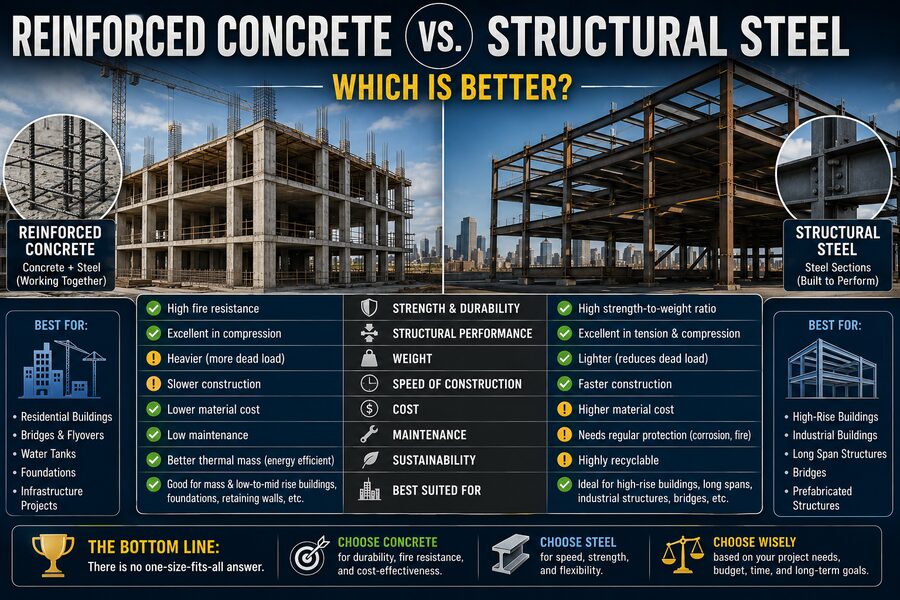
📊 Reinforced Concrete vs. Structural Steel at a Glance
🧱 Reinforced Concrete
Major advantages:
- Strong in compression
- Good inherent fire resistance
- Excellent stiffness and mass
- Good vibration and acoustic performance
- Flexible architectural shapes
- Excellent for foundations
- Often uses readily available local materials
Major challenges:
- Heavy
- Requires curing time
- Formwork can be labor-intensive
- Cracking must be controlled
- Reinforcement can corrode
- Major modifications can be difficult
🔩 Structural Steel
Major advantages:
- High strength-to-weight ratio
- Fast erection
- Excellent for long spans
- Highly ductile
- Easier future modification
- Factory-controlled fabrication
- Highly recyclable
Major challenges:
- Requires corrosion protection in many environments
- Often needs additional fire protection
- Slender members can buckle
- Network of connections requires careful design
- Material prices can fluctuate
🏆 So Which Is Better?
The answer depends entirely on the project.
Choose reinforced concrete when:
- High stiffness is important.
- Fire resistance matters.
- Heavy floors improve vibration performance.
- Complex cast shapes are desired.
- Local concrete construction is economical.
Choose structural steel when:
- Construction speed is critical.
- Long spans are required.
- Low structural weight is valuable.
- Future modification is likely.
- Factory fabrication provides a major advantage.
And choose composite construction when combining both materials produces a better result than either one alone.
🌟 Final Thoughts
Reinforced concrete and structural steel are not competing technologies where one has to defeat the other.
They are two different engineering tools. 🛠️
Concrete provides tremendous compressive capacity, stiffness, mass, durability, and natural fire resistance.
Steel provides exceptional strength for its weight, ductility, construction speed, long-span capability, and adaptability.
Their weaknesses are also different.
Concrete is heavy and prone to cracking.
Steel is vulnerable to high temperatures, corrosion, and instability such as buckling if poorly designed.
That is exactly why engineers often combine them.
A modern building may have a reinforced-concrete foundation, concrete core, steel columns, steel beams, and concrete floor slabs all working together.
The best structural material is therefore not determined by asking:
“Which one is stronger?”
The more useful question is:
“Which material—or combination of materials—provides the safest, most economical, durable, and efficient structure for this particular project?” 🏗️
That is the real engineering decision.