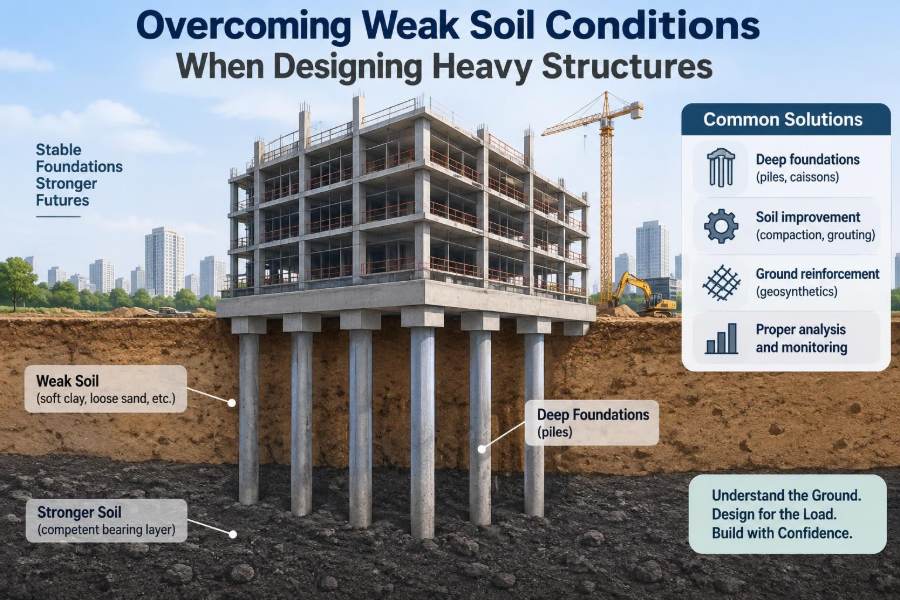

A warehouse may look like a straightforward structural problem: long-span roof trusses, columns on a regular grid, and a floor designed for forklifts and stored goods. But if its site contains soft clay, loose sand, uncontrolled fill, or variable ground left by an old stream channel, the foundation can govern the entire design.
The same issue appears beneath bridge piers, storage tanks, high-rise cores, crane foundations, retaining walls, and industrial equipment. A structure can be exceptionally strong above ground yet perform poorly if the soil beneath it compresses, shifts laterally, or loses strength when wet.
Weak soil does not automatically make a site unusable. It means the load path must be understood from the roof or superstructure all the way into a suitable bearing stratum, while settlement, groundwater, construction effects, and long-term change are addressed deliberately.
Good foundation engineering is therefore not about choosing the deepest or most expensive solution. It is about matching a heavy structure, a ground profile, and a construction method so that the whole system performs predictably over its service life.
🧱 Why Heavy Structures Expose Ground Weakness
All structures transfer load to the ground, but heavy structures do so at higher intensity and often with less tolerance for movement. A small crack in a lightly loaded pavement may be manageable; differential settlement beneath a crane rail, turbine base, or hospital frame can disrupt operation or damage connected systems.
Foundation pressure is not determined by building weight alone. Column spacing, load concentration, foundation area, wind and seismic actions, and overturning moments all influence the stresses delivered to soil.
🌍 Soil Is a Material, Not a Rigid Support
Unlike structural steel or concrete, soil is naturally variable. Its stiffness and strength depend on grain size, density, water content, stress history, layering, and drainage conditions. Two boreholes a short distance apart can encounter different materials.
Soil also changes behavior with time. Some clays consolidate slowly as pore water escapes; loose saturated sands may densify under vibration; expansive clays may swell and shrink as moisture varies. The design must address the relevant mechanism rather than treating “soil capacity” as a single fixed number.
🔎 Recognizing What “Weak Soil” Actually Means
Weak soil is not one material category. It may refer to soil with low shear strength, high compressibility, low stiffness, poor drainage, high organic content, collapsible structure, or susceptibility to liquefaction. Each condition points toward different risks and remedies.
For example, a soft clay can support a load in the short term but settle over years. Loose dry sand may appear firm until wetted or vibrated. Peat and organic soils are generally problematic because they can be highly compressible and variable.
📉 Bearing Capacity Is Only One Check
Bearing capacity is the soil’s resistance to a foundation load without shear failure or excessive local punching. It is essential, but it is not enough. A footing can satisfy a bearing-capacity check and still settle more than the structure can tolerate.
Foundation design commonly considers both an ultimate limit state, related to collapse or instability, and a serviceability limit state, related to acceptable movement, vibration, crack control, and function. For many buildings on soft ground, serviceability governs.
📐 Settlement Often Controls the Design
Settlement is the downward movement of a foundation under load. It can occur immediately from distortion of soil, gradually through consolidation, or over a longer period through creep and changes in moisture.
Total settlement matters, but differential settlement is often more damaging. If every column settles by a similar amount, a flexible structure may accommodate the movement. If one corner settles much more than another, frames distort, slabs crack, pipes lose slope, and doors or equipment can misalign.
↔️ Differential Movement Has Many Causes
Different foundation loads are one cause, but not the only one. Variable fill depth, an inclined bedrock surface, old trenches, inconsistent compaction, changing groundwater, and different foundation geometries can all create uneven movement.
A common hypothetical example is a building partly founded on dense natural sand and partly on deep fill. Giving every column the same shallow footing size may produce very different settlements because the support conditions are not comparable.
💧 Groundwater Changes the Problem
Water in soil pores affects effective stress, which is the stress carried by the soil skeleton. Rising groundwater can reduce effective stress and strength in some soils, while lowering groundwater can trigger settlement as certain deposits consolidate.
Excavation dewatering deserves particular care. Pumping may be necessary for construction, but it can influence adjacent ground and foundations if drawdown extends beyond the excavation. A temporary water-control plan should be treated as a geotechnical design issue, not merely a site logistics task.
🕳️ The Site Investigation Sets the Direction
No foundation concept should be finalized from a surface walkover alone. A geotechnical investigation develops a model of the ground through boreholes, test pits, in-situ testing, sampling, laboratory testing, groundwater observations, and review of site history.
The goal is not simply to find a “good layer.” Engineers need to understand the depth, thickness, continuity, and behavior of all relevant layers, including weak zones below the likely foundation level.
🧪 Tests Need Engineering Interpretation
Field tests such as standard penetration testing, cone penetration testing, vane shear testing, and pressuremeter testing can provide useful indications of soil behavior. Laboratory tests may characterize classification, moisture, strength, compressibility, and permeability.
Numbers from testing are not design answers by themselves. Sample disturbance, groundwater conditions, local variability, and the relation between the test and expected loading must be considered. A geotechnical engineer turns observations and test results into design parameters and recommendations.
🗺️ Build a Ground Model Before Selecting a Foundation
A ground model is a practical representation of layers, groundwater, likely variability, and geotechnical hazards across the site. It should explain what is known, what remains uncertain, and which assumptions are most sensitive to the chosen solution.
For a large footprint, this model should be spatial rather than based on one “representative” borehole. Heavy structures can impose stress well below their foundation bases, so a thin competent crust over soft material may not be adequate.
⚖️ Match Loads to Soil Behavior
Foundation selection starts by mapping how loads enter the ground. A heavily loaded core, isolated machine foundation, continuous wall, or widely distributed warehouse load produces a different stress pattern and may justify a different solution.
Engineers also consider load duration and cycling. A storage tank that is repeatedly filled and emptied can experience settlement behavior different from a building with nearly constant loading. Dynamic machinery introduces vibration and fatigue-related concerns beyond static bearing pressure.
🧱 Shallow Foundations Can Still Work
Strip footings, pad footings, and rafts are often economical when competent soil exists near the surface or when improvement can create a reliable bearing zone. Their simplicity, however, should not be mistaken for universal suitability.
Increasing footing area reduces average contact pressure, but it may also extend stresses deeper into a compressible layer. A much wider footing is not automatically a settlement cure; its effect must be evaluated against the full soil profile.
🛏️ Raft Foundations Spread Loads Across the Footprint
A raft, or mat foundation, is a thick reinforced concrete slab supporting many columns or walls. It can reduce contact pressure, tie the structure together, and help limit differential movement where individual footings would overlap or settle unevenly.
Rafts are particularly useful when column loads are closely spaced and soil is moderately weak but reasonably uniform. They are not a substitute for analysis: total settlement may remain substantial, and uplift, punching, construction joints, and groundwater pressures require attention.
🪛 Deep Foundations Bypass Weak Near-Surface Layers
Piles and drilled shafts transfer load through weak upper soils to deeper competent material, by end bearing at a firm stratum, shaft resistance along their length, or a combination of both. They can also resist uplift and lateral loads when designed for those demands.
Deep foundations introduce their own uncertainties. Installation method affects surrounding soil; driven piles may cause vibration and displacement, while bored elements can be sensitive to hole stability, base cleanliness, and concrete placement quality.
🔗 Pile Groups Behave Differently From Single Piles
A pile that performs well in an isolated test does not guarantee that a closely spaced group will behave identically. Stress zones overlap, and the group plus the enclosed soil can settle as a block, especially where deep compressible strata remain.
The pile cap, load distribution, group geometry, and structural stiffness matter. For heavy columns, engineers must also detail the connection so load is distributed as assumed rather than concentrated unpredictably on only part of the group.
⬇️ Negative Skin Friction Can Add Load to Piles
If surrounding soil settles relative to a pile, it can drag downward along the pile shaft. This effect is called negative skin friction or downdrag. It can occur after placement of new fill, consolidation of soft clay, or groundwater lowering.
Downdrag does not necessarily mean the pile will fail, but it adds axial demand and must be included in design. Ignoring it can be especially consequential when piles pass through thick, settling deposits before reaching a firm layer.
🪨 Remove and Replace When the Weak Layer Is Limited
Excavation and replacement can be practical when unsuitable material is shallow, localized, and safely removable. Organic soils, uncontrolled fill, or soft pockets may be excavated and replaced with engineered granular fill placed and compacted in controlled lifts.
This approach becomes less attractive as depth and groundwater increase. Deep open excavations can require shoring, dewatering, and substantial temporary works, all of which can change the apparent economy and risk profile.
🚜 Densification Improves Some Granular Soils
Loose granular deposits may be improved by compaction methods such as vibrocompaction, dynamic compaction, or compaction grouting, depending on grain size, saturation, depth, and nearby constraints. The aim is generally to increase density, stiffness, and resistance to settlement.
These methods are not appropriate for every soil. Fine-grained soils drain slowly and may not densify effectively under vibration. Nearby structures, buried utilities, and vibration limits can also rule out otherwise suitable equipment.
🧬 Columns, Inclusions, and Reinforcement Change the Soil System
Ground improvement can install stiffer elements within weak ground. Stone columns, rigid inclusions, deep soil mixing, and grouted elements are examples, each with a different load-transfer mechanism and installation effect.
A reinforced soil zone may support a raft or embankment by sharing load between inclusions and surrounding soil. Design must consider settlement, load transfer platforms, installation tolerance, drainage, and quality verification. It is a designed composite system, not simply “stronger soil.”
🧪 Chemical Stabilization Requires Compatibility Checks
Lime, cement, and other binders can improve selected soils by changing their moisture sensitivity and increasing strength or stiffness. Deep soil mixing combines soil and binder in place, which can be valuable where excavation is impractical.
Performance depends on soil mineralogy, organic content, sulfate conditions, water chemistry, mixing energy, and curing. Trial mixes and verification testing are therefore central. A binder that works well in one clay may be unsuitable or less effective in another.
🌊 Liquefaction and Cyclic Loading Need Separate Attention
In susceptible loose, saturated granular soils, earthquake shaking can cause a major temporary loss of effective stress and stiffness, a phenomenon known as liquefaction. Ground settlement, lateral spreading, and loss of support may follow.
Not every loose sand deposit is liquefiable, and regional seismic hazard matters. Where the hazard is relevant, solutions may include densification, drainage, deep foundations designed for ground movement, soil mixing, or changing the site layout. Cyclic loads from machines and waves also require dynamic evaluation, though their mechanisms differ from earthquake loading.
🏗️ Excavation Can Undermine a Good Foundation Plan
Even a sound permanent foundation can be compromised by poor temporary works. Removing lateral support, allowing a base excavation to soften in rain, overexcavating below formation level, or placing heavy equipment too close to an unsupported edge can change soil behavior quickly.
Construction sequencing should identify when the ground is most vulnerable. Formation surfaces often need prompt protection, inspection, and concrete placement to prevent disturbance and weathering.
📏 Verify What Was Built, Not Just What Was Designed
Weak-ground solutions rely on execution. For engineered fill, verification may include lift thickness records, moisture conditioning, density testing, and proof rolling where appropriate. For piles and improvement works, records commonly track location, depth, energy or torque, materials, geometry, and anomalies.
Acceptance criteria should be established before work begins. When results fall outside expectations, the team needs a defined response: investigate, assess the impact, and modify the design or method if necessary rather than quietly accepting uncertainty.
📡 Monitoring Turns Assumptions Into Evidence
Instrumentation can be valuable where movements are uncertain or consequences are high. Settlement plates, precise surveys, inclinometers, piezometers, load cells, and crack monitoring may help confirm whether ground and structure are behaving as predicted.
Monitoring only helps when there is a plan for interpreting it. Baseline readings, trigger levels, reading frequency, responsibility, and potential actions should be agreed in advance. Data without decision rules can create false reassurance.
🤝 Coordinate Structural and Geotechnical Design Early
Foundation design sits at the boundary of disciplines. The structural engineer defines loads, stiffness needs, and acceptable movement; the geotechnical engineer evaluates the ground response and feasible support systems; civil, construction, and environmental teams influence grading, drainage, access, and sequencing.
Early coordination can reveal efficient alternatives. A modest adjustment to column layout, basement depth, finished grade, tank location, or construction sequence may reduce foundation demand more effectively than adding complexity after the superstructure is fixed.
💰 Compare Whole-Life Risk, Not First Cost Alone
The lowest tendered foundation option may not be the best value if it carries unresolved settlement risk, difficult verification, large future maintenance exposure, or substantial programme uncertainty. Conversely, a deep foundation system may be unnecessary where shallow improvement can provide adequate performance.
A meaningful comparison includes investigation confidence, construction access, noise and vibration constraints, dewatering, spoil disposal, inspection needs, schedule, adjacent assets, and the consequence of unexpected movement.
⚠️ Common Shortcuts That Create Problems
- Designing from one borehole: this can miss lateral changes across a large or irregular site.
- Using allowable pressure as the only criterion: this overlooks total and differential settlement.
- Assuming fill is engineered: historic fill may be variable unless its placement and testing are documented.
- Making footings bigger without analysis: wider foundations can still load deep compressible soil.
- Treating groundwater as temporary: seasonal and long-term water conditions can control performance.
- Leaving quality control until construction: verification requirements should shape the chosen method from the start.
🧭 A Practical Decision Sequence
- Define structural loads, performance requirements, and acceptable movement.
- Investigate the site sufficiently to establish a credible ground model.
- Identify governing hazards: bearing failure, settlement, lateral movement, water, seismic effects, or construction impacts.
- Develop feasible shallow, deep, and ground-improvement concepts.
- Compare performance, constructability, verification, cost, and risk.
- Design temporary works, drainage, and sequencing alongside permanent works.
- Inspect, test, and monitor critical assumptions during construction.
This sequence is iterative. New information from test sections, pile installation, excavation, or monitoring may justify refinement, provided the project team has a controlled process for evaluating it.
🧠 The Core Principle: Design the Ground–Structure System
The successful response to weak soil is not a default product or a single foundation type. It is a system-level design that connects the actual ground conditions to loads, structural tolerance, water behavior, construction methods, and verification.
Sometimes that system uses a raft; sometimes piles; sometimes removal and replacement or improvement; often a combination. The best option is the one that achieves acceptable performance with assumptions that can be checked and managed throughout construction and service.
Heavy structures become reliable on weak ground when engineers understand the soil, control uncertainty, and design the foundation and construction process as one connected problem. That mindset turns a difficult site condition into a solvable engineering task. 🏗️🌍