
A small crack in a concrete parking deck may look harmless after a wet winter. Yet it can become a path for water, chlorides, and other aggressive substances to reach the reinforcing steel below.
Once steel corrodes, it expands. Concrete then spalls, repair crews close lanes or cordon off areas, and a defect that began at millimetre scale can become a costly durability problem.
Engineers have always worked to limit this sequence through mix design, cover depth, joints, coatings, drainage, and inspection. Self-healing concrete adds another possibility: designing the material so that certain cracks can close or seal before they become a serious route of deterioration.
The phrase sounds futuristic, but it does not describe one magic material. It covers several mechanisms, each with different capabilities, constraints, and levels of readiness. Understanding those distinctions is essential before treating self-healing concrete as a solution for longer-lived structures.
🧱 What Self-Healing Concrete Actually Means
Self-healing concrete is concrete or a concrete-based system designed to reduce the effect of cracking through an internal or externally activated repair mechanism. In most practical discussions, “healing” means closing a crack, sealing it against water flow, or restoring some durability—not returning a damaged member to its original, uncracked strength.
This distinction matters. A beam with inadequate reinforcement, a foundation undergoing excessive settlement, or a slab damaged by severe freeze-thaw action cannot be made structurally safe simply because fine cracks become less visible.
🔍 Why Ordinary Concrete Cracks
Concrete is strong in compression but relatively weak and brittle in tension. Cracks form when tensile strain exceeds the material’s tensile capacity, whether the cause is applied loading, restrained shrinkage, thermal movement, settlement, or expansive corrosion products.
Not every crack has the same implication. Hairline shrinkage cracks in a restrained topping are different from flexural cracks in a reinforced beam, diagonal shear cracks near a support, or wide cracks caused by foundation movement. Their cause governs the appropriate response.
💧 Why Small Cracks Become Durability Pathways
Cracks provide faster transport routes than intact concrete. Water and dissolved salts can move through them by capillary suction, permeability, diffusion, or pressure-driven flow, depending on the exposure and crack geometry.
In reinforced concrete, the central concern is often corrosion. Chlorides or carbonation can disrupt the passive protective condition around steel; moisture and oxygen then support electrochemical corrosion. Corroding reinforcement can force surrounding concrete apart, worsening the original damage.
⚙️ The Difference Between Healing, Sealing, and Strength Recovery
These terms are often used interchangeably, but they describe different performance targets.
- Crack closure means the visible opening becomes smaller.
- Sealing means water or gas transport through the crack is reduced.
- Durability recovery means resistance to harmful ingress improves.
- Mechanical recovery means stiffness or load-transfer capacity is partly restored.
A system can seal a fine crack effectively without restoring meaningful tensile capacity. For infrastructure exposed to de-icing salts or water pressure, sealing may be valuable; for a structurally deficient member, it is not enough.
🌿 Autogenous Healing: Concrete’s Natural Ability
Conventional concrete has a limited natural capacity for autogenous healing. When water enters very fine cracks, unhydrated cement particles may continue to hydrate, and calcium-containing compounds can form deposits, including calcium carbonate.
This is most likely in narrow cracks with access to moisture and remaining reactive material. It is not a dependable cure for wide, moving, dirty, or repeatedly loaded cracks. Still, it explains why some fine cracks in well-designed concrete may become less permeable over time.
🧪 Mineral-Based Healing Additions
One approach is to include mineral materials that support continued reaction or formation of crack-filling products when water enters. Depending on the formulation, these may provide reactive compounds, supplementary cementitious materials, or crystallization-oriented additives.
The goal is usually improved sealing in a defined crack-size range. Performance depends heavily on curing, water availability, mixture chemistry, and the exposure cycle. A dry interior slab may not activate in the same way as a periodically wetted tank wall.
🦠 Bacteria-Based Concrete Systems
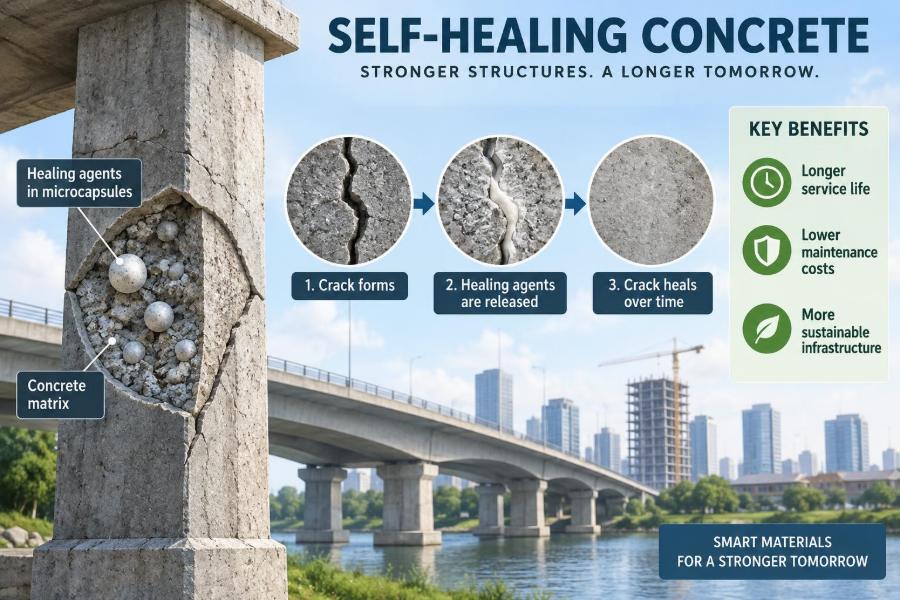
Bacteria-based concepts typically place dormant bacterial spores and a nutrient source into the concrete, often with protection such as porous carriers or capsules. When moisture reaches a crack, conditions may allow metabolic activity that produces mineral precipitates capable of filling part of the crack.
The appealing idea is biological mineral formation where it is needed. However, the concrete environment is highly alkaline, nutrient storage is finite, activation conditions are specific, and the long-term behavior of the complete system must be demonstrated for the intended use.
🫧 Encapsulated Healing Agents
Another family of systems embeds small capsules containing a healing agent. If a crack ruptures a capsule, the released material can flow into the crack and cure or react.
This design is analogous to a tiny internal repair kit, but it has a clear limitation: a capsule is generally used once. Engineers must consider capsule survival during mixing, compatibility with the matrix, location relative to likely cracking, and any effect on strength or workability.
🔌 Vascular and Injectable Networks
More ambitious systems use embedded channels or networks through which repair material can be introduced after cracking. Rather than relying on a finite number of capsules, a network may potentially serve multiple repair events if it remains functional.
These concepts face difficult construction questions. Channels can interrupt the concrete matrix, require carefully planned routing, and create installation and quality-control demands. They are promising research and specialist applications, not a routine substitute for sound member design.
🧲 Shape-Memory and Responsive Approaches
Some experimental approaches use shape-memory alloys, polymers, or responsive components to help close cracks when activated by heat or another stimulus. Mechanical crack closure can then support subsequent sealing by cementitious or chemical processes.
These systems illustrate an important principle: self-healing does not always mean a single material reaction. It can combine sensing, crack closure, and a sealing phase. The engineering challenge is to make the combined system robust, affordable, and practical to build.
📏 Crack Width Is the First Design Question
Every healing mechanism has a usable crack-width range, even when a product description sounds broad. Fine, stable cracks are much easier to seal than wide cracks, especially where water pressure, debris, thermal cycling, or repeated loading are present.
Design teams should ask: What crack widths are expected in service? Are they stable or changing? Is the objective cosmetic closure, lower permeability, or structural performance? Without those answers, “self-healing” is only a label.
🔄 Crack Movement Can Defeat a Repair
A crack that opens and closes daily with temperature, traffic, moisture, or loading is fundamentally different from a dormant shrinkage crack. A brittle mineral deposit may form during a closed period and fracture again when movement resumes.
For joints and active cracks, flexible sealants, movement details, drainage, or a redesign of restraint conditions may be more appropriate. A healing system should be matched to the crack’s expected kinematics, not selected solely because it can form a filler.
🌧️ Water Is Both Trigger and Threat
Many self-healing mechanisms require moisture. Water transports ions, activates continued hydration, or triggers biological or chemical reactions. In that sense, controlled wetting can be necessary for the intended benefit.
But water is also what carries salts and supports corrosion or freeze-thaw damage. The desirable outcome is not simply “water reaches the crack”; it is rapid enough sealing to limit continued ingress under the actual exposure conditions.
🧊 Freeze-Thaw and Marine Exposure Raise the Stakes
Structures in cold climates, coastal zones, or de-icing-salt environments impose severe durability demands. A crack-sealing system may reduce ingress, but it must also tolerate repeated wetting, drying, salt exposure, and temperature cycling.
Material performance observed in a sheltered laboratory condition cannot automatically be assumed for a bridge deck, quay wall, or parking structure. Exposure-specific testing and conservative detailing remain necessary.
🏢 Where the Technology May Fit Best
Self-healing concrete is most credible where crack management and reduced permeability are high priorities, access for future repair is difficult, and the expected cracking is controlled. Examples can include buried components, water-retaining elements, tunnel linings, selected façade panels, and some precast products.
That does not mean every element in these categories is suitable. A highly loaded transfer girder and a non-structural panel have very different consequences of failure and different tolerances for uncertainty.
🌉 Bridges Need a Cautious Interpretation
Bridge decks and substructures are attractive candidates because repairs disrupt traffic and exposure can be aggressive. Yet bridges also experience fatigue, vibration, chloride loading, thermal movement, and complex restraint.
A crack-sealing mixture might become one layer of a durability strategy for an appropriate component. It should not be interpreted as permission to relax reinforcement detailing, drainage design, waterproofing decisions, cover requirements, or inspection planning.
🚇 Underground and Water-Retaining Structures
For tunnels, basements, reservoirs, and water-treatment facilities, leakage is often a serviceability problem long before it is a strength problem. Reduced water transmission through fine cracks can therefore have direct operational value.
However, these structures also rely on joint systems, membranes, waterstops, construction sequencing, and crack-control reinforcement. Healing technology is most useful when integrated into that wider waterproofing concept rather than used as its sole defence.
🏭 Precast Construction Offers Quality Advantages
Precast plants can provide controlled batching, curing, storage, and repeatable production. Those conditions may make it easier to evaluate a specialized mixture or embedded healing component than on a rapidly changing site pour.
On the other hand, transport, lifting, connection zones, and erection loads can introduce cracking modes not represented by a simple laboratory specimen. The full component and its connections must be considered.
📊 Comparing Major Self-Healing Strategies
| Strategy | Typical objective | Key dependency | Main limitation |
|---|---|---|---|
| Autogenous healing | Seal very fine cracks | Moisture and residual reactivity | Limited crack range and reliability |
| Mineral-based systems | Promote crack filling or sealing | Compatible chemistry and exposure | Performance varies by formulation |
| Bacteria-based systems | Mineral precipitation in cracks | Viable activation conditions | Complexity and finite resources |
| Capsules | Release a localized healing agent | Capsule rupture at crack location | Usually single-use |
| Vascular systems | Deliver repair agent repeatedly | Functional embedded network | Construction complexity |
🧱 Mix Design Still Controls the Baseline
A specialized healing ingredient cannot compensate for a poor concrete mixture. Water-to-binder ratio, binder selection, aggregate grading, admixture compatibility, air content where needed, workability retention, placement, consolidation, and curing still establish the basic quality of the hardened material.
The best durability improvement is often preventing excessive cracking and permeability at the outset. Self-healing should be evaluated as an enhancement to a strong baseline, not as an excuse for weak workmanship.
🏗️ Reinforcement Detailing Remains Essential
Reinforcement controls crack distribution and width in reinforced concrete; it does not eliminate cracking altogether. Well-detailed reinforcement can encourage many narrow cracks rather than fewer wide ones, which may be more compatible with certain self-sealing mechanisms.
Cover, bar spacing, anchorage, laps, congestion, and restraint detailing influence both structural behavior and durability. The healing concept should therefore be coordinated with structural analysis and detailing from the earliest design stages.
🧰 Construction Quality Cannot Be Outsourced to Chemistry
Segregation, inadequate consolidation, poor finishing, premature drying, cold joints, and insufficient curing create defects that no self-healing system can reliably erase. Some defects are too large, too irregular, or too disconnected from the intended activation pathway.
Project specifications should preserve ordinary quality controls: trial batches, placement procedures, curing plans, inspection hold points, and acceptance criteria. Novel materials often require even more disciplined documentation, not less.
🔬 How Engineers Should Evaluate Claims
Ask what was measured. A visual image of a closed crack is not the same as a demonstration of lower water permeability, corrosion resistance, stiffness recovery, or durability after repeated cycling.
Useful questions include:
- What crack type and width were tested?
- Was the crack stable, or subjected to repeated movement?
- What moisture, temperature, and exposure conditions were used?
- Was healing assessed visually, hydraulically, mechanically, or chemically?
- How does the material affect fresh and hardened concrete properties?
Evidence should resemble the actual service environment as closely as feasible.
📐 Codes, Specifications, and Professional Responsibility
Design codes and project specifications generally remain the governing basis for structural safety. Where a novel self-healing material is proposed, engineers should not assume that its claimed benefit permits departures from required strength, serviceability, durability, or fire provisions.
Use may require project-specific submittals, testing, mock-ups, independent review, or approval by the responsible authority and owner. Responsibilities for material supply, installation, verification, and long-term performance should be explicit.
💰 Whole-Life Cost Is More Useful Than Initial Price
Specialized systems can increase material, testing, handling, and quality-assurance costs. Their economic case depends on whether they reduce leakage, repair frequency, user disruption, or premature rehabilitation over the asset’s service life.
This value is highly context-dependent. An inaccessible below-grade wall or critical water-retaining facility may justify additional upfront investment more readily than an easily accessible, low-consequence slab.
🌍 Sustainability Depends on the Whole System
Longer service life can reduce demand for repair materials, demolition, traffic disruption, and replacement work. That is a meaningful potential environmental advantage of more durable concrete.
Yet sustainability cannot be assumed from the word “self-healing.” Additional constituents, encapsulation, production energy, transport, and end-of-life considerations also matter. A whole-life assessment should compare the complete design options, including expected maintenance.
⚠️ Common Misconceptions to Avoid
- “It repairs all damage.” Most systems target limited crack sizes and conditions.
- “A sealed crack means full strength is back.” Sealing and structural recovery are different measures.
- “It removes inspection needs.” Monitoring remains necessary because hidden damage can progress.
- “It replaces waterproofing.” Membranes, joints, drainage, and waterstops may still be critical.
- “It is always greener.” Environmental value depends on the full material and service-life balance.
🛠️ A Sensible Path for Project Adoption
For a real project, begin with the failure mode rather than the product. Define the exposure, expected crack pattern, consequence of leakage or corrosion, inspection access, repair constraints, and required service life.
Then compare conventional improvements—better drainage, a lower-permeability mix, added crack-control reinforcement, protective systems, or revised joints—with a healing-enabled option. A pilot element, mock-up, or field trial may be appropriate when uncertainty remains.
📡 Monitoring Complements Healing
Crack gauges, moisture observations, leakage records, corrosion monitoring where justified, and routine visual inspections can show whether a durability strategy is functioning. Monitoring is particularly valuable when a technology’s benefit depends on activation after cracking.
Data also helps distinguish a sealed, stable crack from an active structural problem. In practice, the most resilient assets combine smart material choices with an informed inspection and maintenance plan.
🎓 What Students and Early-Career Engineers Should Learn
Self-healing concrete is a useful reminder that materials engineering and structural engineering are inseparable. A material may have an impressive mechanism, but its value depends on loads, restraint, detailing, exposure, construction, and maintenance.
When reviewing new products or research, practice separating mechanism from performance claim. Ask what activates the mechanism, what scale of damage it addresses, what evidence supports it, and what remains outside its capability.
🔭 Where Development Is Headed
Research continues on improving healing-agent durability, crack targeting, repeatability, compatibility with lower-carbon binders, and methods to verify performance in realistic environments. Better integration with sensors and digital asset management may also make targeted maintenance more efficient.
Progress will likely be incremental. Broad adoption depends not just on a compelling laboratory result, but on reproducible manufacturing, practical installation, relevant testing, standards pathways, and confidence from owners and designers.
✅ The Core Principle: Design for Damage Tolerance
Concrete structures should not be designed on the assumption that they will never crack. They should be designed so that anticipated cracking remains controlled, does not create unacceptable safety or durability consequences, and can be inspected and managed.
Self-healing concrete may improve that damage tolerance by limiting transport through certain cracks. Its greatest value is as part of a layered durability strategy: sound structural design, controlled crack widths, robust detailing, proper construction, suitable protection, and planned maintenance.
Self-healing concrete is most promising when it helps a well-designed structure resist the consequences of small, expected cracks—not when it is asked to conceal major design, construction, or maintenance failures. Used with that discipline, it can contribute to longer-lasting and more manageable infrastructure. 🏗️🧱🌿