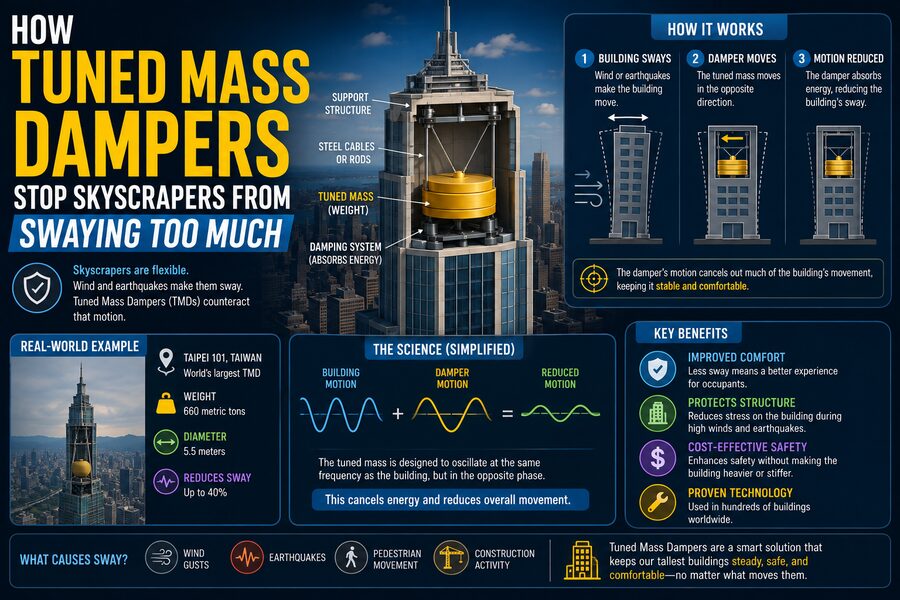

Modern skyscrapers are designed to be strong enough to support enormous vertical loads, but strength is only part of the engineering challenge. Tall buildings also need to remain comfortable and stable when exposed to wind, earthquakes, and other forces that cause them to move sideways. 🌬️🏢
A skyscraper may sway only a small amount, but even relatively small movements can make occupants feel uncomfortable, especially on upper floors. In very tall buildings, wind can create repeated oscillations that last long enough for people to notice motion, dizziness, or even nausea.
One of the most elegant solutions to this problem is the tuned mass damper, often abbreviated as TMD.
A tuned mass damper is a large moving mass installed inside a structure and carefully designed to move in a way that counteracts the building’s motion.
Instead of trying to make the skyscraper completely rigid, engineers allow the building to move slightly—and then use the tuned mass damper to absorb and reduce that motion.
🌬️ Why Do Skyscrapers Sway?
No tall building is perfectly rigid.
When wind pushes against the side of a skyscraper, the structure bends very slightly.
As the wind changes, the building can begin oscillating back and forth.
The taller and more slender the structure, the more noticeable this motion can become.
Several forces may contribute to movement:
- Strong winds
- Wind gusts
- Vortex shedding
- Earthquakes
- Machinery vibration
- Nearby construction
- Changes in structural loading
In most cases, a properly designed skyscraper is nowhere near structural failure.
The issue is often occupant comfort.
Humans can be surprisingly sensitive to low-frequency motion.
Someone standing on the 80th floor may feel movement that would be almost impossible to notice near ground level. 😵💫
📏 Tall Buildings Behave Like Giant Springs
A useful way to understand skyscraper motion is to imagine the building as a giant flexible spring.
When the wind pushes the structure to one side, the building stores elastic energy.
When the wind force decreases, the building moves back toward its original position.
Because it has mass and flexibility, it can overshoot.
The result is oscillation:
Left → Center → Right → Center → Left
This is similar to pulling a ruler off the edge of a desk and letting it vibrate.
The frequency at which a structure naturally prefers to oscillate is called its natural frequency.
Every tall building has one or more natural vibration modes.
These modes are extremely important when engineers design damping systems. 📐
🎵 What Does “Tuned” Mean?
The word tuned is the key to understanding a tuned mass damper.
The damper is designed so that its own natural frequency closely matches the vibration frequency engineers want to reduce.
Imagine pushing someone on a swing.
If you push at exactly the right rhythm, the swing moves farther and farther.
That is an example of resonance.
A tuned mass damper uses the same physics in a controlled way.
Instead of allowing the building to resonate freely, engineers add another mass whose motion is tuned so that it responds strongly to the building’s sway.
The damper then moves in a way that takes energy away from the building’s motion. 🔄
⚙️ What Is Inside a Tuned Mass Damper?
A basic tuned mass damper consists of three main elements:
A mass
A heavy object capable of moving relative to the building.
A spring or suspension system
This determines how the mass moves and helps set its natural frequency.
A damping mechanism
This removes energy from the motion, often through hydraulic, viscous, frictional, or other damping systems.
The entire assembly is carefully engineered.
In large skyscrapers, the moving mass may weigh hundreds of tons.
Some systems use giant pendulums.
Others use sliding concrete or steel blocks.
The exact design depends on the building’s shape, height, mass, stiffness, and expected wind conditions.
🔄 How the Damper Moves Against the Building
Suppose a strong gust pushes the top of a skyscraper to the right.
The building begins moving right.
The tuned mass damper, because of its inertia, does not immediately move exactly with the building.
Instead, relative motion develops between the structure and the damper.
As the building begins swinging back, the damper may move in the opposite direction.
That opposing motion produces forces that reduce the building’s oscillation.
The key idea is:
Building moves one way → damper tends to move the other way
This reduces the amplitude of the building’s sway. ⚖️
The system does not completely stop the building from moving.
Instead, it makes the movement smaller and causes vibrations to die out more quickly.
🧠 Inertia Makes the System Work
The principle of inertia is central to tuned mass dampers.
An object with mass resists changes in motion.
If a building suddenly moves beneath a heavy suspended mass, the mass tends to remain where it is for a moment.
This creates relative motion between the building and the damper.
Engineers use that relative motion to generate forces that oppose the building’s sway.
In effect, the damper becomes a carefully controlled counterweight.
The larger the moving mass, the more influence it can exert.
However, adding mass also increases structural loads and cost, so designers must optimize the system.
🛑 Where Does the Vibration Energy Go?
A tuned mass damper does not magically destroy motion.
The energy must go somewhere.
The damping mechanism converts mechanical vibration energy into other forms, usually heat.
For example, a hydraulic damper may force fluid through narrow passages.
As fluid moves through the resistance, mechanical energy is dissipated as thermal energy.
The same concept appears in vehicle shock absorbers.
The goal is to prevent the system from continuing to oscillate indefinitely.
Without damping, energy could move back and forth between the building and the mass.
With damping, some of that energy is removed during each cycle. 🔥
🏗️ Why Tuned Mass Dampers Are Usually Installed Near the Top
In many tall buildings, the upper floors experience the largest lateral motion.
That makes the upper portion of the skyscraper an effective location for a tuned mass damper.
A mass placed near the top can create a greater counteracting effect than the same mass placed much closer to the ground.
This is because the movement of the structure is generally larger near the top for the fundamental sway mode.
However, the exact location depends on the building’s vibration characteristics.
Structural engineers use computer models to determine where the damper will provide the greatest benefit.
🌊 Vortex Shedding Can Make Buildings Oscillate
Wind does not simply push continuously against a skyscraper.
As air flows around a large structure, swirling regions of air called vortices can form and detach alternately from opposite sides.
This phenomenon is called vortex shedding.
Each vortex creates changing lateral pressure.
Under certain conditions, these alternating forces can occur near the building’s natural frequency.
If that happens, the building may experience larger oscillations.
Engineers therefore study wind behavior very carefully when designing supertall structures.
Wind tunnel tests and computational simulations help determine whether a tuned mass damper may be necessary. 🌪️
🌬️ Wind Comfort Can Be More Important Than Structural Strength
A building can be structurally safe yet still feel uncomfortable to occupants.
This is an important distinction.
Structural engineers must satisfy both:
Strength requirements — ensuring the building does not fail.
Serviceability requirements — ensuring movement, vibration, and deformation remain acceptable during normal use.
A skyscraper could theoretically withstand large wind loads without collapsing but still sway enough to make people on upper floors uncomfortable.
Tuned mass dampers are often designed primarily to improve serviceability and comfort rather than to prevent collapse.
🧍 Why Humans Notice Slow Building Motion
People are very sensitive to acceleration.
A skyscraper does not need to visibly rock back and forth for occupants to notice.
Even slow movements can create sensations similar to being on a ship.
Some people may experience:
- Dizziness
- Headaches
- Motion sickness
- Anxiety
- Difficulty concentrating
These effects become particularly important in hotels, offices, and luxury residential towers.
Reducing acceleration at upper floors can therefore significantly improve the experience of living or working in a tall building.
🏙️ The Famous Taipei 101 Damper
One of the world’s most recognizable tuned mass dampers is inside Taipei 101 in Taiwan.
The building contains a giant suspended spherical mass.
The damper weighs approximately 660 metric tons.
It is suspended near the upper floors using large steel cables.
When the building moves during strong winds or seismic activity, the giant sphere swings relative to the structure.
Its motion helps reduce the building’s response.
Unlike most structural damping systems, the Taipei 101 damper is deliberately visible to visitors, making it a famous example of structural engineering. 🟡🏙️
🧱 Different Types of Tuned Mass Dampers
Not every tuned mass damper looks like a giant pendulum.
Several configurations exist.
🟡 Pendulum Tuned Mass Dampers
A large mass hangs from cables or rods.
As the building moves, the mass swings.
The length of the suspension helps determine the pendulum’s natural frequency.
↔️ Sliding Mass Dampers
A large block moves horizontally along rails or bearings.
Springs and damping devices control its motion.
💧 Tuned Liquid Dampers
Instead of using a solid mass, some buildings use liquid.
Water inside specially designed tanks moves in response to building motion.
This sloshing can be tuned to reduce structural vibration.
🧩 Multiple Tuned Mass Dampers
Some systems use several smaller masses tuned to slightly different frequencies.
This can provide effective damping over a broader range of motion.
💧 How Tuned Liquid Dampers Work
A tuned liquid damper uses water or another liquid as the moving mass.
Imagine a partially filled tank near the top of a building.
When the building moves, the liquid begins sloshing.
The tank dimensions and water depth are designed so the liquid’s natural sloshing frequency corresponds to the structural motion engineers want to reduce.
Baffles may be added to control the movement and dissipate energy.
One advantage is that water may already be needed in the building for fire protection or other systems.
In some designs, the same mass can serve more than one function. 💦
🌉 Tuned Mass Dampers Are Not Only for Skyscrapers
The same principle can be used in many structures.
Tuned mass dampers can appear in:
- Bridges
- Towers
- Stadium roofs
- Chimneys
- Observation structures
- Long-span floors
- Industrial equipment
Pedestrian bridges, for example, can sometimes vibrate when many people walk at similar rhythms.
A tuned damper can help reduce that motion.
Long office or stadium floors may also need vibration control if footsteps or machinery create uncomfortable oscillations.
🌁 Bridges Can Have Their Own Vibration Problems
Bridges experience different forms of dynamic loading.
Wind, vehicles, pedestrians, and structural resonance can all cause vibration.
In some cases, engineers install tuned mass dampers inside bridge decks or towers.
These systems work according to the same principle:
Detect or respond to structural motion.
Allow another mass to move relative to the structure.
Use that motion to oppose vibration.
This illustrates how broadly useful the tuned-damping concept is.
🧮 How Engineers Choose the Damper Mass
The mass of a tuned mass damper is often only a small percentage of the total effective mass of the building.
Yet even this relatively small mass can produce a significant reduction in vibration when properly tuned.
Suppose a building’s effective modal mass is enormous.
A damper might use a mass ratio of only a few percent or less, depending on design.
Making the damper heavier can improve performance, but there are practical limits.
A larger damper:
- Costs more
- Requires more space
- Adds structural load
- Needs stronger supports
- May be harder to maintain
Optimization is therefore essential.
🎚️ Tuning the Damper Frequency
The damper’s natural frequency depends on properties such as:
- Mass
- Spring stiffness
- Pendulum length
- Geometry
- Liquid depth
Engineers adjust these parameters until the damper frequency closely matches the targeted structural frequency.
If the damper is tuned incorrectly, its effectiveness can decrease significantly.
This is why detailed structural models are required.
The tuning may also include some tolerance for changes in the building over time.
🌡️ Buildings Can Change After Construction
A building’s dynamic properties are not perfectly fixed forever.
Its effective mass or stiffness can change because of:
- Furniture
- Occupancy
- Renovations
- Equipment additions
- Structural aging
- Temperature effects
These changes can slightly alter natural frequencies.
A well-designed tuned mass damper must therefore remain effective despite realistic variations.
Some systems are designed with adjustable components so engineers can retune them after installation.
🤖 Active Mass Dampers
Traditional tuned mass dampers are passive.
They respond automatically to building motion without needing motors to create the main counteracting movement.
However, engineers have also developed active mass dampers.
These systems use sensors, computers, and actuators.
Sensors measure the building’s movement.
A control system calculates the desired response.
Motors or hydraulic systems actively move a mass to counteract vibration.
Active systems can adapt to changing conditions, but they require power, controls, and more complex maintenance. 🤖
⚡ Semi-Active Dampers
Between passive and fully active systems are semi-active dampers.
These systems do not necessarily drive a massive counterweight directly.
Instead, they change properties such as damping resistance in response to conditions.
For example, an electronically controlled damper might adjust how easily fluid moves through a device.
Semi-active systems can provide some adaptability with lower energy requirements than fully active systems.
🌎 What Happens During an Earthquake?
Tuned mass dampers can also influence building response during earthquakes, but earthquake motion differs significantly from ordinary wind-induced sway.
Wind often excites relatively predictable low-frequency structural modes.
Earthquakes can produce much broader and more complex ground motions.
A damper optimized mainly for wind comfort may still provide some seismic benefit, but it is not necessarily a complete earthquake-protection system.
Buildings in seismic regions rely on many strategies, including:
- Ductile structural frames
- Shear walls
- Bracing systems
- Base isolation
- Energy-dissipation devices
A tuned mass damper may complement these systems rather than replace them.
🏗️ Tuned Mass Dampers vs. Base Isolation
A tuned mass damper and base isolation both reduce structural motion, but they work very differently.
A tuned mass damper is installed within the structure and moves relative to it.
Base isolation places flexible or sliding elements near the foundation, reducing how much earthquake motion is transferred from the ground into the building.
Base isolation is particularly associated with seismic protection.
Tuned mass dampers are especially well suited for reducing specific vibration modes and wind-induced motion.
Both are examples of engineers using controlled movement rather than relying only on brute structural stiffness.
🌀 Building Shape Also Reduces Sway
Tuned mass dampers are only one tool available to skyscraper designers.
Architects and engineers also shape buildings to reduce wind forces.
Possible strategies include:
- Rounded corners
- Tapered profiles
- Openings through the building
- Setbacks
- Twisting forms
- Changes in cross-sectional shape
These features can disrupt organized vortex formation.
By reducing aerodynamic excitation before it reaches the structure, engineers may reduce the amount of damping required.
Modern skyscraper design therefore combines aerodynamics and structural engineering. 🌬️
🧪 Wind Tunnel Testing
Before constructing a supertall skyscraper, engineers often test scale models in specialized wind tunnels.
Sensors measure:
- Wind pressures
- Structural forces
- Expected accelerations
- Vortex behavior
Engineers may test several versions of the building’s shape.
The results help determine whether changes to the architecture, structural stiffness, or damping system are necessary.
Wind tunnel data can also be used to estimate how frequently occupants might experience noticeable motion.
💻 Computer Simulation and Structural Models
Modern engineers also use sophisticated computer models.
A skyscraper can be represented as a dynamic system with mass, stiffness, and damping.
Simulations apply different wind conditions and calculate how the structure responds.
Then engineers add a virtual tuned mass damper and adjust parameters such as:
- Damper mass
- Frequency
- Damping ratio
- Location
Optimization software can test many possible configurations.
This allows engineers to design a damper long before the physical building is complete.
📉 How Much Can a TMD Reduce Motion?
Performance varies widely depending on the building and damper design.
A well-designed tuned mass damper can substantially reduce peak structural response or acceleration under the targeted conditions.
The exact reduction cannot be represented by one universal percentage.
It depends on:
- Building frequency
- Damper tuning
- Mass ratio
- Damping level
- Wind characteristics
- Structural mode shape
The system is therefore engineered specifically for each building.
A damper designed for one skyscraper cannot simply be copied unchanged into another.
🧰 Maintenance Is Essential
A tuned mass damper may remain inside a skyscraper for decades.
It therefore needs inspection and maintenance.
Engineers may monitor:
- Cables
- Bearings
- Hydraulic dampers
- Springs
- Sensors
- Structural connections
- Corrosion
- Fluid levels
Large pendulum systems can experience enormous forces during strong events.
Components must remain reliable even if the damper is rarely pushed to its maximum movement.
🚧 The Damper Needs Room to Move
One practical challenge is space.
A tuned mass damper may need to move a significant distance relative to the building.
Engineers therefore provide a dedicated movement zone.
Safety systems prevent the mass from exceeding allowable travel.
Buffers or stops may be included to protect the equipment during extreme events.
In supertall buildings, valuable upper-floor space may need to be dedicated to the damping system.
That is part of the tradeoff between rentable space and structural performance.
🏢 Why Not Just Make the Building Much Stiffer?
One obvious question is:
Why not simply make the skyscraper so stiff that it barely moves?
That is possible to some degree—but it can be inefficient.
Increasing stiffness may require:
- More steel
- More concrete
- Larger structural members
- Greater foundation loads
- Higher construction cost
A tuned mass damper can sometimes achieve the desired comfort level without dramatically increasing the entire building’s structural weight.
Instead of fighting all movement with more material, engineers intelligently control the movement that remains.
⚖️ Strength, Flexibility, and Comfort Must Be Balanced
A successful skyscraper is not simply the stiffest possible structure.
It needs to balance many objectives:
- Structural safety
- Wind resistance
- Earthquake performance
- Occupant comfort
- Material efficiency
- Cost
- Architectural requirements
- Usable floor space
Tuned mass dampers give engineers another variable they can optimize.
They allow the structure to remain reasonably flexible while controlling uncomfortable vibration.
🧠 A Simple Analogy: Carrying a Cup of Water
Imagine carrying a tray with a cup of water.
If the tray suddenly moves sideways, the water sloshes.
Now imagine adding a carefully designed counterweight that moves in the opposite direction whenever the tray moves.
The counterweight could reduce the overall motion.
A tuned mass damper works similarly, although the real engineering involves precisely calculated frequencies, masses, and damping.
The system uses motion to fight motion. 🔄
🌆 Why TMDs Matter More as Buildings Get Taller
As skyscrapers become taller and more slender, dynamic behavior becomes increasingly important.
A relatively short, wide building may feel extremely stiff.
A supertall tower extending hundreds of meters into the atmosphere experiences much stronger wind effects and larger potential movement.
Material strength alone does not solve every problem.
Engineers must think about the building as a dynamic system continuously interacting with the atmosphere.
Tuned mass dampers are one of the technologies that make today’s extremely tall and slender towers practical.
✅ The Bottom Line
A tuned mass damper reduces skyscraper sway by using a large movable mass that oscillates in opposition to the building’s motion.
When wind pushes the building, the structure begins to sway.
The damper responds at a carefully tuned frequency.
Its inertia creates forces that oppose the building’s movement, while damping devices remove energy from the oscillation.
The result is smaller movement and lower acceleration. 🏙️⚙️
Tuned mass dampers can take the form of giant pendulums, sliding blocks, liquid tanks, or advanced electronically controlled systems.
They are especially valuable in tall, slender buildings where wind-induced motion could otherwise make upper floors uncomfortable.
The technology demonstrates an important principle of structural engineering:
The best way to control movement is not always to eliminate it completely. Sometimes, engineers introduce another carefully controlled movement to cancel much of it out. 🔄
So when people work, sleep, or dine comfortably hundreds of meters above the ground during strong winds, a massive hidden—or occasionally visible—counterweight may be quietly moving inside the building, helping the tower stay calm. 🌬️🏢