
A building can look perfectly ordinary on the day a hidden problem begins. A small roof leak stains no ceiling at first. A hairline crack near a window may be harmless shrinkage—or a clue that water, movement, or corrosion is beginning to affect the structure.
That is why the question “How long will this building last?” has no single answer. Two similar buildings, built in the same year, can age very differently when one receives timely inspections and repairs while the other allows small defects to accumulate.
For owners, occupants, students, and engineers, structural longevity is not simply about preserving an old building. It is about keeping loads safely carried, materials protected, and risks understood before a defect becomes a disruptive and expensive failure.
Proper inspection and maintenance cannot make a structure immortal. They can, however, help it deliver a long, safe service life—and help decision-makers plan renewal instead of reacting to emergencies.
🏛️ Service Life Is Not the Same as Age
A structure’s service life is the period during which it performs its required functions at an acceptable level of safety, usability, and durability. Calendar age matters, but it does not determine service life by itself.
A well-maintained masonry building may remain useful for generations, while an inadequately protected concrete parking structure can need major rehabilitation much earlier. The difference often lies in exposure, detailing, use, and the consistency of care.
🧱 Buildings Have More Than One “Life”
It helps to separate structural life from the life of finishes and building systems. Carpet, paint, sealants, roofing membranes, mechanical equipment, and plumbing generally require replacement far sooner than the primary frame.
A building may therefore undergo many renovations while its foundations, columns, beams, walls, and slabs continue serving safely. Replacing a worn roof is not evidence that the whole structure is near the end of its life; it may be what protects the structure from premature deterioration.
⚖️ Safety, Function, and Economics Can Diverge
A building can remain structurally safe but become inconvenient, inefficient, or costly to operate. Conversely, a building can look modern and attractive while concealed deterioration reduces its safety margin.
Engineers consider at least three related questions:
- Can the structure safely support anticipated loads?
- Can it continue to perform its intended function without unacceptable damage or movement?
- Is repair, strengthening, or replacement economically and practically appropriate?
The answer to one question does not automatically answer the others.
🌦️ Exposure Often Controls the Pace of Aging
Materials deteriorate in response to their environment. Rain, wind-driven moisture, repeated wetting and drying, freeze-thaw cycles, salt, industrial pollutants, ultraviolet radiation, and temperature movement all influence the rate of damage.
A protected interior steel member and an exposed coastal steel connection do not face the same durability challenge. Similarly, reinforced concrete in a dry interior environment generally experiences different risks than concrete repeatedly exposed to de-icing salts or seawater spray.
💧 Water Is the Most Common Starting Point
Water is not automatically destructive; durable materials are designed to tolerate some exposure. Problems arise when water is trapped, repeatedly enters vulnerable locations, carries salts, or reaches materials that should remain dry.
Leaks can rot timber, corrode steel, weaken finishes that conceal defects, and transport chlorides into concrete. Good drainage, sound flashing, intact sealants, and prompt roof repairs are therefore structural protection measures, not merely cosmetic maintenance.
🧊 Freeze-Thaw Damage Begins in Small Spaces
When water enters pores or cracks and repeatedly freezes, expansion can widen those spaces. This mechanism is particularly relevant for saturated concrete, masonry, and stone in cold climates.
The visible result may be scaling, spalling, or cracked faces. The structural consequence depends on depth and location: superficial surface damage differs greatly from deterioration that exposes reinforcement or weakens a bearing zone.
🧂 Salt Accelerates Reinforced Concrete Deterioration
Concrete normally provides an alkaline environment that helps protect embedded reinforcing steel. Chlorides from marine exposure, de-icing salts, or contaminated materials can disrupt that protection once they reach the steel at sufficient concentration.
Corroding reinforcement expands, creating internal pressure that cracks and dislodges surrounding concrete. A small rust stain or narrow crack does not establish the extent of damage, but it is a reason for a professional assessment—especially on balconies, parking decks, facades, and bridge-like elements.
🔩 Steel Needs Protection at Connections Too
Steel can retain substantial strength even where surface corrosion is present, but section loss, pitting, and corroded connections can eventually reduce capacity. Bolts, welds, bearing surfaces, and areas where water collects deserve particular attention.
Protective coatings work only when the substrate is prepared and the coating remains intact. Maintenance should identify coating breakdown early, address the source of persistent moisture, and avoid simply painting over active corrosion.
🌲 Timber Durability Depends on Moisture Control
Timber structures can last a very long time when kept dry and protected from insects where relevant. Decay organisms generally need favorable moisture conditions, so the first repair is often to correct drainage, flashing, ventilation, or a plumbing leak.
Soft spots, persistent damp odors, fungal growth, sagging floors, and insect evidence should not be ignored. The affected extent can be much larger than the visible staining, particularly where framing is concealed behind finishes.
🧱 Masonry Requires Compatible Repairs
Brick, stone, and block walls age through moisture movement, mortar deterioration, settlement, thermal action, and sometimes corrosion of embedded metal. Repointing can be valuable, but the replacement mortar must be compatible with the historic or existing masonry.
An overly hard or impermeable repair can shift moisture and stress into softer units, leading to cracking or face loss. Durable masonry repair begins with understanding why joints failed, not simply filling them.
🪨 Foundations Respond to Soil and Water
Foundations do not “wear out” like a roof, but changing soil conditions can affect their performance. Poor drainage, leaking services, erosion, expansive soils, nearby excavation, tree roots, and altered loading can all contribute to movement.
Some cracking is expected in many buildings and may remain stable for years. What matters is the pattern, width, location, timing, and whether doors stick, floors slope, or cracks are growing. Monitoring is often more informative than one isolated observation.
📏 Cracks Are Symptoms, Not Diagnoses
A crack can result from concrete shrinkage, thermal movement, settlement, corrosion, overloading, vibration, or structural distress. Looking only at the crack without considering the member, load path, material, and history invites wrong conclusions.
For example, a fine crack in a plaster finish may be minor, while a widening diagonal crack through a masonry wall near an opening could merit prompt investigation. Neither should be diagnosed solely from a photograph.
🏋️ Changes in Use Can Change the Structural Problem
Structures are designed for particular load assumptions. Converting storage to offices may reduce loads, but converting offices to archives, adding heavy equipment, installing rooftop plant, removing walls, or creating new openings can increase demands or disrupt load paths.
Before alterations, a qualified structural engineer should review the existing construction and proposed loads. The common mistake is treating a nonstructural-looking wall or a small roof installation as harmless without checking what it supports.
🚧 Construction Errors Can Remain Hidden for Years
Some durability issues originate at construction: inadequate cover over reinforcement, missing flashing, poor concrete consolidation, unprotected steel, blocked drainage, or incorrectly installed expansion joints. A building may appear successful initially because deterioration needs time to develop.
Inspections are valuable because they compare current conditions with what a durable assembly should do. They are not just a search for dramatic damage; they are a way to catch ordinary defects while repair remains manageable.
🔍 Inspection Is a Planned Process
A useful inspection has a defined purpose, scope, and record. A routine visual survey can identify obvious changes, while a condition assessment may include measurements, photographs, drawings, moisture checks, material sampling, or targeted testing.
Inspectors should document location, severity, likely cause, urgency, and recommended next steps. “Monitor crack” is incomplete unless the record identifies which crack, how it will be measured, and what change would trigger action.
👁️ What a Routine Visual Inspection Can Find
Many early warnings are visible from accessible areas. Building staff and owners can notice changes between formal inspections, provided they understand when to escalate concerns.
- New or changing cracks, stains, rust marks, and spalled concrete
- Ponding water, blocked drains, leaking gutters, and failed sealants
- Loose cladding, displaced masonry, damaged parapets, or sagging elements
- Water entry around roofs, windows, balconies, and service penetrations
- Unexpected deflection, misaligned doors, or unusual noises under load
Visual checks have limits. They cannot reliably establish hidden reinforcement condition, internal decay, or foundation performance without further investigation.
🧪 Targeted Testing Reduces Guesswork
When visible evidence raises questions, engineers may recommend non-destructive or minimally invasive methods. These can include cover surveys, moisture measurements, crack monitoring, infrared imaging under suitable conditions, sounding for delamination, or selective openings.
No test is universally decisive. Results must be interpreted in context, and intrusive investigation may still be necessary when safety-critical details cannot otherwise be confirmed.
📅 Inspection Frequency Should Follow Risk
There is no responsible single interval for every structure. Frequency depends on material, age, exposure, occupancy, consequences of failure, known defects, recent storms or earthquakes, and local regulatory requirements.
High-exposure components—such as roofs, balconies, facades, parking structures, retaining walls, and drainage systems—often justify more frequent attention than protected interior elements. Inspection after an unusual event may also be appropriate even if the normal schedule is not due.
🗂️ Records Turn Observations into Knowledge
Maintenance records are one of the least glamorous and most useful assets a building can have. Drawings, past reports, repair details, photographs, warranties, leak history, and alteration records allow future teams to identify trends rather than restart the investigation each time.
A dated photograph with location information can show whether corrosion staining is stable or spreading. A crack log can distinguish seasonal movement from progressive distress. Good records make maintenance more targeted and defensible.
🛠️ Preventive Maintenance Protects the Load Path
Preventive maintenance means acting before a component fails or damage spreads. It includes cleaning drains, repairing roof defects, renewing sealants, maintaining protective coatings, controlling vegetation, and correcting plumbing leaks.
These tasks may seem separate from structural engineering, but they preserve the conditions the structure needs to work as intended. In practical terms, keeping water out and directing it away is often the first line of defense.
🔧 Repair the Cause, Not Just the Appearance
Cosmetic patching can conceal a defect while the underlying mechanism continues. For example, patching spalled concrete without addressing chloride contamination, corrosion, drainage, or inadequate cover may only delay recurrence.
A proper repair strategy identifies the deterioration mechanism, evaluates the affected extent, and selects materials compatible with the existing system. The correct scope may range from local repair to wider protection, strengthening, or monitoring.
🧭 Prioritization Helps When Budgets Are Limited
Few owners can address every observed issue at once. Prioritization should consider safety, rate of deterioration, consequences of failure, exposure, occupancy, and whether a modest intervention now avoids much larger future work.
| Priority level | Typical condition | Appropriate response |
|---|---|---|
| Immediate | Potential falling hazard, unstable element, severe water entry, or suspected loss of capacity | Restrict access, stabilize if needed, and obtain urgent professional advice |
| Prompt | Active deterioration likely to spread or affect performance | Investigate cause and schedule corrective work soon |
| Planned | Stable defect or predictable end-of-life component | Monitor and include in a maintenance or capital plan |
This is a general framework, not a substitute for a site-specific engineering judgment.
🏥 Critical Facilities Need a Higher Standard of Readiness
Hospitals, schools, emergency facilities, public assembly buildings, and structures with high occupancy may require more rigorous inspection and maintenance planning because disruption or failure has broader consequences.
Redundancy, access for inspection, emergency response planning, and documented decision-making become especially valuable. The goal is not only to avoid collapse, but also to preserve reliable function during routine operation and after hazards.
🌪️ Extreme Events Can Reset the Inspection Plan
After flooding, fire, impact, high winds, earthquakes, or unusual snow loads, a building may need assessment even if no dramatic damage is visible. Connections, concealed framing, foundations, and water-damaged materials may require targeted review.
Occupants should follow emergency instructions and avoid entering areas with visible instability, fallen components, major cracking, or damaged utilities. A post-event inspection should be performed by people with suitable expertise for the hazard involved.
🏙️ Older Buildings Need Investigation, Not Assumptions
Age alone is not a defect. Many older buildings have robust materials and have survived because they were well built and regularly cared for. At the same time, original details may not meet current expectations for drainage, seismic behavior, fire resistance, or accessibility.
Renovation is an opportunity to understand the existing structure before new loads and finishes conceal it again. Exploratory openings and archival drawings can be valuable, but field verification remains essential because old buildings are often altered over time.
♻️ Extending Service Life Is Often a Sustainability Strategy
Retaining and rehabilitating a structurally sound building can avoid the material use and disruption associated with premature demolition. This does not mean every building should be preserved regardless of condition; serious hazards, functional needs, and repair feasibility still matter.
Durability planning supports sustainability when it prevents repeated repair cycles and selects repair methods that work with the existing construction. Long life is most meaningful when it is paired with safety, adaptability, and manageable maintenance.
💰 Deferred Maintenance Has Compounding Costs
Deferring a minor repair can sometimes be sensible when a component is stable and monitored. But deferring work that allows ongoing water entry, corrosion, or movement often expands both the repair area and the disruption.
The financial issue is not merely the eventual repair bill. Leaks can interrupt operations, damage interiors, create temporary access restrictions, and make future investigations more invasive. A maintenance plan turns unpredictable emergencies into planned decisions.
👷 Know When to Call a Structural Engineer
Building managers can handle routine observation and ordinary upkeep, but certain signs call for professional assessment. These include significant new cracking, visible deflection, concrete spalling with exposed reinforcement, corroded structural steel, persistent water damage, fire or impact damage, and planned structural alterations.
Seek urgent advice where there is a potential falling object hazard, sudden movement, major loss of support, or an unsafe area. If immediate danger is suspected, restrict access and contact appropriate local emergency services or building authorities as applicable.
⚠️ Common Maintenance Mistakes
Several avoidable habits shorten service life. The first is treating recurring leaks as a finish problem rather than tracing the water path. The second is applying incompatible repair materials that trap moisture or create stress concentrations.
Other frequent mistakes include blocking drainage routes, neglecting difficult-to-reach areas, removing walls without review, and assuming a previous repair solved the underlying cause. Maintenance succeeds when it is curious: it asks what changed, where water goes, and how forces travel.
🧠 Design for Inspectability and Repair
The easiest defect to manage is one that can be seen, accessed, and repaired before it becomes severe. New designs can support long service life by providing drainage slopes, durable details, access to critical connections, replaceable sealants, appropriate material protection, and clear maintenance information.
Designers must balance these choices against cost, aesthetics, and construction practicality. Still, a detail that eliminates trapped water or allows a drain to be cleaned can have a larger lifetime effect than a more expensive finish.
📈 A Simple Long-Life Management Cycle
Effective structural stewardship is cyclical rather than reactive. Inspect, document, diagnose, prioritize, repair, and inspect again. Each cycle improves the quality of information available for the next decision.
For a hypothetical apartment building, this might mean identifying balcony drainage defects during a routine survey, repairing them before reinforcement corrosion advances, recording the repair locations, and checking those areas in later inspections. The value lies in interrupting deterioration early.
✅ The Core Principle: Protect, Observe, Act
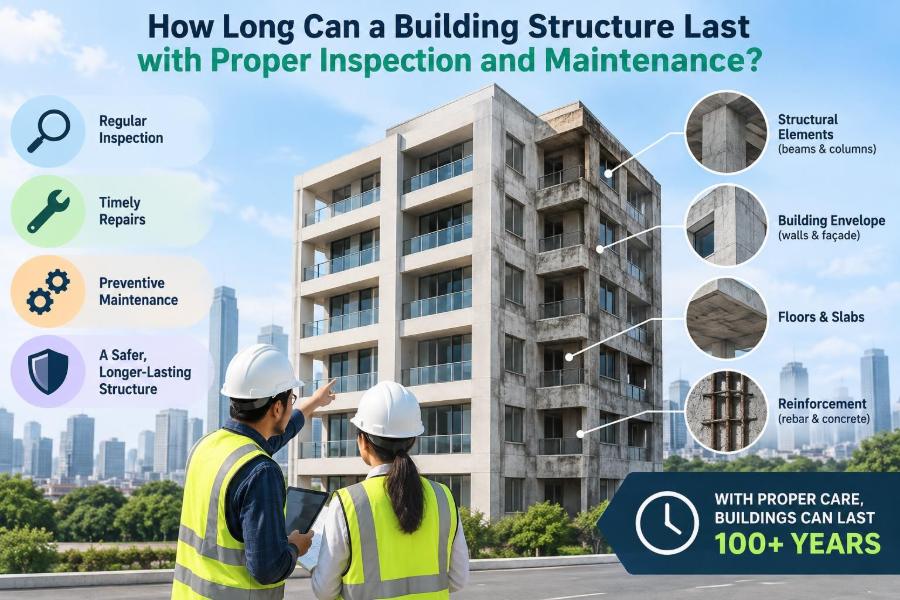
Buildings last when their materials are protected from avoidable exposure, their changing condition is observed, and defects are addressed according to their cause and risk. Inspection does not replace maintenance, and maintenance does not replace competent assessment when structural questions arise.
There is no universal expiration date for a building structure. Its realistic service life depends on design quality, construction, environment, loading, adaptation, and the discipline of everyone responsible for its care.
A building can serve far beyond its original expectations when small problems are found early, understood correctly, and repaired before they compromise the structure. Thoughtful inspection and maintenance make longevity a managed outcome rather than a matter of luck. 🏗️🔍🌧️