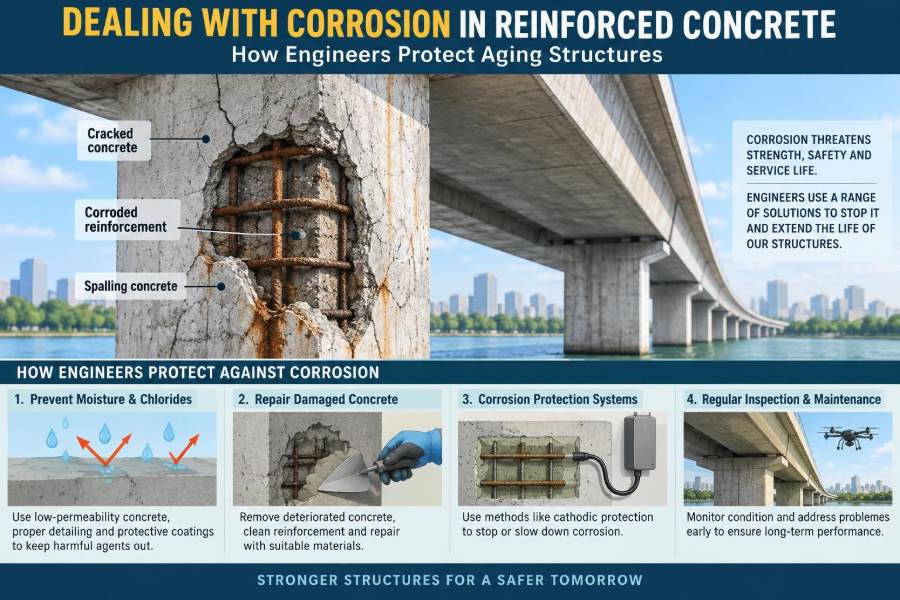

A parking garage develops rusty streaks beneath a joint. A coastal apartment balcony shows cracked concrete along its edge. On a bridge pier, a small area of spalling reveals a reinforcing bar that looks far thinner than it should.
These are familiar sights on aging concrete structures, but they are not merely cosmetic defects. They can be visible symptoms of corrosion occurring inside a material that is often assumed to be permanent.
Reinforced concrete remains one of engineering’s most useful construction systems because concrete handles compression well and steel carries tension efficiently. Its long-term performance, however, depends on keeping the embedded steel in a protective environment.
Understanding how that protection is lost helps engineers make better decisions: when to inspect, what to test, which repair is appropriate, and when a local patch is not enough.
🏗️ Why Reinforced Concrete Needs Steel
Concrete is strong when squeezed but comparatively weak when bent or pulled. Reinforcing steel, usually called rebar, is placed where tensile forces are expected so that the two materials work together.
Concrete and steel also have broadly compatible thermal movement, allowing a composite member to respond reasonably well to temperature change. In sound concrete, the steel is surrounded by a dense alkaline pore solution that normally helps keep corrosion low.
🛡️ The Passive Film That Protects Rebar
Fresh hardened concrete has a high pH. In that alkaline environment, a very thin, stable oxide layer forms on the steel surface. This is called the passive film.
Passive steel is not magically immune to damage, but its corrosion rate can remain extremely low while the surrounding concrete stays sufficiently alkaline and harmful salts do not reach the bar in critical concentration. Durability design is largely about preserving this condition for the intended service life.
⚗️ Corrosion Is an Electrochemical Process
Steel corrosion in concrete is an electrochemical reaction, not simply steel “getting wet.” At anodic locations, iron loses electrons and forms corrosion products. At cathodic locations, another reaction consumes those electrons, commonly involving oxygen and water.
A working corrosion cell needs an electrical path through the steel, an ionic path through pore water in the concrete, moisture, and oxygen. Removing or severely limiting one of these ingredients can slow corrosion, which explains why drainage, sealing, concrete quality, and cathodic protection can all matter.
💥 Why Rust Causes Concrete to Crack
Many corrosion products occupy more volume than the original steel. As rust accumulates around a bar, it presses outward on the surrounding concrete cover.
Concrete is weak in tension, so longitudinal cracks often form above the reinforcing bar. Continued pressure can detach pieces of cover concrete, a failure called spalling. The exposed bar then has easier access to oxygen and moisture, accelerating local deterioration.
🌬️ Carbonation: Losing Alkalinity from the Surface Inward
Carbon dioxide from air slowly enters concrete pores and reacts with alkaline constituents. This process, called carbonation, reduces the pH of concrete over time.
Carbonation is not automatically harmful; it is a normal surface process. The concern begins when the carbonation front reaches reinforcement and the passive film can no longer remain stable, particularly where moisture conditions support corrosion.
Carbonation depth depends on exposure, permeability, curing, cover depth, cracking, and concrete composition. It should therefore be measured or assessed rather than inferred from a building’s age alone.
🧂 Chlorides: A Direct Threat to Passivity
Chloride ions can disrupt the passive film even when the concrete remains alkaline. Common sources include marine spray, de-icing salts, contaminated aggregates or mixing water, and some industrial environments.
Chlorides move inward mainly with water or water vapor through pores, cracks, and poorly detailed joints. Once enough chloride reaches the reinforcement level, corrosion may initiate in localized pits rather than uniformly across the bar.
🌊 Marine Exposure Is More Than Saltwater Contact
Coastal structures do not all face the same risk. A member continuously submerged may have limited oxygen available, while a member in a splash or tidal zone experiences wetting, drying, salt deposition, and oxygen replenishment.
Windborne marine aerosol can affect structures well away from the shoreline. Balconies, facades, piers, and parking levels open to sea air need exposure-specific design and maintenance rather than a generic assumption that “near the coast” describes the whole problem.
❄️ De-Icing Salts Create a Different Exposure Pattern
Road bridges and parking structures can receive chlorides from de-icing operations. Vehicles carry salt-laden meltwater into garages, where it drips repeatedly onto slabs, beams, columns, and joints.
Damage often concentrates at wheel paths, drainage low points, expansion joints, and leaking deck penetrations. These patterns are useful during inspection because they connect visible distress to the route water and chlorides actually take through the structure.
💧 Water Movement Controls the Pace
Water is often the practical driver of deterioration. It transports dissolved salts, supplies the electrolyte needed for corrosion, and enters through cracks, leaking joints, failed membranes, blocked drains, and porous concrete.
Very dry concrete may not support a rapid corrosion reaction, while fully saturated concrete can restrict oxygen access. Many severe cases occur in repeatedly wet-and-dry zones where both moisture and oxygen are available.
🧱 Concrete Cover Is a Protective Barrier
Cover is the distance from the concrete surface to the outer reinforcing steel. It is not empty sacrificial material; it is the physical barrier through which carbon dioxide, chlorides, water, and oxygen must travel.
Insufficient cover can result from poor bar placement, construction tolerances, or later surface removal. Even high-quality concrete cannot provide the intended protection if the bars are much closer to the surface than the design assumes.
🕳️ Cracks Are Pathways, Not Automatic Failure
Cracks deserve investigation, but their presence does not always mean reinforcement is corroding or that structural capacity is immediately compromised. Some cracks result from shrinkage, thermal restraint, settlement, or loading, and may remain narrow and stable.
The key questions are whether a crack is active, whether it admits water or chlorides, whether it aligns with reinforcement, and whether associated staining or delamination is present. A crack that leaks repeatedly can be more consequential than a wider crack in a dry, protected location.
👀 Early Warning Signs in the Field
Visible symptoms provide useful clues, though they are usually later-stage indicators. Engineers and facility teams should note patterns rather than judging one isolated blemish.
- Rust staining that follows the line of a bar or joint
- Cracks parallel to reinforcement, especially near slab edges and beam soffits
- Hollow-sounding, loose, or detached cover concrete
- Spalls that expose corroded reinforcement
- Persistent damp patches, efflorescence, failed sealants, or blocked drainage
Safety concerns increase when loose concrete may fall, when bars have lost noticeable section, or when damage affects highly stressed structural regions. Those conditions call for timely evaluation by a qualified structural engineer.
🔍 Inspection Begins Before Testing
A useful condition assessment starts with drawings, repair history, exposure history, leak reports, and a systematic visual survey. The goal is to understand the structure’s layout, likely load paths, drainage routes, and recurring distress locations.
Inspectors often mark cracks, spalls, stains, and dampness on elevation or plan sketches. Mapping turns scattered observations into a pattern: for example, deterioration concentrated below a leaking plaza joint suggests a different intervention from deterioration spread across an entire chloride-exposed deck.
📏 Sounding Helps Find Hidden Delamination
Delaminated concrete can look intact from the surface. Tapping with a hammer or chain drag may produce a hollow sound where the cover has separated from sound concrete below.
Sounding is fast and valuable for defining probable repair boundaries, especially on slabs and vertical faces. It is still an indirect method: results depend on access, thickness, reinforcement layout, and inspector judgment, so critical decisions may need confirmation through selective removal or other tests.
🧪 Testing Must Answer a Specific Question
Testing is most valuable when it supports a decision. A carbonation indicator applied to a freshly broken surface can help locate the carbonated zone. Chloride analysis of powder samples can help identify whether salt exposure has reached reinforcement depth.
Other tools may include cover measurement, electrical resistivity, half-cell potential mapping, corrosion-rate methods, core sampling, and petrographic examination. Each method has limitations; no single reading can fully diagnose corrosion activity, severity, and future progression.
⚡ Interpreting Half-Cell Potential Carefully
Half-cell potential surveys compare electrical potentials at the concrete surface to a reference electrode. They can identify areas where the likelihood of active corrosion is relatively higher or lower under suitable test conditions.
A potential map is not a direct measurement of steel loss. Moisture, concrete resistivity, electrical continuity, surface condition, and access can influence readings. The best use is often as one layer of evidence alongside visual observations, cover data, chloride results, and targeted openings.
📉 Section Loss Changes Structural Capacity
Not all corrosion has the same structural consequence. Mild surface corrosion may mainly threaten cover concrete, while sustained corrosion can reduce bar diameter, impair bond between steel and concrete, and affect anchorage or lap splice performance.
Engineers assess the member’s actual geometry, reinforcement details, damage extent, loading, and remaining capacity. This is especially significant at supports, connections, slab-column regions, prestressing tendons, and other zones where a small local defect may have disproportionate consequences.
🚧 Make Unsafe Areas Safe First
Before permanent repairs are designed, immediate risk may need control. Loose spalls above pedestrians or traffic can require removal under an engineered plan, exclusion zones, protective netting, shoring, or temporary load restrictions.
Emergency measures do not diagnose the root cause or replace a durable repair. They create time for a proper assessment while reducing immediate risk to occupants, users, and workers.
🩹 Patch Repairs Work Only Within a System
A conventional patch repair removes unsound concrete, cleans or replaces deteriorated steel as necessary, restores the profile with compatible repair material, and cures the repair properly. It can be effective when damage is localized and the cause has been addressed.
Simply filling a spall without removing chloride-contaminated or delaminated concrete can leave active corrosion beside the patch. The new repair may then remain sound while adjacent concrete breaks away, a pattern sometimes called the incipient anode effect.
🧰 Repair Preparation Often Determines the Outcome
Repair material cannot compensate for weak preparation. Sound substrate, properly defined edges, suitable surface roughness, clean reinforcement, adequate clearance around bars, and moisture conditioning all affect bond and durability.
Material selection also matters. Shrinkage, stiffness, permeability, thermal behavior, and compatibility with the parent concrete should be considered. A repair that is too rigid, too impermeable, or poorly cured can crack or debond even when the visible patch initially looks excellent.
🎨 Coatings and Sealers Reduce Future Ingress
Surface treatments can reduce the entry of water, carbon dioxide, and chlorides. Penetrating water repellents are commonly used where vapor transmission is desirable, while coatings can provide a more continuous barrier when the substrate and detailing are suitable.
These systems are not universal cures. A coating applied over damp, contaminated, actively cracking, or poorly prepared concrete may fail prematurely. Joints, terminations, drainage details, and future inspection access are as important as the coating product itself.
🔌 Cathodic Protection Can Control Ongoing Corrosion
Cathodic protection uses an external electrical system or sacrificial anodes to shift the electrochemical conditions at the steel and reduce corrosion. It can be a practical option for widespread chloride contamination where removing all affected concrete would be disruptive or uneconomical.
It requires specialist design, installation, commissioning, and monitoring. Electrical continuity of reinforcement, access for maintenance, power reliability for impressed-current systems, and compatibility with other repairs must be evaluated early.
🧱 Electrochemical Treatments Have Narrower Roles
Methods such as chloride extraction and re-alkalization use temporary electrical fields to change conditions around reinforcement. They may be considered for particular structures and exposure scenarios.
These approaches are not substitutes for sound concrete, good drainage, or proper structural repair. Their suitability depends on reinforcement arrangement, concrete condition, contaminant profile, geometry, and the ability to verify performance afterward.
🌧️ Drainage Details Are Durability Details
Many corrosion problems begin with ordinary water-management failures: clogged drains, inadequate falls, leaking joints, cracked toppings, or downpipes discharging onto concrete. These are maintenance issues, but they become structural durability issues when moisture repeatedly reaches reinforcement.
Effective repair scopes should trace water to its source and route it away. Fixing a soffit spall while leaving the leaking deck directly above it is rarely a lasting strategy.
📋 Choosing a Repair Strategy by Condition
There is no single best repair method. The choice should match the deterioration mechanism, distribution of damage, structural role, expected exposure, access constraints, and owner’s maintenance capacity.
| Observed condition | Typical engineering response | Key caution |
|---|---|---|
| Localized spalls with an isolated leak | Concrete repair plus leak and drainage correction | Check nearby areas for hidden delamination |
| Carbonation approaching reinforcement over broad areas | Targeted repair and an appropriate protective surface system | Confirm carbonation depth and crack behavior |
| Widespread chloride contamination | Repair combined with protection, electrochemical control, or phased renewal | Local patches alone may shift corrosion nearby |
| Significant steel loss or compromised member behavior | Structural strengthening, replacement, or load management | Capacity assessment must lead the decision |
🧠 Avoid the “Patch and Paint” Mistake
A common failure is treating visible damage as the entire problem. Removing a spall and applying paint may improve appearance while leaving contaminated concrete, active corrosion, poor drainage, or moving cracks untouched.
Another mistake is specifying a repair product before understanding the mechanism. Good corrosion repair starts with diagnosis: what initiated corrosion, how far it has progressed, what pathways remain open, and what service life is expected after intervention.
🪜 Access and Workmanship Affect Durability
Corrosion repairs often occur in awkward locations: bridge undersides, occupied garages, marine structures, and high-rise facades. Poor access can lead to incomplete concrete removal, inadequate cleaning, poor curing, or skipped inspection steps.
A practical repair design includes safe access, containment, sequence of work, quality checks, curing protection, and realistic weather allowances. These are not administrative extras; they influence whether the finished repair performs as intended.
📅 Monitoring Turns Repair into Asset Management
After repair, structures benefit from a documented inspection plan. The plan may track cracks, coating condition, moisture sources, new staining, delamination, drainage function, and any corrosion-control system readings.
Repeatable photographs, marked-up drawings, and consistent survey locations make change easier to detect. Monitoring is particularly valuable when an owner chooses a phased repair strategy or manages a large portfolio with limited annual budgets.
🏢 Different Structures Need Different Priorities
A bridge, a hospital parking deck, a residential balcony, and a water-treatment structure can all contain corroding reinforcement, but their priorities differ. Public safety, consequence of closure, redundancy, exposure intensity, access, and tolerance for disruption shape the intervention.
For example, a hypothetical garage may prioritize immediate overhead spall safety and saltwater drainage, while a coastal façade may prioritize fall hazards, wind-driven rain resistance, and discreet access for recurring inspections.
📐 Design Lessons for New Construction
The most economical corrosion repair is often the one avoided through durable new construction. Designers can improve resilience with appropriate cover, low-permeability concrete, crack-control detailing, drainage, waterproofing continuity, joint design, and exposure-appropriate materials.
Construction quality is equally decisive. Correct curing, bar support, consolidation, cover verification, and protection from early contamination determine whether the designed durability is achieved in the completed structure.
🤝 Coordination Prevents Water from Finding Weak Points
Durability depends on details that cross disciplines. Structural engineers, architects, waterproofing consultants, civil designers, contractors, and facility staff all influence how water is shed, collected, sealed, and maintained.
A reinforcement repair may be technically correct yet repeatedly exposed because a roof drain overflows or a façade joint was never included in the repair scope. Coordinated investigations prevent these gaps.
⚖️ Know When Specialist Advice Is Necessary
Visible corrosion does not by itself reveal remaining strength, and concealed deterioration may be more extensive than surface symptoms suggest. A qualified structural engineer or durability specialist should evaluate conditions involving falling-concrete hazards, substantial spalling, exposed or damaged reinforcement, prestressed concrete, critical load-bearing elements, or uncertainty about capacity.
Field observations are valuable, but safety decisions should not rely on appearance alone. Testing and analysis should be proportionate to the consequence of failure and the uncertainty in the available evidence.
🎯 The Core Principle: Control the Cause, Not Just the Symptom
Corrosion in reinforced concrete is manageable when engineers treat it as a system problem. Steel condition, concrete quality, chloride or carbonation exposure, water pathways, structural demand, repair compatibility, and future maintenance all interact.
The durable sequence is straightforward in principle: identify the mechanism, establish the extent, address immediate safety, remove or control the cause, repair damaged material appropriately, and monitor the result. The details may be complex, but the logic prevents short-lived cosmetic fixes.
Aging reinforced concrete lasts best when corrosion is diagnosed early and managed at its source—not merely covered after it becomes visible. Thoughtful inspection, targeted repair, and disciplined water management protect both the structure and the people who rely on it. 🏗️🛡️🔧