
A bridge opens, an office building fills with tenants, or a new retaining wall disappears behind landscaping. To the public, the project is finished. For engineers, a different phase has begun: learning how the structure behaves in the conditions it will actually face.
Drawings and calculations describe an intended response to load, temperature, wind, moisture, and time. Real structures experience all of those influences together, often in patterns that are difficult to reproduce during design or construction.
Long-term monitoring turns observations into evidence. It helps owners distinguish normal movement from developing distress, plan maintenance before damage grows, and verify whether a structure is performing as expected.
This work is not limited to spectacular bridges or high-rise towers. From a cracked concrete car park to a settling industrial floor, post-construction engineering depends on informed inspection, measured data, and sound judgment.
🏗️ Monitoring Begins When Construction Handover Ends
Structural monitoring is the planned observation of a structure’s condition and behavior after, or sometimes during, construction. It may involve visual inspections, physical measurements, testing, maintenance records, and automated instruments.
The goal is not to prove that a structure will never change. All structures move, age, and respond to their environment. The goal is to understand whether those changes remain within an expected and acceptable range.
In practice, monitoring supports decisions: whether to inspect more closely, repair a defect, alter operations, restrict loading, or simply continue routine observation.
🔍 Why Design Calculations Are Not the Final Answer
Design calculations use models. A model simplifies reality by making assumptions about material properties, support conditions, load paths, restraints, and future use. This is necessary and appropriate, but it cannot represent every local detail.
For example, a steel beam may be assumed to have a certain level of restraint against lateral movement. After construction, connections, surrounding finishes, and actual loading may create slightly different restraint conditions.
Monitoring provides a feedback loop between the predicted structure and the operating structure. It does not replace design, but it can reveal where assumptions were conservative, incomplete, or affected by construction tolerances.
📈 Performance Is More Than “No Collapse”
A structure can remain safe while still performing poorly. Excessive floor vibration, recurring façade leaks, cracking finishes, uneven settlement, or doors that no longer align can disrupt use long before a primary structural failure is a concern.
Engineers commonly think about performance across several levels:
- Serviceability: comfort, appearance, water-tightness, deflection, vibration, and everyday usability.
- Durability: resistance to corrosion, weathering, chemical attack, fatigue, and repeated deterioration.
- Strength and stability: capacity to resist loads without collapse, buckling, overturning, or loss of support.
- Resilience: ability to tolerate unusual events and return to useful operation.
A good monitoring plan identifies which performance questions matter most for a particular asset.
🧭 Start With a Clear Monitoring Objective
Collecting data without a question creates large files and little insight. Before selecting instruments or inspection intervals, engineers define the decision that the information must support.
A bridge owner may need to know whether a crack is growing under truck traffic. A building owner may need to confirm whether settlement has stabilized before fitting sensitive equipment. A dam operator may need early indication of changing seepage or movement.
Useful objectives are specific: establish a baseline, track a suspected defect, verify construction-stage behavior, assess response to an altered load, or trigger an inspection after an extreme event.
📋 Establish a Baseline Before Interpreting Change
A baseline is a documented picture of the structure at a known point in time. It may include photographs, crack maps, survey levels, material condition, drainage condition, instrument readings, and notes on occupancy or loading.
Without a baseline, a later observer may see a crack but not know whether it appeared yesterday, existed at handover, or changes with the seasons. A simple dated photograph with a scale can sometimes be more valuable than an isolated verbal report.
Baseline records should also capture the monitoring context: weather, temperature, recent rain, construction activity nearby, and any unusual loading. These factors often explain apparent changes.
👀 Visual Inspections Remain the First Line of Defense
Visual inspection is not a lesser alternative to sensors. It is often the fastest way to identify blocked drains, damaged joints, rust staining, loose components, impact damage, water paths, vegetation growth, or unauthorized alterations.
An effective inspection is systematic rather than casual. Inspectors use consistent routes, checklists, photographs, and location references so that observations can be compared over time.
Close visual work also tests engineering judgment. A crack’s location, direction, width, edges, and relationship to joints or reinforcement can suggest very different mechanisms.
🧱 Reading Cracks in Context
Cracks are common in concrete and masonry, and their presence alone does not identify a structural problem. Concrete can crack because of shrinkage, thermal movement, restraint, settlement, corrosion, overload, or detailing conditions.
What matters is the pattern and progression. A crack near a re-entrant corner may reflect stress concentration. A set of diagonal cracks near a support may warrant a different line of investigation than fine, broadly distributed shrinkage cracks.
Engineers record width, length, orientation, location, moisture condition, and whether edges are offset. They also ask whether the crack is active, seasonal, or stable. Interpretation requires evidence; a photograph alone rarely tells the full story.
📏 Surveying Settlement, Tilt, and Alignment
Survey monitoring measures the position of points on or around a structure. Repeated level surveys can track vertical settlement, while total stations, precise leveling, or satellite-based methods may help assess horizontal movement or tilt.
For a building on compressible ground, the key question is often not whether settlement exists, but whether it is uniform and slowing. Differential settlement—one area moving more than another—can distort frames, partitions, cladding, and services.
Measurements need stable reference points. If the benchmark itself moves, the survey can produce a misleading picture of structural behavior.
📐 Measuring Deflection and Rotation
Deflection is the change in shape or position of an element under load. A floor slab may sag slightly when occupied; a bridge girder may deflect under a passing vehicle. Rotation describes angular movement, such as a retaining wall leaning outward.
Some movement is expected and reversible. The concern grows when deflection exceeds expectations, accumulates over time, remains after unloading, or appears alongside cracking, distress, or changes in use.
Inclinometers, tiltmeters, displacement transducers, and survey targets are selected according to the movement being investigated. The instrument must be accurate enough to resolve meaningful change, not merely produce a number.
🌡️ Temperature Can Make Sound Structures Look Alarming
Steel, concrete, glass, and other materials expand and contract as temperature changes. A long bridge deck can move noticeably between cool mornings and hot afternoons; a sunlit façade can behave differently from a shaded one.
Temperature also affects sensor readings and material stiffness. If an engineer compares two measurements without considering temperature, normal thermal behavior may be mistaken for damage.
Monitoring systems often record temperature alongside strain, displacement, or crack movement. This allows analysts to identify repeating seasonal or daily patterns before treating a change as abnormal.
💨 Wind, Vibration, and Dynamic Behavior
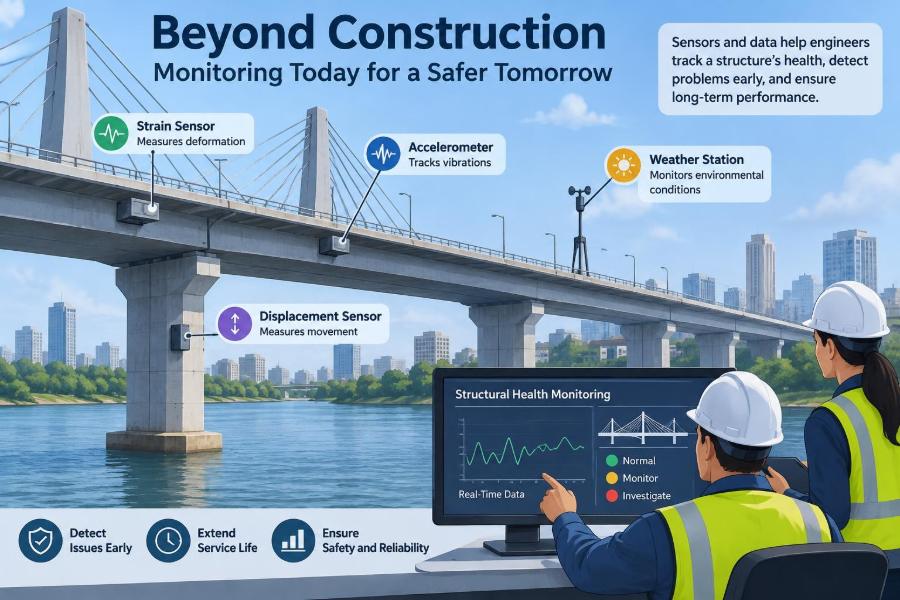
Dynamic monitoring examines how a structure responds to time-varying loads such as wind, traffic, machinery, crowds, waves, or seismic shaking. Accelerometers measure acceleration and can help characterize vibration.
Every structure has natural frequencies, meaning rates at which it tends to vibrate. A change in those characteristics can be worth investigating, but it is not automatically evidence of damage; temperature, occupancy, and boundary conditions can also affect the response.
For occupied floors, monitoring may focus on human comfort. A floor can be strong enough while still feeling uncomfortable when rhythmic activity or equipment excites a flexible mode.
⚙️ Strain Gauges Reveal How Forces Travel
Strain is a very small change in length relative to original length. Strain gauges attached to steel or embedded in concrete can indicate how a member responds when load is applied.
With appropriate material assumptions and calibration, strain data can help estimate stress trends. It can be especially useful where engineers want to compare actual load distribution with an analytical model.
However, a gauge reports behavior at its installation location, not everywhere in a member. Bond quality, wiring, temperature effects, and local details influence the result. A few gauges cannot by themselves describe an entire complex structure.
🛰️ Automated Structural Health Monitoring
Structural health monitoring, often shortened to SHM, combines sensors, data acquisition, communications, and analysis to observe a structure continuously or at scheduled intervals. It is particularly useful where access is difficult or changes can occur between inspections.
A typical system may include sensors for displacement, acceleration, strain, temperature, humidity, corrosion-related conditions, or water level. Data may be stored locally or transmitted for review.
Automation improves coverage, but it does not eliminate engineering responsibility. Sensors can fail, drift, lose power, or report values affected by installation conditions. Someone still needs to validate the signal and interpret its meaning.
🔌 Choose Instruments to Answer the Actual Question
Instrument selection should follow the monitoring objective, expected range of movement, required precision, environmental exposure, access needs, power supply, and maintenance plan. The most sophisticated sensor is a poor investment if it cannot survive its location or be checked later.
| Question | Common approach | What it can indicate |
|---|---|---|
| Is a crack opening or closing? | Crack gauge or tell-tale | Relative movement across a crack |
| Is the structure settling? | Level survey or settlement points | Vertical movement over time |
| Is wind causing excessive motion? | Accelerometer or tilt sensor | Dynamic response and vibration trends |
| Is steel experiencing unusual response? | Strain gauge | Local strain trend under load |
| Are internal conditions supporting corrosion? | Durability or environmental sensors | Exposure conditions requiring assessment |
Many important questions can be answered with modest tools, regular observation, and good records.
🧪 Materials Age Differently in Service
Concrete may shrink, creep under sustained load, carbonate at the surface, crack, or allow chlorides and moisture to reach reinforcement in certain exposures. Steel can corrode where coatings fail or water is trapped. Timber responds strongly to moisture and may decay when persistently wet.
These processes are not always visible at their earliest stages. Monitoring combines surface observations with knowledge of exposure: salt spray, freeze-thaw cycling, industrial chemicals, poor drainage, condensation, and leakage all change the risk profile.
Material testing may be needed when a condition cannot be understood visually. Sampling and non-destructive methods should be planned carefully because each has limits and may only represent a local area.
💧 Water Management Is Structural Maintenance
Water rarely respects the boundary between architectural and structural maintenance. A blocked roof drain, failed sealant joint, leaking expansion joint, or damaged flashing can keep structural components wet far longer than intended.
Persistent moisture accelerates many deterioration mechanisms. It can promote reinforcement corrosion, timber decay, freeze-thaw damage, masonry deterioration, and soil softening near foundations or retaining structures.
Inspection plans should therefore include gutters, drains, downpipes, waterproofing transitions, joints, and discharge locations. Preventing water accumulation is often simpler than repairing its long-term consequences.
🧂 Corrosion Needs More Than a Rust Stain Check
Corrosion is an electrochemical process that can reduce steel section, weaken connections, disrupt protective coatings, and crack concrete cover as corroding reinforcement expands. Rust staining is a warning sign, but absence of visible staining does not guarantee that corrosion is absent.
Particular attention is justified at deck joints, splash zones, crevices, interfaces between dissimilar metals, concealed connections, and areas exposed to salts or repeated wetting.
Condition assessment may involve close access, coating review, thickness measurements where appropriate, and investigation of moisture pathways. The repair strategy must address the cause of corrosion, not only its visible result.
🚚 Actual Loads Often Change After Opening Day
Structures are designed for stated uses, but use evolves. Storage rooms become archive rooms, offices gain heavy equipment, roofs acquire plant, industrial floors receive new machinery, and bridges carry traffic patterns that differ from original assumptions.
Changes in load do not automatically create danger, but they should not be treated casually. Added loads may affect beams, slabs, columns, foundations, vibration response, and connections.
Owners should involve a qualified structural professional before removing walls, cutting openings, hanging equipment, adding rooftop installations, or changing occupancy. Monitoring can then confirm behavior where the modification introduces uncertainty.
🏢 Building Alterations Can Interrupt Load Paths
A load path is the route by which force travels through a structure to its supports and ultimately to the ground. Partitions, braces, diaphragms, connections, and even apparently minor components may contribute to that route.
Renovation work can inadvertently weaken a load path by removing a wall, cutting reinforcement, enlarging a penetration, damaging fireproofing that also protects steel, or disconnecting bracing.
Post-alteration inspection should look beyond the renovated room. If forces are redirected, effects may appear at supports, adjacent members, or connection zones elsewhere in the structure.
🌧️ Extreme Events Change Inspection Priorities
After flooding, impact, fire, high winds, significant ground movement, or unusual snow accumulation, a structure may need targeted assessment even if it appears intact from a distance. The inspection scope should reflect the event and the asset’s vulnerabilities.
Flooding can scour soil, saturate materials, transport debris into drainage paths, and undermine retaining systems. Fire can alter material properties and damage protective layers. Vehicle impact can compromise columns, barriers, or bridge elements locally.
An emergency inspection is not the same as a routine inspection. It may require temporary restrictions until critical supports, connections, foundations, or protective systems are assessed.
🗓️ Inspection Frequency Should Follow Risk
There is no universal interval suitable for every structure. Inspection frequency depends on age, material, exposure, consequence of failure, known defects, accessibility, rate of change, and the severity of service conditions.
A sheltered, low-risk element in stable condition may need only periodic review. A coastal structure with known corrosion, or a retaining wall showing movement after heavy rainfall, may require closer follow-up.
Risk-based planning directs effort where it is most useful. It also avoids the false economy of infrequent inspections that miss a rapidly developing condition.
🧠 Data Is Useful Only When It Has Context
A sensor dashboard can create an illusion of certainty. A line on a graph needs units, timestamps, calibration information, sensor location, environmental data, and an understanding of what normal variation looks like.
For example, a gradual displacement trend could represent settlement, sensor drift, thermal expansion, a loose mounting, or a changed reference point. Engineers test competing explanations before drawing conclusions.
Good data management includes quality checks, clear naming, backup procedures, documented changes to the system, and records of maintenance or nearby construction activities.
🚦 Thresholds Should Trigger Review, Not Blind Panic
Monitoring systems may use thresholds to flag readings for attention. A threshold can be based on design expectations, past behavior, instrument capability, or a defined operational concern.
Well-designed alert levels are often staged. An initial alert may prompt data validation and visual inspection; a higher level may require engineering review; an urgent level may lead to operational restrictions.
Thresholds must account for normal cycles. Setting a single rigid limit without considering temperature or routine loading can create frequent false alerts, which encourages people to ignore the system.
🛠️ Maintenance Turns Findings Into Longer Service Life
Monitoring identifies conditions; maintenance changes outcomes. Cleaning drainage, renewing coatings, sealing joints, repairing local damage, tightening or replacing components, and addressing leaks can slow deterioration significantly when completed at the right time.
Deferred maintenance often increases both scope and uncertainty. A small water-entry issue may eventually require repairs to finishes, corrosion protection, reinforcement, or supporting materials.
The best maintenance program connects inspection findings to priorities, responsibilities, budgets, repair methods, and follow-up verification.
🧾 Keep a Living Record of the Structure
Useful records outlast individual staff members and project teams. They include as-built information, design assumptions where available, repair drawings, inspection reports, photographs, test results, sensor data, and records of alterations.
A clear location system is essential. “Crack near the north stair” becomes much more useful when it includes a level, grid reference, elevation, photograph, date, and previous observations.
Digital records can improve retrieval, but their value depends on consistent input. An unlabelled photograph folder is not a condition history.
🤝 Monitoring Requires Clear Roles and Communication
Owners, facility managers, inspectors, contractors, instrument specialists, and structural engineers each see different parts of a structure’s story. Problems develop when observations are not reported or when responsibility for acting on them is unclear.
Staff should know how to report concerns such as new cracking, water ingress, unusual vibration, damaged protective barriers, or vehicle impacts. Reports should reach someone able to assess urgency rather than disappearing into a general maintenance queue.
For critical assets, a written response plan clarifies who reviews data, who authorizes access restrictions, and how findings are communicated to users and decision-makers.
⚠️ Common Monitoring Mistakes
Many failures in monitoring are procedural rather than technological. They result from weak baselines, inconsistent inspections, unclear objectives, or conclusions drawn from too little evidence.
- Installing sensors without planning calibration, power, protection, or data review.
- Comparing readings taken under substantially different temperature or loading conditions.
- Treating every crack as critical, or dismissing every crack as cosmetic.
- Recording defects without enough location detail to find them again.
- Repairing visible symptoms while leaving leaks, salts, movement, or overload unaddressed.
- Assuming a passing visual check proves hidden components are sound.
A disciplined process is usually more valuable than a large quantity of poorly interpreted information.
🧩 When Monitoring Cannot Provide the Answer Alone
Monitoring has limits. A stable reading does not necessarily prove that every concealed component is undamaged, and a changed reading may not identify the cause. Instruments observe selected locations and variables, not the whole structure in every condition.
Some questions require engineering analysis, targeted opening-up works, material testing, load assessment, or specialist investigation. The appropriate response depends on the evidence, the potential consequence, and the uncertainties involved.
Monitoring should therefore be viewed as one part of asset management, alongside inspection, maintenance, design review, and professional judgment.
🎓 A Practical Workflow for Engineers and Owners
A proportionate process helps turn concern into action without overreacting to isolated observations.
- Define the asset, its use, and the condition or behavior of concern.
- Review available drawings, past repairs, inspection records, and recent changes.
- Establish or update a baseline with photographs, measurements, and environmental notes.
- Select inspection methods or instruments that can answer the specific question.
- Collect data consistently and validate unusual readings.
- Interpret results alongside loading, temperature, moisture, and observed condition.
- Decide on maintenance, further investigation, repair, restrictions, or continued observation.
- Document the decision and check whether the action achieved the intended result.
This workflow scales from a small building defect to a complex infrastructure asset.
🌉 The Core Principle: Observe, Understand, Act
Long-term structural performance is not protected by a single inspection or a sensor network alone. It comes from repeated observation tied to a clear understanding of how the structure should behave and how its environment can change that behavior.
Engineers monitor to detect trends early, test assumptions, target maintenance, and make decisions proportionate to risk. The most valuable finding is not necessarily a dramatic alarm; it may be confirmation that movement is seasonal, repairs are working, or a known defect remains stable.
When evidence does indicate change, timely action matters. A small, well-documented anomaly is easier to investigate than a condition allowed to progress without a reliable history.
A structure’s service life is extended not by ignoring normal change, but by recognizing it, understanding it, and responding before manageable conditions become costly problems. 🏗️📊🔧