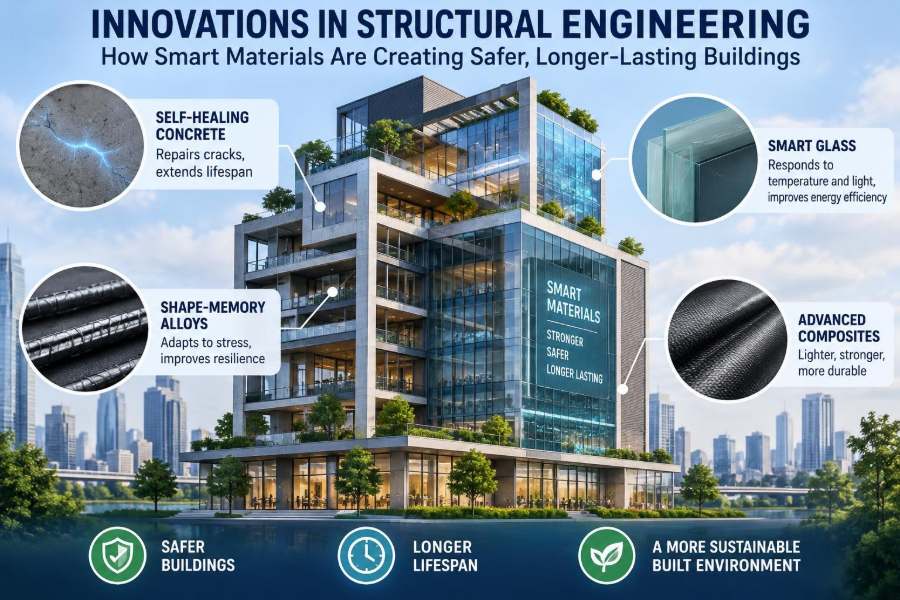

A bridge deck begins to crack long before it looks unsafe from the road. A reinforced-concrete car park may be quietly losing steel section beneath a stained soffit. A high-rise can experience thousands of small movements from wind, temperature, occupancy, and settlement without any of them being obvious to the people inside.
Traditionally, structural engineers address these realities through conservative design, inspections, maintenance, and repair. Those safeguards remain essential. But materials are beginning to take on a more active role: detecting damage, responding to heat, limiting vibration, sealing small cracks, or revealing changes that would otherwise remain hidden.
These are broadly known as smart materials. The term can sound futuristic, yet many applications build on familiar engineering principles: movement, heat transfer, electrical resistance, chemical reactions, and material phase change.
The opportunity is not to make buildings “think” like people. It is to create structures that give engineers better information and, in selected cases, respond in useful ways before minor deterioration becomes a costly or dangerous defect.
For students, this field connects mechanics, materials science, construction, and asset management. For practitioners, it raises a practical question: where does a new material genuinely improve performance, and where does a simpler, well-detailed conventional solution remain the better choice?
🧠 What Makes a Material “Smart”?
A smart material has a property that changes in a useful, predictable way when exposed to an external stimulus. That stimulus may be stress, strain, temperature, moisture, electric current, magnetic field, or light.
In structural engineering, the useful change is usually one of two things: a signal that helps identify the condition of a structure, or a response that improves its behaviour. Some materials do both when combined with sensing and control systems.
A conventional steel beam is not unintelligent; it performs extremely reliably within its design assumptions. A smart-material system adds the ability to observe or modify behaviour, rather than merely resist loads passively.
🏢 Why Conventional Structures Need Better Feedback
Most structures are assessed at intervals. Inspectors examine accessible surfaces, review drawings, identify cracks and corrosion, and decide whether more investigation is needed. This approach is valuable, but it cannot continuously observe every critical location.
Damage is also often hidden. Corrosion can start inside concrete, fatigue can initiate at a welded connection, and moisture can collect behind a façade system before visible staining appears.
Smart sensing does not remove the need for inspection. It can help engineers direct inspections toward locations where the data suggests an unusual change, reducing uncertainty and improving the timing of intervention.
📏 The Difference Between Monitoring and Control
Not every smart-material application actively changes a structure. Monitoring materials measure or indicate condition, while control materials apply a physical response.
A fiber-optic sensor embedded in a bridge element is primarily a monitoring tool. A shape-memory alloy brace that changes its deformation behaviour during seismic movement is an active or semi-active structural component.
Keeping this distinction clear matters during design. Monitoring produces data that must be interpreted; control changes force, stiffness, damping, or geometry and therefore requires careful integration into the structural model.
🔌 Piezoelectric Materials: Turning Movement into Signals
Piezoelectric materials produce an electrical charge when mechanically strained. In the reverse effect, they deform slightly when an electrical voltage is applied. This electromechanical relationship makes them useful in sensors and vibration-control devices.
Piezoelectric ceramics can be attached to or embedded near structural elements. When a beam vibrates or a crack changes local stiffness, the electrical response can provide information about that behaviour.
They are particularly useful for detecting relatively high-frequency changes, such as impacts or local vibration patterns. However, installation details, cable protection, calibration, and long-term durability often determine whether a promising laboratory application succeeds in the field.
🌉 Vibration Control in Bridges and Floors
Slender pedestrian bridges, long-span floors, towers, and lightweight roofs may be structurally adequate yet uncomfortable because of vibration. Human walking, machinery, wind, or traffic can excite motions that occupants notice.
Piezoelectric systems may be configured to sense vibration and, through a control circuit, counter part of the motion. The mechanism is subtle: it does not make a bridge rigid, but it can add damping or alter dynamic response in specific conditions.
For many projects, conventional tuned mass dampers, added stiffness, or altered geometry remain more practical. Smart systems are most compelling when space, weight, adjustability, or real-time response creates a clear advantage.
🧲 Shape-Memory Alloys and Recoverable Deformation
Shape-memory alloys, commonly including nickel-titanium alloys, can undergo large strains and then recover much of their original shape under appropriate loading and temperature conditions. Their behaviour differs significantly from ordinary reinforcing steel.
In seismic design, this recoverability is attractive because an element may dissipate energy and help reduce permanent displacement after an earthquake. Lower residual drift can make a building easier to repair and reoccupy.
That does not mean shape-memory alloys automatically replace steel. Their cost, connection detailing, temperature sensitivity, manufacturing availability, and design methodology must all be evaluated for the intended application.
🌍 Seismic Resilience Is More Than Preventing Collapse
A code-compliant building is generally designed around life safety objectives, not necessarily immediate post-earthquake functionality. Significant damage can still require demolition, repair, or long closures even when collapse is prevented.
Smart materials support a broader goal called resilience: limiting damage, retaining critical functions, and enabling faster recovery. Hospitals, emergency facilities, transport hubs, and data centres may place particular value on this outcome.
For example, a self-centring brace using specialized materials can be designed to encourage the frame to return closer to its original position. Its effectiveness depends on the entire load path, not only the brace itself.
🩹 Self-Healing Concrete: What It Can Actually Repair
Concrete is strong in compression but naturally prone to cracking. Fine cracks are not always structurally alarming, but they can allow water, chlorides, and other harmful agents to reach embedded reinforcement.
Self-healing concrete aims to close or seal small cracks through mechanisms such as continued hydration, mineral-forming additives, encapsulated repair agents, or biological processes involving dormant bacteria and nutrients.
The phrase can be misleading if taken too literally. These systems are generally intended for limited crack widths and durability improvement, not for restoring a severely damaged column, repairing major settlement, or replacing structural assessment.
💧 Autogenous Healing in Ordinary Concrete
Even conventional concrete can display some natural crack sealing. Unhydrated cement particles may react with water, and calcium carbonate can form in cracks under suitable wet conditions.
This is called autogenous healing. It is most relevant to fine cracks and favourable exposure conditions, and it varies substantially with mix design, crack movement, age, and available moisture.
Engineers should not rely on it as a universal repair strategy. Still, understanding it helps explain why some self-healing technologies seek to enhance processes that already occur to a limited extent.
🦠 Bacteria-Based Concrete and Mineral Formation
Some self-healing approaches incorporate bacterial spores and a nutrient source into the concrete or into protected capsules. When water enters a crack, the system may promote mineral precipitation that helps seal the pathway.
The engineering interest is primarily durability: reducing water ingress can slow reinforcement corrosion and extend the useful interval before repair. Performance depends on compatibility with the concrete matrix and the exposure environment.
Real projects require careful specification. Questions include whether the healing agent survives mixing, whether capsules affect strength or workability, and whether the anticipated cracks are within the system’s practical capability.
🧪 Encapsulated Repair Agents
Another method places small capsules containing a repair agent within a cementitious material or coating. When a crack ruptures a capsule, the released material can react, cure, or fill part of the damaged zone.
The concept resembles a puncture-sealing coating, but structural concrete presents a harsher challenge. Capsules must survive batching and placement, break when needed, and release enough material without reducing the host material’s required performance.
These systems may be especially relevant to protective layers, grouts, coatings, and components where a local barrier against moisture is as valuable as recovery of mechanical capacity.
⚙️ Fiber-Reinforced Polymers as Adaptive Retrofit Tools
Fiber-reinforced polymer, or FRP, is a composite made from strong fibers in a polymer matrix. Carbon, glass, basalt, and aramid fibers are common examples. FRP itself is not always “smart,” but it often becomes part of smart retrofit systems.
FRP wraps can confine concrete columns, plates can strengthen beams, and strips can improve flexural or shear capacity. Embedded or bonded sensors can then track strain, debonding risk, temperature, or moisture near the retrofit.
This pairing is useful because retrofit design is often constrained by access, added weight, and disruption. Yet FRP requires attention to fire exposure, ultraviolet protection, adhesive performance, and the possibility of brittle or debonding failure modes.
🧵 Fiber-Optic Sensors Inside Structural Members
Fiber-optic sensors transmit light through very thin optical fibers. Changes in strain or temperature alter characteristics of the light signal, allowing measurement along a point or, in some systems, over a distributed length.
Unlike electrical sensors, optical fibers are not affected by electromagnetic interference. They can be attractive around high-voltage equipment, rail systems, or locations where many measurements are needed along a long element.
When embedded in concrete, the sensor must be protected during construction and its location documented precisely. A sensor that survives but cannot be related confidently to the structural geometry has limited value.
🗺️ Distributed Sensing and the Value of a Continuous Picture
A conventional strain gauge reports conditions at a specific point. Distributed fiber-optic sensing can provide measurements at many positions along a fiber, creating a more continuous picture of strain or temperature.
Consider a long bridge girder. Rather than asking only whether one critical gauge has changed, an engineer may examine how the strain profile varies along the span and whether the pattern still matches expected load behaviour.
This does not eliminate interpretation challenges. Temperature effects, installation strain, sensor drift, and construction-stage data all need to be separated from meaningful structural change.
📡 Wireless Sensors and Structural Health Monitoring
A structural health monitoring system combines sensors, data transmission, storage, and interpretation. Wireless sensor networks can reduce the need for extensive cabling, particularly in existing structures where routing cables is difficult.
Accelerometers, corrosion sensors, displacement sensors, and strain sensors can work alongside smart materials. The “smart” outcome comes from the system’s ability to collect useful evidence over time.
Power supply is a central constraint. Batteries require replacement, energy harvesting may be intermittent, and wireless signals can be obstructed by concrete, steel, or distance. A maintenance plan is therefore part of the engineering design, not an afterthought.
🔋 Energy Harvesting: Useful but Usually Modest
Some smart-material systems can convert vibration, solar energy, thermal differences, or mechanical movement into small amounts of electrical power. This is called energy harvesting.
For a remote sensor with very low energy demand, harvested energy may help extend operating life or reduce battery dependence. It is generally not a realistic substitute for grid power in high-demand building systems.
The practical question is simple: does the energy source remain available when data is most needed? A vibration-powered sensor, for example, may generate less power precisely when a bridge is quiet.
🌡️ Phase-Change Materials for Temperature Stability
Phase-change materials, or PCMs, absorb or release substantial heat when changing phase, often between solid and liquid. In buildings, they can be incorporated into wallboards, plasters, ceiling systems, or envelopes to moderate indoor temperature swings.
When the material melts, it absorbs heat; when it solidifies, it releases heat. The effect can shift thermal loads and improve comfort when the phase-change temperature aligns with the building’s operating conditions.
PCMs are primarily an envelope and building-physics technology rather than a load-bearing structural material. Their performance depends on climate, ventilation, encapsulation, cycling durability, and whether the material can fully reset overnight.
🔥 Fire Performance Cannot Be Assumed
New materials must be assessed under fire conditions, not judged only by room-temperature strength. Polymers can soften, adhesives can lose bond, protective layers can degrade, and certain composite systems require carefully designed fire protection.
Similarly, a sensing system may be useful during normal service but fail during a severe fire. That may be acceptable if it is not intended for post-fire diagnosis, but the limitation must be explicit.
Material innovation does not bypass fire engineering. It expands the number of interfaces—material, coating, connection, insulation, and sensor—that need coordinated review.
🛡️ Corrosion-Sensing Materials and Reinforcement Protection
Reinforced concrete durability is often governed by corrosion. Chlorides, carbonation, moisture, oxygen availability, cracking, and poor detailing can combine to create conditions where reinforcing steel loses section and surrounding concrete cracks or spalls.
Embedded corrosion sensors and electrically conductive materials can help identify changes associated with corrosion activity or moisture movement. Used well, they support targeted investigation before visible damage becomes extensive.
A sensor reading is not a corrosion-rate verdict on its own. Engineers need the exposure history, concrete resistivity, cover depth, chloride information, and inspection evidence to make a sound diagnosis.
🧱 Conductive Concrete and Self-Sensing Composites
Concrete can be modified with conductive fillers such as carbon-based materials to change its electrical properties. When strained or cracked, its electrical resistance may change, creating a possible self-sensing function.
The attraction is clear: the material becomes part of the sensor rather than relying entirely on discrete devices attached afterward. Potential applications include traffic monitoring, strain observation, heating surfaces, and damage indication.
Uniform dispersion is difficult, and electrical response can be influenced by moisture and temperature. The relationship between resistance change and structural condition must be established for the specific mix and application, not assumed from a generic description.
🌬️ Responsive Façades and Structural Interfaces
Smart materials also appear at the boundary between building structure and environment. Thermochromic glazing changes optical properties with temperature, while electrochromic glazing changes tint in response to electrical control.
These systems can reduce glare and solar heat gain, influencing cooling loads and occupant comfort. They do not usually carry primary structural loads, but their support frames, seals, wiring, maintenance access, and failure states are structural coordination issues.
A responsive façade is only as reliable as its interfaces. Water management, differential movement, replacement strategy, and safe behaviour during power loss deserve as much attention as the glazing technology itself.
📊 Data Is Not the Same as Understanding
Smart structures can generate large volumes of readings. More data does not automatically mean better decisions; it can create false alarms, missed anomalies, or confusion if baseline behaviour is poorly understood.
A strong monitoring plan defines what will be measured, why it matters, what range is expected, who reviews the information, and what action follows an alert. This is often more valuable than adding another sensor type.
For instance, an increase in measured strain may reflect heavier occupancy, seasonal temperature movement, sensor drift, or actual stiffness loss. Context turns measurement into engineering judgment.
🧮 Establishing a Baseline Before Calling Something Damage
Every structure has normal variation. A bridge expands and contracts, a tower sways in wind, and a concrete slab creeps and shrinks over time. Without a baseline, normal behaviour can be mistaken for deterioration.
Baseline data should ideally begin during construction or commissioning and capture different seasons, load conditions, and operational states. Design predictions provide a starting point, but measured behaviour often reveals effects that simplified models do not fully represent.
Thresholds should not be treated as universal alarm numbers. They need to reflect the structure, sensor accuracy, uncertainty, and the consequence of missing a genuine problem.
🏗️ Designing for Installation, Not Just Performance
A smart material that is difficult to install consistently may create more risk than value. Sensors can be crushed during reinforcement placement, fibers can be bent beyond their tolerance, and bonded devices can detach if surface preparation is poor.
Designers should specify installation sequence, protection measures, test procedures, cable routes, labeling, and acceptance criteria. Mock-ups are especially helpful when the system is new to the project team.
The construction team needs a clear reason for each component. When installers understand that a conduit protects a monitoring line needed for long-term bridge assessment, they are more likely to treat it as critical work rather than incidental hardware.
🔩 Connections Often Govern Real-World Reliability
Advanced material behaviour is frequently studied in a specimen, while project failures occur at joints, anchors, terminations, seals, and transitions. The connection between a smart component and conventional structure must transfer force and preserve the intended signal or response.
A shape-memory device may perform well in tension but depend on anchorage details that introduce slip. An FRP sensor package may work in principle but be compromised by an exposed connector vulnerable to moisture.
Good detailing asks two questions: how does the load travel, and how does the information travel? Both paths require protection and inspection access.
💰 Whole-Life Value Versus First Cost
Smart materials can have a higher initial cost than standard alternatives. Their value may lie in avoided disruption, better maintenance timing, improved post-event assessment, lower repair scope, or greater resilience.
That value is highly project-specific. Continuous monitoring may be justified for a difficult-to-access bridge or a critical hospital, while periodic visual inspection may remain appropriate for a simple, accessible, low-consequence structure.
Whole-life assessment should include procurement, installation, commissioning, software, calibration, replacement parts, training, cybersecurity where relevant, and eventual decommissioning. A low-cost sensor that cannot be maintained is not necessarily economical.
⚠️ Common Mistakes When Specifying Smart Materials
Innovation often fails through ordinary project-management gaps rather than exotic science. Teams can avoid many problems by recognizing common patterns early.
- Choosing technology before defining the decision: specify the maintenance or safety question first, then select the measurement method.
- Assuming laboratory results transfer directly: field exposure, workmanship, temperature cycles, and access conditions can alter performance.
- Ignoring false positives and missing data: sensors require validation, redundancy where warranted, and a response procedure.
- Treating monitoring as a substitute for capacity: detection does not strengthen an inadequate structure.
- Forgetting ownership: someone must be responsible for reviewing data and authorizing action throughout the asset life.
📋 A Practical Selection Framework
Before adopting a smart material, work through the engineering problem in a disciplined sequence. The goal is not to use the most novel system; it is to choose a proportionate and maintainable solution.
- Define the hazard, performance objective, and consequences of failure.
- Identify whether the need is sensing, protection, control, repair, or a combination.
- Compare conventional and smart alternatives under the expected environment and loading.
- Assess constructability, interfaces, inspection access, and operational support.
- Specify verification testing and the decision process for abnormal results.
- Review the whole-life plan, including replacement and data stewardship.
This framework keeps material selection connected to structural responsibility rather than novelty.
🎓 Skills Structural Engineers Need to Build
Working with smart materials requires more than selecting products. Engineers benefit from a working knowledge of material behaviour, sensors, basic signal interpretation, durability, construction sequencing, and risk-based maintenance.
Students can start by linking theory to observable behaviour: how strain changes resistance, why temperature affects measurements, how a crack redirects stress, and why connection stiffness matters. Simple laboratory tests and careful documentation build useful intuition.
Professionals do not need to become software developers or chemists, but interdisciplinary communication is increasingly valuable. The best outcomes often come from structural engineers, materials specialists, architects, contractors, and asset owners defining requirements together.
🔮 Where Smart Materials Fit in the Future of Construction
Smart materials are likely to become more common first in places where their benefit is easiest to justify: critical infrastructure, high-value assets, hard-to-access components, extreme environments, and projects with strong resilience targets.
Wider adoption will depend on reliable field performance, clearer design guidance, practical installation methods, interoperable data systems, and evidence gathered over long service periods. Not every promising technology will become routine practice.
The most credible future is not a building filled with gadgets. It is a building where selected materials and sensors address specific failure mechanisms, improve decisions, and work alongside sound structural fundamentals.
🏁 The Core Principle: Smarter Materials Need Smarter Engineering
Smart materials can help structures sense strain, moderate heat, seal small cracks, resist corrosion-related deterioration, reduce vibration, and recover more effectively after extreme loading. These capabilities can improve safety, serviceability, durability, and maintenance planning when they match a real project need.
They do not cancel uncertainty, replace inspection, or compensate for poor load paths, inadequate detailing, weak construction control, or neglected maintenance. In many cases, conventional materials used with excellent design and workmanship remain the strongest option.
The central lesson is to treat smart materials as part of a complete structural system: define the performance objective, understand the mechanism, design the interfaces, verify installation, and plan for the full operating life.
Safer, longer-lasting buildings will come not from materials alone, but from using material innovation with the same judgment, rigor, and responsibility that good structural engineering has always required. 🏗️🔍🌱