
Concrete is one of the most widely used construction materials in the world. It forms bridges, buildings, parking structures, railway sleepers, tanks, stadiums, and countless other structures. Concrete is excellent at carrying compressive forces, but it has an important weakness: it is much less effective at resisting tension. 🧱⚖️
This difference becomes a major engineering challenge when concrete beams, slabs, and bridge girders bend under heavy loads. Bending creates compression on one side of a structural member and tension on the other. If the tensile stress becomes too high, ordinary concrete begins to crack.
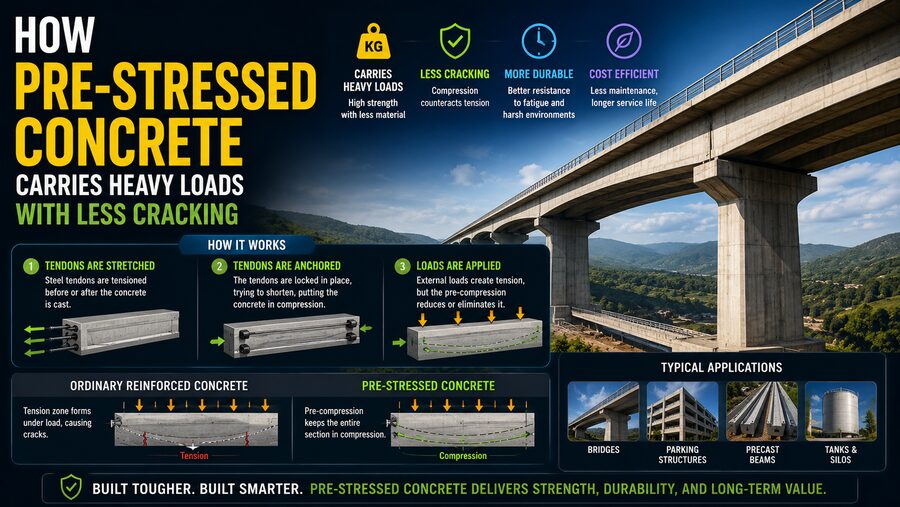
Pre-stressed concrete solves this problem by deliberately placing the concrete into compression before it carries its full service load.
High-strength steel tendons are tensioned so that they squeeze the concrete. Later, when traffic, people, equipment, or the structure’s own weight create tensile stresses, those stresses first have to overcome the pre-existing compression.
The result is a structural system that can carry heavier loads, span greater distances, use thinner sections, and develop fewer service cracks than comparable conventional reinforced-concrete members. 🏗️💪
🧱 Why Ordinary Concrete Cracks Under Tension
Concrete performs extremely well when squeezed.
This is known as compression.
If a concrete column carries a building load, much of the material is compressed vertically. Concrete is naturally suited to this type of force.
But when concrete is pulled apart, it is much weaker.
This is called tension.
A concrete beam supported at both ends illustrates the problem clearly.
When a downward load is placed on the beam, it bends slightly.
Typically:
- the upper part of the beam experiences compression,
- the lower part experiences tension.
If the tensile stress at the bottom exceeds the concrete’s tensile capacity, cracks begin to form.
Conventional reinforced concrete solves this partly by adding steel reinforcement bars. The concrete carries much of the compression, while the steel reinforcement carries tension after cracking occurs.
Pre-stressed concrete takes the concept further by trying to reduce or delay the development of tensile stress in the concrete itself.
⚙️ What Does “Pre-Stressed” Mean?
The term pre-stressed means that engineers intentionally introduce internal stresses into the structure before normal service loads are applied.
In most cases, steel tendons are stretched under high tension.
These tendons may consist of:
- high-strength steel wires,
- steel strands,
- high-strength bars.
The stretched steel attempts to return to its original length.
Because it is attached to or anchored against the concrete, it compresses the concrete member. 🔩➡️🧱
This produces a built-in compressive stress.
The structure therefore begins its working life already compressed.
When external loads later create tensile stresses, the tensile forces must first reduce this existing compression before the concrete experiences significant net tension.
🧠 The Basic Principle
Imagine a beam that would normally develop a tensile stress of 8 units under load.
If the concrete begins with no pre-stress:
Applied tensile stress = 8
The concrete directly experiences those 8 units of tension.
Now imagine prestressing introduces 6 units of compression before the load is applied.
Under the same external load:
Initial compression = 6
Applied tension = 8
The approximate resulting stress becomes:
8 tension − 6 compression = 2 tension
Instead of experiencing 8 units of tension, the concrete experiences only about 2.
Depending on the design, engineers may even arrange the prestress so the concrete remains entirely in compression under normal operating loads. 🎯
This is the central reason pre-stressed concrete cracks less.
🏋️ Why Reducing Tension Allows Heavier Loads
Because cracking is closely related to tensile stress, reducing tension allows the concrete cross-section to be used more efficiently.
A prestressed member can often carry greater loads before reaching critical cracking or deflection limits.
This gives engineers several possible advantages:
- larger structural spans,
- higher allowable loads,
- thinner beams and slabs,
- reduced structural weight,
- improved crack control,
- greater stiffness in service.
These benefits are particularly valuable in bridges, long-span roofs, floor systems, and precast construction.
🔩 Pre-Tensioning: Stressing the Steel Before Casting
There are two major methods of prestressing concrete.
The first is pre-tensioning.
In pre-tensioning, the steel tendons are stretched before the concrete is cast.
A simplified process is:
- High-strength steel tendons are stretched between strong anchor points.
- Concrete is poured around the tensioned steel.
- The concrete is allowed to harden and gain sufficient strength.
- The steel tendons are released.
- The steel tries to shorten.
- Bond between the steel and concrete transfers compression into the concrete.
🔩➡️🧱
Pre-tensioning is commonly performed in specialized precast factories.
Products made this way can include:
- bridge beams,
- floor planks,
- railway sleepers,
- piles,
- poles,
- roof members.
Factory production allows good control over concrete quality, tendon placement, curing, and prestressing force.
🏗️ Post-Tensioning: Stressing the Steel After Concrete Hardens
The second major method is post-tensioning.
In post-tensioned concrete, the concrete is cast first.
Ducts, sleeves, or sheaths are positioned within the member so that steel tendons can run through them.
After the concrete has gained enough strength, hydraulic jacks pull the tendons into tension.
The tendons are then anchored at the ends of the member.
The steel attempts to contract, and the anchors transfer compressive force into the concrete. ⚙️
Post-tensioning is widely used in:
- bridges,
- parking garages,
- high-rise floors,
- large slabs,
- tanks,
- complex cast-in-place structures.
It is particularly useful when the structure is too large to manufacture and transport as a single precast element.
📐 Why Tendons Are Often Curved
Prestressing tendons are not always placed in a straight line.
In many beams, they follow a curved or draped profile.
This is intentional.
A simply supported beam under downward load tends to bend downward most strongly near the middle of its span.
Engineers can position the tendon lower in the middle of the beam and higher near the supports.
When tension is applied, this tendon geometry creates forces that oppose the beam’s natural bending under gravity loads.
In simplified terms:
External load tries to bend beam downward.
Prestressing force helps counteract that bending.
This improves structural efficiency and controls deflection. 📐⬆️
↗️ Prestressing Can Create an Upward Camber
Before a prestressed beam is placed under full service load, it may curve slightly upward.
This upward curvature is called camber.
Why does it happen?
The prestressing tendon is often located below the beam’s centerline near midspan.
When the tendon compresses the concrete, it creates a bending effect that can lift the middle of the beam.
Later, the beam’s own weight and external loads pull it downward.
Ideally, the prestressing camber and the service-load deflection are balanced so the beam remains relatively level during use. ⚖️
This is another way prestressing helps manage structural deformation.
🚧 How Prestressing Controls Cracks
Cracks in concrete are not always signs of structural failure.
Conventional reinforced concrete is often designed to permit controlled cracking in tension zones.
However, excessive cracking can create several problems:
- reduced durability,
- water penetration,
- corrosion risk,
- appearance concerns,
- leakage in tanks,
- increased deflection.
Prestressing reduces crack formation by keeping the concrete under compression for much of its normal operating range.
In some designs, cracking is intended to be prevented under normal service conditions.
In others, small tensile stresses may be allowed, but crack widths remain tightly controlled.
This makes prestressed concrete particularly useful where watertightness or long-term durability is important. 💧🛡️
🌉 Why Prestressed Concrete Is Ideal for Bridges
Bridges are one of the most recognizable applications of prestressed concrete.
Bridge beams must carry:
- their own weight,
- deck weight,
- vehicle loads,
- impact effects,
- environmental loads.
Longer spans create greater bending moments.
If ordinary reinforced concrete were used for very long beams, the members could become extremely deep and heavy.
Prestressing allows engineers to design longer, slimmer girders with better crack and deflection control.
This can reduce the number of bridge piers required. 🌉
Fewer supports can simplify construction over:
- highways,
- rivers,
- railway lines,
- valleys.
🏢 Prestressed Concrete in Buildings
Prestressing is also widely used in buildings.
Post-tensioned floor slabs are common in:
- office buildings,
- hotels,
- parking structures,
- residential towers,
- shopping centers.
A post-tensioned slab can often span farther between columns than a conventional slab of similar thickness.
This can provide:
- larger open floor plans,
- fewer columns,
- thinner floors,
- reduced overall building height,
- lower material quantities.
For architects and developers, this flexibility can be commercially valuable. 🏢📐
🪨 High-Strength Concrete Is Usually Required
Prestressed concrete typically uses relatively high-strength concrete.
This is necessary because prestressing introduces significant compression before service loads are applied.
The concrete must be strong enough to resist:
- concentrated anchorage forces,
- compressive stresses,
- handling loads,
- long-term effects.
High-quality concrete also improves durability and helps control deformation.
Prestressed members are therefore generally produced or constructed with tighter material and quality-control requirements than ordinary low-strength concrete elements.
🔩 Why High-Strength Steel Is Used
The steel used for prestressing is also different from ordinary reinforcing bars.
Prestressing steel must sustain very high tensile stresses.
High-strength strands are commonly used because they can be stretched significantly and still remain within safe operating limits.
This is important because some of the initial prestress is gradually lost over time.
Using high-strength steel ensures enough useful compression remains in the concrete after these losses occur.
📉 What Are Prestress Losses?
The force introduced during prestressing does not remain perfectly constant forever.
Several physical effects reduce it.
These are known as prestress losses.
Important causes include:
🧱 Concrete Creep
Concrete slowly deforms under sustained compression.
As it shortens, tendon tension may decrease.
💧 Concrete Shrinkage
Concrete can shrink as it loses moisture and undergoes long-term material changes.
This also reduces tendon strain.
🔩 Steel Relaxation
Prestressing steel under constant strain can gradually lose some stress over time.
⚙️ Anchorage Slip
In post-tensioning systems, small movements at anchors can reduce tendon force.
🔄 Friction
Curved post-tensioning ducts create friction between tendons and their surroundings.
This can reduce the effective prestressing force along the member.
Engineers calculate these expected losses when selecting the initial jacking force.
🧮 Structural Design Requires Careful Stress Calculations
Prestressed concrete must be checked at several stages.
Engineers may examine conditions:
- when prestress is first transferred,
- during transport,
- during construction,
- under normal service loads,
- under extreme design loads.
A member that is safe after installation might still be vulnerable during lifting or transport if the load pattern is different.
For this reason, prestressed design requires careful analysis of both temporary and permanent conditions. 📊
🧱 Prestressed vs. Reinforced Concrete
Prestressed and reinforced concrete both combine steel and concrete, but they use the materials differently.
Conventional Reinforced Concrete
Steel reinforcement remains relatively unstressed until the structure carries load.
Concrete may crack in tension, after which reinforcing steel carries much of the tensile force.
Prestressed Concrete
High-strength steel is deliberately tensioned in advance.
The resulting compression offsets some or all of the tensile stresses created by service loads.
This distinction leads to different structural behavior.
Prestressed concrete often provides better crack control and permits more efficient long-span designs.
📏 Smaller Sections Can Reduce Self-Weight
A major advantage of prestressing is material efficiency.
A deeper, heavier beam creates more dead load simply because it weighs more.
That extra self-weight must itself be supported.
By allowing thinner and lighter structural members, prestressing can reduce this self-weight.
This creates a beneficial cycle:
More efficient section → lower self-weight → lower structural demand → potentially smaller supporting members
This can reduce material use throughout a structure. 🏗️
🚆 Railway Sleepers Use Prestressing Too
Prestressed concrete railway sleepers are another common application.
Sleepers experience repeated wheel loads and must distribute forces into the track ballast.
Repeated bending could lead to cracking in ordinary concrete.
Prestressing helps keep the sleepers under favorable compressive stress and improves resistance to repeated loading.
It also provides excellent durability and dimensional stability.
This is why prestressed concrete sleepers are widely used in modern railway systems. 🚆
💧 Tanks and Liquid-Retaining Structures
Crack control is especially important in water tanks and other liquid-retaining structures.
Even structurally acceptable cracks can allow leakage.
Prestressing can compress walls or floors so that tensile stresses caused by internal fluid pressure are reduced.
Circular tanks may use circumferential prestressing around their walls.
The prestressing force helps counteract the outward pressure produced by the stored liquid.
This can improve watertightness and durability. 💧
🛡️ Durability Benefits of Reduced Cracking
Concrete protects embedded steel by providing physical cover and a chemically protective environment.
However, cracks can create pathways for:
- water,
- chlorides,
- carbon dioxide,
- other aggressive substances.
If these materials reach the steel, corrosion risk may increase.
By reducing crack widths, prestressed concrete can improve durability in demanding environments such as bridges, coastal infrastructure, and parking structures exposed to deicing salts. 🌊🛡️
Proper detailing and construction quality are still essential.
⚠️ Prestressed Concrete Also Has Challenges
Prestressed concrete offers major advantages, but it is more complex than ordinary reinforced concrete.
Challenges include:
- specialized design,
- high-strength materials,
- precision tendon placement,
- specialized jacking equipment,
- trained workers,
- strict quality control,
- careful anchorage detailing.
Post-tensioning tendons and anchors must also be protected from corrosion.
Failures involving prestressing steel can be serious because tendons carry large forces.
Inspection and maintenance procedures therefore matter greatly.
💰 Is Prestressed Concrete More Expensive?
Prestressed concrete may have higher initial engineering and construction costs than simple reinforced concrete.
However, overall project economics can favor prestressing when it enables:
- longer spans,
- fewer columns,
- fewer bridge piers,
- thinner slabs,
- lower material quantities,
- repetitive precast production,
- faster installation.
A project should therefore be evaluated based on total structural and construction cost rather than only the price of the prestressing system itself.
For large or repetitive structures, the economic benefits can be substantial. 💰
🔬 Prestressing Is a Form of Structural “Preloading”
A useful way to think about prestressing is as deliberate preloading.
Engineers know that external loads will create harmful tensile stresses.
So before those loads arrive, they create an opposite stress.
The prestressing force is not simply extra strength added afterward.
It changes how the structure begins its life.
Instead of starting at zero internal stress and then moving directly into tension, critical concrete zones may start in compression and move toward zero as external loads increase.
That gives the structure much more usable capacity before cracking begins. 🧠
🏗️ A Simple Beam Example
Consider a concrete bridge girder.
Without prestressing:
Beam self-weight + traffic → downward bending → tension at bottom → cracking
With prestressing:
Prestressing tendons → compression + upward bending effect
Then:
Beam self-weight + traffic → reduces prestress effect
The two actions partly oppose each other.
The final stress state is therefore much more favorable than in an equivalent plain or lightly reinforced concrete beam.
This is why prestressed girders can carry enormous loads while remaining relatively slender.
🌍 Why Prestressed Concrete Matters in Modern Infrastructure
Modern infrastructure demands structures that are:
- strong,
- durable,
- economical,
- space-efficient,
- capable of long spans.
Prestressed concrete addresses all of these goals by making much better use of concrete’s natural strength in compression.
Rather than waiting for cracks to form and relying entirely on reinforcement afterward, prestressing changes the initial stress condition so tensile stresses are reduced before they become damaging.
This allows engineers to create long bridge girders, wide building floors, durable railway components, storage tanks, and many other high-performance structures. 🌉🏢🚆
🧠 Compression Before Load, Fewer Cracks Afterward
The fundamental idea behind prestressed concrete is surprisingly simple.
Concrete dislikes tension but performs exceptionally well in compression.
Engineers therefore use high-strength steel tendons to compress the concrete before external loads place it in tension.
When service loads arrive, they first reduce that built-in compression. Only after enough loading occurs does significant tensile stress develop.
That is why prestressed concrete can carry heavy loads with less cracking.
Pre-tensioning applies the tendon force before concrete is cast, while post-tensioning applies it after the concrete has hardened. In both cases, the goal is similar: create a favorable internal stress pattern before the structure begins normal service.
The central engineering principle can be summarized as:
Instead of allowing heavy loads to immediately pull concrete apart, prestressing squeezes the concrete first—so the structure has a reserve of compression that counteracts future tension. 🏗️🔩➡️🧱💪
This clever use of opposing forces is what allows prestressed concrete to build longer, thinner, stronger, and more crack-resistant structures throughout the modern world.