
A fire in a building is first an emergency for the people inside it. Once evacuation and firefighting are under way, however, another urgent question emerges: can the structure still safely stand?
That question is not answered by looking at whether a building is made of “non-combustible” materials. Steel does not burn like timber, and concrete will not fuel a fire, but both can be seriously damaged by heat. Their strength, stiffness, geometry, and connections can all change while the fire is still burning.
For students, this is a useful reminder that structural design is about more than carrying gravity loads on a calm day. For practicing engineers, it explains why fire protection, compartmentation, inspection, and repair decisions must be integrated with the structural system from the beginning.
An intense fire is a rapidly changing thermal and structural event. Understanding how heat moves through a building—and how materials respond to it—makes post-fire damage less mysterious and helps prevent dangerous assumptions.
🔥 Fire is a structural load
Engineers normally think of loads as forces: people, furniture, snow, wind, earthquakes, and the self-weight of a building. Fire is different, but it is still a design action because it changes material properties and creates deformations that generate forces.
Heating can reduce strength and stiffness, cause members to expand, weaken connections, and crack protective materials. A member that was adequate at room temperature may therefore become inadequate even if the applied gravity load has not changed.
Fire resistance is not the same thing as being non-combustible. It describes how long an assembly can perform a required function, such as maintaining load-bearing capacity, integrity, or insulation, under a specified fire exposure.
🌡️ Why an intense fire heats structures unevenly
Heat reaches structural elements through radiation from flames and hot surfaces, convection from hot gases, and conduction within the material itself. Radiation can be particularly severe where flames directly impinge on a member or where hot smoke layers form beneath a ceiling.
Temperatures are rarely uniform across a room. A beam close to the ceiling may see hotter gases than a column lower in the compartment. One side of a column may face flames while the other is shielded by a wall, producing uneven expansion and bending.
The fire also evolves with available fuel, ventilation, compartment geometry, and firefighting. This is why real building fires do not necessarily follow a single idealized temperature curve.
🧭 The stages of a compartment fire
A simplified compartment fire often begins with ignition and growth, followed by a fully developed period and then decay as fuel is consumed or suppressed. During growth, a localized plume may heat only part of the structure.
Flashover is a transition in which radiation from hot gases and surfaces can cause widespread ignition of combustible contents. After flashover, the compartment may expose many structural elements to high temperatures at once.
In a ventilation-controlled fire, limited oxygen may restrict burning while leaving unburned fuel gases present. Introducing air—for example through a failed opening or changed ventilation—can alter conditions abruptly. Engineers assessing damage need evidence of the actual fire, not only an assumed peak temperature.
📈 Temperature, time, and heating rate all matter
It is tempting to ask for one “critical temperature” for steel or concrete. In practice, performance depends on the temperature history: how hot the material became, how quickly it heated, how long it stayed hot, and how it cooled.
Rapid heating can create steep temperature gradients. These gradients matter because adjacent parts of a member try to expand by different amounts. Long-duration heating can allow heat to penetrate deeper, affecting larger portions of a section.
Standard furnace tests provide a common basis for classification, but a real fire may be shorter, longer, more localized, or affected by openings and fuel distribution. The test rating remains valuable, yet it is not a complete reconstruction of every fire scenario.
🔩 Why steel loses stiffness before it visibly fails
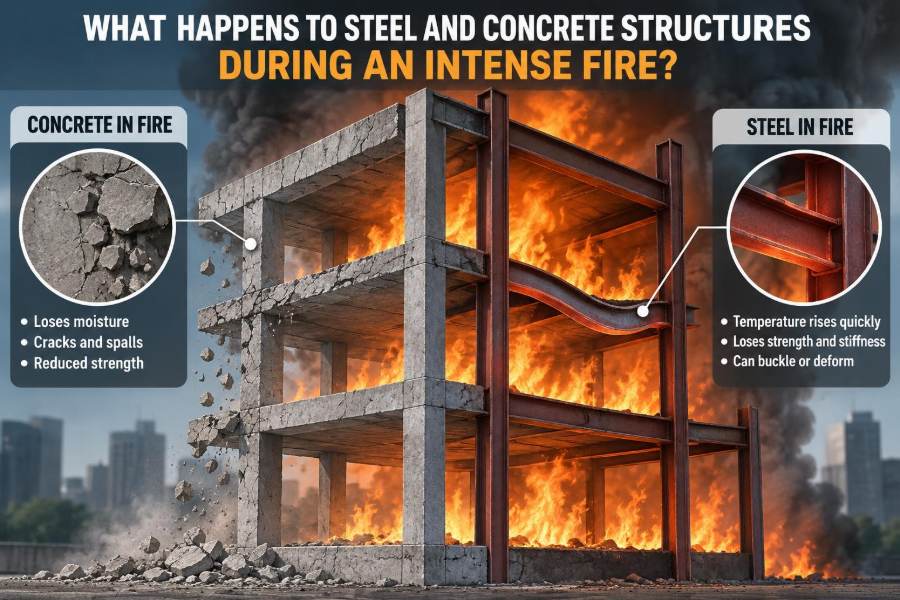
Steel is strong and ductile at ordinary temperatures, but its mechanical properties are temperature-dependent. As it heats, both yield strength and elastic modulus decrease. The reduction in elastic modulus means a member becomes more flexible before it necessarily reaches its reduced yield strength.
That loss of stiffness can be structurally significant. A heated beam may deflect substantially under a load that caused only a modest room-temperature deflection. Large deflection can pull on connections, damage partitions, or redistribute load to adjacent members.
Steel’s high thermal conductivity helps heat move through exposed thin sections relatively quickly. An unprotected light steel member can therefore heat much faster than a massive concrete member under the same exposure.
📐 Expansion can create forces as well as movement
Steel expands when heated. If a beam is free to move, thermal expansion may mainly appear as increased length and sagging. If its ends are restrained by cooler structure, walls, bracing, or neighboring framing, expansion generates compressive forces.
Those compressive forces can cause a beam to buckle or push columns and connections out of alignment. As the beam later cools, it contracts and may develop tension, potentially pulling on supports or connections in a different direction.
A useful analogy is a tightly fitted metal lid warmed under hot water: it wants to grow. In a structural frame, the consequences are far greater because the restraint comes from load-bearing components.
↩️ Beam deflection and catenary action
A heated steel beam commonly sags because stiffness falls, gravity loads remain, and thermal gradients introduce curvature. The beam’s response can change as deflection grows.
If connections and supports can sustain the required forces, a deeply deflected beam may develop catenary action. Instead of resisting load mainly through bending, it carries part of the load through tension along its length, similar to a cable.
Catenary action is not automatically beneficial. It can impose large horizontal pulling forces on columns and connections during cooling. Designers must consider the complete system and connection behavior; relying on an unverified alternate load path is unsafe.
🧱 Columns face a different stability problem
Columns must continue carrying axial load while their strength and stiffness decrease. A steel column that heats uniformly can lose capacity through material softening, but uneven heating adds bending from thermal curvature.
Slender columns are especially sensitive because buckling capacity depends strongly on stiffness. Heating can turn a stable compression member into a buckling-prone one without any obvious fracture.
Column protection is therefore often treated with particular care. Loss of a primary column can affect multiple floors or bays, whereas the failure of a secondary element may have a more localized consequence—though every case depends on the structural arrangement.
🔗 Connections are often the hidden weak point
Connections transfer force between members, and they experience the same temperature-driven property reductions as the members they join. Bolts, welds, plates, end connections, and composite shear connectors must all be considered.
Connection behavior is complicated by different thicknesses and exposure conditions. A thin plate may heat faster than a large supporting member. Bolts may see localized heating, while restrained beam movement can introduce forces not considered in a simple ambient-temperature connection check.
After a fire, engineers should not assume a connection is sound because it remains attached. Distortion, damaged bolts, fractured welds, lost bearing, and altered fit-up can all reduce reliability.
🛡️ How fire protection buys time for steel
Spray-applied fire-resistive material, board encasement, intumescent coatings, concrete encasement, and protected ceilings are common ways to delay heating of structural steel. Their purpose is not to make steel immune to fire; it is to keep the steel temperature low enough for the required duration.
The quality of installation matters greatly. Gaps, insufficient thickness, impact damage, moisture damage, and unprotected connection regions can create vulnerable locations. A protection system also needs to remain compatible with inspection, corrosion control, and later building alterations.
Intumescent coatings are often selected where the appearance of exposed steel is desired. Under heat they expand into an insulating char, but their specified thickness, substrate preparation, and approved application details are essential to performance.
🏢 Composite floors behave as systems
Many buildings use steel beams supporting concrete slabs, often on profiled metal deck. These composite systems can perform differently from isolated steel beams because the slab, reinforcement, deck, beams, and connections interact.
A concrete slab may shield the top flange of a beam, while the lower flange remains exposed. Reinforcement can provide membrane action in a deflecting slab if it is continuous and adequately anchored, but cracking, support conditions, and connection behavior influence whether this mechanism can develop.
System behavior can provide redundancy, yet it must be demonstrated by appropriate design methods. It should not be assumed from the presence of a slab alone.
🪨 Concrete does not burn, but heat changes it
Concrete is usually described as non-combustible, which is true in the sense that it does not act as fuel. But it is a composite material containing cement paste, aggregate, pores, moisture, and often reinforcement, all of which respond to high temperature.
Heating reduces concrete strength and stiffness, particularly near heated surfaces. It can also create cracking from thermal gradients and from incompatible movement between paste and aggregate.
Because concrete has relatively low thermal conductivity and substantial mass, its interior may remain much cooler than its surface during a short fire. This thermal inertia can be helpful, but it can also conceal damage concentrated near the exposed face.
💨 Moisture and the risk of concrete spalling
Concrete contains water in its pores even when it appears dry. During rapid heating, liquid water and water vapor move through the pore structure. If pressure builds faster than it can dissipate, pieces of concrete can break away explosively or progressively; this is called spalling.
Spalling exposes fresh, hotter material and can reduce the cover protecting reinforcing steel. The risk is influenced by moisture condition, permeability, concrete composition, heating rate, member geometry, and restraint. Dense, high-strength concrete can be especially challenging because its low permeability may restrict vapor movement.
Not every fire-exposed concrete member spalls, and not every crack indicates severe loss of capacity. Assessment requires evidence, testing where appropriate, and engineering judgment.
🧪 Aggregate type affects concrete at high temperature
Aggregate forms much of concrete’s volume, so its thermal behavior matters. Different aggregate types expand differently and may undergo mineral changes at elevated temperatures. This affects cracking, stiffness, and residual properties.
Siliceous aggregates, carbonate aggregates, and lightweight aggregates do not respond identically to heat. The original mix design may not be known in an older building, which adds uncertainty to a post-fire assessment.
For this reason, engineers avoid treating “concrete temperature” as the only relevant variable. The material’s composition, observed condition, and depth of heating all help determine whether repair, strengthening, or replacement is appropriate.
🧵 Reinforcement depends on its concrete cover
Reinforcing bars rely on concrete cover for more than corrosion protection. Cover also delays heat reaching the steel. Adequate cover can keep reinforcement substantially cooler than the exposed concrete surface during a limited fire.
If cover cracks or spalls away, bar temperature can rise rapidly. Heated reinforcement loses strength and stiffness much like structural steel, while bond between steel and concrete may also deteriorate. A member can therefore lose flexural capacity even if its overall shape remains recognizable.
Prestressing steel deserves special caution. Its performance can be sensitive to elevated temperatures, and loss of prestress or damage to tendons can have serious implications. Specialist assessment is typically needed for fire-exposed prestressed concrete.
⚖️ Steel and concrete respond differently
Neither material is simply “better in fire.” Steel is predictable, ductile, and well suited to protected systems, but exposed slender steel can heat quickly. Concrete’s mass and cover can delay heating, but cracking and spalling can expose reinforcement or reduce section capacity.
| Feature | Steel structure | Reinforced concrete structure |
|---|---|---|
| Heat movement | Conducts heat readily, especially in thin exposed sections | Heat penetrates more slowly through mass |
| Typical response | Strength and stiffness reduce; expansion and deflection can dominate | Surface cracking, strength reduction, possible spalling |
| Key protection issue | Continuity and thickness of fire-resistive protection | Cover depth, moisture, material condition, and reinforcement temperature |
| Common assessment concern | Member straightness, connections, residual deformation | Depth of damage, spalled cover, bond, and hidden reinforcement condition |
In mixed systems, the interaction between materials is often the governing issue. Differential expansion and changing restraint can affect slabs, beams, connectors, and façade supports at the same time.
🧩 Differential movement can damage mixed structures
Steel and concrete expand at broadly similar orders of magnitude at ordinary temperatures, but their temperature distributions and high-temperature behavior are not identical. A protected steel member, an exposed steel connection, and a concrete slab may all be at different temperatures during the same fire.
That mismatch can crack finishes, damage cladding connections, distort deck supports, or alter forces in composite members. Nonstructural elements matter here because they can either restrain movement unexpectedly or fail and expose structural components.
Fire design should therefore account for the building as an assembly, not as a collection of independent material samples.
🚧 Fire barriers and compartmentation protect the frame indirectly
Walls, floors, doors, dampers, and service penetrations help confine fire and smoke to a compartment. Their role is life safety first, but compartmentation also limits the area and duration of structural heating.
A fire-resisting wall with unsealed penetrations or an open door may not perform as intended. When flames and hot gases spread beyond the planned compartment, elements outside the expected fire zone can become exposed.
Changes during renovation deserve attention. A new cable tray, duct, or pipe passing through a rated barrier can compromise the barrier unless the penetration is protected with a compatible tested system.
💧 Sprinklers change the thermal problem
Automatic sprinklers can control or suppress many fires before conditions become fully developed. In structural terms, successful sprinkler operation can greatly reduce heating severity and duration.
They are not a substitute for every passive fire-protection measure. Water discharge may be delayed, obstructed, impaired, or insufficient for an unusual fire scenario. Passive protection and compartmentation remain valuable because they do not depend on detection, water supply, or mechanical operation.
Water applied to hot materials can also create thermal shock or rapid cooling effects. This does not mean firefighters should withhold water; life safety and fire control govern the emergency response. It means post-fire assessment must account for the cooling history.
🧯 Firefighting can alter the evidence
Suppression, ventilation, overhaul, and debris removal are necessary operations, but they can change the scene that engineers later inspect. Water can wash away soot patterns, collapsed finishes can conceal local damage, and ventilation changes can influence where heat was concentrated.
Early documentation is valuable when it can be done safely: photographs, fire service observations, descriptions of smoke and flame locations, and records of the affected compartments. This evidence supports a more realistic understanding of exposure.
Visual observations are clues, not a complete temperature record. Dark soot, discolored steel, and cracked concrete can indicate exposure, but they do not independently establish residual capacity.
🔍 The first post-fire structural assessment
Before detailed investigation, a qualified engineer typically considers immediate stability hazards. These can include visibly sagging members, displaced columns, damaged connections, loose concrete, unstable façades, and floors carrying water or debris loads.
Access restrictions, temporary shoring, debris exclusion zones, and monitoring may be necessary. The safest decision is sometimes to keep people out until the load path and condition are understood.
Initial assessment should also identify what was heated, what was protected, which structural bays may have been affected, and whether the fire spread to concealed spaces. The goal is to stabilize uncertainty, not to make a rushed declaration that a building is safe.
📏 Looking beyond visual damage
Detailed assessment may include dimensional surveys, level measurements, crack mapping, cover measurements, material sampling, and selected non-destructive or semi-destructive tests. The appropriate method depends on the structural system and the decisions that must be made.
For steel, engineers may examine residual deflection, local buckling, connection distortion, coatings, and evidence of heat exposure. For concrete, they may investigate the depth of weakened or delaminated material, reinforcement condition, and bond-related concerns.
Tests have limitations. A rebound hammer, for example, offers surface-related information but cannot by itself establish the capacity of a fire-damaged member. Results need to be interpreted alongside drawings, exposure evidence, and structural analysis.
🧮 Why residual capacity is not guessed from color
Steel colors can change with heat, and concrete may turn pinkish, gray, or pale depending on materials and exposure. Such changes can be useful indicators, but they are not dependable stand-alone temperature gauges.
Surface appearance may be affected by oxidation, soot, paint, moisture, aggregate type, and cleaning. Conversely, severe internal heating may not be obvious from a brief walk-through.
A sound assessment combines observed damage with plausible fire scenarios and calculations. Where uncertainty remains high, conservative restrictions, monitoring, further testing, or targeted replacement may be more appropriate than an overconfident estimate.
🛠️ Repair is more than patching the surface
Concrete repair may involve removing unsound material, treating or replacing damaged reinforcement, reinstating cover with compatible repair materials, and restoring fire resistance. The repair design must address the underlying cause of damage, not only its appearance.
Steel repair may involve replacing distorted members or connections, straightening only where engineering evaluation supports it, restoring protective coatings, and checking alignment and load transfer. Heat-damaged fire protection must also be repaired or replaced according to its system requirements.
Sometimes repair is technically possible but impractical because of access, uncertainty, business interruption, or the extent of hidden damage. Replacement can be the more reliable choice, especially for critical load-bearing components.
🏗️ Designing for robustness, not just member survival
A robust building has alternate load paths and details that reduce the chance that a local failure becomes disproportionate collapse. In fire, this may involve continuity, ties, ductile connection behavior, and system-level analysis.
Robustness does not eliminate the need for fire protection. Instead, it recognizes that real events can include local damage, restraint forces, changing support conditions, and imperfect assumptions.
The design objective should be proportionate to the building’s use, height, occupancy, structural form, and required performance. A warehouse, hospital, parking structure, and high-rise office building can present very different fire and consequence scenarios.
📋 Codes provide a framework, not a shortcut
Building codes and standards establish fire-resistance requirements, test methods, material provisions, and design approaches. They provide a shared baseline for designers, authorities, contractors, and owners.
However, code compliance does not remove the need for competent detailing, construction quality, inspection, maintenance, and engineering judgment. Complex geometries, unusual occupancies, long spans, exposed structural expression, and performance-based designs often require more detailed analysis.
Requirements also vary by jurisdiction and project type. Engineers should use the current applicable rules and coordinate early with fire-protection specialists, architects, contractors, and authorities having jurisdiction.
⚠️ Common misconceptions after a structural fire
- “Steel did not melt, so it is fine.” Steel can lose substantial strength and stiffness well below its melting temperature.
- “Concrete cannot be fire-damaged.” Heat can reduce strength, crack concrete, damage bond, and cause spalling.
- “No collapse means no structural problem.” The remaining structure may have reduced capacity or damaged connections and protection.
- “A fire rating applies to every arrangement.” Ratings apply to specific tested or evaluated assemblies, details, and exposures.
- “Water damage is only a cleanup issue.” Ponded water, added debris weight, corrosion risk, and thermal effects can all matter structurally.
These misconceptions are understandable because structural damage is often less visible than burned finishes. They are also why formal assessment should precede reoccupation or major repair decisions.
🧠 A practical sequence for engineers and owners
- Protect life safety and prevent access to potentially unstable areas.
- Document conditions as safely as possible before extensive cleanup changes the evidence.
- Identify the structural system, fire-protection systems, affected areas, and likely fire development.
- Perform an initial stability review and install temporary measures where needed.
- Plan focused investigation, testing, analysis, and repair based on the decisions required.
- Restore both structural capacity and fire-protection performance before returning the building to service.
This sequence is deliberately methodical. It helps teams avoid two costly errors: unnecessary demolition based on superficial evidence, and premature reuse based on superficial reassurance.
🎯 The core lesson: fire performance is a system problem
Steel and concrete do not respond to fire in isolation. Their behavior depends on heating, restraint, loading, geometry, connections, protection, compartmentation, suppression, and the way neighboring elements share force.
Steel may soften and deflect rapidly when exposed; concrete may retain a cooler core while suffering surface cracking or spalling. Both can remain serviceable after a fire in some circumstances, and both can require major intervention in others.
The right question is not “Did the material burn?” but “What happened to the complete load path during heating, at peak exposure, and during cooling?” That question leads to better design, safer inspection, and more defensible repair decisions.
When intense fire meets a structure, safety depends on understanding material change, system interaction, and the evidence left behind—not on assumptions based on appearance alone. 🏗️🔥🧯