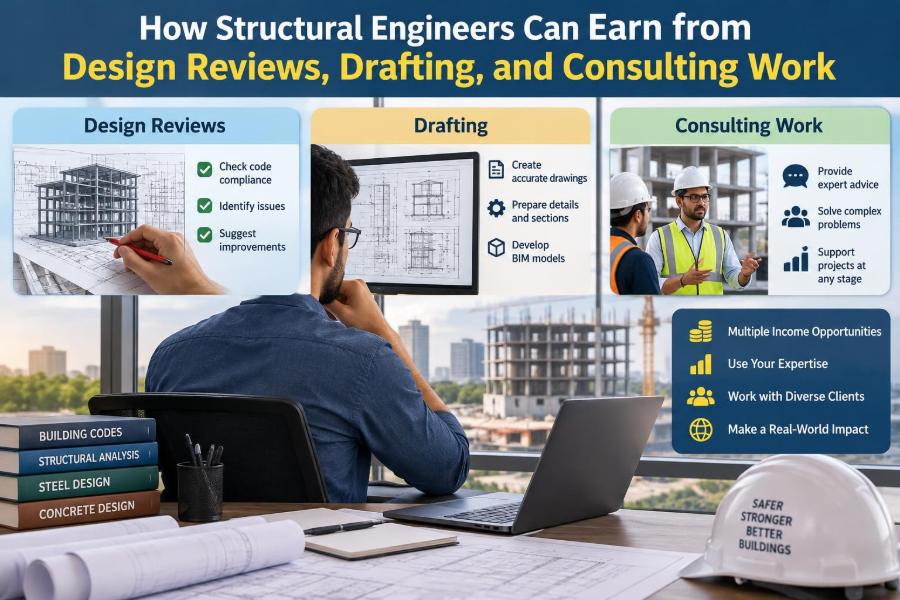

A structural engineer may finish a full-time design package on Friday and still receive a message that evening: “Could you quickly check this beam layout?” Another request follows—a contractor needs revised connection sketches, and a small architect needs someone to review a steel-frame concept before issuing drawings.
These requests are common because structural work sits at the point where design intent meets physical reality. Buildings, equipment supports, retaining walls, fit-outs, and temporary works all need decisions that are safe, buildable, and clearly communicated.
For engineers, this creates legitimate opportunities beyond a single employer or a traditional lead-designer role. Design reviews, drafting support, and focused consulting can become useful income streams while also developing technical judgment and professional relationships.
But structural services are not casual side work. A sketch can influence fabrication, a comment can be treated as approval, and a rushed calculation can create a risk far larger than its fee. Earning well starts with choosing work that matches your competence, authority, insurance, and available time.
🧭 Start with the services you can responsibly offer
The first question is not “What can I sell?” but “What can I stand behind?” Your offer should match your training, experience, local registration status, employer obligations, and the professional rules that apply where you work.
A graduate engineer might provide CAD production under another engineer’s direction. An experienced engineer may independently review preliminary framing or advise on constructability. Only a suitably authorized professional should issue work that local rules require to be sealed, signed, or certified.
Competence is specific, not general. Experience in reinforced-concrete buildings does not automatically qualify someone to assess a crane runway, an offshore platform, or a post-fire timber structure.
💼 See the three income streams clearly
Design reviews, drafting, and consulting overlap, but clients buy them for different reasons. Separating them helps you describe scope, price work fairly, and avoid taking on hidden design responsibility.
| Service | Primary client need | Typical deliverable |
|---|---|---|
| Design review | An independent technical check | Marked drawings, review memo, issue log |
| Drafting support | Clear project documentation | Plans, details, models, schedules |
| Consulting | Engineering judgment for a defined problem | Advice note, calculation package, concept options |
A client may ask for all three, but treating them as one vague “help with structure” assignment is a common source of scope creep.
🔍 Understand what a design review really is
A design review is a structured examination of work prepared by someone else. It may test load paths, member sizing logic, detailing consistency, coordination, code assumptions, constructability, or compliance with a client brief.
Review does not necessarily mean taking over as engineer of record. Its value often lies in finding omissions before construction, fabrication, or permit submission makes them expensive to correct.
A useful review states what was examined, which documents and revisions were used, what assumptions were made, and what was not checked. Without those boundaries, an informal comment can be mistaken for a full verification.
🧱 Make load-path thinking your review advantage
Many review comments become more useful when they follow the load path: where does load originate, how does it travel through slabs, beams, walls, bracing, foundations, and soil, and where could continuity fail?
For example, a transfer beam may appear adequately sized in isolation, while the supporting columns below have not been checked for the concentrated reactions. A reviewer who traces the force path can expose this gap quickly.
This approach also helps non-engineer clients understand comments. Instead of saying “member coordination issue,” explain that a removed wall may have interrupted the route carrying wind load to the foundation.
📐 Offer drafting as technical communication, not mere CAD labor
Good structural drafting turns analysis and design decisions into information that a fabricator and site team can use. It includes dimensions, levels, section references, member marks, notes, tolerances where relevant, and coordination with architectural and services information.
Clients often need help because their engineer can calculate a member but lacks production capacity during a deadline. Others need drawing cleanup after late design changes. Both are valuable needs, but drafting should follow approved engineering intent rather than invent it.
Never silently resolve an unclear structural decision through drafting. Flag the issue, record the query, and obtain direction from the responsible designer.
🖥️ Build fluency in the tools clients already use
Software competence affects how easily you can join a team. Depending on your market, useful tools may include 2D CAD, building information modeling software, structural analysis programs, spreadsheets, PDF markup systems, and document-control platforms.
Tool fluency alone is not a service. A model with attractive views can still contain incorrect releases, offsets, load assignments, or design settings. Clients pay more for someone who understands both the software and the structural consequences of its inputs.
Before accepting a model-based assignment, confirm the required software version, model ownership, exchange format, naming convention, and who controls revisions.
🧠 Turn calculations into focused consulting work
Consulting work often begins with a specific decision: Can an existing roof carry new mechanical equipment? Is a proposed opening feasible? What framing options suit a small extension? Can a contractor’s temporary sequence be developed safely?
The best small consulting assignments have a clear decision at the end. That decision might be “reinforce,” “relocate,” “use a different member arrangement,” or “obtain further investigation before proceeding.”
A concise engineering note can be more valuable than a long report if it clearly states inputs, assumptions, analysis method, conclusions, limitations, and required actions.
🏢 Choose a practical client niche
General availability is harder to market than a useful specialty. A niche does not need to be exotic; it can be a recurring project type where you understand the drawings, stakeholders, and common failures.
- Architectural support for home alterations and small additions
- Shop-drawing review for steel, precast, or timber fabricators
- Overflow production drafting for engineering offices
- Existing-building assessment support for property managers
- Constructability reviews for contractors before procurement
A niche improves efficiency because you reuse workflows and recognize typical questions. It should never become an excuse to apply a standard detail without checking the actual conditions.
🎯 Define an ideal first assignment
Early freelance work should be bounded, familiar, and reviewable. A clearly defined set of framing plans, an independent check of a limited calculation package, or drafting a known system under supervision is usually safer than a complex renovation with incomplete information.
A good first assignment has identifiable inputs, one decision-maker, a realistic deadline, and a deliverable you can describe in one sentence. It should also leave enough time for your own quality-control process.
Avoid work where the client says, “Just look at everything and tell us if it is okay.” That request has no measurable finish line.
📝 Write a scope that prevents misunderstandings
Your proposal is a technical risk-control document as well as a commercial document. State the project, requested service, documents to be provided, deliverables, schedule, fee basis, client responsibilities, and exclusions.
For a review, specify whether you are checking selected elements, drawing coordination, or the entire structural design. For drafting, state whether you are producing drawings from supplied markups or developing details from engineering information.
Useful exclusions may cover site measurement, destructive investigation, permit submissions, construction administration, specialist design, and changes after an agreed revision point. Exclusions are not evasions; they make responsibility visible.
⚖️ Separate review, advice, and design responsibility
Language matters. “Reviewed for general conformance” is not the same as “designed and approved.” “Preliminary advice” is not the same as a construction-ready design. Use terms that match your actual role and avoid labels that a client could reasonably interpret more broadly.
If you alter another engineer’s design materially, responsibility may shift in ways that need formal agreement. Local laws and professional regulations vary, so do not assume that a disclaimer alone resolves this issue.
When the responsibility boundary is unclear, pause and clarify it before continuing. A short written clarification is cheaper than trying to reconstruct intentions after a dispute.
🛡️ Address insurance and legal obligations early
Professional indemnity or errors-and-omissions cover may be essential for independent consulting, but policies differ in activities covered, project locations, retroactive dates, deductibles, and exclusions. Do not represent that you are insured for work your policy does not cover.
Also check registration, licensing, business registration, tax, confidentiality, and record-retention requirements in your jurisdiction. If you are employed, review your employment contract for restrictions on outside work, conflicts of interest, and use of employer equipment or templates.
Where public safety is affected, uncertainty should lead to professional advice—not assumptions.
💰 Price the uncertainty, not only the drawing count
Hours are a reasonable basis for many review and advisory tasks because the condition of the input information is uncertain. A fixed fee can work when the scope is tightly defined and assumptions are explicit.
Drafting may suit a fixed fee when sheet count, model quality, revision limits, and supplied information are known. Consulting on an existing structure often suits hourly billing or staged fees because discoveries can change the work.
Do not quote solely from the apparent size of a building. A small existing alteration with hidden framing and poor records can require more judgment than a larger, repetitive new-build layout.
⏱️ Estimate effort with a visible work breakdown
Estimate by tasks rather than intuition. Break the assignment into setup, input review, analysis or drafting, coordination, internal checking, client discussion, revisions, and issue preparation.
Then identify dependencies. If you cannot begin calculations until a site survey arrives, say so. If the fee allows one consolidated comment cycle, state that multiple piecemeal revisions are additional services.
A simple estimate protects both sides because it explains why “a quick check” can involve several hours of document reading before any engineering conclusion is possible.
📦 Create deliverables clients can actually use
A polished deliverable answers the client’s next practical question. A review memo should prioritize issues by consequence and action required. A drawing package should identify revision status and coordinate with the information used. A calculation note should make the governing assumptions traceable.
For example, instead of writing “connection inadequate,” state the location, observed concern, missing information if any, required verification, and whether work should pause at that location. Clear action language reduces misinterpretation on busy projects.
Issue files in a controlled format, with a date and revision identifier. Keep the issued copy separate from working files.
✅ Use a repeatable quality-control routine
Independent checking is difficult when you are working alone, but a deliberate routine still catches many errors. Step away from the work before final review if time permits, then check it against source documents rather than relying on memory.
- Confirm project name, location, drawing revisions, units, and coordinate system.
- Check that loads, materials, member sizes, and design assumptions match the issued information.
- Trace critical reactions to supports and foundations.
- Compare plans, sections, details, schedules, and notes for consistency.
- Verify that comments from earlier reviews were resolved or clearly carried forward.
For high-consequence work, arrange a competent peer check where the scope and budget allow it.
🔄 Control revisions before they control the job
Structural work changes as architecture, services, cost plans, and contractor methods evolve. Without revision control, a reviewer may comment on an obsolete PDF or a drafter may issue a detail based on a superseded layout.
Maintain a transmittal log showing what you received, when it was received, and which revision you used. Ask clients to consolidate comments when possible. Mark assumptions that depend on unconfirmed information.
When a change affects the basis of your work, issue a written notice: the earlier conclusion may no longer apply until the revised condition is assessed.
🤝 Work effectively with architects and contractors
Architects often need structural input early enough to preserve ceiling heights, openings, façade lines, and room layouts. Contractors need details that can be sequenced, accessed, fabricated, and inspected. The engineer’s role is stronger when these concerns are heard before documents are issued.
Use plain language in coordination meetings. Rather than simply rejecting a request, explain the constraint and offer feasible alternatives: a shallower member with a different support arrangement, a relocated opening, or an early check of a connection concept.
Collaboration does not mean accepting unsupported site changes. Confirm decisions in writing and identify who must approve them.
🏗️ Add value through constructability reviews
Constructability asks whether a design can be built safely and efficiently with realistic access, tolerances, lifting methods, erection sequence, and trade interfaces. It is distinct from code design, although the two interact.
Consider a beam that can theoretically be installed but leaves no room for bolts to be tightened after cladding is installed. A constructability review can identify the issue while changes are still inexpensive.
Be careful with temporary conditions. Construction-stage stability, lifting, and bracing can be specialized work. If you are not engaged to design temporary works, say so explicitly rather than implying approval through general comments.
🏚️ Treat existing structures as investigation-led work
Existing-building consulting can be rewarding because owners need clear decisions quickly. It also carries uncertainty: drawings may be missing, alterations may be undocumented, and visible conditions may hide corrosion, decay, weak connections, or different materials than expected.
Begin by identifying what is known, what was observed, and what needs verification. Measurements, opening-up works, material testing, or geotechnical input may be necessary before a definitive conclusion is responsible.
Never present an assumption as an observation. A statement such as “member size to be verified on site” is more honest—and more useful—than building a conclusion on an unverified sketch.
📋 Build a small portfolio without exposing client information
A portfolio should demonstrate your process and problem-solving ability, not reveal confidential drawings. With permission, use sanitized excerpts, generic diagrams, or short case summaries that remove identifying project information.
Describe the challenge, your role, the scope, and the type of deliverable. For example: “Prepared coordinated framing drawings from engineer-marked plans for a small commercial fit-out.” Do not claim responsibility for work performed by a broader team.
For new practitioners, sample exercises can show drafting clarity and calculation organization, provided they are clearly labelled as hypothetical rather than built projects.
🌐 Find work through trust, not broad promises
Most early opportunities come from people who have already seen your work: former colleagues, small engineering offices with deadline pressure, architects, detailers, fabricators, and contractors. A concise introduction describing your specific capacity is more credible than claiming to handle every structural problem.
Say what you do, what project types you know, what software or deliverables you support, and what geographic or licensing limits apply. Reliability in communication often matters as much as technical ability for repeat assignments.
Do not solicit work in a way that breaches an employer agreement or creates a conflict with current clients.
📞 Run discovery calls like an engineer
A discovery call should reduce uncertainty before you quote. Ask what decision the client needs, what has already been designed, who is responsible for the overall project, when information will be available, and what the project stage allows.
Request the latest drawings, photographs where appropriate, relevant surveys, design criteria, and prior reports. If key information is absent, offer a first stage to review records and define investigation needs rather than guessing a total solution.
End the call by repeating your understanding in plain terms. This makes it easier to identify a mismatch before work begins.
🚩 Recognize assignments worth declining
Some projects are unsuitable because the risk is disproportionate to the fee or because the client wants a professional label without the necessary investigation and design effort.
- Requests to copy or stamp work you did not prepare or adequately review.
- Pressure to certify hidden conditions without inspection or evidence.
- Instructions to bypass permits, codes, or required specialist input.
- Unrealistic deadlines that leave no time for checking.
- Clients unwilling to provide a written scope, current drawings, or payment terms.
Declining professionally protects your reputation. Where appropriate, explain what additional information or properly scoped service would be needed to proceed.
📚 Keep standards and knowledge current
Structural practice evolves through updated codes, manufacturer information, software changes, construction methods, and lessons from projects. Continuing professional development is therefore part of maintaining an income stream, not an optional extra.
Keep a personal library of verified references, calculation templates with change control, drafting checklists, and lessons learned. Review templates periodically; an old template can preserve an old assumption long after the project that created it is forgotten.
When working across jurisdictions, confirm applicable standards rather than assuming a familiar code has the same requirements or legal status elsewhere.
🧮 Use templates carefully, not mechanically
Templates save time in proposals, review reports, calculations, and drawing notes. They also create a risk of carrying forward the wrong project name, load case, material grade, or limitation statement.
Design templates should guide a process, not replace engineering judgment. Lock protected formula cells where appropriate, record software versions, and provide visible spaces for assumptions and checks.
A useful habit is to ask, “What would make this template unsuitable for this project?” That question prevents a familiar format from disguising an unfamiliar problem.
💬 Communicate bad news early and precisely
Consulting value is often highest when the answer is inconvenient: a proposed opening is too large, a member cannot be verified from available evidence, or a design change requires wider coordination. Delaying that message rarely improves the outcome.
State the issue, basis, consequence, and available next steps. For example, a preliminary review may indicate that the existing support arrangement cannot be confirmed; the next step could be targeted opening-up and measurement before a reinforcement scheme is developed.
Calm, specific communication builds trust even when the answer is not what the client hoped to hear.
📈 Grow capacity before expanding complexity
Once work becomes regular, growth may come from better systems rather than larger or riskier projects. Standardize onboarding, file naming, proposal language, time tracking, and quality checks. Build relationships with peer reviewers and complementary specialists.
Subcontracting drafting or analysis can increase capacity, but it also requires supervision, confidentiality controls, clear task allocation, and checking. You remain responsible for the work you issue within your agreed role.
Grow from repeatable, well-understood assignments toward broader responsibility only when your skills, authority, insurance, and review resources have grown with them.
🌱 Protect your time, judgment, and reputation
Side consulting can become unsustainable if it consumes evenings, compromises rest, or conflicts with a demanding primary role. Set realistic availability, use written turnaround times, and avoid promising immediate responses for non-emergency work.
Reputation is built through reliable scope, careful records, technically sound work, and honest boundaries. A client may forget a fast informal favor, but they will remember unclear responsibility when a problem appears.
Good professional habits are therefore commercial habits: they reduce rework, improve referrals, and make your services easier to trust.
🧩 Bring the three services into one professional practice
Design reviews sharpen judgment because they expose patterns in errors and coordination gaps. Drafting develops an understanding of how decisions are communicated and constructed. Consulting connects both skills to a client’s real decision.
The strongest opportunity is not simply selling extra hours. It is becoming known for a defined kind of dependable help: a careful second set of eyes, clear structural documents, or practical advice when a project reaches a difficult point.
Earn from structural services by making your scope, competence, responsibility, and deliverables as carefully engineered as the structure itself.
Start with work you can perform confidently, document every boundary, and let quality—not overpromising—create the next opportunity. That approach supports useful income while protecting the people and projects that depend on sound engineering. 🏗️📐🤝