
A bridge can carry thousands of vehicles in a single day and still look perfectly ordinary from the road. Beneath that familiar surface, however, small changes may be developing: a bearing may be stiffening, a joint may be admitting water, or repeated heavy traffic may be slowly changing the way a girder vibrates.
Traditionally, engineers find many of these issues through scheduled inspections, targeted tests, maintenance records, and professional judgment. Those methods remain essential, but they offer snapshots rather than a continuous picture of structural behavior.
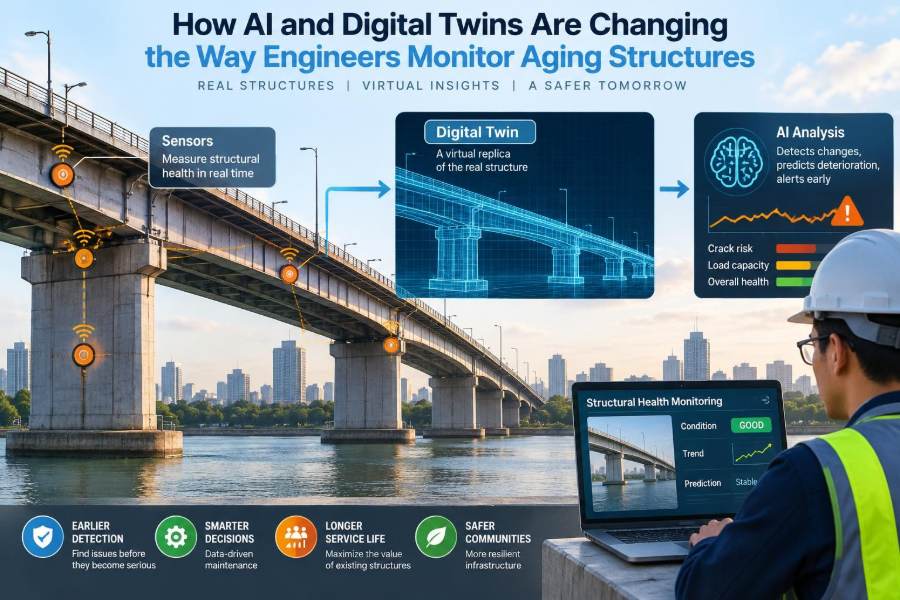
AI-enabled monitoring and digital twins are adding a new capability. They help teams connect sensor readings, inspection observations, design information, and environmental conditions so that an aging structure can be assessed as a living system rather than a file of disconnected reports.
The promise is not a structure that “looks after itself.” The real value is better engineering decisions: knowing where to inspect, what deserves attention first, and how confidently a change can be interpreted.
🏛️ Why aging structures need closer attention
Structures age because materials, loads, details, and environments interact over time. Reinforced concrete can crack and permit moisture ingress; steel can corrode or experience fatigue; timber can decay when moisture remains trapped; and foundations can respond to changing groundwater or adjacent construction.
Age alone does not define condition. A well-detailed bridge in a mild environment may remain reliable for decades, while a younger asset exposed to chlorides, poor drainage, or unanticipated loading may deteriorate faster. Monitoring helps engineers focus on actual performance and credible risks, not simply the year an asset was built.
🔍 The limits of periodic inspection
Visual inspection is indispensable because it reveals cracking, leakage, corrosion staining, spalling, deformation, damaged protective systems, and many other conditions that sensors may not capture directly. Yet a person cannot be present continuously, and access can be difficult on tall buildings, offshore structures, rail corridors, or busy highways.
A condition observed on one inspection date may have existed for months, or it may have appeared shortly before the visit. Periodic inspections can also struggle to distinguish a harmless seasonal change from a developing structural issue. Digital data does not replace inspection; it helps make inspection intervals and locations more purposeful.
📡 What structural health monitoring means
Structural health monitoring, often shortened to SHM, is the repeated measurement and interpretation of a structure’s response. Instruments may track strain, acceleration, displacement, tilt, temperature, humidity, crack movement, corrosion-related indicators, or load effects.
The central question is not merely “What did the sensor read?” It is “What does that reading imply about the structure’s condition, safety margin, serviceability, or maintenance need?” Answering that question requires knowledge of structural mechanics, the asset’s history, and the limitations of each measurement.
🧠 AI is a tool for pattern recognition
Artificial intelligence in this context usually means algorithms that identify patterns in large or complicated datasets. A system may group similar vibration signatures, flag readings that differ from normal behavior, classify visible surface defects in images, or estimate a missing value from related measurements.
AI is most useful when the data volume exceeds what engineers can reasonably review by hand. It is not a substitute for engineering responsibility. A model can detect an unusual pattern, but a qualified engineer must decide whether that pattern is caused by damage, temperature, sensor drift, operational changes, or another factor.
🪞 A digital twin is more than a 3D model
A digital twin is a connected digital representation of a physical asset that is updated using information from the real structure. It may include geometry, materials, design assumptions, inspection history, maintenance records, live sensor data, and analytical models.
A visually impressive 3D model is useful for communication, but it is not automatically a twin. The defining feature is the link between physical evidence and the digital representation. That link enables the model to support questions such as: which member is behaving differently, what loading condition occurred, and what inspection information is already available?
🧩 The layers inside a useful twin
Effective twins combine several layers rather than relying on one software environment or data source.
- Asset information: drawings, dimensions, component IDs, materials, and construction records.
- Condition information: inspections, photographs, defect maps, repair history, and ratings.
- Operational information: traffic, occupancy, machinery use, water level, or other service loads.
- Environmental information: temperature, rainfall, wind, humidity, chloride exposure, or ground movement.
- Engineering models: calculations or finite element models used to test plausible explanations.
Not every asset needs every layer at the same level of detail. A practical twin is built around decisions the owner needs to make.
🌡️ Why context matters as much as data
Most structures respond to ordinary changes in their environment. A steel bridge expands in heat, a concrete deck may contract in cooler conditions, and a tall building moves differently during a windy day than during calm weather.
If an anomaly system ignores temperature, it may flag predictable thermal movement as damage. If it ignores traffic or occupancy, it may mistake a change in operating conditions for a change in stiffness. Contextual data turns raw readings into evidence that can be interpreted responsibly.
📏 Sensors measure proxies, not “damage”
A strain gauge measures strain at its installed location. An accelerometer measures acceleration. A crack gauge measures relative movement across a particular crack. These are proxies: observable responses that may be related to condition but are not usually a direct diagnosis.
For example, a vibration frequency can change because of stiffness loss, but also because of temperature, added mass, boundary-condition changes, or measurement processing choices. Sound monitoring starts by understanding what each instrument can and cannot establish.
⚙️ Common instruments and what they reveal
| Instrument or source | Typical use | Key limitation |
|---|---|---|
| Accelerometer | Vibration response and modal behavior | Interpretation is sensitive to operating and environmental conditions |
| Strain sensor | Local load effect, stress range, and fatigue-related response | Represents a small location, not an entire member |
| Displacement or tilt sensor | Movement at joints, supports, or critical points | Reference stability and installation quality matter greatly |
| Camera or drone imagery | Visible cracking, spalling, corrosion, and access support | Cannot reliably reveal hidden internal deterioration alone |
| Environmental sensor | Temperature, humidity, wind, and moisture context | Does not measure structural condition by itself |
Sensor selection should begin with a failure mechanism or decision question, not with a desire to collect more data.
📈 Establishing a baseline before judging change
A single measurement rarely tells an engineer what is normal. Teams need a baseline that covers representative conditions: daily and seasonal temperature variation, expected operating loads, weather, and routine use.
For an existing asset, historical inspection records may provide part of the baseline. For a newly instrumented structure, the early monitoring period is especially valuable. It establishes the range of ordinary behavior against which later deviations can be compared.
🚨 Anomaly detection is not an automatic alarm
Anomaly detection identifies data that differs from an expected pattern. This might be an unexpected strain range, a changed vibration feature, a sensor that becomes intermittent, or an unusual relationship between temperature and movement.
That result should initiate a workflow, not a conclusion. A sensible sequence is to check data quality, compare with weather and operational records, review nearby instruments, examine recent maintenance or construction activity, and then decide whether an inspection or analysis is warranted.
🧮 Physics-informed AI keeps models grounded
Purely data-driven models can find correlations without understanding why they occur. This is risky when a structure has limited historical data, when operating conditions change, or when rare damage states are absent from the training data.
Physics-informed approaches combine measured data with known engineering behavior, such as equilibrium, compatibility, material response, or expected modal relationships. A finite element model may provide plausible response ranges, while AI helps identify deviations that deserve investigation. The combination is often more defensible than a black-box prediction alone.
🏗️ Updating analytical models with field evidence
Design models make assumptions about stiffness, supports, mass, boundary conditions, and loads. Those assumptions are necessary, but an in-service structure may behave differently because of construction tolerances, aging, repairs, composite action, or unmodeled restraint.
Model updating adjusts selected parameters so that simulated behavior better aligns with observed measurements. It should be done carefully: several combinations of parameters can sometimes match the same data. The goal is not to force a perfect fit, but to develop a model that is useful for decision-making and honest about uncertainty.
🌉 Bridge monitoring: separating traffic from deterioration
Bridges are well suited to digital monitoring because traffic loading, temperature, bearings, expansion joints, drainage, and fatigue all affect performance. A sensor system can capture strain cycles from trucks, acceleration during crossings, and movement at supports.
Consider a hypothetical bridge where a support movement trend changes over several months. Before treating it as structural distress, engineers would check temperature records, bearing maintenance, sensor references, nearby ground activity, and traffic patterns. The twin organizes those clues so the team can test explanations efficiently.
🏢 Tall buildings and serviceability monitoring
For tall buildings, occupants often notice motion, vibration, or unusual noises before they identify a structural cause. Monitoring can help relate measured response to wind conditions, building use, façade activity, or mechanical equipment.
Most day-to-day monitoring is about serviceability: comfort, movement, drift, or the performance of nonstructural components. It does not mean that every noticeable sway event is dangerous. The value lies in comparing measured response with expected behavior and investigating meaningful departures.
🌊 Dams, tunnels, and buried assets
Some critical structures are difficult to inspect comprehensively because much of the asset is submerged, underground, or inaccessible during normal operation. Instruments can provide evidence on seepage-related conditions, deformation, pore pressures, joint movement, or ground response.
These systems require particularly careful interpretation because groundwater, rainfall, reservoir level, temperature, and construction nearby can all influence readings. A digital twin can bring geotechnical, hydraulic, and structural evidence together, but it cannot remove the need for specialist review.
📷 Computer vision expands the inspector’s reach
Image-based AI can help sort large collections of photographs, identify candidate cracks or spalls, compare repeated images, and direct attention to locations that may need closer human review. Drones and robotic platforms can also improve access to hard-to-reach surfaces.
Image quality, lighting, viewing angle, surface moisture, and occlusion strongly affect results. A visible line may be a crack, a joint, a stain, a shadow, or a coating feature. Computer vision is best treated as a triage and documentation tool, with inspection professionals validating significant findings.
🔊 Vibration data can reveal changing behavior
Every structure has dynamic properties, including natural frequencies and mode shapes. These describe characteristic ways it tends to vibrate. Engineers can estimate them from measured response to traffic, wind, machinery, or controlled testing.
A meaningful change may indicate altered stiffness, mass, restraint, or damage, but no single vibration metric provides a universal diagnosis. Reliable interpretation usually combines trends across several features with temperature normalization, repeat measurements, and knowledge of the structural system.
🛠️ From reactive repair to risk-based maintenance
Traditional maintenance often reacts to observed defects or follows fixed intervals. Monitoring can support a more risk-based approach by showing which components experience demanding load cycles, which defects are changing, and where uncertainty remains high.
This does not mean every monitored asset should receive less inspection. It means limited budgets can be directed toward the components where consequences, exposure, deterioration evidence, and uncertainty justify closer attention. A twin can make this prioritization more transparent.
💰 The value case depends on the decision
Instrumentation, communications, data storage, integration, maintenance, and specialist interpretation all cost money. The business case is strongest when monitoring changes a real decision: avoiding unnecessary closure, targeting access equipment, verifying a repair, managing fatigue exposure, or improving emergency response information.
Installing sensors because technology is available often creates dashboards without a clear user. Before procurement, owners should define the decisions, users, acceptable response times, data retention needs, and action thresholds that the system is expected to support.
🔌 Data quality is an engineering issue
A sophisticated algorithm cannot repair a poorly installed sensor, an unstable power supply, a drifting reference, incorrect timestamps, or undocumented calibration changes. Missing data and communications outages are normal operational realities, not embarrassing exceptions.
Good programs document instrument location, orientation, sampling rate, calibration, replacement history, and expected range. They also include automated quality checks for impossible values, stuck readings, clock errors, and sudden changes that may be caused by the measurement system rather than the structure.
🧹 Data governance prevents a future archive problem
Aging assets may remain in service longer than the software, sensors, or contractors originally used to monitor them. If data formats are proprietary or component identifiers are inconsistent, future teams can lose the context needed to interpret valuable records.
Owners should establish clear rules for data ownership, naming conventions, metadata, access control, retention, and export. The twin should not become an isolated digital archive that only one supplier can understand. Open, documented information practices make long-term use more realistic.
🔐 Cybersecurity belongs in structural monitoring
Connected monitoring systems introduce digital risks alongside physical ones. Unauthorized access, altered data, unavailable dashboards, or compromised remote devices can undermine operational confidence and, in some settings, affect safety-related decision processes.
Practical protections include controlled user access, secure device configuration, network segmentation where appropriate, software updates, backups, and procedures for detecting suspicious activity. Cybersecurity planning should involve both asset engineers and information technology specialists from the beginning.
👷 Human judgment remains at the center
AI can rank anomalies, but it does not carry professional responsibility for a decision to restrict traffic, repair a member, revise a load rating, or defer work. Engineers must understand the data lineage, model assumptions, uncertainty, and consequences of acting—or not acting.
Equally, experienced inspectors contribute knowledge that is hard to reduce to a spreadsheet: the sound of a loose connection, a recurring leak pattern, access constraints, and construction details that differ from drawings. The best systems preserve and amplify this field knowledge.
⚠️ Common ways monitoring programs fail
Many programs struggle for predictable reasons. Sensors are installed without a clear purpose, baseline behavior is never established, alerts are too frequent, data is not reviewed, or ownership shifts after the project team leaves.
- Measuring convenient locations instead of locations linked to a credible failure mechanism.
- Treating an AI score as a condition rating without validation.
- Ignoring temperature, operations, and sensor health when interpreting changes.
- Creating alarm limits without defining who responds and what they should do.
- Assuming remote data eliminates hands-on inspection.
These failures are management and engineering problems, not simply technology problems.
🧭 A practical implementation sequence
A phased approach reduces wasted effort and makes results easier to defend.
- Define the asset risks, decisions, and users.
- Review drawings, inspections, repairs, and known uncertainties.
- Identify measurable indicators connected to plausible deterioration or performance mechanisms.
- Select instruments, data pathways, quality checks, and responsibilities.
- Collect a baseline across representative conditions.
- Set review workflows, escalation criteria, and inspection responses.
- Evaluate whether the information changed maintenance or operational decisions.
A modest, well-managed system tied to one high-value question is often more useful than a complex platform with no defined workflow.
📚 Skills engineers need to develop
Structural engineers do not need to become full-time software developers to use these tools well. They do need enough data literacy to ask sensible questions about sampling, uncertainty, missing values, model validation, false alarms, and whether a dataset represents the conditions of interest.
Collaboration is becoming a core skill. Monitoring projects bring together structural, geotechnical, materials, inspection, software, electrical, operations, and cybersecurity professionals. Engineers who can translate between these disciplines help ensure that technology remains connected to physical behavior.
⚖️ Validation, uncertainty, and defensible decisions
Every measurement has uncertainty, every model simplifies reality, and every threshold reflects a judgment about risk. A responsible digital twin makes these limitations visible rather than hiding them behind a colored dashboard.
Validation may include comparing sensors with manual readings, checking predictions against later observations, reviewing algorithm performance on known conditions, and documenting where the system is not reliable. Decisions should state the evidence used, the assumptions made, and the conditions that would trigger reconsideration.
🔮 What the next stage is likely to look like
Monitoring systems will likely become more integrated, with better links between inspection records, imagery, environmental data, analytical models, and maintenance workflows. Edge processing—analyzing selected data near the sensor—may reduce communications demands for some applications.
Progress will be uneven because assets differ widely in risk, accessibility, ownership, and available records. The most useful advances will not necessarily be the most visually dramatic. They will be the ones that help teams detect meaningful change sooner, explain it more clearly, and allocate resources more intelligently.
✅ The core principle: better evidence, better engineering
AI and digital twins are changing structural monitoring by turning isolated observations into a more continuous, connected evidence base. They can help engineers see trends, prioritize inspections, test explanations, and document decisions across a structure’s service life.
But the technology works only when it is attached to sound engineering questions, reliable data, clear workflows, and accountable professional judgment. A twin is valuable not because it is digital, but because it improves how the physical asset is understood and managed.
The future of aging-structure monitoring is not automated judgment; it is engineers using better evidence to make safer, more timely, and more defensible decisions. 🏗️📡🧠