
A hairline crack appears above a living-room door. A diagonal line runs across brickwork near a window. In a parking structure, a dark fissure crosses a concrete slab. Most people see the same thing first: damage.
Cracks deserve attention, but they are not all warnings of structural failure. Buildings are assembled from materials that shrink, expand, bend, settle, and respond to changing loads. Some cracking is expected; some reveals that a design assumption, connection, foundation, or maintenance detail needs review.
The difficult question is not simply, “Is there a crack?” It is: what caused it, is it changing, and has it affected the building’s ability to carry load safely?
For students, this topic connects material behavior to visible building performance. For working professionals, it is a reminder that a crack survey is an investigation—not a diagnosis based on appearance alone.
🔍 A Crack Is Evidence, Not a Complete Diagnosis
A crack is a separation in a material caused when local tensile stress, movement, restraint, or deterioration exceeds what that material can accommodate. It records that something happened, but it does not identify the cause by itself.
For example, a vertical crack in masonry may result from drying movement, thermal movement, differential foundation settlement, or corrosion of embedded steel. The same visual symptom can therefore lead to very different repairs.
An engineer begins by asking what the crack is doing: its location, orientation, width, depth, age, pattern, and whether it is active. Context—the structure, materials, loading history, drainage, and nearby work—matters as much as the line itself.
🏗️ Buildings Are Designed to Move
Perfect stillness is not a realistic building condition. Floors deflect under occupants and furniture, steel warms in sunlight, concrete shortens as it dries, and soils adjust beneath changing loads and moisture conditions.
Good structural design allows for expected movement through reinforcement, joints, bearings, flexible seals, and detailing. Cracking often occurs where a movement is restrained or concentrated rather than distributed.
Think of a ruler bent gently between two hands: the ruler’s curvature is obvious, but the critical stress is greatest near the fibers being stretched. Buildings work similarly. Small overall movement can produce high local stress near openings, re-entrant corners, stiff connections, or abrupt changes in geometry.
🧱 Why Brittle Materials Show Cracks First
Concrete, masonry, plaster, drywall, and many finishes are relatively weak in tension compared with their strength in compression. When they are pulled apart even slightly, they tend to crack rather than stretch extensively.
Steel behaves differently. It can deform significantly before fracture in many common structural applications, which is one reason steel structures may show yielding, distortion, or connection damage rather than widespread visible cracking in the main members.
This distinction matters: a crack in paint or plaster may reflect harmless finish movement, while a crack through a reinforced concrete beam or a welded steel connection demands a different level of scrutiny.
📏 Crack Width Is Useful but Never Sufficient
Width is easy to observe and record, so it is often treated as the main indicator of seriousness. It is useful, especially when measured consistently over time, but it cannot independently establish structural risk.
A narrow crack crossing a highly stressed reinforced concrete member may be more relevant than a wider crack in nonstructural render. Conversely, a stable, old crack can be visually prominent without indicating ongoing movement.
Engineers also consider depth and continuity. A surface finish may crack while the substrate remains intact; a crack that passes through a wall, slab, or member section has different implications.
📐 Crack Direction Reveals the Stress Story
Crack geometry often provides the first clue to the underlying action. Tension cracks generally form roughly perpendicular to the direction of tensile stress, while shear-related cracks commonly develop diagonally.
In a simply supported reinforced concrete beam, flexural cracks commonly appear near the region of highest bending moment and tend to be close to vertical. Diagonal cracks nearer supports may indicate significant shear demand, though an on-site assessment must consider the full detail and loading arrangement.
Patterns are clues, not verdicts. Paint layers, masonry joints, reinforcement layout, and previous repairs can redirect or disguise a crack pattern.
🌡️ Thermal Expansion and Contraction
Materials change length as temperature changes. A long roof, facade, bridge deck, or exposed slab can develop substantial movement across its full length even when daily temperature changes seem modest.
If that movement is restrained by rigid walls, adjacent construction, or poorly detailed joints, stress accumulates. Cracks may then appear at weak points, particularly corners and transitions between different materials.
Thermal cracking is often seasonal or linked to sun exposure. A facade crack that opens during cold periods and closes during warm periods suggests movement, but monitoring is needed before assigning a cause.
💧 Drying Shrinkage in Concrete
Fresh concrete contains more water than is ultimately retained in its hardened structure. As moisture leaves over time, concrete undergoes drying shrinkage. If the concrete is restrained by reinforcement, a wall, a previous pour, or the subbase, tensile stresses can develop.
Early-age cracking may also arise from rapid surface drying, temperature differences within the concrete, settlement of fresh concrete around reinforcement, or inadequate curing. These mechanisms occur at different times and need different preventive measures.
Proper mixture selection, curing, joint layout, pour sequencing, and reinforcement detailing help manage cracking. They reduce crack width and distribute movement; they do not promise completely crack-free concrete.
🧪 Chemical Shrinkage, Creep, and Long-Term Effects
Concrete continues to change after construction. Creep is time-dependent deformation under sustained load. Shrinkage and creep can increase deflection in slabs and beams, alter load sharing, and create stress in partitions or facade elements connected to a moving frame.
A long-span slab may gradually deflect enough to crack a rigid partition beneath it even when the slab remains structurally adequate. The visible damage is then in the partition, while the source is compatibility between elements.
Long-term prediction relies on material properties, environment, loading duration, member dimensions, and restraint. It is an engineering estimate, not an exact forecast.
🌧️ Foundation Settlement and Differential Movement
All foundations experience some movement as loads are transferred into soil. Concern rises when one part of a building moves more than another. This is differential settlement, and it distorts the structure above.
Diagonal cracks in masonry around doors and windows are commonly associated with differential movement because openings interrupt the wall and concentrate stress. However, diagonal cracking alone does not prove settlement.
Possible contributors include variable soil stiffness, poorly compacted fill, leaking drains, changes in groundwater, excavation beside a building, expansive or shrinking soils, and uneven loading. Determining the mechanism may require records, level surveys, trial pits, or geotechnical input.
🌱 Expansive Soils and Seasonal Ground Movement
Some clay-rich soils change volume significantly as their moisture content changes. In dry conditions they may shrink; when wetted, they may swell. Shallow foundations and slabs-on-ground are particularly sensitive to these cycles.
Trees, poor drainage, broken water lines, altered landscaping, and changes to paved areas can change moisture distribution around a building. The resulting movement is often uneven rather than uniform.
Managing water is usually central to any solution. That can include repairing leaks, directing roof runoff away appropriately, maintaining drainage, and seeking site-specific foundation advice before removing mature vegetation or making major grading changes.
🏠 Settlement Is Not the Same as Subsidence
The words are often used interchangeably, but they describe different ideas. Settlement is downward movement of a foundation or ground under load; it can be small, expected, and stable. Subsidence generally refers to lowering of ground level or loss of support, potentially from soil shrinkage, voids, mining effects, erosion, or other ground changes.
The distinction matters because repair strategies differ. Filling a cosmetic crack does not address ongoing ground movement, and underpinning is not automatically appropriate for every settlement-related crack.
Engineers seek evidence of progression and mechanism before selecting an intervention.
🚪 Openings Create Stress Concentrations
Windows, doors, service penetrations, and notches interrupt the normal flow of forces through a wall or slab. Stress must curve around these openings, often producing high local tensile stresses at corners.
That is why cracks frequently begin at the corner of a window or door. In concrete, reinforcing bars are often detailed around openings to control cracking. In masonry, lintels and movement joints must accommodate both vertical loads and material movement.
A crack at an opening may be a predictable response to shrinkage, but its direction, width, recurrence, and relationship to lintel deflection still deserve review.
🧩 Different Materials Move Differently
A building is rarely made from one material. Concrete frames, masonry infill, steel supports, glazing, timber roofs, plaster finishes, and sealants each respond differently to temperature, moisture, and loading.
When a stiff masonry panel is tightly connected to a flexible frame, frame deflection can crack the panel. When a concrete slab meets a rigid wall without an appropriate movement detail, shrinkage may create a separation or crack.
Many apparent “material failures” are actually compatibility failures: the components were individually adequate, but their movements were not accommodated at the interface.
🪵 Timber Moisture Movement and Checking
Timber gains and loses moisture with surrounding humidity. It changes dimension most across the grain, and this movement can affect floors, cladding, framing, and connections.
Surface splits called checks are common in larger timber members as outer layers dry differently from the core. Their significance depends on location, depth, orientation, member function, and whether decay or connection distress is present.
Timber cracking should not be dismissed automatically. A split near a heavily loaded connection, a bearing area, or a zone of moisture damage needs informed inspection.
⚙️ Overloading and Changed Use
Buildings are designed for assumed loads and uses. A storage room converted into archives, a roof loaded with new equipment, or a floor supporting dense racks can change the demand on structural members.
Excess load can increase deflection and produce cracking in finishes, slabs, partitions, or beams. It may also expose an existing weakness that was not visible under lower loading.
Before changing occupancy, adding plant, cutting openings, or installing heavy equipment, verify the structural capacity and load path. “It has held so far” is not a structural assessment.
🔨 Alterations Can Interrupt the Load Path
Every load needs a continuous route to the ground: slab to beam, beam to column or wall, then foundation and soil. Removing a wall, drilling a large opening, cutting reinforcement, or notching a joist can interrupt or weaken that route.
Cracking after renovation deserves particular attention when it appears near altered walls, new openings, supports, or penetrations. Construction vibration may explain minor finish cracks, but it should not be assumed to explain all damage.
Temporary works matter too. A structure can be vulnerable while a permanent support is removed and a replacement beam or connection is not yet fully installed.
🌊 Water Damage, Corrosion, and Concrete Spalling
Water is not always the original cause of a crack, but it can transform a manageable defect into a durability problem. In reinforced concrete, moisture and contaminants can reach reinforcing steel through cracks, porous concrete, or failed protective systems.
Corroding steel expands as corrosion products form. This internal expansion can crack surrounding concrete, push off cover, and create spalling—the loss of pieces of concrete from the surface.
Rust staining, delaminated concrete, exposed reinforcement, and falling fragments warrant prompt professional assessment. The key issue is not only appearance; corrosion may reduce steel area and bond while threatening public safety below.
🧊 Freeze-Thaw Damage in Exposed Construction
Water that enters porous materials can freeze and expand. Repeated freezing and thawing may damage concrete, brick, stone, mortar, and coatings, especially where drainage is poor or protective surfaces have failed.
The usual visual signs include scaling, surface loss, open joints, and cracking near saturated areas. Freeze-thaw action often works with other mechanisms, such as salt exposure, corrosion, and water infiltration.
Durable repair requires managing water entry and selecting compatible materials. Covering damaged surfaces without resolving drainage can trap moisture and accelerate deterioration.
🏭 Construction Defects and Detailing Errors
Some cracks reflect errors in workmanship or detailing: insufficient curing, misplaced reinforcement, poorly compacted concrete, missing movement joints, weak mortar, inadequate bearing, or improperly installed flashings.
It is tempting to label every defect a “construction crack,” but a proper conclusion needs evidence. Drawings, photographs, material records, exposed details, and site observations may be needed to separate design intent from actual construction.
Early cracking does not necessarily mean a structure is unsafe, but it can signal reduced durability, water-tightness, or serviceability. Addressing it early is generally easier than waiting for moisture and corrosion to become involved.
🚧 Vibration, Impact, and Nearby Excavation
Demolition, piling, traffic, machinery, blasting, and excavation can create vibration or ground movement. Existing brittle finishes may crack under vibration, while excavation can alter lateral soil support or groundwater conditions near foundations.
Where nearby work is planned, a pre-construction condition survey is valuable. Photographs, crack maps, and dated measurements create a baseline and reduce uncertainty if a claim arises later.
New cracking accompanied by settlement, sticking doors, ground gaps, retaining-wall movement, or changes after excavation should be escalated rather than treated as a superficial nuisance.
👀 Cosmetic Cracks Versus Structural Cracks
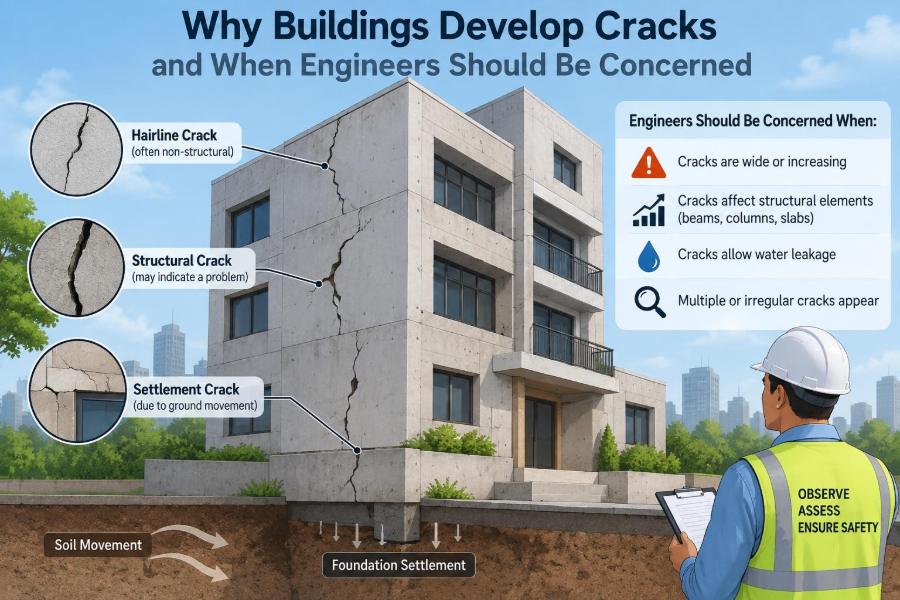
“Cosmetic” does not mean imaginary; it means the crack is limited to a finish or non-load-bearing component and is not known to impair structural capacity. Hairline paint or plaster cracking is often in this category.
Structural cracking involves a load-bearing member, a connection, or a condition that may affect strength, stiffness, stability, or load transfer. The visible finish can hide the distinction, so location and construction type are essential.
| Observation | Often consistent with | What still needs checking |
|---|---|---|
| Fine, random paint or plaster lines | Finish shrinkage or minor movement | Whether cracks are growing or aligned with deeper defects |
| Cracks at window corners | Stress concentration or wall movement | Pattern, foundation movement, lintel condition, and recurrence |
| Vertical cracks in a concrete beam | Flexural response | Location, width, loading, deflection, and reinforcement details |
| Diagonal cracks near beam supports | Possible shear-related distress | Immediate engineering evaluation of the member and loads |
| Rust stains and detached concrete | Reinforcement corrosion | Extent of delamination, steel condition, and falling-object risk |
🚨 Warning Signs That Need Prompt Attention
Some observations justify contacting a structural engineer quickly, particularly if they are new, worsening, or combined with visible distortion. Do not wait for a crack to become dramatic before recording and reporting it.
- Rapidly widening cracks or cracks that reopen after repair.
- Noticeable sagging, bowing, leaning, bulging, or floor unevenness.
- Cracks in beams, columns, load-bearing walls, or critical connections.
- Diagonal cracking near supports, especially with displacement across the crack.
- Doors and windows suddenly binding together with new wall cracking.
- Spalling concrete, exposed reinforcement, severe corrosion, or falling debris.
- Cracking after impact, fire, flooding, earthquake shaking, excavation, or unauthorized alteration.
If there is an immediate risk of collapse or falling material, keep people away from the area and follow local emergency procedures. Remote advice cannot determine whether a specific building is safe to occupy.
📸 Start with a Systematic Crack Survey
A useful survey turns an anecdote into evidence. Record each crack on a plan or elevation, assign an identifier, note its approximate location, direction, length, width, and visible condition.
Take dated photographs with a scale and enough surrounding context to identify the location later. Note nearby doors, windows, drains, joints, columns, recent works, leaks, and changes in use.
Surveying should be repeatable. Measurements taken from a different point, with a different camera angle, or without a reference scale are much harder to compare meaningfully.
📈 Monitoring Separates Active Movement from Old Damage
Monitoring asks whether a crack is changing and whether the change correlates with time, temperature, rainfall, construction activity, or loading. Simple crack gauges, calibrated marks, level readings, and repeated photographs may be appropriate depending on the case.
A stable crack over an adequate observation period may support a repair focused on appearance or water exclusion. An active crack requires the cause to be understood before permanent repair is attempted.
Monitoring is not a substitute for urgent assessment where warning signs exist. It is most valuable when an engineer has judged that measured observation is safe and informative.
🧭 Engineers Read the Whole Structural System
Professional assessment goes beyond the crack itself. Engineers review structural form, load paths, likely material behavior, site conditions, drainage, construction history, original documents when available, and changes made over the building’s life.
They may use targeted investigation such as cover-meter surveys, sounding for delamination, moisture checks, level surveys, selective opening-up, or material testing. The least invasive method that can answer the relevant question is usually preferred.
A sound conclusion states both what is known and what remains uncertain. That transparency is valuable when deciding whether monitoring, repair, strengthening, or further investigation is justified.
🛠️ Repair the Cause Before Repairing the Surface
Filling a crack can be appropriate, but only after deciding what the repair must achieve. A decorative plaster crack may need flexible finishing; a leaking facade crack may need weatherproofing; a structural concrete crack may need a designed repair that restores continuity or protects reinforcement.
Common approaches include sealants for movement, injection for suitable stable cracks, stitching or reinforcement where designed, patch repair for damaged concrete, improved drainage, joint installation, localized strengthening, and foundation interventions. Each has limits.
Rigidly filling an active movement crack often leads to a new crack beside the repair. A durable outcome matches the repair material and detail to the movement mechanism.
🧱 Why Epoxy Is Not a Universal Fix
Epoxy injection can bond faces of a crack and may restore continuity in certain dry, clean, stable concrete cracks when used in an appropriate structural repair design. It is not a cure for ongoing settlement, thermal cycling, water pressure, active corrosion, or poorly understood distress.
If movement continues, a rigid epoxy repair may crack again elsewhere. If water is present, resin selection and preparation become more difficult, and a flexible or water-management solution may be needed instead.
The question should be, “What behavior must this detail accommodate?” rather than, “Which product fills the line?”
🧰 Maintenance Prevents Many Crack Problems from Escalating
Routine maintenance cannot prevent every crack, but it reduces common pathways to deterioration. Keep roof drainage functioning, repair plumbing leaks, maintain sealants and flashings, clear outlets, and investigate persistent dampness.
Watch for changes at the ground line: ponding water, eroded soil, gaps beside slabs, blocked drains, or vegetation that is changing moisture conditions around shallow foundations. Small site changes can have large consequences over time.
Maintenance records also help diagnosis. Knowing when a leak began or when a crack was first photographed can be more useful than a vague recollection that it “has always been there.”
🧑🎓 Common Misjudgments to Avoid
The first mistake is assuming every crack is dangerous. This can lead to unnecessary disruption and poorly targeted repairs. The opposite mistake—assuming a crack is harmless because it is narrow or old-looking—can overlook progressive deterioration.
- Judging severity from width alone.
- Repairing before documenting the original condition.
- Ignoring new cracks after a change in use, leak, excavation, or alteration.
- Treating finish cracks and structural cracks as interchangeable.
- Using a rigid patch where movement is expected.
- Assuming corrosion is only a visual issue.
- Relying on an online photograph instead of site-specific assessment.
Good engineering replaces quick labels with evidence, mechanics, and proportionate action.
📝 A Practical Response Plan for Building Owners
When a crack is noticed, begin calmly. Photograph it, note the date, mark its location, and observe whether there are associated changes such as leaks, sticking doors, uneven floors, or nearby construction.
- Protect people from obvious hazards such as loose concrete or unstable elements.
- Document the crack and the surrounding area with scale and context.
- Check for simple contributing conditions such as active leaks or blocked drainage.
- Review recent alterations, heavy new loads, impacts, and site work.
- Seek a qualified structural professional when warning signs exist, movement is suspected, or the crack affects load-bearing construction.
- Carry out repairs based on the identified mechanism, then keep records for future inspection.
This sequence avoids both panic and neglect. It also gives the assessor a clearer starting point.
⚖️ Serviceability and Safety Are Different Questions
Structural engineering considers more than collapse prevention. Serviceability includes deflection, vibration, water-tightness, appearance, durability, and the ability of doors, finishes, and equipment to function acceptably.
A crack can be unacceptable because it leaks or damages finishes even if the member remains safe. Conversely, a member can look relatively intact while having a hidden capacity or connection problem.
Separating these questions improves decisions. A repair may be needed for durability or usability without implying imminent structural failure, while a safety concern may demand action even when visible cracking is limited.
🔑 The Core Principle: Pattern, Progression, and Context
Buildings develop cracks because materials and foundations move, loads change, details restrain movement, and environmental exposure causes deterioration. Cracking is therefore common; unsafe cracking is not the same as common cracking.
The most reliable interpretation combines three ideas: pattern—where and how the crack runs; progression—whether it is changing; and context—the structure, materials, loads, site, and history around it.
That approach prevents cosmetic repairs from hiding active problems and prevents ordinary material behavior from being mistaken for disaster. It is the foundation of proportionate, evidence-based structural judgment.
A crack is a signal to investigate thoughtfully, not a reason to guess—and not a reason to ignore what the building is telling you. 🏢🔍🛠️