
A door that used to latch cleanly now needs a shoulder push. A hairline crack has appeared above a window, and after a wet winter the patio seems to slope toward the house. These are familiar observations, but they do not automatically mean a building is failing.
Every building settles to some extent. Soil compresses under new loads, construction materials dry and shrink, and small movements occur as moisture and temperature change. The concern begins when different parts of a structure move by different amounts.
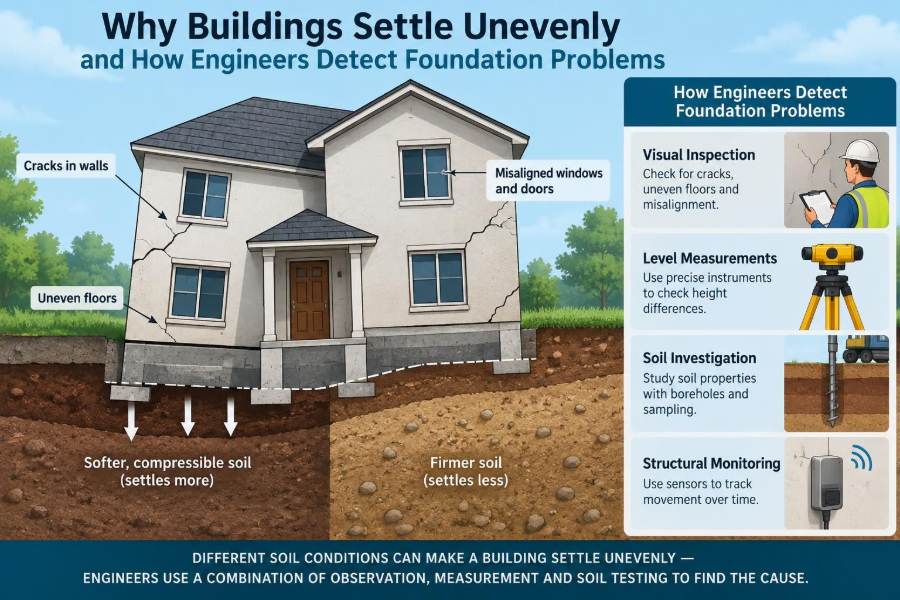
That condition, called differential settlement, can distort walls, floors, roofs, and services that were designed to work as a connected system. The visible crack is often only the symptom; the engineering question is what is moving, why it is moving, and whether the movement is ongoing.
Understanding the mechanics helps owners describe problems accurately, helps students connect soil behavior to structural response, and helps professionals choose investigations that address causes rather than cosmetic evidence.
🏗️ Settlement Is Not Always a Defect
Settlement is the downward movement of a foundation as the ground beneath it deforms. Some settlement is expected, particularly after construction loads are first applied.
A well-designed foundation can tolerate a modest, relatively uniform downward movement because the whole building moves together. What matters more than total vertical movement in many cases is the difference in movement between supports.
📐 Uniform and Differential Settlement
Uniform settlement is like lowering a book straight down onto a cushion: its orientation stays nearly the same. Differential settlement is like placing one end of that book on a softer cushion; it tilts or bends.
When one footing settles more than another, beams redistribute forces, masonry cracks, partitions separate, and windows may become out of square. The resulting damage depends on the amount, pattern, and rate of relative movement, as well as the building’s stiffness.
| Movement pattern | Typical structural effect | Common clue |
|---|---|---|
| Mostly uniform downward movement | Often limited distortion | Building remains level relative to itself |
| One side moves more | Racking and rotation | Sloping floors or sticking doors |
| Middle moves more | Sagging distortion | Cracks and low points near the center |
| Ends move more | Hogging distortion | Cracking concentrated near internal supports |
🧱 Foundations Transfer Loads, Not Problems Away
A foundation spreads building loads into soil or rock at pressures the ground can support without excessive deformation. It does not make weak, variable, or water-sensitive ground disappear.
Shallow foundations, such as strip footings, pad footings, and rafts, rely on near-surface materials. Deep foundations transfer load farther down through piles, piers, or drilled shafts. Each system has failure modes that depend on the site and construction quality.
🌍 Soil Is a Variable Construction Material
Unlike steel or concrete, soil is deposited by natural processes and can vary substantially over short distances. A site may contain firm sand in one area, soft clay in another, and old fill near a former excavation.
Engineers consider soil layering, density or consistency, groundwater, drainage, strength, compressibility, and the likely changes over the building’s life. A borehole gives valuable local evidence, but several investigation points may be needed to understand a variable site.
🧽 Compressible Clay and Consolidation
Saturated clay often settles gradually when loaded because water in its tiny pores must drain before the soil skeleton carries more of the load. This time-dependent process is called consolidation.
The rate and magnitude depend on clay properties, layer thickness, drainage paths, and imposed stress. A structure on thick compressible clay may continue moving long after construction, while a nearby area founded on stiffer material moves much less.
🏖️ Loose Sand and Densification
Loose granular soils can rearrange into a denser state when loaded or vibrated. Settlement may occur during construction, under repeated traffic or machinery vibration, or after changes in water conditions.
Compacted engineered fill can perform well when placed in controlled layers and tested. Uncontrolled fill containing variable soil, rubble, organic material, or voids is much less predictable and is a frequent source of local settlement.
🌱 Organic Soils and Decaying Material
Peat, topsoil, buried vegetation, and other organic deposits are generally unsuitable as direct bearing material. They are compressible and can lose volume as organic matter decomposes.
Problems also arise where demolition debris, tree stumps, or poorly documented fill has been buried below a slab or footing. A building may look sound initially, then develop localized movement when a void forms or weak material compresses.
💧 Water Changes Soil Behavior
Water is often the key variable in foundation problems. It can soften certain soils, alter effective stress in saturated ground, erode fine material, and trigger shrink-swell cycles in clay.
Water alone is not inherently harmful; many foundations perform safely below groundwater. The risk is an unfavorable change in moisture, drainage, or seepage that the original design did not accommodate.
🌧️ Poor Surface Drainage
Roof runoff, paved surfaces, and ground grading should direct water away from the building in a controlled manner. Downpipes that discharge beside a footing can repeatedly wet the same zone of soil.
Ponding near walls may indicate blocked drains, settled landscaping, or poorly sloped paving. Correcting surface drainage can be an essential part of a repair strategy, but it should not be assumed to cure damage without diagnosing the soil and foundation conditions.
🚰 Leaking Pipes and Hidden Washout
A leaking water supply, drain, or sewer can introduce water where it was not expected. In granular soils, sustained flow may carry fine particles away, creating loss of support or a void.
Leaks can be difficult to distinguish from normal groundwater or stormwater effects. Plumbing pressure tests, camera surveys, moisture observations, and selective excavation may be combined to investigate the possibility.
🌡️ Expansive Clay Shrink and Swell
Some clays expand when wet and shrink when dry. If moisture changes are uneven beneath a building, the resulting heave or settlement can be uneven too.
Vegetation, leaking services, seasonal weather, and changes in paving can all influence local moisture. Expansive soil behavior is site-specific; it should be assessed using geotechnical evidence rather than inferred solely from the presence of cracks.
🌳 Trees Can Influence Foundation Moisture
Tree roots do not usually “push” a heavy building upward in the way popular illustrations suggest. More commonly, a mature tree extracts water from moisture-sensitive clay, causing soil volume reduction within its zone of influence.
Removing a large tree can also change the moisture regime and allow some clays to rehydrate and swell. Decisions about pruning, removal, or replacement need coordination among structural, geotechnical, and arboricultural professionals where movement is significant.
🏘️ Adjacent Construction and Excavation
Excavating next to an existing foundation can remove lateral support from the soil, change groundwater conditions, or cause local ground relaxation. The risk grows when work extends below neighboring foundation level.
Nearby dewatering, tunneling, pile installation, heavy compaction, and demolition can also affect ground movement. Baseline condition surveys and movement monitoring are practical safeguards when construction is close to existing structures.
⚖️ Uneven Building Loads
Variable soil is not the only explanation for differential movement. A heavily loaded column, an added storey, a water tank, or a new masonry wall can impose much greater load on one part of a foundation.
A change of use can matter as well. Converting a lightly loaded space into storage or installing heavy equipment may require verification of both the structural framing and the supporting ground.
🕳️ Voids, Erosion, and Ground Loss
Ground can be lost through leaking drains, erosion along a slope, poorly compacted service trenches, collapse of abandoned utilities, or natural dissolution features in susceptible geology. These mechanisms may create localized settlement rather than broad, gradual movement.
Sudden depressions, recurring sinkholes, persistent wet spots, or loss of material from a drain are reasons for prompt professional assessment. The investigation must establish the extent of the void before an effective repair can be selected.
🏠 Slabs and Foundations Behave Differently
A cracked ground-bearing slab is not always evidence that the main foundation has moved. Many slabs are designed to rest on prepared ground and are separated structurally from the building frame or perimeter footings.
Conversely, a slab can contribute to structural behavior in some systems. Drawings, construction details, crack locations, and level surveys help determine whether observed movement belongs to a nonstructural floor, the foundation, or both.
🧩 What Cracks Can and Cannot Tell You
Cracks are evidence, not a diagnosis. Their direction, width, location, shape, and whether they are changing can suggest patterns of movement, but no single crack proves a particular cause.
Diagonal cracks near openings may be associated with distortion because openings concentrate stress. Vertical cracks in masonry may relate to movement, thermal effects, shrinkage, or detailing. A qualified assessment considers the whole pattern rather than treating one photograph as conclusive.
🚪 Everyday Signs Worth Recording
Small changes are easier to assess when they are documented over time. A simple record can help a professional separate an old, stable imperfection from active movement.
- Doors or windows that begin sticking without an obvious hardware problem.
- New separation at skirtings, cornices, built-in cabinets, or service penetrations.
- Cracks that reopen after repair or visibly widen.
- Floors that feel uneven, especially if the change is recent.
- Gaps where walls meet ceilings, extensions, or external paving.
- New drainage issues, wet ground, or unexplained changes in nearby vegetation.
Photographs with dates and a consistent reference point are more useful than memory. Do not force doors, cover cracks, or undertake structural alterations before the condition has been assessed.
📏 Level Surveys Measure the Shape of Movement
A level survey establishes elevations at selected points across floors, footings, pavements, or external walls. The result is a map of relative levels, which can reveal tilt, sag, or localized depressions.
A single survey is a snapshot. Repeated surveys using consistent reference points are more informative when movement is suspected to be active. Measurement precision, access, floor finishes, and the chosen datum all affect interpretation.
📍 Crack Gauges and Movement Monitoring
Crack monitors can measure opening, closing, and sometimes relative shear across a crack. They are useful when installed across a representative crack and read at planned intervals.
Monitoring does not explain the cause by itself. It answers a narrower but crucial question: is the feature changing, by how much, and in what conditions? Engineers may correlate readings with rainfall, temperature, construction activity, or plumbing repairs.
🔎 Site Inspection Starts With a Pattern
A structural engineer typically begins by reviewing the building form, age, additions, visible distress, drainage, topography, nearby trees, and adjacent work. The aim is to identify patterns that merit testing.
Inspection also includes noting crack locations on plans, checking relative alignment, looking for service damage, and distinguishing structural elements from finishes. Historic photos, past reports, repair records, and original drawings can be particularly valuable.
🧪 Ground Investigation Tests Assumptions
Where the cause remains uncertain or repairs are substantial, a geotechnical investigation may include boreholes, trial pits, sampling, in-situ testing, and laboratory testing. Trial pits can expose footing depth, width, material, and near-surface soil, but must be excavated safely.
The scope should answer a decision-focused question: for example, whether a weak layer extends beneath the building, whether fill is present, or whether underpinning can reach competent bearing material. More testing is not automatically better if it does not reduce the key uncertainty.
📡 Non-Destructive Tools Have Limits
Ground-penetrating radar, thermal imaging, drain cameras, moisture meters, and acoustic methods can provide useful clues with limited disturbance. They are often valuable for screening utilities, anomalies, or moisture patterns.
However, indirect methods require experienced interpretation and may be affected by soil type, reinforcement, moisture, and access. They rarely replace direct confirmation where a major foundation decision is at stake.
🧠 Diagnosis Requires Multiple Lines of Evidence
Good diagnosis combines observations, measurements, drawings, service information, soil data, and the timeline of changes. A crack pattern may suggest a hypothesis; level data and a trial pit may support or challenge it.
This approach prevents a common error: treating correlation as proof. For example, a nearby tree and a crack may coexist, but the operative cause might instead be a leaking drain, shallow fill, an overloaded extension, or a combination of factors.
🛑 When the Situation Needs Urgent Attention
Some signs call for prompt assessment rather than routine monitoring: rapidly changing cracks, a visibly leaning wall, sudden floor depression, loss of support beneath a wall, fractured gas or water services, or new movement following excavation.
If there is a credible risk of collapse or a service hazard, keep people away from the affected area and contact appropriate emergency or utility services as well as a qualified professional. Temporary shoring is a specialist task; improvised supports can transfer loads unpredictably.
🪜 Drainage Repairs May Be the First Fix
When water is contributing to movement, practical repairs may include reconnecting downpipes, repairing leaks, improving grading, clearing drains, or redesigning surface runoff. These measures address the mechanism rather than merely hiding its effects.
They are not universally appropriate. Rapidly changing soil moisture can itself influence expansive clay, and drainage modifications must not divert water onto a neighbor’s property or undermine a slope. The design should match the site conditions.
🔧 Underpinning Is a Tool, Not a Default Answer
Underpinning strengthens or deepens an existing foundation so load can be transferred to more suitable ground or distributed differently. Methods include mass concrete underpinning, beam-and-base systems, mini-piles, and resin or grout approaches in selected situations.
The best method depends on access, load path, soil profile, groundwater, services, adjacent structures, and the cause of movement. Underpinning a foundation without stopping an active leak or ground-loss mechanism may not solve the underlying problem.
🧱 Ground Improvement and Rebuilding Options
Some projects are better addressed by improving the ground, compacting or replacing unsuitable material, filling verified voids, or rebuilding a lightly loaded slab. In severe cases, partial demolition and reconstruction may be safer and more rational than attempting to preserve every element.
Each option has limits. Grouting, for example, can be useful in appropriate soils and void conditions but is not a generic way to “lift” every settled building. Repair proposals should state the intended load-transfer or ground-improvement mechanism clearly.
🪚 Repair Cracks Only After Movement Is Understood
Repointing masonry, patching plaster, sealing joints, and rehanging doors restore appearance and function, but they do not establish whether the structure has stabilized. Cosmetic repairs are best timed after the cause is addressed or after monitoring provides a defensible basis for proceeding.
Where limited ongoing movement is expected, repair details may need flexibility: movement joints, compatible sealants, or finishes that tolerate small displacement. Rigid patches placed across active joints commonly crack again.
🗂️ Records Make Future Decisions Safer
Keep investigation reports, drawings, photos, monitoring records, drainage plans, repair specifications, and completion information together. Future owners and engineers need to know what was found, what was changed, and whether the repair addressed soil, water, structure, or all three.
Clear documentation also prevents unnecessary repeat work. A repaired crack without a record may look like fresh damage years later, while a dated monitoring history can show that a condition has remained stable.
⚠️ Common Misdiagnoses to Avoid
Several shortcuts lead to poor decisions. “All cracks are settlement” is wrong; many are related to shrinkage, temperature, finishes, or local detailing. “No cracks means no problem” is also wrong, especially where movement occurs in hidden foundations, external ground, or flexible framing.
- Assuming a visual inspection alone can determine soil conditions.
- Choosing underpinning before identifying the movement mechanism.
- Using a single level reading to claim movement is ongoing.
- Blaming trees, weather, or age without supporting observations.
- Ignoring drainage and underground services during a foundation assessment.
- Comparing crack widths without considering wall type, location, and time.
👷 Roles of Structural and Geotechnical Engineers
Structural engineers assess how the building carries load, how distortion affects safety and serviceability, and what strengthening or repair details are feasible. Geotechnical engineers assess ground conditions, groundwater, soil behavior, and foundation-ground interaction.
Many cases benefit from both disciplines. A sound repair needs a compatible answer to two questions: can the ground support the loads, and can the structure safely transfer those loads there?
🧭 A Sensible Investigation Sequence
The exact sequence varies, but a proportionate process prevents both neglect and overreaction.
- Make safe any immediate hazards and record visible conditions.
- Review the building history, services, drainage, site changes, and nearby works.
- Inspect and map the pattern of distress.
- Measure levels or install monitoring where active movement is uncertain.
- Undertake targeted drainage, service, structural, or geotechnical investigations.
- Develop repairs that address the confirmed mechanism and verify their performance where needed.
This sequence can stop early when evidence shows a stable, nonstructural issue. It can become more detailed when consequences or uncertainty are greater.
🎯 The Core Principle: Find the Mechanism
Uneven settlement is not a single defect with a universal repair. It is the structural outcome of unequal support, unequal loading, changing soil conditions, water movement, ground loss, or a combination of these factors.
The most reliable assessments move from symptoms to mechanism: observe the building, measure change, investigate the ground and water where justified, then select a repair that fits the evidence. That discipline protects both safety and resources.
Buildings settle unevenly when support or loading changes unevenly, and the right response is careful diagnosis before cosmetic repair or major intervention. A crack deserves attention, but sound engineering turns that attention into evidence-based action. 🏗️💧🔍