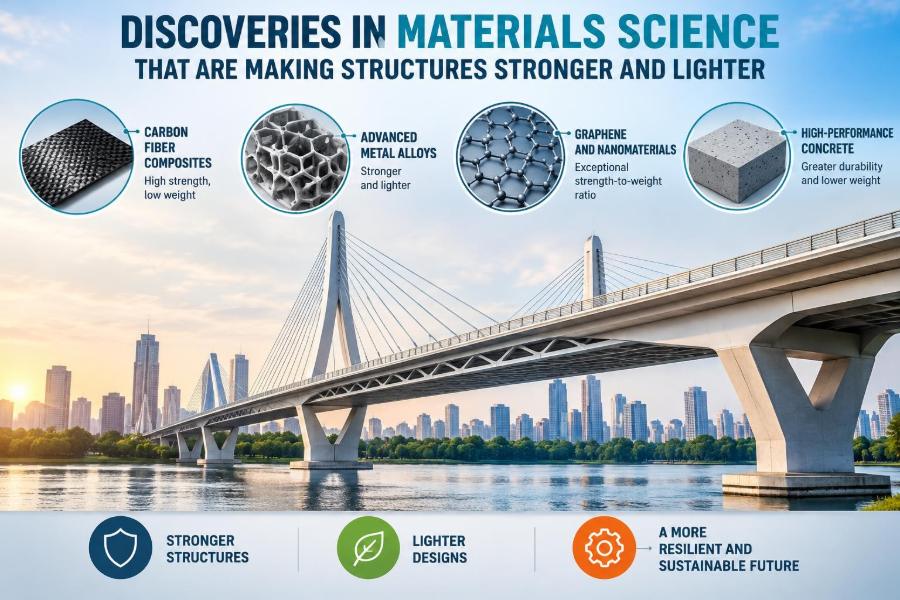

A footbridge deck that deflects less, a tower crane that lifts a larger payload, and an electric vehicle that travels farther all share a deceptively simple engineering objective: achieve the required performance with less unnecessary mass.
For structural engineers, reducing weight is never just an aesthetic exercise. Dead load influences foundations, seismic forces, member sizes, transport, erection methods, and sometimes the feasibility of an entire project. Yet a lighter material is not automatically a better structural material.
The real opportunity lies in materials that deliver more useful strength, stiffness, durability, or energy absorption for each kilogram used. Advances in chemistry, manufacturing, and computational design are expanding that toolbox.
Some of these advances are already routine on job sites. Others remain specialized or developmental. Understanding the difference helps engineers ask better questions long before a material appears in a specification.
🧭 The engineering target is performance, not simply low weight
Density measures mass per unit volume, but structural selection depends on much more. A low-density foam may be extremely light and still be unsuitable for a beam because it lacks stiffness, strength, or resistance to local crushing.
Engineers therefore often compare specific strength and specific stiffness: strength or elastic modulus divided by density. These ratios show how efficiently a material carries load relative to its own weight.
Aerospace structures make this tradeoff highly visible, but the same logic applies to long-span roofs, façades, modular units, cranes, offshore platforms, and seismic retrofits.
⚖️ Strength and stiffness solve different problems
Strength is resistance to failure, such as yielding, fracture, buckling, crushing, or fatigue damage. Stiffness is resistance to deformation under service loads. A member can be strong enough to avoid collapse but flexible enough to cause discomfort, cracking, ponding, or façade damage.
This distinction matters when replacing steel with aluminum, fiber-reinforced polymer, or timber. The redesign may need a deeper section, a different geometry, or more careful connection detailing to satisfy deflection and vibration limits.
🧱 Concrete is becoming more precisely engineered
Concrete has long been valued for compressive strength, fire resistance, local availability, and adaptability. Materials science is making its internal structure more controllable, from particle packing in the paste to fibers that bridge cracks.
Modern mixes are not defined only by cement, sand, stone, and water. Supplementary cementitious materials, chemical admixtures, optimized aggregate grading, and fibers can be selected to address a particular structural behavior.
The aim is often not the highest possible cylinder strength. It may be lower permeability, reduced shrinkage cracking, improved placement in congested reinforcement, or reliable early-age strength for a fast construction sequence.
🔬 Particle packing improves cement paste efficiency
The paste in concrete contains tiny voids between cement and other fine particles. Better particle-size distribution allows smaller particles to fill spaces between larger ones, reducing the water needed for workable placement.
Lower water content can increase strength and reduce capillary porosity when curing is adequate. Fine mineral additions can also change the pore structure and react with calcium hydroxide, depending on the material and mix conditions.
This is one reason high-performance concrete is a system rather than a single ingredient. A promising laboratory proportion can perform poorly in the field if moisture corrections, mixing energy, temperature, or curing are not controlled.
🧪 Supplementary binders can improve durability
Materials such as slag, fly ash where available and suitable, calcined clay, and natural pozzolans can partially replace portland cement in selected mixtures. Their effects vary with chemistry, fineness, replacement level, curing, and exposure conditions.
In favorable applications, these additions can refine pore structure and improve resistance to chloride ingress or certain chemical exposures. They may also reduce the clinker content associated with cement production.
However, slower early-age strength development can affect stripping times and construction schedules. Specifications should define performance requirements and testing rather than assume every replacement behaves identically.
🕸️ Fibers change how concrete cracks
Plain concrete is strong in compression but weak and brittle in tension. Steel, synthetic, glass, basalt, or other fibers can bridge developing cracks and provide post-cracking resistance.
Fiber-reinforced concrete is especially useful where distributed reinforcement is valuable: slabs-on-ground, tunnel linings, precast elements, overlays, and impact-resistant components. Fibers can reduce crack widths and improve toughness, but they do not automatically replace conventional reinforcing bars.
The crucial design question is the residual capacity after cracking. Fiber type, aspect ratio, dosage, orientation, and bond all influence this behavior, as do the testing method and the intended failure mode.
🌡️ Shrinkage and heat still govern real concrete behavior
A stronger mixture can still crack if it undergoes restrained shrinkage or excessive temperature gradients. Large pours, thin slabs, hot weather, and high-binder mixes require an early-age plan.
That plan may include curing, insulation, placement sequencing, joint design, temperature monitoring, or adjusted binder selection. Material innovation works best when paired with construction control.
🪨 Ultra-high-performance concrete uses a dense microstructure
Ultra-high-performance concrete, often abbreviated UHPC, typically combines a very dense cementitious matrix with carefully graded fine particles and fibers. It can provide high compressive strength, very low permeability, and substantial tensile performance after cracking.
Its most compelling structural use is frequently material reduction in targeted locations: thin precast panels, connection zones, bridge joints, overlays, and slender elements. It is not necessarily economical for every cubic meter of a large foundation or floor plate.
Designers must consider curing requirements, fiber distribution, specialized placement, and the availability of validated design guidance. A small volume used strategically can be more sensible than specifying it everywhere.
🧵 Carbon fiber creates efficient tension members
Carbon-fiber-reinforced polymer, or CFRP, combines strong carbon fibers with a polymer matrix that transfers load and protects the fibers. It is lightweight, corrosion-resistant, and exceptionally efficient in tension along the fiber direction.
Common structural uses include externally bonded strengthening strips, near-surface-mounted bars, prestressing tendons in specialized applications, and lightweight components. For an existing beam with limited reserve capacity, adding CFRP can avoid the dead load and disruption of a thicker concrete or steel jacket.
Its directional nature is fundamental. Fibers can be placed where tension is expected, but loads perpendicular to the fibers or through the thickness require careful laminate and connection design.
🧶 Glass and basalt fibers offer different tradeoffs
Glass-fiber-reinforced polymer, commonly GFRP, is generally less stiff than carbon fiber but can be a practical corrosion-resistant reinforcement option. Basalt-fiber products are also used in certain reinforcement and composite applications.
Unlike steel, fiber-reinforced polymer bars do not yield in the familiar ductile way; many exhibit linear-elastic behavior until rupture. This changes serviceability checks, safety philosophy, anchorage details, and the desired warning before failure.
Environmental exposure, resin formulation, alkaline conditions, creep rupture, ultraviolet exposure, and fire performance must be considered for the particular product—not assumed from the broad label “FRP.”
🔥 Fire is a decisive limit for polymer composites
Fibers may retain considerable capability at high temperatures, but polymer matrices can soften, degrade, or lose bond as temperatures rise. Smoke, flame spread, and protective detailing are also relevant to building applications.
This does not rule out composites. It means fire design must be explicit: use tested assemblies, suitable protection, conservative detailing, and performance requirements appropriate to the occupancy and exposure.
🔩 High-strength steel is more than a higher yield value
Advanced high-strength steels can allow thinner sections or higher-capacity components, particularly in vehicles, equipment, bridges, and certain building applications. Their benefit comes from combining strength with carefully managed ductility, toughness, weldability, and forming behavior.
Simply substituting a higher-grade steel into an existing detail is risky. Connection design, local buckling, fatigue, heat-affected zones, and code limits may control before nominal yield strength does.
A very thin high-strength plate may also be more vulnerable to distortion, corrosion loss as a proportion of thickness, or construction damage. Material choice and section geometry must advance together.
🧯 Toughness protects against unstable fracture
Toughness is a material’s ability to absorb energy before fracturing. It is not interchangeable with strength. A high-strength material with insufficient toughness for its service temperature and flaw tolerance can be a poor choice for a critical connection.
This is particularly relevant where cyclic loading, low temperatures, welded details, or accidental impact are possible. Fracture mechanics helps engineers assess how cracks and defects interact with stress rather than treating every component as flawless.
🧲 Stainless steel earns its place in aggressive environments
Stainless steels cost more initially than many carbon steels, but their corrosion resistance can reduce maintenance and section-loss risk in chloride-rich, wet, or architecturally exposed conditions. The right grade depends on the environment and detailing.
Crevices, stagnant water, contamination from carbon-steel tools, and dissimilar-metal contact can still create problems. “Stainless” does not mean maintenance-free or immune to poor drainage.
🌲 Engineered timber turns small pieces into large members
Mass timber products, including glued-laminated timber, cross-laminated timber, laminated veneer lumber, and related systems, use controlled manufacturing to create reliable structural elements from smaller wood pieces or veneers.
Timber has favorable strength-to-weight characteristics and can reduce transported mass compared with mineral-based systems. Prefabrication can also shorten erection time and improve dimensional coordination.
Wood remains a hygroscopic material: it exchanges moisture with its surroundings. Movement, moisture protection, connection detailing, biological durability, and long-term load effects require deliberate design.
🔥 Charring can be designed for, but it is not a shortcut
Large timber members exposed to fire can form a char layer that insulates the remaining section. This allows certain mass-timber elements to be designed using recognized fire-resistance methods.
That behavior is not universal across all timber assemblies. Adhesives, joints, exposed edges, cavities, encapsulation, and connection hardware can affect performance. Fire design must be based on the tested or code-recognized system, not on a general assumption that all thick wood behaves alike.
🐚 Biomimicry improves geometry as well as chemistry
Natural materials often derive remarkable performance from hierarchical structure. Bone, wood, shells, and spider silk organize material across multiple scales instead of relying on one uniform solid.
Engineers borrow this principle through cellular cores, ribbed panels, graded materials, and fiber architectures. The lesson is not to copy nature literally; it is to place material where stress paths demand it and remove it where it does little work.
🕳️ Cellular materials reduce mass while controlling deformation
Honeycomb panels, metal foams, lattice cores, and corrugated sandwiches place material away from the neutral axis. This can create a very stiff, light panel because bending stiffness rises sharply when material is separated into face sheets.
Such systems are useful for façades, vehicle floors, bridge decks, protective barriers, and lightweight enclosures. Their weak point is often not the panel field but the edges, inserts, joints, local impacts, or water ingress.
A sandwich panel should be designed as a system: face sheets resist bending, the core transfers shear and stabilizes the faces, and connections distribute concentrated load safely.
🖨️ Additive manufacturing enables complex load paths
Additive manufacturing builds parts layer by layer. Metal printing can create internal lattices, branched nodes, and topology-optimized forms that would be difficult or impossible to machine or cast conventionally.
For structural engineering, the clearest current opportunities are often specialized connectors, replacement parts, prototypes, and complex components with high value relative to their volume. Large primary building members remain constrained by build size, rate, cost, inspection, and qualification.
Layer direction, residual stresses, surface roughness, porosity, and post-processing can strongly affect fatigue performance. A beautiful printed geometry still requires defensible material data and quality assurance.
🧩 Topology optimization removes low-value material
Topology optimization uses loads, supports, design-space limits, and manufacturing constraints to propose where material should remain. The familiar organic-looking results reflect calculated stress paths, not decoration.
The output is a starting point, not a construction-ready design. Engineers must add tolerances, connection zones, inspection access, drainage, fire protection, fabrication logic, and redundancy. Optimization that ignores real constraints can create an elegant but impractical component.
🧠 Computational materials design speeds up screening
Models can help researchers and manufacturers explore compositions, microstructures, and process settings before extensive physical testing. This is useful for narrowing options in alloys, cementitious binders, polymers, and coatings.
But prediction is not certification. Small changes in production, impurities, curing, or geometry can alter measured properties. Structural applications still depend on representative testing, traceable production, and reliable design values.
📡 Self-sensing materials can reveal structural condition
Some materials and embedded systems can provide information about strain, cracking, moisture, corrosion conditions, or temperature. Examples include fiber-optic sensors, conductive fillers in cementitious materials, and instrumented composite components.
Monitoring can support maintenance decisions and reveal whether a structure behaves as intended. It does not eliminate inspection, and a sensor reading is only useful when its location, calibration, durability, and interpretation are understood.
♻️ Circular materials require a full life-cycle view
Recycled steel and aluminum can retain high value through repeated processing, while reclaimed timber, recycled aggregates, and reused structural components can reduce demand for virgin material when carefully assessed.
The structural question is not merely whether content is recycled. It is whether variability, contamination, residual damage, geometry, and traceability have been managed. Reuse is strongest when a component’s history and condition can be verified.
Designing for disassembly—using accessible bolts, separable layers, and documented components—can make future recovery more realistic than permanently bonded assemblies.
🚚 Lightweight construction changes the whole project system
Reducing superstructure mass can reduce seismic inertial forces, foundation loads, transportation demand, and crane capacity requirements. It can also enable prefabricated modules where site access is constrained.
These benefits may be offset by more expensive fabrication, stricter tolerances, specialized labor, or complex connection requirements. The best comparison considers the whole system rather than the purchase price of one material.
📏 Serviceability often controls lightweight design
In a light, slender structure, vibration, deflection, acoustics, and local denting can govern before ultimate strength. A floor that is safe but noticeably bouncy may not be acceptable to occupants.
Early dynamic analysis and realistic load-path modeling are especially valuable for long-span floors, pedestrian bridges, façades, and composite decks. Stiffness can be added efficiently through depth, curvature, diaphragms, ribs, or composite action rather than simply adding bulk.
🔗 Connections are where innovative materials succeed or fail
New materials frequently meet conventional steel fasteners, anchors, welds, adhesives, and bearings. These interfaces concentrate stress and expose differences in stiffness, thermal movement, corrosion behavior, and creep.
For example, drilling a composite member can interrupt fibers, while a timber-to-steel connection may need to accommodate moisture movement and fire protection. A lightweight member with an oversized connection may lose much of its system-level advantage.
Connection testing and constructability reviews should happen early, not after the primary member has been optimized.
🧪 Qualification bridges the gap from laboratory to site
Novel materials need a credible route from promising specimen to dependable structural product. That route includes repeatable manufacturing, characterization, durability assessment, component testing, design rules, inspection criteria, and installation procedures.
Engineers should ask what properties are guaranteed, over what temperature and exposure range, and by which test method. They should also ask whether the specified supplier, fabrication process, and geometry match the evidence being relied upon.
⚠️ Common mistakes when specifying advanced materials
- Using a headline property alone: high tensile strength does not resolve buckling, deflection, fire, or connection design.
- Ignoring anisotropy: composites and timber perform differently in different directions.
- Assuming durability without detailing: drainage, cover, coatings, sealing, and inspection still matter.
- Copying an unfamiliar detail: a successful application may rely on exposure conditions or quality controls that do not exist on the new project.
- Overlooking repair: access, replacement procedures, and compatible repair materials should be considered before construction.
🧰 A practical material-selection workflow
Start with the governing project need: reduced dead load, corrosion resistance, rapid erection, lower embodied impacts, impact resistance, or a difficult geometry. A material cannot be judged well until the performance target is clear.
- Define load cases, serviceability criteria, exposure, fire requirements, and design life.
- Compare candidate systems by structural efficiency, not density alone.
- Develop the connection and construction sequence alongside member sizing.
- Review supply chain, quality controls, repairability, and code acceptance.
- Use prototypes, mock-ups, or targeted testing when the risk or novelty warrants it.
📚 Codes provide a floor, not a substitute for judgment
Established standards provide tested design approaches for familiar materials and systems. When an innovative product falls outside those approaches, the engineer may need project-specific testing, evaluation reports, peer review, or an alternative means of compliance.
Conservatism is not resistance to innovation. It is the discipline of matching evidence to consequence. A noncritical cladding component and a primary seismic load path deserve different levels of validation.
🌍 The future is likely hybrid, not single-material
The strongest solutions increasingly combine materials according to what each does best: concrete for compression and protection, steel for ductility and connections, timber for efficient prefabricated members, and composites for selective reinforcement or corrosion resistance.
Hybrid construction also demands clear responsibility for interfaces. Differential movement, moisture pathways, galvanic corrosion, fire protection, and sequencing become central design issues.
🎯 The core principle: put the right material in the right place
Materials science gives structural engineers more choices, but it does not repeal mechanics. Lighter structures remain governed by load paths, stability, deformation, durability, fire, fatigue, and workmanship.
The most valuable discovery is often not a miraculous new substance. It is a better ability to tailor microstructure, geometry, and manufacturing so that each kilogram performs a defined job with less waste and greater reliability.
Stronger and lighter structures emerge when material innovation is paired with whole-system engineering, careful detailing, and evidence-based validation. That is how promising materials become dependable infrastructure rather than interesting samples in a lab. 🏗️🔬🌍