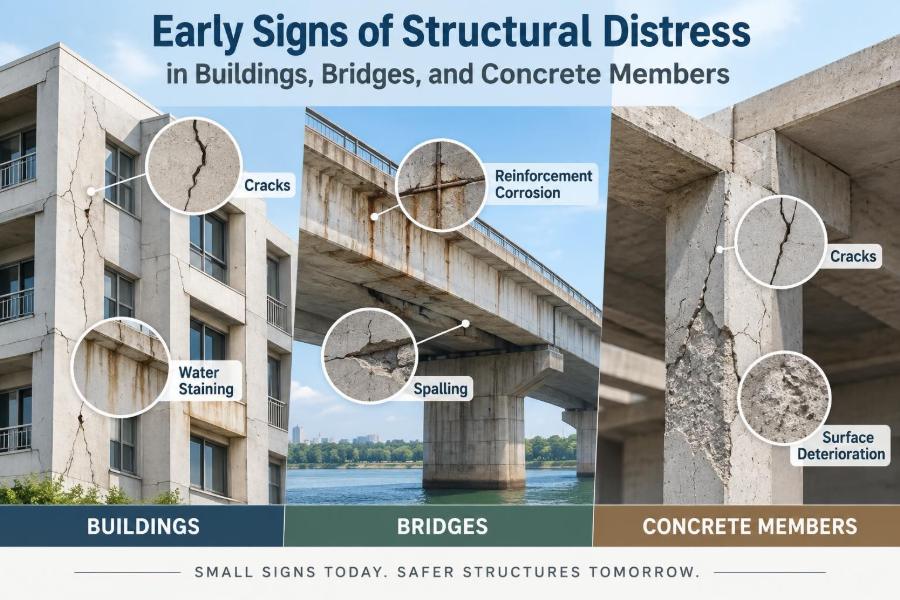

A hairline crack across a plastered wall, a bridge joint that suddenly feels rough under a vehicle, or a concrete beam with a rust-colored stain can seem like minor maintenance issues. Sometimes they are. Sometimes they are the first visible clues that loads, water, movement, or material deterioration are no longer being managed as intended.
Structural distress rarely announces itself with one dramatic event. More often, it develops through small changes: a door begins to stick, a floor feels uneven, concrete starts to flake, or a crack reopens after repeated patching. The challenge is to notice the pattern without jumping to conclusions.
For students, learning to read these signs builds sound engineering judgment. For working professionals and building occupants, it supports earlier reporting, safer decisions, and more targeted investigations.
A visible symptom is not a diagnosis. The same crack may result from harmless drying shrinkage, differential foundation settlement, thermal movement, corrosion, or overload. The task is to observe carefully, understand the structural context, and involve a competent engineer whenever the signs suggest a safety concern.
🧭 What Structural Distress Actually Means
Structural distress is a condition in which a structural system shows evidence of damage, deterioration, excessive deformation, or behavior outside what was intended in design. It does not automatically mean imminent collapse, but it does mean the condition deserves evaluation.
A structure works by transferring loads through connected elements: slabs to beams, beams to columns, columns to foundations, and foundations to soil. Distress may appear at any point in that load path. A local defect can remain local, or it can indicate a broader problem affecting the system.
🔍 Symptoms, Causes, and Consequences
Engineers separate what they see from why it occurred. A crack, spall, sag, stain, or misalignment is a symptom. Settlement, corrosion, inadequate detailing, water ingress, impact, or altered loading may be the cause.
This distinction prevents superficial repair. Filling a crack may improve appearance and keep out moisture, but it will not stop further movement if the foundation is still settling. A useful assessment asks three questions: What is visible? What mechanism could create it? What could happen if it continues?
📏 Crack Width Is Only One Clue
People often focus immediately on crack width. Width matters, especially when it increases over time, but it is not enough by itself to judge severity. Location, direction, depth, age, and whether the crack is active can be more revealing.
A narrow diagonal crack running from a window corner may indicate movement concentrated around an opening. A wider crack in nonstructural plaster may be visually alarming but less significant. Cracks should be assessed in relation to the element they cross and the forces that element carries.
🧱 Reading Crack Patterns in Masonry Walls
Masonry walls commonly crack along mortar joints because joints are weaker and provide a natural path. Stepped diagonal cracking can be associated with differential movement in foundations, although it may also arise from thermal and moisture movement or local stress around openings.
Vertical cracks may reflect shrinkage, thermal movement, or separation between materials. Horizontal cracking can be more concerning where it suggests lateral pressure, wall bowing, corroding embedded steel, or inadequate support. The wall’s role matters: a lightly loaded partition and a load-bearing masonry wall require very different levels of concern.
📐 Cracks Around Doors and Windows
Openings interrupt the flow of stress through a wall. Corners of doors and windows therefore concentrate stress, much like a notch in a sheet of material. Small cracks at these points are common in finishes, particularly where materials shrink or move differently.
Concern increases when cracks are diagonal and extend through masonry, grow seasonally or progressively, accompany sticking doors, or occur with uneven floors. A hypothetical example is a diagonal crack from a window corner that lengthens while nearby doors become difficult to close; together, those observations justify prompt professional review.
🏢 Column Cracks and What They Can Indicate
Columns deserve special attention because they are primary vertical load-bearing members. Vertical cracks may result from shrinkage, splitting caused by reinforcement corrosion, or compression-related distress. Inclined cracking can suggest shear effects, particularly near beam-column joints or heavily loaded regions.
Crushing, major spalling, exposed reinforcement, or a visibly displaced column should not be treated as routine cosmetic damage. Restrict access if safe to do so and arrange an urgent assessment by a qualified structural professional. The appropriate response depends on the structure, load condition, and extent of damage.
➰ Beam Cracks Follow the Forces
Reinforced-concrete beams tend to develop flexural cracks roughly perpendicular to their length in regions of high bending moment, often near midspan. Diagonal cracks closer to supports may be associated with shear, the internal force that tends to make one part of a beam slide past another.
Not every beam crack signals inadequate capacity; reinforced concrete is often designed with the expectation that controlled service cracks can occur. However, changes in crack width, an unusual crack pattern, heavy loading added after construction, or cracking combined with deflection requires engineering judgment.
🪜 Slab Cracking and Uneven Floors
Concrete slabs can crack from drying shrinkage, restraint, temperature changes, settlement, overloading, or inadequate joints. Random surface cracking, often called crazing when very shallow, differs from cracks that extend through a slab or form a persistent pattern around columns and supports.
An uneven floor may result from a finishing issue, slab deflection, foundation movement, or deterioration below the surface. A floor that has changed noticeably, feels springy, or shows new cracking near supports should be documented rather than simply covered with new finishes.
📉 Deflection, Sagging, and Loss of Level
Deflection is movement or bending under load. Some deflection is normal: a long beam or bridge span will flex when loaded. Distress is suggested when the movement is excessive, permanent, increasing, or accompanied by cracking, vibration, or damage to adjacent finishes.
A sagging ceiling line may be caused by framing deflection, roof loading, moisture damage, or a nonstructural ceiling problem. Measuring level changes at repeated locations can be more useful than relying on memory, which is easily influenced by lighting and perspective.
🚪 Sticking Doors and Windows as Movement Indicators
A sticking door is not proof of structural failure. Wood swells with humidity, hinges loosen, and frames can be installed out of square. Yet multiple doors or windows that begin sticking in the same area can reveal distortion of the supporting frame or movement in the building.
Look for associated evidence: cracked finishes at corners, gaps that widen at one side of a frame, sloping floors, or recent excavation nearby. The value of this symptom lies in the pattern, particularly when it represents a change from normal operation.
🌊 Water Is a Persistent Structural Adversary
Water does not always damage a structure immediately, but it creates conditions for many deterioration mechanisms. Leaks can rot timber, corrode steel, reduce soil strength, carry chlorides into concrete, and freeze in porous materials in cold climates.
Water staining should be traced to its source rather than painted over. Roof drainage, failed sealants, leaking pipes, blocked weep holes, poor site grading, and defective expansion joints can all direct water into places where it was never intended to remain.
🟤 Rust Stains and Reinforcement Corrosion
Rust-colored staining on concrete may indicate corrosion of embedded reinforcing steel. Steel expands as it corrodes, creating internal pressure that can crack concrete cover and eventually cause pieces to detach. This process is especially relevant where moisture and salts can reach the reinforcement.
Corrosion does not affect every stained area equally; stains can also originate from surface fixtures or runoff. Still, cracking parallel to reinforcing bars, hollow-sounding cover, and spalling near stains are strong reasons to investigate depth, extent, and the source of moisture.
🧩 Spalling, Delamination, and Exposed Steel
Spalling is the breaking away of concrete from the surface. Delamination describes a separated layer beneath an apparently intact surface. Both can arise from corrosion, freeze-thaw action, poor consolidation, fire exposure, impact, or chemical deterioration.
Spalls create two risks: falling concrete can endanger people below, and the loss of cover exposes steel to faster deterioration. Patching is often necessary, but durable repair also requires treating the cause, such as leaks, inadequate drainage, chloride exposure, or active corrosion.
🧪 Concrete Surface Clues That Need Context
Concrete may show discoloration, efflorescence, scaling, pop-outs, or surface dusting. Efflorescence is a white mineral deposit left when water moves through concrete or masonry and evaporates. It often indicates moisture movement, though not necessarily serious structural damage.
Scaling is loss of surface mortar, while pop-outs are small conical breakouts that can occur when reactive or porous particles near the surface expand. These clues guide inspection, but laboratory testing or detailed field assessment may be needed before assigning a cause.
🌡️ Thermal Movement and Failed Expansion Joints
Buildings and bridges expand and contract as temperatures change. Joints, bearings, seals, and flexible connections accommodate this movement. When they are blocked, deteriorated, or incorrectly detailed, forces can transfer into slabs, parapets, walls, and supports.
Signs include cracked joint sealant, displaced joint edges, buckled pavement, crushed joint material, and leaking water below a joint. A bridge expansion joint that allows water through can also accelerate deterioration of bearings and substructure components beneath it.
🌉 Bridge Deck Warning Signs
Bridge decks face repeated wheel loads, weather, de-icing chemicals in some regions, and water infiltration. Early distress may appear as cracking, potholes, scaling, leaking joints, worn waterproofing, or patches that fail repeatedly.
Deck defects are not only riding-quality issues. Water and salts entering through cracks can reach reinforcement and supporting elements. Inspection should consider drainage paths, joint condition, underside staining, and whether defects cluster in wheel paths, near drains, or at construction joints.
🔩 Bearings, Connections, and Unusual Movement
Bearings permit controlled movement and rotation between bridge superstructures and supports. Corroded, seized, displaced, or debris-filled bearings can restrain movement and introduce unintended forces elsewhere.
In buildings, bolted and welded steel connections also deserve scrutiny for corrosion, loose components, deformation, or cracked weld regions. An unusual gap, shifted bearing pad, or visibly distorted connection is not a condition to diagnose from a distance; it needs close inspection by trained personnel.
🚧 Impact Damage Is Often Underestimated
Vehicle strikes to columns, bridge girders, barriers, and parking structures can damage concrete, bend steel, fracture protective cover, or alter alignment. The visible dent or chipped corner may not reveal the full condition of reinforcement, connections, or internal cracking.
After an impact, note the location, likely direction of force, visible deformation, debris, and any change in clearance or alignment. Do not assume that a structure is safe because it remains standing; many members retain partial capacity after damage while needing repair or restrictions.
🌍 Foundation Movement and Soil-Related Distress
Foundations distribute building loads to soil or rock. Soil can change with moisture, erosion, adjacent excavation, poor drainage, settlement of fill, tree-root effects, or inadequate bearing conditions. The resulting movement is often uneven, known as differential settlement.
Common symptoms include diagonal wall cracking, floor slope, separations at additions, tilting elements, and distorted openings. The structural response may be visible far from the actual soil problem, so investigation should include site drainage, ground conditions, and recent changes around the building.
🌧️ Drainage Failures Can Trigger Bigger Problems
Downspouts that discharge beside a foundation, clogged roof drains, leaking underground services, and eroded slopes can concentrate water where it changes soil behavior or attacks materials. On bridges, blocked scuppers can pond water and accelerate deck and joint deterioration.
Drainage improvements are often among the most practical preventative measures, but they are not a substitute for evaluating existing damage. Redirecting water may slow future deterioration while an engineer determines whether settlement, corrosion, or section loss has already affected capacity.
🪵 Timber Distress Looks Different
Timber members may show rot, insect damage, splitting, crushing at bearings, excessive deflection, or moisture staining. Decay requires sustained moisture, so the source of wetting is central to any repair strategy. A dry-looking surface does not guarantee sound timber behind finishes.
Probing, moisture measurement, and selective opening-up can help determine extent, but these activities should be planned to avoid unnecessary damage or unsafe disturbance. Connections are especially important: a sound beam can still be compromised by deteriorated bearing areas or corroded fasteners.
🔥 After Fire, Appearance Can Mislead
Fire can reduce the strength and stiffness of steel, damage concrete near the heated surface, and char timber. The degree of damage depends on temperature, duration, protection, cooling, and load during the event. Soot alone does not describe structural condition.
Post-fire assessment may require examination of distortion, cracking, spalling, connection behavior, and material properties. Reoccupation or loading decisions should be made through a formal assessment process, not solely by visual cleaning or the absence of obvious collapse.
📳 Vibration, Noise, and Serviceability Changes
New vibration, rattling, popping, or creaking can be unsettling, but sound is not automatically a sign of structural failure. It can arise from thermal movement, loose finishes, mechanical equipment, traffic, or normal material response.
The useful question is whether the behavior is new, repeatable, load-related, or accompanied by visible movement and cracking. Excessive vibration can be a serviceability issue even where strength remains adequate, affecting occupant comfort and sometimes contributing to damage in finishes or connections.
📸 Document Changes Before They Disappear
Good documentation turns an isolated observation into usable evidence. Take clear photographs with a scale reference, record date and location, and use consistent viewing angles. Simple sketches can identify crack direction, nearby openings, drains, supports, and previous repairs.
For suspected movement, engineers may use crack gauges, level surveys, tilt monitoring, or other instruments. Monitoring is valuable when it answers a decision-focused question, such as whether a crack is stable, rather than becoming a substitute for action where immediate hazards are apparent.
🧰 What a Professional Assessment May Involve
A structural assessment typically begins with history: original drawings where available, age, alterations, leaks, loading changes, prior repairs, and timing of symptoms. The engineer then examines load paths, visible damage, surrounding conditions, and the relationship between symptoms.
Depending on the problem, further work can include measurements, non-destructive testing, material sampling, reinforcement location scanning, selective opening-up, or geotechnical investigation. Each method has limits. For example, a surface scan can reveal useful patterns but may not fully establish internal condition or cause.
🚦 When to Escalate Immediately
Some conditions should be treated as urgent rather than watched casually. Examples include sudden or rapidly increasing deformation, major concrete loss, exposed and heavily corroded reinforcement, damage after a significant impact, cracked or displaced primary members, or falling debris.
- Keep people away from the affected area if there is a credible risk of falling material or instability.
- Do not remove shores, braces, barriers, or temporary supports without competent direction.
- Report the condition through the building owner, facility manager, bridge authority, or emergency process appropriate to the site.
- Arrange evaluation by a qualified structural engineer or other responsible professional.
Local emergency services may be appropriate when there is an immediate threat to life or public safety.
🧱 Why Cosmetic Repairs Often Fail
Sealants, fillers, paint, and patch mortar have valid roles, but they cannot solve an active structural mechanism on their own. A repaired crack that returns is not necessarily evidence that the repair product was poor; it may indicate continuing movement, moisture entry, or restraint.
Successful repair begins with diagnosis. It may require drainage correction, corrosion mitigation, crack injection, joint restoration, added support, member strengthening, foundation work, or simply monitoring a stable condition. The least invasive repair is not always sufficient, and the most extensive repair is not always justified.
⚖️ Distinguishing Serviceability From Safety
Structural performance is not limited to collapse resistance. Serviceability covers behavior during normal use, including deflection, vibration, cracking, leakage, and appearance. A structure can be safe in a strength sense while still performing poorly for occupants or allowing deterioration to progress.
Conversely, a visible crack does not automatically mean a member lacks strength. This distinction encourages proportionate decisions: investigate evidence, understand the mechanism, and avoid both complacency and needless alarm.
🛠️ Maintenance Is Part of Structural Reliability
Many early distress signs are easier to prevent than to repair. Routine attention to roofs, drainage, joints, coatings, waterproofing, corrosion protection, and exposed connections keeps small defects from becoming pathways for water and deterioration.
Maintenance records also matter. Knowing when a crack first appeared, when a leak began, or when a joint was last replaced gives engineers a timeline that visual inspection alone cannot provide. Reliability depends on design, construction, use, and continued care.
🎓 A Practical Inspection Mindset
Whether you are a student on a site walk or a facilities professional reporting an issue, observe systematically. Start broad: What changed? Where does water travel? Which elements carry load? Then move closer: What is the crack pattern, condition of materials, and relationship to joints or supports?
Avoid declaring a cause from one sign. Instead, form possible explanations and look for confirming or conflicting evidence. This is the habit that turns inspection from a search for dramatic defects into disciplined engineering observation.
✅ The Core Principle: Notice, Record, Diagnose, Act
Early signs of distress matter because structures usually give information before damage becomes extensive. Cracks, corrosion stains, spalls, sagging, leaks, misalignment, and unusual movement are messages about material behavior, load transfer, or environmental exposure.
The right response is neither panic nor neglect. Notice the condition, record its features and progression, identify whether there is an immediate safety concern, and obtain competent assessment when the evidence points beyond routine maintenance. Treating the cause—not just the visible symptom—is what protects long-term performance.
The safest and most economical structural intervention is often the one made early, after careful observation and sound diagnosis. 🏗️🔎🧱