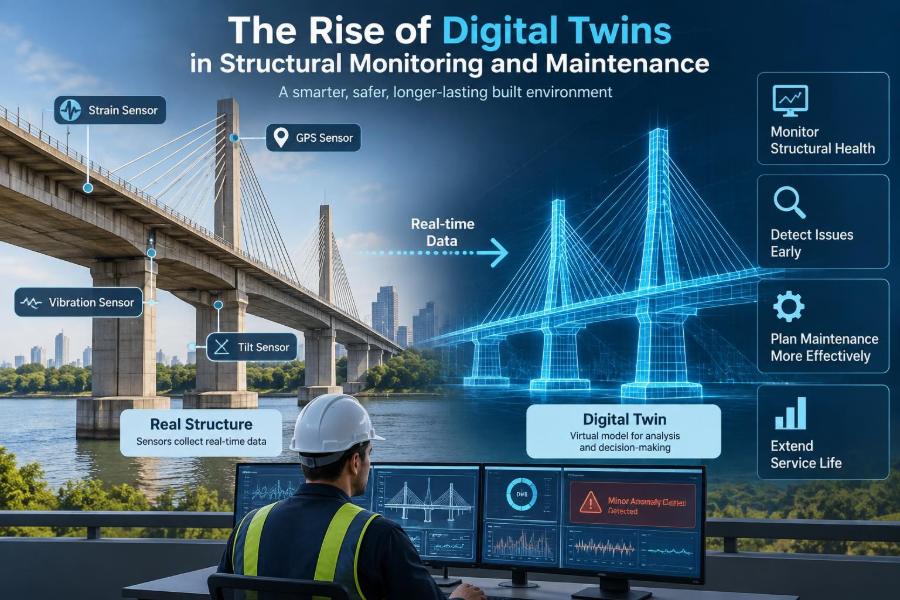

A bridge can look unchanged from the roadside while its bearings stiffen, a connection begins to slip, or a drainage detail allows moisture into a vulnerable joint. By the time a visible crack or closure appears, the underlying condition may have been developing for months or years.
Traditionally, engineers learn about that change through inspections, maintenance records, occasional surveys, and, sometimes, an unexpected event. These methods remain essential, but they are snapshots of an asset that is continuously responding to traffic, wind, temperature, water, and time.
A digital twin offers a different way to organize that understanding. It connects a usable digital representation of a physical structure with information from the real structure, allowing teams to compare expected and observed behavior as conditions evolve.
For students, the topic turns familiar structural concepts into a practical workflow. For working professionals, it raises a more demanding question: how can data improve engineering judgment without replacing it?
🧩 What a Digital Twin Actually Is
A digital twin is not simply a 3D model, a building information model (BIM), or a folder of sensor readings. It is a structured digital representation of an asset that is connected, at an appropriate level, to its real condition and operating context.
The connection may include geometry, material data, inspection findings, maintenance history, sensor measurements, analytical models, and environmental information. The twin is useful because these elements can be interpreted together rather than stored in separate systems.
🗂️ A Model Is Not Automatically a Twin
A design model describes what engineers intended to build. An as-built model records what was constructed. A digital twin goes further by supporting updates as the asset is used, inspected, repaired, and altered.
The distinction matters. A highly detailed 3D model with no reliable condition data may be valuable for coordination, but it cannot by itself reveal whether structural behavior has changed.
📡 The Link Between Physical and Digital
The “twin” relationship depends on a repeatable information loop: observe the structure, transfer and check data, interpret it against a model or baseline, then act when engineering review indicates action is warranted.
That loop need not be continuous. For a low-risk asset, periodic inspection updates may be enough. For a long-span bridge, a stadium roof, or a critical industrial facility, near-real-time measurements can be justified by the consequences of missed change.
🏗️ Why Structural Assets Need Continuous Context
Structures rarely experience one simple load. A bridge deck expands in heat, contracts at night, vibrates under vehicles, and responds differently as support conditions change. A raw measurement is difficult to interpret without this context.
A twin helps place observations alongside loading, weather, geometry, material assumptions, and past behavior. It turns the question from “is this number high?” into “is this response consistent with this structure under these conditions?”
🧠 Structural Monitoring Is More Than Sensors
Structural health monitoring is the organized observation of a structure to identify behavior, condition changes, or damage indicators. Sensors are one part of it, alongside inspection, calibration, data management, engineering interpretation, and decision rules.
Installing instruments without a clear purpose produces data, not necessarily knowledge. The first decision should be what uncertainty the monitoring system is meant to reduce: load effects, movement, vibration, corrosion exposure, fatigue demand, settlement, or another concern.
📏 Common Measurements in a Twin
Different structural questions require different measurements. A practical system selects a limited set that relates directly to credible failure modes or maintenance decisions.
- Strain indicates local deformation and can help assess stress trends when material behavior and sensor placement are understood.
- Acceleration captures vibration response and can support modal analysis, which examines natural frequencies and mode shapes.
- Displacement and tilt reveal movement at expansion joints, supports, towers, façades, or retaining structures.
- Temperature and humidity provide essential context because environmental effects can dominate structural readings.
- Corrosion-related measurements may help track exposure or electrochemical conditions, but they require careful interpretation.
🌡️ Temperature: The Most Frequent False Alarm
Many structures move more because of daily or seasonal temperature change than because of damage. A steel member lengthens when warmed; a concrete bridge can also respond through thermal gradients, creep, shrinkage, and restraint.
If a twin does not account for temperature, normal movement may be flagged as abnormal. Conversely, an actual change can be hidden inside broad seasonal variation. Establishing an environmental baseline is therefore a central part of implementation.
🎵 Vibration and the Structural Fingerprint
Every structure has dynamic characteristics, including natural frequencies, damping, and mode shapes. These characteristics can shift when mass, stiffness, boundary conditions, or temperature changes.
A frequency shift is not proof of damage. Traffic, occupancy, moisture, and temperature can cause shifts as well. Its value lies in a trend that prompts investigation, particularly when it appears with related observations such as unusual strain or a new inspection finding.
🧱 The Analytical Model Behind the Screen
Finite element models can form an important part of a structural twin. They estimate forces, displacements, stresses, and vibration behavior under defined assumptions, giving measurements a mechanical frame of reference.
But the model is an approximation, not a perfect replica. Connection stiffness, support restraint, cracking, construction tolerances, and load distribution are often uncertain. Calibration against measured behavior can improve usefulness, provided engineers do not tune parameters merely to make results look neat.
🔄 Model Updating Without Self-Deception
Model updating adjusts selected model parameters so calculated behavior better matches observations. It can refine assumptions about stiffness, mass, support conditions, or boundary restraints.
The risk is non-unique answers: several combinations of assumptions may match the same limited data. Updating should use physically plausible parameter ranges, independent checks, documented decisions, and more than one type of evidence where possible.
🧭 From Design Intent to As-Operated Reality
Design calculations usually address specified load cases and defined limit states. Operation introduces real traffic patterns, actual temperature cycles, modifications, maintenance constraints, and occasional unusual events.
A digital twin can preserve design intent while recording how the structure is truly performing. This is particularly valuable when knowledge would otherwise be lost during handovers between designers, contractors, operators, and future asset managers.
🚧 Bridges: A Natural Use Case
Bridges combine public safety, repeated loading, exposed environments, difficult access, and long service lives. Monitoring may focus on bearing movement, deck response, cable forces, fatigue-prone details, pier settlement, scour risk, or wind-induced vibration.
Consider a hypothetical movable or long-span bridge where an expansion joint begins showing a different movement pattern. The twin can compare its behavior with temperature, traffic loading, adjacent support movements, and inspection records. That does not diagnose the cause automatically, but it gives the engineer a focused starting point.
🏢 Buildings and Changing Use
In buildings, a twin can assist with settlement observation, lateral movement, vibration comfort, façade movement, long-term deflection, and the effects of changes in use. Renovations can introduce loads and openings that differ from original assumptions.
For occupied buildings, monitoring must be proportionate. A simple survey-control program and a well-maintained record of alterations may be more valuable than a complex sensor network with no clear maintenance plan.
🌬️ Tall Structures and Wind Response
Tall buildings, chimneys, masts, and towers may experience significant wind-driven movement. Accelerometers and weather data can help distinguish expected dynamic response from unusual patterns.
Monitoring can also inform occupant-comfort investigations, although comfort depends on perception, exposure duration, and building motion characteristics—not just one peak acceleration value. Structural safety and comfort are related but separate design and operational questions.
🏭 Industrial Structures Have Their Own Loads
Industrial facilities often face vibration from machinery, thermal cycling, moving equipment, pipe loads, corrosion, and frequent modifications. Their twin must reflect the actual operating process, not just the primary frame.
For example, a support structure near rotating equipment may need data on machine operating state as well as vibration. Without that operating context, a normal response at one speed could be misread as deterioration.
🧾 Inspection Data Still Carries Great Weight
Visual inspection, close-up examination, nondestructive testing, material sampling where appropriate, and dimensional surveys remain indispensable. Sensors may identify where to look; they do not see every crack, coating failure, blocked drain, or local defect.
A well-designed twin makes inspection findings searchable and spatially linked to elements. Photographs, defect descriptions, severity assessments, dates, and repair records become part of the engineering story rather than isolated attachments.
🧼 Data Quality Comes Before Analytics
A dashboard can make weak data look persuasive. Sensors drift, cables fail, clocks become unsynchronized, communication drops out, and units are entered incorrectly. A missing or biased reading can distort a trend.
Every monitoring plan should define quality checks, including plausible ranges, time synchronization, calibration records, missing-data flags, sensor metadata, and procedures for replacement. Data provenance—knowing where a value came from and how it was processed—is essential for defensible decisions.
🚨 Alerts Need Engineering Logic
Single fixed thresholds are often too crude because structural response varies with temperature, load, and operational state. A more mature approach uses baselines, contextual limits, rates of change, and combinations of indicators.
An alert should trigger a defined response, such as checking data quality, reviewing weather and operations, conducting a targeted inspection, or escalating to a responsible engineer. It should not imply that software has independently declared a structure safe or unsafe.
🛠️ Predictive Maintenance Means Better Timing
Predictive maintenance uses observed condition and performance trends to help plan interventions before a defect becomes disruptive. It differs from reactive maintenance, which begins after failure, and from purely calendar-based maintenance, which occurs on a fixed schedule regardless of condition.
The aim is not to predict every future defect precisely. It is to make timing, prioritization, access planning, and resource allocation better informed. Inaccessible components, such as bearings or cable anchorages, can be especially suitable candidates for targeted monitoring.
💰 Value Depends on the Decision
A digital twin earns its cost when it improves a real decision: whether to inspect, restrict loading, investigate movement, schedule a repair, defer a low-priority intervention, or preserve knowledge through an ownership transition.
High-risk and high-consequence assets often justify richer systems. For simpler assets, a disciplined asset register, condition records, periodic surveys, and selected instruments may provide a stronger return than a large, underused platform.
⚖️ A Practical Comparison of Approaches
| Approach | Best suited to | Main limitation |
|---|---|---|
| Periodic inspection | Visible condition, broad asset portfolios, accessible elements | Changes between visits may not be observed |
| Standalone sensor system | A focused question, such as movement or vibration | Measurements may lack asset and maintenance context |
| Digital twin workflow | Complex assets requiring integrated condition decisions | Requires governance, maintained data, and clear ownership |
These approaches are complementary rather than competing. A twin should strengthen inspection and engineering review, not create a false choice between physical and digital practice.
🔐 Cybersecurity Is a Structural Reliability Issue
Connected monitoring systems create digital vulnerabilities alongside physical ones. Unauthorized access, altered readings, unavailable data, or poorly controlled remote devices can undermine confidence in the system.
Asset owners should define access roles, authentication, network separation where appropriate, software update responsibilities, backups, and incident procedures. Cybersecurity decisions should involve information-technology specialists as well as engineers.
👥 Clear Ownership Prevents Digital Decay
Many promising systems lose value after commissioning because nobody owns calibration, data review, model updates, user training, or long-term hosting. A twin is an operational capability, not a one-time deliverable.
Responsibilities should be explicit: who validates incoming data, who can change the model, who reviews alerts, who approves maintenance actions, and how records are handed over. Without this governance, even excellent technology becomes an expensive archive.
🧑🔧 Human Judgment Remains at the Center
Algorithms can detect patterns, group similar responses, and prioritize large data sets. They cannot remove uncertainty about material condition, hidden defects, construction history, or the consequences of a decision.
Engineers must assess whether the measured quantity relates to a meaningful structural mechanism. They must also recognize when evidence is insufficient and further inspection or analysis is needed. A digital twin supports judgment; it does not transfer professional responsibility to software.
⚠️ Common Implementation Mistakes
- Starting with technology rather than a condition or maintenance question.
- Instrumenting convenient locations instead of critical structural details.
- Ignoring environmental and operational variables that explain normal variation.
- Treating an unvalidated finite element model as ground truth.
- Collecting more data than staff can review and act upon.
- Failing to budget for calibration, replacement, communications, and data stewardship.
These failures are usually process failures, not sensor failures. A smaller system with defined decisions and reliable upkeep is often more useful than a large one with unclear purpose.
🧪 Begin with a Focused Pilot
A pilot should address a bounded question, such as whether a suspected movement pattern is temperature-related, whether a difficult-to-access bearing is functioning as expected, or whether vibration changes after a retrofit.
- Define the asset risk and the decision the data must support.
- Identify credible mechanisms, measurements, and locations.
- Establish a baseline across representative operating and environmental conditions.
- Set quality checks, review responsibilities, and escalation actions.
- Evaluate whether the result improved the intended decision before expanding.
This approach lets teams learn about installation, data behavior, and organizational workload before committing to an enterprise-scale system.
📚 Skills Engineers Need to Build
Digital twin work sits across disciplines. Structural mechanics remains the foundation, but engineers also benefit from literacy in sensing, signal processing, statistics, databases, visualization, cybersecurity, and asset management.
Students need not become specialists in every field. The key is learning to ask sound questions: what does this sensor measure, what assumptions connect it to structural behavior, what confounders exist, and what decision changes if the result is different?
🌱 Lifecycle Thinking Changes the Design Brief
The best time to plan useful monitoring is often during design or major rehabilitation, when access, power, sensor protection, reference points, and data requirements can be incorporated deliberately. Retrofitting remains possible, but it may be more constrained.
Design teams can also leave a stronger digital foundation through consistent element identification, accessible documentation, records of critical assumptions, and details that facilitate future inspection. These modest choices help a twin remain credible over decades.
🔭 What the Next Stage Looks Like
Future systems will likely combine better sensing, automated image review, remote inspection tools, richer operational data, and more accessible analytical models. The useful advance will not be a more elaborate visualization alone; it will be tighter, traceable links between observation and maintenance action.
Interoperability will remain a practical challenge. Data must move between design tools, asset registers, monitoring platforms, inspection records, and maintenance systems without losing meaning, units, locations, or revision history.
✅ The Core Principle: Useful Twins Are Decision Systems
The strongest digital twin is not the one with the most sensors or the most realistic rendering. It is the one that helps responsible people understand an asset’s behavior, identify uncertainty early, and choose proportionate action.
That requires sound structural mechanics, reliable evidence, calibrated models, inspection discipline, and clear governance. Used this way, digital twins can make maintenance more targeted and asset knowledge more durable without claiming certainty where none exists.
Digital twins deliver real structural value when they connect trustworthy observations to engineering decisions across the life of an asset. The technology matters, but the quality of the questions, data, and judgment matters more. 🏗️📈🔧