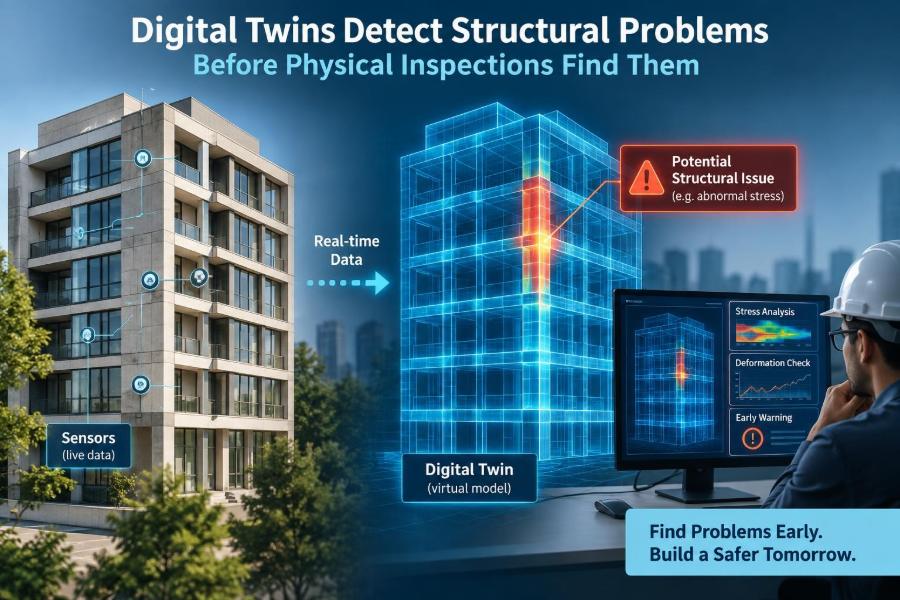

A facilities team notices that doors on one floor of an office building have started sticking after a long spell of hot weather. Nothing looks obviously wrong from the street. The next scheduled structural inspection is months away, and closing areas of the building for exploratory work would disrupt tenants.
Now imagine that the building’s digital model has been comparing recent sensor readings with its expected behaviour. It flags an unusual movement pattern near a transfer beam, shows when it began, and tells engineers which measurements need checking first. The alert is not a verdict, but it changes an unfocused search into a targeted investigation.
This is the promise of a structural digital twin: not a magical virtual building that “knows” everything, but a continuously updated engineering representation that helps teams notice meaningful change earlier.
For owners, engineers, and students, the key question is not whether a digital twin can replace inspections. It cannot. The more useful question is how it can make inspections more timely, safer, and better informed.
🏢 What a Structural Digital Twin Actually Is
A digital twin is a digital representation of a physical asset that is connected, to some degree, to information from the real asset. For a structure, it commonly combines geometry, design information, analysis models, inspection records, environmental data, and sensor measurements.
A static 3D building model is not automatically a twin. The “twin” idea becomes meaningful when the model is updated with operational evidence and used to compare observed behaviour with expected behaviour over time.
🧭 Why Conventional Inspections Can Miss Early Change
Visual inspections remain essential, but they are periodic snapshots. A crack may be hidden by finishes, movement may occur between visits, and the first visible symptom may appear far from the underlying cause.
Many structural changes begin as subtle shifts in strain, vibration, displacement, temperature response, or moisture conditions. A digital twin can track trends between site visits, especially where access is difficult or the structure is in continuous use.
🔍 Detection Is Not the Same as Diagnosis
An unusual sensor reading is an anomaly: something that differs from a reference condition or anticipated range. It does not automatically identify damage. A temperature swing, changed occupancy, construction nearby, a loose sensor, or a data transmission fault can all create unexpected readings.
Diagnosis requires engineering judgment. The twin helps establish where to look, what changed, and which hypotheses are plausible; engineers still determine whether the issue is deterioration, altered loading, a modelling limitation, or harmless variation.
🧱 The Physical Asset Comes First
A reliable twin begins with a clear understanding of the real structure: its load paths, materials, connections, support conditions, construction sequence, repairs, and known vulnerabilities. A detailed model cannot compensate for uncertain basics.
For an existing building, this may mean reconciling drawings with site verification. Renovations, undocumented openings, changed partitions, and altered drainage can matter as much as the original structural scheme.
📐 Building the Baseline Model
The baseline is the reference against which future observations are interpreted. It may include a building information model, a finite element analysis model, asset registers, photographs, and records of prior defects.
A finite element model divides a structural system into smaller mathematical elements to estimate forces, stresses, deformations, and vibration characteristics. Its value lies less in visual sophistication than in representing the behaviours that matter for monitoring.
📡 Sensors Turn Behaviour into Data
Sensors provide the connection between the physical asset and its digital counterpart. Common structural-monitoring instruments include strain gauges, accelerometers, displacement sensors, tiltmeters, crack gauges, temperature sensors, and moisture sensors.
Each measures only a particular quantity at a particular location. No single instrument “measures structural health,” so a monitoring plan must relate every measurement to a realistic failure mode, uncertainty, or inspection question.
🌡️ Environmental Effects Need Their Own Explanation
Structures expand, contract, dry, absorb moisture, and respond differently as temperatures change. A steel roof truss, concrete frame, bridge deck, and masonry wall all have environmental responses that can be larger than early damage signals.
That is why temperature, humidity, wind, rainfall, and sometimes solar exposure are valuable contextual inputs. Without them, a normal hot-day movement could be mistaken for a structural warning.
📈 Establishing Normal Behaviour Before Raising Alarms
Monitoring should usually begin with a learning period. The system needs observations across routine operating conditions: day and night, different temperatures, typical occupancy, traffic patterns, and seasonal changes where applicable.
“Normal” is rarely one fixed number. It is often a range or a relationship, such as how a measured strain changes with temperature or how a floor’s vibration response shifts with occupancy.
🧠 Comparing Measurements with Expected Response
The twin compares measured behaviour with one or more expectations: design calculations, calibrated numerical models, historical measurements, or relationships among sensors. A useful question is often, “Does this structure still behave like itself under comparable conditions?”
For example, a roof member that consistently shows more deflection than its established temperature-adjusted pattern may justify investigation, even if the absolute deflection alone is not obviously alarming.
⚙️ Model Calibration Makes Predictions More Useful
Initial engineering models contain assumptions about stiffness, connections, supports, material properties, and boundary conditions. Calibration adjusts plausible model parameters so predicted behaviour better matches observed data.
Calibration should not become curve fitting at any cost. If unrealistic parameters are needed to match readings, the mismatch may reveal a missing feature, poor data quality, or an incorrect understanding of the structure.
📉 Trend Changes Often Matter More Than Single Readings
A lone unusual value may be noise. A sustained drift, a sudden step change, or a growing difference between related sensors is often more informative. Time history gives engineers context that a single inspection observation cannot provide.
Consider a hypothetical parking structure: gradual increase in support rotation after repeated wet seasons could indicate settlement, joint deterioration, or drainage-related soil changes. The pattern would direct attention before distress became easily visible.
🎵 Vibration Can Reveal Changes in Stiffness
Every structure has natural ways of vibrating, described by frequencies and mode shapes. Changes in stiffness, mass, support conditions, or boundary restraints can alter those characteristics.
Accelerometers can help track this dynamic behaviour, particularly in bridges, tall buildings, floors, towers, and long-span roofs. Interpretation is challenging because temperature, operational loading, and sensor placement also affect measured vibration.
🪜 Movement Monitoring Can Expose Support Problems
Settlement, bearing movement, joint closure, and excessive rotation are not always easy to observe directly. Displacement sensors, survey targets, tiltmeters, and satellite or terrestrial surveying methods can provide repeatable evidence of movement.
A twin places those measurements within the load path. If two adjacent supports move differently, engineers can assess whether the differential movement is compatible with structural tolerance or likely to cause secondary stresses elsewhere.
💧 Moisture Data Can Warn of Deterioration Pathways
Water is not automatically a structural defect, but persistent moisture can enable corrosion, freeze-thaw damage, timber decay, leakage-related material degradation, or deterioration of finishes that conceal structural components.
Moisture and environmental data are especially useful when paired with inspections. Rather than searching every area equally, teams can prioritize zones with repeated wetting, poor drying conditions, or changing moisture patterns.
🧩 Combining Different Evidence Strengthens Confidence
The most credible alerts usually emerge from data fusion: combining multiple evidence sources. A strain change, local temperature record, nearby crack-gauge movement, maintenance history, and engineering model may tell a more coherent story together than any one signal.
This does not mean collecting every possible data stream. It means selecting complementary evidence that reduces ambiguity for the specific structural risks being managed.
🚦 Alert Thresholds Should Drive Decisions, Not Panic
An alert framework should define who receives a notification, what they review, how quickly they respond, and when an on-site inspection or operational restriction is required. Thresholds may be based on statistical deviation, physical limits, rate of change, or combinations of these.
A practical system often uses tiers: a data-quality check, an engineering review trigger, and a higher-level condition requiring immediate escalation. Thresholds must reflect uncertainty and the consequences of being wrong.
🛠️ A Typical Alert-to-Inspection Workflow
- Verify the measurement: check sensor health, communications, timestamps, and environmental context.
- Compare the event with baseline trends and related measurements.
- Review the calibrated model, drawings, recent alterations, and maintenance activity.
- Send an engineer to inspect the most relevant locations using targeted methods.
- Record findings, update the asset record, and revise the model or alert logic if needed.
This workflow is where early detection creates value. The twin does not eliminate fieldwork; it helps make fieldwork proportional to the evidence.
🏗️ Example: A Long-Span Roof Under Changing Loads
Imagine a hypothetical arena roof monitored with temperature sensors, displacement points, and strain gauges on selected critical members. During a winter event, snow accumulation and low temperatures occur together.
Rather than treating all increased strain as damage, the twin compares readings with the expected combined thermal and gravity-load response. If one region departs materially from comparable members or from the model trend, engineers can inspect that connection, drainage route, or local accumulation area first.
🌉 Example: Bridges Benefit from Continuous Context
Bridge inspections are indispensable, yet access constraints and variable loading make continuous context valuable. A twin can organize vehicle loading proxies, temperature, expansion-joint movement, bearing observations, vibration data, and inspection findings around the same structural model.
It may reveal that a bearing’s movement is becoming less responsive to temperature over time, suggesting that an inspection should focus on possible restraint, debris, corrosion, or deterioration. It cannot establish the cause without verification.
🏙️ Existing Buildings Are Often Harder Than New Projects
New structures can incorporate monitoring provisions during design and construction. Existing assets may have incomplete drawings, inaccessible members, unknown repair history, incompatible software records, and limited spaces for sensors.
Start with the decision need, not the desire for a fully instrumented model. A modest twin focused on settlement-prone foundations, a transfer structure, or a deteriorating facade support can be more useful than a broad but poorly maintained dashboard.
🧪 Data Quality Is a Structural Safety Issue
Bad data can waste engineering effort or conceal real change. Sensors can drift, detach, saturate, lose power, develop poor bonding, or report values in inconsistent units. Clock errors can also corrupt comparisons between systems.
Quality assurance should include calibration records, plausible-value checks, missing-data flags, sensor redundancy where justified, and routine physical verification. A digital twin needs maintenance just as physical monitoring equipment does.
🤖 Analytics Help Find Patterns, but They Need Guardrails
Statistical methods and machine-learning tools can identify unusual patterns in large datasets, cluster similar operating conditions, and prioritize records for review. They are helpful when data volume exceeds what people can inspect manually.
They are not a substitute for mechanics. An algorithm trained only on normal conditions may flag harmless changes, while one trained on incomplete or biased records may overlook meaningful events. Explainable outputs and engineering review remain crucial.
🧑🔧 Human Expertise Remains the Decision Layer
Structural engineers interpret load paths, construction details, degradation mechanisms, and consequences of failure. Inspectors bring direct observation: corrosion staining, unusual sounds, cracking geometry, drainage defects, loose fixings, and changes that instruments may not capture.
The strongest practice joins these roles. Monitoring analysts identify patterns, engineers form and test hypotheses, and inspectors verify conditions in the field.
⚠️ False Positives and False Negatives Have Different Costs
A false positive sends teams to investigate a condition that is not damaging. Too many can create alert fatigue and reduce trust. A false negative misses a meaningful developing problem, which may delay intervention.
The acceptable balance depends on the asset and consequence. A minor false alert at a low-risk location may be tolerable; a missed anomaly near a critical support or occupied public space demands more conservative monitoring and escalation.
🔐 Cybersecurity and Data Governance Belong in the Design
Connected monitoring systems create digital dependencies. Access control, secure communications, software updates, data backups, clear ownership, and audit trails should be planned from the start.
Data governance also answers practical questions: Who can alter a model? Which version is authoritative? How long are measurements retained? Can future engineers understand sensor locations, units, assumptions, and alert history?
💰 Value Comes from Better Decisions, Not More Dashboards
A twin can support maintenance planning, reduce unnecessary access work, document condition, and focus specialist inspections. Its value is greatest where failure consequences, inspection difficulty, uncertainty, or operational disruption justify the effort.
It may not be economical for every asset or every component. Instrumentation, communications, data storage, software integration, and skilled interpretation all have ongoing costs that should be considered honestly.
📋 Choosing a Sensible First Use Case
A good first use case has a defined structural question and an available response. Examples include monitoring differential movement during adjacent excavation, tracking a known crack near a critical connection, or observing a long-span roof through seasonal loading.
- Define the hazard or uncertainty being monitored.
- Identify the physical response that would provide useful evidence.
- Select measurements and locations that relate to that response.
- Set review and escalation responsibilities before data begins arriving.
- Plan how field findings will improve the twin.
If no action would change regardless of the reading, collecting that data is difficult to justify.
🧭 Common Implementation Mistakes
One common mistake is beginning with software procurement rather than engineering objectives. Another is copying sensor layouts from a different structure without checking whether the same load paths and deterioration mechanisms apply.
Teams also underestimate change management. If site staff, owners, designers, inspectors, and engineers use different naming conventions or cannot access the same current records, the twin becomes a parallel information silo.
📚 What Students and Early-Career Engineers Should Learn
Digital twins reward strong fundamentals. Learn structural analysis, material behaviour, dynamics, surveying, inspection practice, uncertainty, and construction methods before treating data analytics as the main skill.
Then develop data literacy: understand sampling rates, sensor accuracy, missing values, visualisation choices, and the difference between correlation and causation. The ability to ask whether a measurement makes physical sense is invaluable.
🔄 The Twin Should Evolve Through the Asset Life
A useful twin changes as the structure changes. Construction records establish the starting point; commissioning data establishes normal operation; inspections and repairs update condition; refurbishment changes geometry, loads, and assumptions.
This lifecycle view prevents a common failure: treating the model as a project handover artifact rather than a living engineering record. Updates should be controlled, traceable, and tied to verified information.
🧱 What Digital Twins Cannot Do
A twin cannot see inside every concealed component, predict every rare event, correct poor design, or remove the need for competent inspection. It also cannot reliably infer a specific defect from a limited signal when several explanations remain plausible.
Its output is only as dependable as the physical understanding, data quality, model assumptions, and response process behind it. Presenting uncertainty clearly is a strength, not a weakness.
✅ The Core Principle: Earlier Questions, Better Inspections
Digital twins are most valuable when they turn continuous observations into better engineering questions. Instead of asking inspectors to search a large asset with little context, they can indicate where behaviour has changed, under what conditions, and which structural mechanisms deserve attention.
That creates a practical division of labour: the digital system watches patterns, the model supplies context, and people inspect, judge, and act. Early detection is not about replacing physical inspections; it is about making them more targeted before small changes become harder, costlier, or riskier to understand.
When built around real structural decisions rather than impressive visuals, a digital twin becomes a disciplined way to connect measurements, mechanics, and field evidence across the life of an asset. 🏢📡🔧