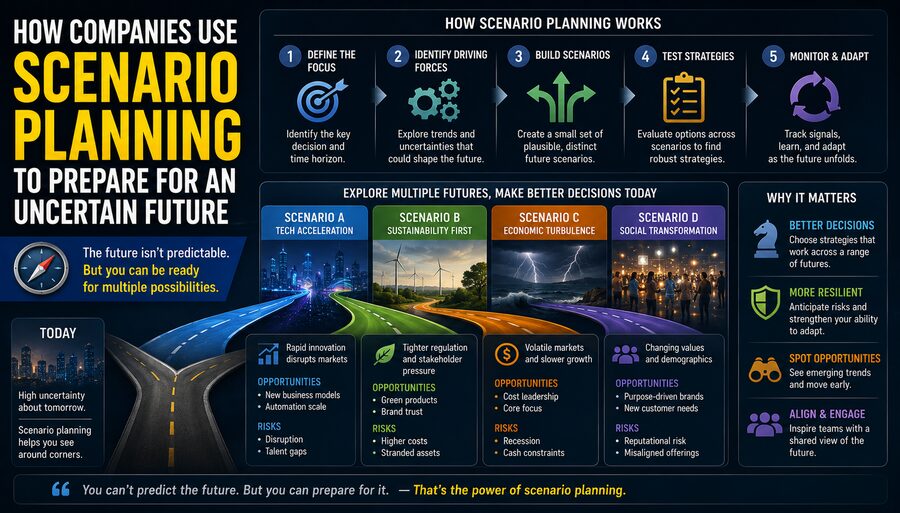

Businesses make decisions today that may not produce results for months or even years. A manufacturer may build a new factory, an energy company may invest in infrastructure expected to operate for decades, and a technology company may commit billions of dollars to a new platform. The difficulty is that no company can know exactly what the future will look like. 🌍📊
Economic conditions can change. New technologies can disrupt entire industries. Regulations may shift. Supply chains can fail. Consumer behavior can evolve rapidly. Competitors can emerge unexpectedly, and geopolitical events can reshape markets almost overnight.
Trying to predict one exact future is therefore extremely risky.
Instead, many organizations use a strategic technique known as scenario planning.
Scenario planning does not attempt to forecast precisely what will happen. Instead, it develops several plausible versions of the future and asks how the organization would respond if each one occurred.
The basic idea is:
Identify uncertainty ➡️ Create plausible futures ➡️ Test strategies ➡️ Prepare responses ➡️ Monitor warning signals
By rehearsing different futures before they happen, companies can make strategies more resilient and respond faster when conditions change. 🧠⚙️
🔍 What Is Scenario Planning?
Scenario planning is a structured method for exploring how major uncertainties could affect an organization.
A company might create scenarios such as:
- 📈 Rapid economic growth
- 📉 Global recession
- 🤖 Accelerated automation
- 🌱 Strict environmental regulation
- 🚢 Major supply-chain disruption
- 💰 Persistently high inflation
Each scenario describes a coherent future environment rather than simply changing one number in a spreadsheet.
For example, a recession scenario might include:
- Lower consumer spending
- Higher unemployment
- Increased price sensitivity
- Reduced business investment
- Pressure on profit margins
Management then asks:
“Would our current strategy still work under these conditions?”
If not, the company can identify changes that would make it stronger.
🔮 Scenario Planning Is Not the Same as Forecasting
Traditional forecasting usually tries to estimate the most likely future outcome.
A sales forecast might predict:
Revenue next year: $120 million
A financial model may then create a range around that number.
Scenario planning asks a different question:
“What different futures could fundamentally change the environment in which we operate?”
Instead of assuming that today’s trends continue, scenario planners deliberately explore discontinuities.
For example:
Scenario A: AI improves gradually.
Scenario B: AI dramatically automates 40% of industry workflows.
Scenario C: New regulations sharply restrict the use of AI.
All three futures may require very different business strategies.
Scenario planning therefore complements forecasting rather than replacing it.
🎯 Step 1: Define the Strategic Question
Good scenario planning begins with a clear decision.
A company might ask:
“How should we expand internationally over the next five years?”
or:
“What manufacturing capacity should we build for the next decade?”
or:
“How could artificial intelligence change our competitive position?”
The question needs a specific time horizon.
A retailer might study three years into the future, while an infrastructure company may examine twenty years.
Without a clear decision and time frame, scenario planning can become an interesting exercise that produces little practical value.
🌍 Step 2: Identify the Forces Shaping the Future
The next step is identifying major forces that could influence the company.
Strategists often examine categories such as:
💰 Economic Forces
These may include:
- Interest rates
- Inflation
- Employment
- Consumer spending
- Currency movements
- Economic growth
🏛️ Political and Regulatory Forces
Examples include:
- Tax policy
- Trade restrictions
- Environmental rules
- Data regulation
- Labor laws
- Government incentives
🤖 Technological Forces
These could involve:
- Artificial intelligence
- Robotics
- Biotechnology
- Cloud computing
- New energy technologies
- Cybersecurity
👥 Social Forces
Examples include:
- Demographic changes
- Consumer preferences
- Remote work
- Aging populations
- Urbanization
- Changes in public attitudes
🌱 Environmental Forces
These may include:
- Climate risks
- Water availability
- Extreme weather
- Carbon regulations
- Resource scarcity
Looking broadly prevents companies from focusing only on familiar business variables.
⚖️ Step 3: Separate Trends From Uncertainties
Not every future factor deserves equal attention.
Some developments are relatively predictable.
For example, population aging in a particular country may already be strongly supported by demographic data.
Other factors are highly uncertain.
For example:
Will governments impose aggressive carbon pricing within ten years?
or:
Will a new technology make today’s product obsolete?
Scenario planning focuses especially on uncertainties that are both:
Highly uncertain + Highly important
These are sometimes called critical uncertainties.
A factor that is uncertain but irrelevant to the business does not need to shape the scenarios.
Likewise, an important factor that is almost certain can often be included in every scenario.
🧭 Step 4: Select the Critical Uncertainties
Suppose an automobile manufacturer is planning for the next ten years.
Two major uncertainties might be:
1. How quickly will electric-vehicle adoption grow?
2. How strict will emissions regulation become?
These uncertainties could form the basis for several futures.
For example:
| Low Regulation | High Regulation | |
|---|---|---|
| Slow EV Adoption | Gradual Transition | Forced Transition |
| Fast EV Adoption | Market-Led EV Boom | Rapid Green Transformation |
Each quadrant creates a different strategic environment.
This simple framework helps ensure that scenarios are genuinely different from one another.
📖 Step 5: Turn Variables Into Stories
Scenario planning works best when each future is described as a coherent narrative.
Numbers alone may not reveal how events interact.
Suppose a company creates a scenario called:
🌱 “Green Acceleration”
In this world:
Governments introduce strict carbon limits. Electric vehicles become cheaper. Consumers increasingly prefer sustainable products. Fossil-fuel demand declines faster than expected. Renewable-energy investment increases sharply.
Another scenario might be:
🛢️ “Slow Transition”
Energy prices remain volatile, but regulation changes slowly. Consumers remain price-sensitive. Traditional technologies continue to dominate longer than expected.
These narratives help executives imagine how customers, competitors, suppliers, and governments might behave.
🧠 Step 6: Test the Current Strategy Against Every Scenario
Once the scenarios are built, management examines its existing strategy.
Questions might include:
- Would demand for our products increase or decrease?
- Which assets could become unprofitable?
- Which competitors would gain an advantage?
- Would our supply chain remain reliable?
- Which capabilities would become more valuable?
- Where would cash flow come under pressure?
Suppose a company is considering building a factory designed to operate for 25 years.
In one scenario, demand remains strong.
In another, a new technology replaces the product within ten years.
That does not necessarily mean the factory should be canceled.
But it may encourage management to design the facility so it can manufacture several products instead of only one.
Scenario planning therefore changes decisions by exposing hidden assumptions. 🔍
🛡️ Finding Strategies That Work Across Multiple Futures
Some strategies perform well in only one scenario.
Others remain useful across many different futures.
These are sometimes called robust strategies.
For example, suppose every scenario suggests that customers will value faster delivery.
Improving logistics may therefore be a robust investment.
Similarly, if several scenarios suggest that digital capabilities will matter, investing in better data systems could be valuable even if the exact future remains uncertain.
The goal is not always to choose the strategy with the highest potential return in one forecast.
It may be better to choose a strategy that performs reasonably well across many plausible conditions.
🎲 What Are Strategic Options?
Companies can also preserve flexibility by maintaining strategic options.
Instead of making one enormous irreversible investment immediately, a company might:
- Run a pilot project
- Purchase a minority stake
- Lease capacity instead of buying it
- Build a modular facility
- Sign conditional supplier contracts
- Enter a market through a partnership
These choices allow management to gather information before committing more capital.
An option may cost money today, but it can become extremely valuable if uncertainty resolves in a favorable direction.
🏭 Example: Scenario Planning for a Manufacturer
Imagine a manufacturer depends heavily on one overseas supplier.
Management identifies two major uncertainties:
Global trade stability
and:
Transportation costs
Four scenarios emerge.
🌍 Scenario 1: Stable Globalization
Trade remains open and shipping stays inexpensive.
The current supply network performs well.
🚢 Scenario 2: Expensive Logistics
Shipping costs rise sharply.
Regional manufacturing becomes more competitive.
⚠️ Scenario 3: Trade Fragmentation
Tariffs and political restrictions disrupt international sourcing.
Domestic suppliers become strategically important.
🌪️ Scenario 4: Severe Disruption
Both trade restrictions and high transportation costs occur.
The company’s existing supply chain becomes highly vulnerable.
After studying these scenarios, the company might decide to maintain its low-cost international supplier while qualifying a secondary local supplier.
That decision may cost slightly more today but dramatically reduce future risk.
💰 Scenario Planning and Financial Modeling
Scenarios can be linked to financial models.
Each scenario may have different assumptions for:
- Revenue growth
- Costs
- Inflation
- Interest rates
- Capital spending
- Market share
- Currency exchange rates
The company can then estimate:
- Profit
- Cash flow
- Debt levels
- Investment requirements
- Return on capital
This helps management understand not just strategic consequences but financial resilience.
A scenario that looks manageable operationally might still create a dangerous cash-flow problem.
📉 Scenario Planning vs. Sensitivity Analysis
Scenario planning is sometimes confused with sensitivity analysis.
Sensitivity analysis changes one variable while keeping others relatively constant.
For example:
What happens to profit if raw-material costs rise by 10%?
Scenario planning changes several connected assumptions at once.
For example:
What happens if a recession lowers demand, increases customer defaults, pushes interest rates upward, and creates aggressive competitor discounting?
Sensitivity analysis examines isolated variables.
Scenario planning explores coherent future environments.
Both techniques are useful, but they answer different questions.
🚨 Preparing Contingency Plans
Once companies identify vulnerable areas, they can create contingency plans.
A plan might specify:
If supplier disruption lasts more than 30 days ➡️ Activate secondary supplier
or:
If customer demand falls 20% ➡️ Delay expansion and reduce discretionary spending
or:
If a new regulation passes ➡️ Accelerate product redesign
These predefined actions reduce hesitation during a crisis.
When managers have already discussed difficult choices, they can act more quickly.
📡 Step 7: Identify Early Warning Indicators
Scenarios become more useful when the organization monitors signals that indicate which future may be emerging.
These are often called signposts or early warning indicators.
For an electric-vehicle scenario, indicators might include:
- Battery prices
- EV market share
- Charging-station deployment
- Government subsidies
- Fuel prices
- Automaker investment
If several indicators begin moving in one direction, management may conclude that a particular scenario is becoming more likely.
The company can then adjust its strategy before competitors do.
🔄 Scenario Planning Is a Continuous Process
Scenarios should not remain unchanged for ten years.
The environment evolves.
Some uncertainties disappear while new ones emerge.
A company may revisit scenarios annually or whenever a major event occurs.
The cycle becomes:
Explore uncertainty ➡️ Create scenarios ➡️ Make decisions ➡️ Monitor signals ➡️ Update scenarios
This makes strategic planning more adaptive.
👥 Why Diverse Teams Improve Scenario Planning
If scenarios are created only by senior executives from similar backgrounds, the exercise may reinforce existing assumptions.
Better scenario planning often involves people from different functions, including:
- Finance
- Operations
- Sales
- Technology
- Risk
- Supply chain
- Human resources
External experts and customers may also provide valuable perspectives.
Diverse viewpoints help identify risks and opportunities that one group might overlook.
🧠 Avoiding Groupthink
Organizations can become trapped by shared assumptions.
For example:
“Customers will always want this product.”
“Our supplier network will remain stable.”
“This regulation will never pass.”
Scenario planning deliberately challenges these beliefs.
A useful scenario may feel uncomfortable because it forces management to imagine conditions that contradict current expectations.
The purpose is not pessimism.
It is preparedness.
⚠️ Common Scenario Planning Mistakes
Scenario planning can fail when companies:
- Create only optimistic and pessimistic forecasts
- Use too many scenarios
- Build unrealistic science-fiction futures
- Ignore difficult possibilities
- Fail to connect scenarios to real decisions
- Never define early warning indicators
- Produce reports that executives never use
The most useful scenario exercises usually involve three or four sufficiently distinct futures.
Each should be plausible, relevant, and strategically challenging.
🦠 Scenario Planning During Major Disruptions
Events such as pandemics, wars, financial crises, or technological breakthroughs can suddenly invalidate long-standing assumptions.
Organizations that have previously considered disruptive scenarios may respond more effectively.
For example, a company that has already examined a scenario involving major supply-chain interruption may know:
- Which suppliers are critical
- Which products have substitutes
- How much inventory is required
- Which production sites can adapt
Scenario planning cannot predict the exact crisis.
But it can build organizational readiness for entire categories of disruption.
🤖 Scenario Planning for Artificial Intelligence
AI creates a particularly useful scenario-planning problem because its future development is uncertain.
A company might explore:
🐢 Slow Adoption
AI improves gradually and mainly supports existing workers.
⚡ Rapid Automation
AI dramatically reduces the cost of many knowledge-work tasks.
🏛️ Heavy Regulation
Governments impose strict limits on sensitive AI applications.
🌐 Industry Transformation
New AI-native competitors radically change customer expectations.
Management can then evaluate hiring plans, technology investments, product strategy, and training under each future.
🌱 Scenario Planning and Climate Risk
Companies with long-lived assets increasingly use scenarios to examine environmental uncertainty.
For example, a coastal infrastructure operator might study:
- Sea-level rise
- Extreme storms
- Insurance availability
- Carbon regulation
- Energy prices
A power company may evaluate futures with very different combinations of renewable adoption, electricity demand, storage costs, and emissions policy.
Because infrastructure investments can last decades, understanding multiple possible futures is critical.
🏦 Banks Use Stress Scenarios
Financial institutions use a related technique called stress testing.
A bank might examine conditions such as:
- Severe recession
- Falling property prices
- Rising loan defaults
- Market crashes
- Interest-rate shocks
The bank estimates whether it would retain enough capital to survive.
Stress testing is more focused on financial resilience than broad strategic scenario planning, but the underlying logic is similar:
Imagine an adverse future before it happens and determine whether the organization can withstand it.
📈 Turning Scenario Planning Into Competitive Advantage
Scenario planning is not only defensive.
It can also reveal opportunities.
Suppose one scenario suggests a new regulation will force customers to adopt a technology that your company already understands.
Management might begin investing early.
If that scenario develops, the company could enter the market before competitors.
Prepared organizations may therefore respond faster not only to threats but also to emerging growth opportunities.
🌟 The Bigger Picture
Scenario planning helps companies deal with a fundamental reality of business: the future cannot be predicted with certainty.
Instead of betting the entire strategy on one forecast, organizations create several plausible futures and examine how their decisions would perform in each one.
The process typically looks like:
Define the decision 🎯 ➡️ Identify major forces 🌍 ➡️ Select critical uncertainties ⚖️ ➡️ Build scenarios 📖 ➡️ Test strategy 🧠 ➡️ Develop options 🛡️ ➡️ Monitor signals 📡
The greatest value is often not the scenarios themselves.
It is the thinking process they create.
Scenario planning forces managers to expose assumptions, discuss uncomfortable possibilities, recognize hidden dependencies, and prepare decisions before a crisis demands immediate action.
A company cannot know exactly whether the next decade will bring rapid growth, recession, technological disruption, regulatory change, geopolitical instability, or entirely unexpected events.
But it can become better prepared for several of those possibilities.
That is the central purpose of scenario planning: not to predict one future perfectly, but to build an organization capable of succeeding across many possible futures. 🔮📊🚀