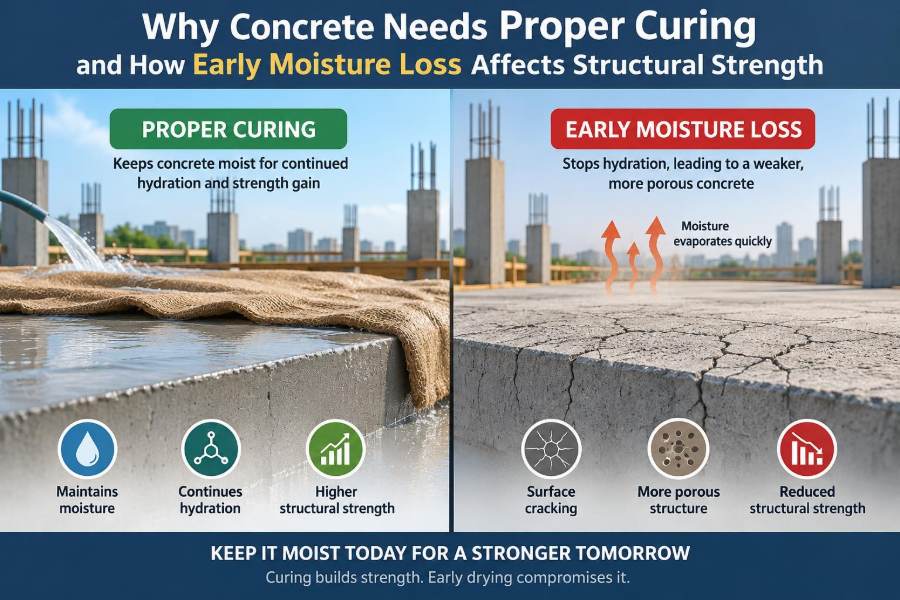

A newly poured concrete slab can look finished within hours. Its surface has been leveled, the forms are still in place, and a light grey crust may already support a careful footstep. On a hot, windy afternoon, though, that apparently solid surface can be losing water faster than the concrete beneath it can tolerate.
This is where curing becomes more than a site routine. The decisions made during the first hours and days after placement influence cracking, surface durability, permeability, and the concrete’s ability to develop the strength assumed in design.
For students, curing explains why a specified concrete strength is not simply “built into” a truckload of material. For working professionals, it is a reminder that quality depends on the whole sequence: mixture selection, placement, finishing, protection, and verification.
Concrete does not become strong merely because time passes. It needs suitable moisture and temperature conditions while its binding system develops. Understanding that process makes many familiar site problems easier to diagnose—and easier to prevent.
🧱 Curing Is Controlled Early-Age Protection
Curing is the practice of maintaining conditions that allow freshly placed concrete to develop its intended properties. Usually, this means limiting moisture loss and avoiding harmful temperature conditions during the period when concrete is young and vulnerable.
It is not the same as waiting for concrete to “dry.” In fact, drying too early can interfere with the reactions that create the hardened cement paste binding the aggregate together.
Curing methods include retaining water with coverings or compounds, supplying water where appropriate, insulating the concrete, and protecting it from sun, wind, rain, and freezing. The right method depends on the member, environment, mixture, specification, and construction sequence.
⚗️ Hydration Creates the Hardened Cement Paste
When cement and water are mixed, cement particles react with water in a process called hydration. The products of hydration gradually form a rigid, interlocking microstructure around aggregate particles.
A major hydration product is commonly described as calcium-silicate-hydrate gel, or C-S-H. It is a principal contributor to the strength and density of ordinary portland-cement concrete. Other products also form and affect setting, volume change, and durability.
Hydration does not occur all at once. It proceeds over time, especially when water and suitable temperatures remain available. That is why concrete can continue gaining strength long after it has set, although the rate of gain slows with age.
💧 Water Is Both an Ingredient and a Condition
The water initially batched into concrete has two roles. Part participates chemically in hydration; part gives fresh concrete enough fluidity for mixing, pumping, placing, consolidation, and finishing.
Not all mixing water must remain as free liquid forever, but early evaporation can deprive the cement paste of moisture needed for continued hydration near exposed surfaces. The result may be a weaker, more porous surface zone even where the interior remains relatively protected.
This distinction matters: adding water indiscriminately after placement is not curing. Water placed on an unfinished surface at the wrong time can damage the paste or raise the local water-cement ratio. Proper curing controls moisture without compromising the finished surface.
🌬️ The Evaporation Problem Starts at the Surface
Evaporation occurs when water at the concrete surface enters the surrounding air. The rate rises when concrete is warm, air is dry, wind moves across the surface, or direct sunlight adds heat.
Fresh concrete may bleed water upward as solid particles settle. If evaporation removes this bleed water faster than it arrives, the surface can dry while the concrete is still plastic. That imbalance is a warning condition for early cracking.
Large horizontal placements—slabs, pavements, bridge decks, and flatwork—are particularly exposed because they have broad surfaces relative to their thickness. Vertical formed members are often better protected until forms are removed, though they still need curing afterward.
🌡️ Temperature Changes the Rate of Everything
Temperature influences hydration, setting, workability, evaporation, and thermal movement. Warm concrete generally sets and gains early strength faster, but hot conditions can make placement and moisture retention much harder.
Cold concrete reacts more slowly. If concrete freezes before it develops sufficient early strength, expanding water can damage its developing structure. Conversely, very high internal temperatures in massive placements can create later thermal-stress concerns as the member cools.
There is no single temperature rule that fits every project. Site teams need to consider concrete temperature, ambient temperature, wind, humidity, member size, cementitious materials, and the protection measures actually available.
🕰️ Setting, Hardening, and Strength Gain Are Different Stages
Setting is the transition from a workable material to one that resists deformation. It is not proof that concrete has reached useful design strength. A set surface can still be easily damaged and can still lose moisture rapidly.
Hardening describes the continuing development of a solid cementitious matrix. Strength gain is one measurable outcome of hardening, but curing also affects shrinkage behavior, permeability, abrasion resistance, and resistance to environmental exposure.
A common mistake is to treat the end of finishing as the end of attention. In reality, it is the point when deliberate curing protection must begin as soon as it can be applied without harming the surface.
📉 Early Moisture Loss Limits Strength Development
If concrete dries prematurely, hydration slows sharply in the drying region. Cement particles may remain only partly hydrated, leaving a less continuous and less dense binding structure than intended.
The strength effect is not always uniform through a member. The top of a slab or the exposed face of a wall can be more affected than the protected interior. This matters because the surface is also where traffic, weather, salts, and abrasion often act first.
Loss of moisture does not mean all future strength gain is impossible. Rewetting can allow some hydration to resume if unhydrated cement and suitable conditions remain. But later wetting may not fully reverse cracking or poor structure formed during the critical early period.
🔬 A Denser Microstructure Resists More Than Load
Properly cured concrete tends to develop a finer, less connected pore system near exposed surfaces. This does not make concrete waterproof, but it can reduce the ease with which water and dissolved substances move through it.
That improvement supports durability. Lower permeability can help limit the ingress of chlorides, sulfates, carbon dioxide, and other agents that contribute to reinforcement corrosion or chemical deterioration in suitable exposure conditions.
Strength is therefore only part of the story. A member may meet a compressive-strength test requirement yet still have a vulnerable surface if finishing and curing were poorly controlled.
🕸️ Plastic Shrinkage Cracks Form Before Concrete Hardens
Plastic shrinkage cracking can occur when water evaporates from fresh concrete faster than bleed water replaces it. The surface contracts while the underlying material restrains that movement, producing shallow cracks before the concrete has fully set.
These cracks often appear as roughly parallel or irregular short lines across slabs. Their pattern depends on finishing, restraint, wind direction, geometry, and the rate of surface drying.
Plastic shrinkage cracking is not usually prevented by adding more mixing water. Better responses include reducing evaporation, planning placement around severe weather, using windbreaks or sunshades, and beginning appropriate curing promptly.
📏 Drying Shrinkage Happens Later but Begins Early
After hardening, concrete can shrink as moisture gradually leaves its pore structure. This is called drying shrinkage. Restraint from reinforcement, subgrades, adjacent members, or changes in section can turn that movement into tensile stress and cracking.
Good curing does not eliminate drying shrinkage. It can, however, improve the concrete’s early strength and tensile capacity while reducing abrupt moisture gradients near the surface.
Joint layout, reinforcement detailing, mixture proportions, aggregate selection, member geometry, and construction timing all influence later shrinkage cracking. Curing is a major control, but not a substitute for sound design and detailing.
🧊 Thermal Cracking Has a Different Mechanism
Not every early crack is a moisture-loss crack. Cement hydration releases heat, particularly in large placements or mixtures with high cementitious content. If the interior becomes much warmer than the exterior, later cooling can produce restrained tensile stresses.
Thin slabs in hot wind often face evaporation-driven surface problems. Thick foundations, piers, and heavily reinforced walls may instead require a temperature-control plan, insulation, staged placement, or a mixture designed to moderate heat development.
Several mechanisms can act together. A careful investigation considers crack timing, depth, pattern, weather records, concrete temperature, joint locations, and restraint before assigning a cause.
🪨 The Water-Cement Ratio Still Matters
The water-cement ratio, often extended in practice to include cementitious materials, is the mass ratio of water to cement. Within normal concrete technology, excessive water relative to binder generally creates more capillary pore space after hardening and reduces potential strength.
That does not mean the lowest possible ratio always produces the best field concrete. Very low-water mixtures may be difficult to place or consolidate unless admixtures and procedures are suited to them. Poor consolidation introduces its own defects.
Curing cannot transform an overwatered mixture into a high-quality one. Likewise, a well-proportioned mixture can underperform if it is placed in conditions that cause early moisture loss.
🚿 Moist Curing Supplies or Retains Moisture
Moist curing keeps concrete wet or prevents it from drying. Common options include ponding on suitable horizontal surfaces, continuous fogging or sprinkling where runoff and finishing conditions permit, wet coverings, and water-retaining sheets.
Wet burlap or similar absorbent coverings must be kept continuously wet. A covering that dries can draw moisture from the slab below, defeating its purpose. It also needs to be placed carefully so it does not mark or damage immature concrete.
Water curing can be highly effective, but it requires labor, water management, protection from staining or erosion, and dependable supervision. It is not always the most practical method for every shape or site.
🛡️ Membrane Curing Reduces Evaporation
Membrane-forming curing compounds create a film that slows moisture loss. They are often practical for pavements, slabs, and large areas where continuous wet curing would be difficult.
Application timing and coverage are critical. The compound must be applied uniformly at the specified rate after finishing and after surface water conditions permit. Missed zones, thin application, or damage from later traffic create weak links in the moisture barrier.
Compatibility matters as well. Some curing compounds can interfere with later coatings, toppings, adhesives, or flooring systems unless they are removed or specifically approved. The finishing schedule should be coordinated before selecting a compound.
🧥 Forms and Covers Can Be Part of the Cure
Leaving forms in place can help retain moisture and moderate temperature on vertical or enclosed surfaces. Formwork is not automatically a complete curing system, especially where edges are exposed or forms are removed early.
Plastic sheets, curing blankets, and insulated covers can reduce moisture loss and temperature swings. They should be secured against wind and arranged to avoid concentrated water flow, staining, or abrasion of the young surface.
For cold-weather work, insulating covers are selected and monitored as part of a broader temperature-protection approach. Covers that are useful in cool weather may trap undesirable heat in hot conditions.
🏢 Slabs Need Fast, Coordinated Protection
Slab construction demands coordination because finishing and curing occur across a large, exposed area. A delay in one part of the operation can leave completed portions unprotected while crews work elsewhere.
A practical plan identifies where concrete will be placed, how it will be struck off and finished, when the curing method will start, and who is responsible for maintaining it. Materials should be on site before the first truck arrives.
For example, a hypothetical warehouse slab placed under low humidity and steady wind may require windbreaks, evaporation-reduction measures compatible with finishing, and immediate membrane curing after final finishing. Waiting until the pour is complete may be too late for the earliest panels.
🌉 Bridge Decks Face Severe Exposure
Bridge decks combine a broad exposed surface with demanding durability requirements. They may encounter wind, sun, vibration, traffic schedules, deicing salts, and complex finishing operations.
The top surface is especially consequential because it is the route by which water and chlorides can enter. Early surface drying, finishing defects, and insufficient curing can increase the likelihood of a porous or cracked cover zone over reinforcement.
Deck specifications commonly prescribe detailed curing procedures, but the field result still depends on execution. Equipment, water supply, coverings, staffing, weather monitoring, and contingency planning all need to support the specified method.
🏠 Small Residential Work Is Not Exempt
A driveway, patio, footing, or garage slab may not have the complexity of a bridge deck, but it faces the same basic chemistry. Hot weather, dry subgrades, wind, premature form removal, and casual aftercare can still reduce quality.
A homeowner may see a surface become dusty, scale under freeze-thaw exposure, or show fine early cracks and assume the concrete was simply “bad.” The cause may instead be a combination of finishing while bleed water was present, rapid drying, or inadequate protection.
Small projects benefit from simple preparation: dampening absorptive subgrades where appropriate, staging curing materials, avoiding placement during unsuitable conditions when possible, and protecting fresh work from foot traffic and rapid drying.
🧰 Preparation Before the Truck Arrives
Effective curing begins before placement. Teams should assess weather, delivery sequence, exposed area, water availability, curing materials, labor, and the time needed for finishing.
- Store coverings, curing compound, sprayers, and anchors where they can be used immediately.
- Check that the selected curing method is compatible with specified finishes and later construction.
- Plan windbreaks, shade, lighting, and cold-weather protection when site conditions call for them.
- Assign responsibility for applying and maintaining the cure rather than treating it as an unowned final task.
This preparation reduces the temptation to improvise after the concrete has already begun to set.
👀 Weather Assessment Must Be Site-Specific
Ambient temperature alone is a poor guide to evaporation risk. A mild day can still be demanding if the concrete is warm, the air is dry, and wind crosses an open slab. Conversely, a warm but humid and calm day may be less severe.
Teams should observe conditions at the placing surface, not just rely on a distant weather report. Nearby buildings, open doors, temporary fans, solar exposure, and terrain can create local conditions quite different from the general forecast.
When conditions are marginal, changing the start time, reducing the exposed pour size, improving protection, or adjusting the construction sequence can be more reliable than hoping weather remains favorable.
🚫 Adding Water During Finishing Creates Risks
Workers sometimes spray water onto a stiffening slab to make finishing easier. Unless a procedure specifically permits a compatible evaporation-control product, this practice can create a weak, high-water surface layer.
Finishing bleed water back into the surface can cause a similar problem. The upper paste may become less durable and more prone to dusting, scaling, or delamination, particularly where later finishing densifies the surface over trapped water.
The solution to lost workability should be addressed through mixture design, delivery timing, admixture selection, temperature management, and placing procedures—not by casually changing the surface composition on site.
🪚 Joints Control Cracks; They Do Not Replace Curing
Contraction joints provide planned locations for shrinkage cracks in slabs. They reduce random cracking by creating a weakened plane where movement-related cracking can occur in a controlled line.
Joints must be correctly located, deep enough, and installed at the appropriate time for the system being used. Yet a well-jointed slab can still develop plastic shrinkage cracks or poor surface durability if it dries too quickly.
Think of joints as movement management and curing as material protection. Both are required, and neither compensates fully for failure of the other.
🧪 Test Cylinders Need Their Own Correct Curing
Strength specimens are valuable only when they are made, stored, transported, and cured according to the applicable testing procedure. Improper field handling can produce test results that do not fairly represent the delivered concrete.
Standard-cured specimens indicate potential strength under prescribed laboratory conditions. Field-cured specimens, when required, can help indicate the effects of actual jobsite curing and may assist decisions about form removal, loading, or protection changes.
Neither type should be interpreted casually. Acceptance criteria, sampling frequency, specimen handling, and maturity-based methods are governed by project requirements and relevant standards. A qualified project team should evaluate unusual results in context.
📈 Maturity Helps Relate Temperature and Strength
Concrete maturity is a method that uses the time-temperature history of a specific mixture to estimate strength development after correlation testing. It can provide useful real-time information when managing stripping, post-tensioning, opening to traffic, or cold-weather protection.
Maturity does not eliminate the need for curing. A warm concrete member may accumulate maturity quickly while still suffering from surface moisture loss or undesirable thermal gradients.
It also relies on a valid calibration for the mixture and on correctly installed, protected sensors. Treat it as a project-control tool, not a universal shortcut or replacement for engineering judgment.
🧱 Supplementary Cementitious Materials Affect Timing
Fly ash, slag cement, silica fume, calcined clays, and other supplementary cementitious materials can change workability, heat development, permeability, and the rate at which strength develops. Their effects depend on material type, replacement level, temperature, and mixture proportions.
Some mixtures may develop later-age properties very effectively but gain early strength more slowly under cool conditions. This can extend the period during which protection and curing must be maintained.
Specifications should avoid assuming that every mixture behaves like a conventional portland-cement mixture. Trial batches, supplier data, and project-specific verification help align construction schedules with actual material behavior.
❄️ Cold Weather Requires Heat and Moisture Management
In cold conditions, concrete needs protection against freezing and against slow strength development that leaves it vulnerable for longer. Heating ingredients, insulating forms, blankets, and enclosures may be used under an appropriate cold-weather plan.
Dry heated air inside an enclosure can increase surface evaporation. Protection must therefore address moisture as well as temperature. Rapid temperature changes when covers are removed can also create stress and should be managed carefully.
Local specifications and experienced technical oversight are essential because acceptable practices vary with member size, exposure, mixture, and required early-age performance.
☀️ Hot Weather Requires Evaporation Control
Hot-weather concreting is not defined by air temperature alone. Warm materials, solar radiation, low humidity, and wind can combine to accelerate slump loss and surface drying.
Useful measures may include cooling ingredients, scheduling work during cooler periods, shading stockpiles, using windbreaks, shortening delivery and discharge times, and reducing the area left exposed before curing begins.
Any proposed admixture or evaporation-control product must be compatible with the mixture and finishing operation. It should support the specified process rather than become an excuse to delay curing.
🔍 Recognizing Signs of Inadequate Curing
Visible clues can include fine early cracking, a powdery or dusty surface, unexpected surface softness, discoloration, shallow scaling, or irregular curing-compound coverage. These signs are not definitive diagnoses by themselves.
A sound evaluation asks what happened and when: weather during placement, concrete temperature, finishing sequence, bleed-water condition, curing start time, method, duration, and subsequent exposure. Surface observations should be compared with records and, where needed, appropriate testing.
Destructive removal or repair should not be assumed from appearance alone. The structural significance of a defect depends on its extent, depth, location, intended use, and the engineer’s assessment.
🛠️ Repair Decisions Depend on the Actual Defect
Hairline plastic shrinkage cracks may require monitoring, sealing, or localized treatment depending on exposure and service demands. A weak or delaminated surface may require removal and replacement of unsound material before applying a compatible repair system.
Repair materials have their own curing requirements. A durable patch is unlikely if the substrate is poorly prepared, the bond surface is too dry or contaminated, or the repair is allowed to dry prematurely.
For structural members, widespread cracking, suspected low strength, or reinforcement-related durability concerns, evaluation by the responsible engineer or qualified specialist is appropriate. A cosmetic fix should not mask an unresolved performance issue.
📋 A Practical Curing Checklist
Before approving a curing operation, ask whether it protects the concrete that was actually placed under the conditions that actually occurred.
- Has the exposed concrete been protected as soon as finishing permits?
- Is the selected method continuous, uniform, and maintained for the required period?
- Are edges, corners, penetrations, and transitions receiving the same attention as broad surfaces?
- Is the curing system compatible with coatings, overlays, flooring, or architectural finishes that follow?
- Have temperature and weather changes altered the original plan?
- Are records sufficient to explain what was done if later questions arise?
Simple checklists make curing visible as a construction activity, not an afterthought performed only when time allows.
🤝 Design, Specification, and Field Execution Must Align
Durable concrete is created through coordinated decisions. Designers identify exposure demands and performance requirements; specifications define acceptable materials and procedures; contractors plan and execute the work; inspectors verify critical steps; suppliers support mixture performance.
Problems arise when curing requirements are generic while the project presents unusual risks, such as thin architectural elements, high wind exposure, massive sections, aggressive environments, or a schedule requiring early loading.
Clear preconstruction discussion is especially valuable where the required finish conflicts with a preferred curing method, or where weather protection has major logistical consequences.
🎯 The Core Principle: Protect Concrete While It Develops
Concrete strength and durability emerge from a developing internal structure, not from surface appearance alone. Early moisture loss can interrupt hydration near exposed faces, increase cracking risk, and leave concrete less resistant to the environment it must serve.
Proper curing is therefore a controlled protection process: retain or supply moisture as appropriate, manage temperature, begin at the right time, sustain the method, and adapt the plan to the member and weather conditions.
The most reliable approach is not a single product or ritual. It is a deliberate system that connects mixture behavior, placement conditions, finishing, curing method, duration, inspection, and the real demands of service.
Concrete reaches its intended potential when it is protected as carefully after placement as it is proportioned before placement. That principle turns curing from a final chore into a fundamental part of structural quality. 🏗️💧🧱