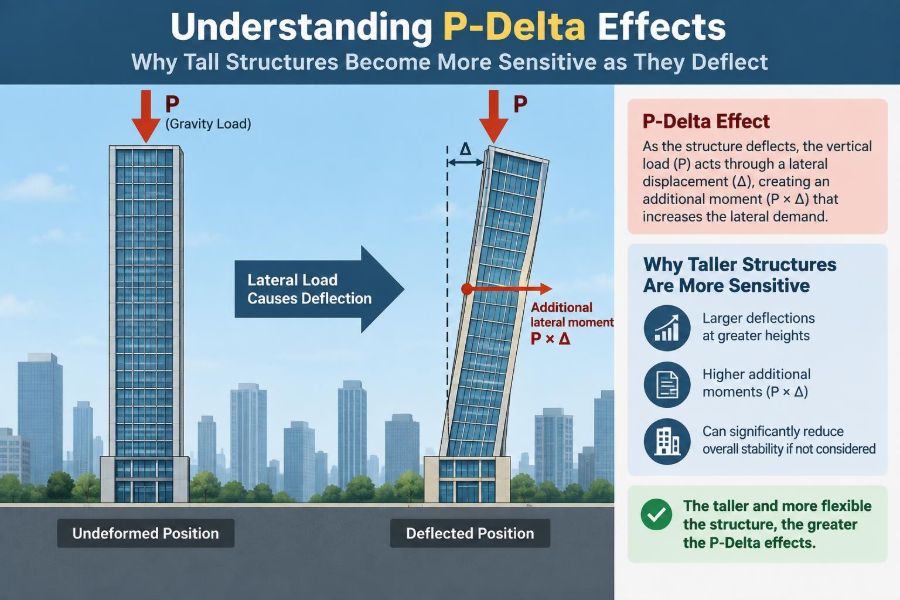

A tower sways a little in the wind. A multi-storey frame settles into a slightly displaced shape during an earthquake. A warehouse rack leans after an accidental impact. In each case, the movement may appear modest at first.
But gravity does not stop acting when a structure moves sideways. The vertical load already carried by columns, walls, or braces now acts through an offset position, creating an extra turning effect that can increase the sideways movement.
This interaction is known as the P-Delta effect. It is one of the reasons a structure that seems adequately strong in a first-pass calculation can become less stable as it deflects.
For students, P-Delta is a gateway to second-order structural behavior. For practicing engineers, it is a routine but consequential design check connecting analysis assumptions, stiffness, detailing, construction sequence, and safety.
🏗️ The Basic Idea Behind P-Delta
P-Delta describes the additional moment created when an axial force acts through a laterally displaced member or structural system. The letter P represents the axial load, usually dominated by gravity load, and Δ represents the lateral displacement.
For a simplified column, the additional moment is often expressed as M = PΔ. The equation is simple; its consequences are not. The added moment can increase bending, which produces more displacement, which can create still more added moment.
📐 First-Order Versus Second-Order Analysis
First-order analysis assumes that loads act on the original, undeformed geometry. A vertical load remains aligned over its initial line of action even if the structure later displaces.
Second-order analysis updates the equilibrium relationship to account for the displaced geometry. P-Delta effects are therefore called geometric nonlinearity: the material may remain elastic, but the changing shape alters internal forces.
First-order analysis is often suitable where movements and axial forces are small enough. Where they are not, ignoring the altered geometry can underestimate moments, drifts, and stability demands.
🔤 Why Engineers Write P-Δ
The notation P-Δ is shorthand, not a statement that every behavior can be captured by one multiplication. In a real frame, axial forces vary between members, displacements vary by floor, and stiffness changes as cracking, yielding, connection flexibility, or foundation movement develops.
Still, PΔ gives a useful physical picture: load times eccentricity. If a column carries a large compressive force and its ends move relative to one another, the force has a lever arm. That lever arm must be resisted by additional bending.
🧍 A Column Analogy
Imagine holding a ruler vertically on a desk and pressing downward at its top. When it is perfectly straight, the force passes close to the ruler’s centerline. Push the top sideways while maintaining the downward force, and the ruler suddenly has both compression and bending.
A building column is more complex and much stiffer, but the mechanism is similar. Its lateral displacement turns what began as predominantly axial loading into a combined axial-and-bending condition.
🏢 Story Drift Creates System-Level P-Delta
In buildings, the most visible form is often linked to storey drift, the relative horizontal movement between two adjacent floors. Gravity loads supported at the upper floor are carried through a frame that is no longer vertical.
The resulting overturning contribution at a storey is related to the gravity load tributary to that level multiplied by its interstorey drift. This can amplify the lateral shears and moments demanded of the lateral-force-resisting system.
That is why a drift check and a stability check are closely related but are not identical checks.
🧩 Local P-δ Is Not the Same Thing
Engineers often distinguish P-Δ from P-δ. Capital delta usually refers to the overall displacement between a member’s ends or between floors. Lowercase delta refers to local curvature and bowing within an individual member.
A slender column in a braced frame may have relatively small storey sway but appreciable P-δ magnification because it bows between its end restraints. Conversely, a stiff individual column may be governed more by the frame’s global sidesway.
| Effect | Displacement involved | Typical concern |
|---|---|---|
| P-Δ | Frame sway or interstorey drift | Global frame stability and drift amplification |
| P-δ | Member curvature between ends | Column buckling and member moment magnification |
📏 Why Height Makes Structures More Sensitive
Tall structures generally accumulate larger lateral displacement because lateral deflection grows with height and depends strongly on stiffness distribution. A small rotation at the base can produce a substantial offset many storeys above.
Height alone is not the cause. A short but extremely flexible frame can be sensitive, while a tall, efficiently braced core may control drift well. Yet increasing height commonly brings larger gravity loads, longer load paths, and greater opportunities for lateral displacement to create second-order effects.
🌬️ Wind Is a Repeated Source of Deflection
Wind can produce service-level movements that influence occupant comfort, façade behavior, and cladding joints, as well as strength-level demands used for structural design. A flexible tower may take on a noticeably displaced shape under strong wind.
The P-Delta contribution depends on the accompanying gravity force and the resulting displacement. Wind does not need to be dramatic to make second-order behavior relevant; a structure with substantial sustained gravity load can develop meaningful added moments at moderate drift.
🌎 Earthquake Response Adds Another Layer
During earthquake shaking, a structure undergoes reversing lateral deformations while carrying gravity load. As members yield, crack, or otherwise lose effective stiffness, lateral displacement can increase beyond the elastic estimate.
P-Delta effects can then reduce the apparent restoring capability of the system. In nonlinear response, they may contribute to a concentration of deformation in one storey, particularly if that storey is already weaker or more flexible than those above.
Seismic design provisions address this differently across jurisdictions and structural systems. Designers must apply the governing code rather than transfer a simplified rule from one standard to another.
⚖️ The Restoring Force Perspective
A lateral system resists drift through stiffness and strength. As it is displaced, elastic elements generally develop restoring forces that tend to bring it back toward its original position.
P-Delta acts in the opposite direction for a gravity-loaded, laterally displaced structure: it tends to increase the overturning effect associated with the displacement. One useful mental model is that P-Delta subtracts from effective lateral stiffness.
This does not mean every deflected building is unstable. It means the available stabilizing response must be evaluated after accounting for this destabilizing contribution.
📉 Stability Is Different From Strength
A beam may have adequate bending strength for a calculated first-order moment yet still be part of a system with inadequate stability. Strength asks whether a member can resist a force effect. Stability asks whether the equilibrium configuration remains viable as geometry changes.
At severe conditions, the additional PΔ moment can grow faster than the structure’s ability to develop restoring resistance. This is the conceptual path toward instability, sometimes described as a runaway or divergence of displacement.
🌀 The Link to Buckling
Column buckling is a classic second-order problem. As a compressed column bends, its axial load creates additional moment; this further bending reduces the load level needed to sustain the straight configuration.
Global frame instability follows the same broad principle at a larger scale. The frame’s columns, beams, walls, braces, and connections collectively provide lateral stiffness, while the gravity loads acting through drift provide destabilizing effects.
The exact behavior can include material yielding, residual stresses, imperfections, and connection behavior, so ideal elastic buckling formulas should not be treated as complete building models.
🧱 Where the Gravity Load Comes From
The relevant P in P-Delta is not merely the self-weight of one column. It can include tributary floor dead load, sustained portions of occupancy load where applicable, roof load, equipment, façade weight, and other vertical actions defined by the governing load combinations.
Upper-storey columns may carry less accumulated load than lower-storey columns, while their displacements may be larger. Lower-storey columns often carry high axial force and can be critical because they participate in the overturning resistance of the whole building.
🏛️ Lateral Systems Change the Response
A moment frame relies primarily on beam-column flexure and connection rigidity. It can offer architectural openness, but it may require substantial member sizes to control drift in taller applications.
Braced frames, reinforced concrete or masonry shear walls, and core systems generally provide more direct lateral stiffness. Outrigger systems can engage perimeter columns with a central core, increasing resistance to overturning-related deformation.
No system is automatically immune to P-Delta. The question is whether the chosen arrangement provides enough stiffness, strength, ductility, and reliable load paths for its height and loading.
🧭 Stiffness Distribution Matters More Than One Big Member
A structure needs lateral stiffness where deformation demand occurs. A very stiff upper portion does not fully compensate for a soft or weak lower storey, because the lower level must transmit the drift and gravity effects of the building above.
Discontinuities deserve special attention: a transfer level, open ground-floor frontage, abrupt wall termination, setback, floating column, or change in bracing layout can concentrate drift. Once drift concentrates, the P-Delta moment associated with the gravity load above also concentrates there.
🚪 The Soft-Storey Concern
A soft storey is one that is substantially more flexible than adjacent storeys. Common architectural causes include tall lobby spaces, parking levels with few walls, or removal of braces to create open circulation.
Consider a hypothetical five-storey building in which the ground floor is much more flexible than the residential floors above. Most lateral displacement can accumulate at ground level, while that level also supports nearly all of the upper-storey gravity load. This is an unfavorable setup for P-Delta amplification.
The remedy is not simply “add more steel.” Engineers may revise wall continuity, bracing placement, frame proportions, connection stiffness, or the architectural arrangement itself.
🔩 Member Slenderness Still Matters
Global P-Delta checks do not replace member design. Individual columns must still be assessed for their own slenderness, end conditions, unbraced length, axial force, biaxial bending, and local second-order effects.
A strong lateral system can reduce sidesway, but a long, lightly restrained column can still experience significant P-δ. Likewise, a robust column cannot compensate for an entire frame that is excessively flexible in the lateral direction.
🧮 A Simple Hypothetical Calculation
Suppose a column carries an axial force of 2,000 kN and experiences a 20 mm relative lateral offset between its ends. Converting 20 mm to 0.020 m, the added second-order moment is approximately 40 kN·m: 2,000 kN × 0.020 m.
That number is not a complete design moment. The actual result depends on the member’s curvature, boundary conditions, load pattern, frame interaction, and the analysis method. It does show why a displacement that looks small can matter when axial load is large.
🧠 Why Linear Analysis Can Miss the Feedback Loop
A conventional linear elastic model calculates forces from an undeformed geometry and fixed stiffness. It is efficient and remains useful for many design tasks, especially when second-order effects are demonstrably small.
Its limitation is that it does not naturally capture the feedback loop of displacement creating additional moment. Engineers may address this through moment magnification, notional-load methods, code-prescribed amplification, or direct second-order analysis, depending on the system and governing requirements.
💻 What Second-Order Software Analysis Actually Does
Structural analysis software can include geometric stiffness, often called a P-Delta matrix, and solve equilibrium on the deformed configuration through iterative steps. This can provide member forces and drifts that include second-order influence.
However, a software setting is not a substitute for engineering judgment. Results are only as credible as the model’s gravity loads, boundary conditions, element stiffness, diaphragm assumptions, connection releases, load combinations, and treatment of cracked or yielded components.
Users should also understand whether the program is performing a small-displacement P-Delta approximation or a more comprehensive nonlinear geometric analysis.
🧱 Stiffness Assumptions Can Control the Answer
Concrete cracks, steel connections may have flexibility, partitions may not act as reliable structural braces, and soil support can deform. If the model uses unrealistically stiff members or restraints, it may predict too little drift and therefore too little P-Delta amplification.
Conversely, applying large stiffness reductions without a basis can distort load sharing and create misleading demands. The appropriate effective stiffness depends on material, expected response, design stage, and applicable standard.
🌍 Foundations and Soil Are Part of the System
The superstructure does not sit on an infinitely rigid base. Foundation rotation, lateral soil movement, pile flexibility, and differential settlement can alter the deformed shape of a building.
For some structures, soil-structure interaction changes periods, drifts, force distribution, and stability effects. It should be evaluated at a level consistent with the project’s complexity and site conditions, especially for slender towers, soft soils, and systems with substantial overturning demand.
🏗️ Construction Sequence Can Alter P-Delta Demand
Many structures do not acquire load and stiffness all at once. Floors are built sequentially, concrete properties evolve, shoring is removed, and permanent lateral elements may engage at different stages.
Construction-stage analysis can matter for tall buildings, long-span frames, transfer structures, and systems sensitive to differential shortening. A final-state model may not reveal all temporary stability conditions encountered while the structure is partially complete.
🛠️ Design Choices That Reduce Sensitivity
The most effective response is usually to control the cause: reduce lateral displacement or improve the reliability of the resisting system. Common strategies include:
- placing shear walls or braces in a balanced, continuous layout;
- increasing core, frame, or brace stiffness where drift concentrates;
- avoiding abrupt stiffness changes between storeys;
- providing robust diaphragm and collector load paths;
- improving member proportions and connection continuity; and
- considering foundation flexibility early rather than after member sizing.
Increasing member strength alone may not solve a stability-driven problem if it does little to reduce deformation.
🎯 Drift Limits Are Necessary but Not Sufficient
Drift limits serve several purposes: they protect nonstructural elements, support occupant comfort objectives in some contexts, reduce damage, and help maintain a reasonable margin against excessive deformation.
Meeting a prescribed drift limit does not automatically prove that every second-order, member-stability, or irregularity issue has been resolved. Likewise, a P-Delta check does not replace serviceability assessment. Good design treats these as connected but distinct evaluations.
⚠️ Common Modeling and Design Mistakes
Several mistakes recur because they produce tidy-looking calculations while overlooking how a building actually behaves:
- checking only individual column buckling and omitting global frame sway;
- using gravity loads inconsistently between P-Delta analysis and design combinations;
- assuming a diaphragm is rigid without confirming its configuration and load path;
- neglecting stiffness reductions where cracking or connection flexibility is expected;
- overlooking discontinuous walls, braces, or collectors at transfer levels; and
- accepting software output without reviewing deformed shapes and reactions.
A deformed-shape plot is often one of the fastest quality-control tools available. Unexpected kinks, isolated drift concentrations, or unusual torsion deserve investigation.
🧪 A Practical Review Workflow
A disciplined review starts before the model runs. Identify the gravity load path, lateral-force-resisting system, likely soft levels, expected deformed shape, and members carrying high compression.
Then review second-order results alongside first-order results. Ask whether amplified moments appear where mechanics predicts, whether drift is distributed plausibly, and whether changes in stiffness or support assumptions alter the conclusion disproportionately.
- Verify geometry, member connectivity, and support conditions.
- Confirm the gravity load included in the stability evaluation.
- Review storey drifts, member axial forces, and deformed shapes.
- Check local slender members separately from global sidesway behavior.
- Document the selected analysis method and assumptions.
📚 What Design Standards Generally Require
Building and material design standards commonly require some evaluation of second-order effects when structures exceed specified sensitivity thresholds or when member slenderness makes those effects material. The exact terminology, load factors, limits, and permitted simplified methods differ among codes.
For that reason, P-Delta should not be reduced to a universal percentage increase or a single software checkbox. Project location, material system, hazard level, analysis type, and code edition determine the required procedure.
🧑🎓 A Useful Learning Sequence for Students
Start with a pin-ended compressed column and derive the meaning of P times lateral offset. Next, study a portal frame with lateral sway, where column axial loads create added storey moment.
Then compare first-order and second-order results in a simple analysis model. Vary only one parameter at a time—axial load, column stiffness, storey height, or imposed drift—and observe how the response changes. This reveals the governing relationship more clearly than memorizing terminology.
🔍 Questions to Ask During Design Reviews
Clear questions expose weak assumptions early. Useful prompts include:
- Where is the largest interstorey drift, and what gravity load passes through it?
- Which levels have abrupt changes in stiffness, strength, or geometry?
- Are effective member stiffnesses consistent with the anticipated response?
- Does the model represent the intended load path into walls, braces, frames, and foundations?
- Would modest additional displacement materially increase demand?
These questions are valuable because P-Delta is fundamentally about sensitivity: how strongly the structure’s forces change when its shape changes.
🧭 The Core Takeaway: Load Acting Through Movement
P-Delta effects are not an obscure correction reserved for unusually tall towers. They are the natural consequence of carrying axial gravity load while the structure has displaced laterally.
The risk grows when substantial compression, flexibility, and drift occur together. Thoughtful structural configuration, realistic stiffness assumptions, appropriate second-order analysis, and careful attention to irregular storeys keep that interaction within a manageable and code-compliant range.
The essential principle is simple: as a gravity-loaded structure deflects, its vertical loads gain a lever arm, and the design must account for the extra moment that lever arm creates.
Seeing P-Delta as a feedback mechanism—not merely a formula—helps engineers recognize where stability depends on the whole structural system working together. 🏗️📐