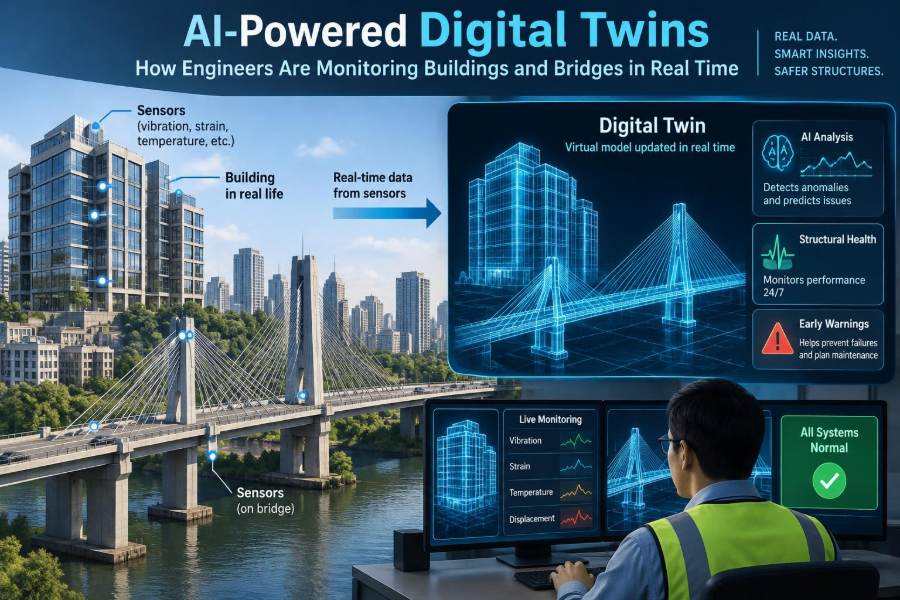

A bridge can look perfectly ordinary from the road while carrying millions of load cycles, expanding in summer heat, contracting overnight, and responding to every heavy vehicle that crosses it. A building can appear unchanged while its foundation settles by millimetres, its façade moves in the wind, or moisture accumulates near a vulnerable connection.
Traditionally, engineers learn about many of these changes through inspections: planned site visits, visual surveys, test measurements, maintenance records, and reports from occupants or the public. Those remain essential. But they offer snapshots, not a continuous view of structural behaviour.
AI-powered digital twins are changing that picture. By connecting a living digital model to sensor data and engineering knowledge, teams can observe how an asset behaves between inspections, investigate anomalies sooner, and make maintenance decisions with better context.
The technology is not a crystal ball, and it does not replace engineering judgment. Used carefully, however, it can turn scattered measurements into a practical understanding of a building or bridge in real time.
🧩 What a Structural Digital Twin Actually Is
A digital twin is a digital representation of a physical asset that is connected to information from the real asset. For a bridge, it may combine geometry, material data, inspection history, traffic conditions, and live readings from sensors. For a building, it may include structural drawings, occupancy patterns, environmental conditions, and monitoring data.
The key distinction is the connection. A static 3D model is useful for visualization, but it is not necessarily a twin. A twin is updated as conditions change, allowing engineers to compare expected behaviour with observed behaviour.
Its level of detail should match the decision it supports. A portfolio-level twin may track asset condition and maintenance status, while a detailed twin for a long-span bridge may simulate dynamic response at critical locations.
🔄 From BIM Model to Living Asset Model
Building information modelling, or BIM, often provides a strong starting point. It organizes geometry, components, specifications, and construction information. Yet a BIM model is commonly most complete at design and handover, whereas a digital twin must remain useful throughout operation.
To become a living asset model, the information must be maintained after construction. This means linking component identifiers, maintenance work orders, inspection findings, sensor locations, and revised drawings when alterations occur.
A twin can also exist without a perfect original BIM model. Older infrastructure may require records to be digitized gradually, with the most critical structural elements modelled first. A useful twin is not necessarily the most visually elaborate one.
📡 The Sensors That Give a Twin Its Eyes and Ears
Sensors turn structural behaviour into measurable data. Selection starts with a question: what failure mechanism, operational concern, or uncertainty are engineers trying to understand? Installing instruments simply because they are available often creates expensive data with little decision value.
Common structural-health-monitoring instruments include:
- Strain gauges, which measure deformation over a short length and help estimate stress when material properties are known.
- Accelerometers, which capture vibration and are used to identify natural frequencies, mode shapes, and unusual dynamic events.
- Displacement sensors, which track movement at bearings, joints, cracks, or floors.
- Temperature and humidity sensors, which explain environmental effects that might otherwise resemble structural change.
- Inclinometers, which measure rotation or tilt in towers, retaining structures, and foundations.
Cameras, corrosion probes, fibre-optic sensing, weather stations, and load cells may also be appropriate, depending on the asset and its risks.
📏 Measurements Are Not the Same as Meaning
A sensor reading has no safety conclusion attached to it by default. A strain value, for example, must be interpreted against its location, orientation, temperature, calibration history, loading condition, and the component’s expected response.
Consider a bridge girder that shows higher strain during a hot afternoon. The increase may reflect thermal restraint, heavier traffic, or a sensor issue rather than damage. Engineers need baseline behaviour and contextual data before deciding whether a reading is abnormal.
This is where the digital twin becomes more than a dashboard. It relates measurements to structural form, mechanics, and operating conditions, helping teams ask the right follow-up questions.
🧠 Where Artificial Intelligence Fits In
Artificial intelligence can help process data at a scale that would overwhelm manual review. It can identify recurring patterns, group similar events, detect readings that differ from a baseline, and prioritize information for engineering review.
In this context, AI usually works alongside conventional methods rather than replacing them. A finite-element model may estimate how a bridge should respond under a known load. A machine-learning model may recognize that the measured response has drifted from its normal temperature-adjusted pattern.
AI identifies patterns; engineers determine what those patterns mean. A model cannot independently verify a sensor installation, inspect a crack, or accept responsibility for a safety decision.
⚙️ Physics-Based Models and Data-Driven Models
Physics-based models use established engineering principles: equilibrium, material stiffness, mass, boundary conditions, and load paths. They are valuable because their assumptions can be examined and their outputs can be checked against known structural behaviour.
Data-driven models learn relationships from observations. They can be effective where behaviour is complex or where a direct analytical relationship is difficult to define, such as occupancy-related vibration in a tall building.
| Approach | Best use | Main limitation |
|---|---|---|
| Physics-based model | Testing structural hypotheses and evaluating changes in load path or stiffness | Depends on accurate assumptions, geometry, and boundary conditions |
| Data-driven model | Finding trends, classifications, and anomalies in large monitoring datasets | Can perform poorly outside the conditions represented in its training data |
| Hybrid model | Combining measured data with engineering constraints and simulations | Requires careful integration and transparent validation |
Hybrid approaches are often the most practical. They use physical understanding to prevent implausible conclusions while using data methods to reveal subtle operational patterns.
🌡️ Why Temperature Can Mislead a Monitoring System
Temperature is one of the strongest drivers of apparent structural change. Steel expands and contracts, concrete responds more slowly because of its thermal mass, bearings move, and temperature gradients can cause a deck or façade to curve.
Without environmental compensation, a monitoring system may flag predictable seasonal movement as damage. Conversely, genuine deterioration can be hidden inside a large temperature-related signal.
Engineers therefore collect temperature data at meaningful locations and compare readings under similar environmental conditions. For some assets, a baseline must cover a full range of seasons before thresholds can be set confidently.
🌬️ Wind, Traffic, Occupancy, and Other Operating Loads
A structure’s normal response depends on how it is used. Road traffic changes by time of day, wind speed changes by minute, and building floor vibrations change with occupancy, machinery, and nearby construction.
For a bridge, axle loads and vehicle speeds influence measured strain and acceleration. For a building, an elevator bank, mechanical plant, or a crowded event space can alter vibration signatures without indicating distress.
A useful twin connects structural data to these operating conditions where possible. This makes it easier to distinguish a genuine shift in behaviour from a predictable response to a changed load environment.
📊 Establishing a Baseline Before Raising Alarms
An alarm threshold should not be chosen as an arbitrary line on a graph. The team first needs a baseline: a record of normal response across expected temperatures, loading conditions, and operational states.
Baseline development may involve data cleaning, sensor verification, controlled load tests, and comparison with analytical predictions. The goal is to understand the normal range and the reasons behind its variation.
For example, an accelerometer on a footbridge may show different vibration characteristics when the deck is wet, when crowds cross, or when wind is present. A twin that ignores these conditions will generate either too many false alerts or thresholds so broad that useful warnings are missed.
🚦 Anomaly Detection Is a Triage Tool
Anomaly detection identifies readings or patterns that depart from expected behaviour. It may compare a current value with a threshold, a temperature-adjusted baseline, neighbouring sensors, or a trained model of normal operation.
It should be treated as triage, not diagnosis. A flagged event can result from a loose cable, communication dropout, sensor drift, unusual loading, construction activity, or a meaningful structural change.
Good workflows classify alerts by urgency and attach the relevant context: time, weather, sensor health, recent works, images, and comparison plots. This helps an engineer move from “something changed” to “what should we inspect next?”
🔔 Designing Alerts That People Will Trust
Alert fatigue occurs when users receive repeated warnings that do not lead to action. Eventually, even important alerts can be overlooked. This is a technical and organizational failure, not simply a user problem.
Effective alert design often uses tiers. A low-level notification may request a data-quality check; a higher-level alert may trigger engineering review; an urgent threshold may call for a predefined operational response. The escalation path should be agreed before the system goes live.
- Specify who receives each alert and who has authority to act.
- Record the assumed cause, evidence, and resolution of each event.
- Review false alerts to improve sensor checks and analytical rules.
- Keep emergency procedures independent of a cloud dashboard or internet connection.
🏢 Monitoring Tall Buildings in Real Time
Tall buildings naturally sway under wind and may move perceptibly during seismic events. Monitoring can track acceleration, drift, tilt, vibration, and conditions at damping devices or movement joints.
The purpose is not to eliminate movement; flexibility is often part of safe design. The useful question is whether measured movement is consistent with the building’s expected behaviour for the observed wind, occupancy, and temperature conditions.
In an occupied tower, a digital twin can also support comfort investigations. If occupants report noticeable vibration, engineers can compare event times with wind records, equipment operation, and measured floor accelerations before selecting further tests or modifications.
🌉 Monitoring Bridges Beyond the Visual Inspection
Bridge monitoring is particularly valuable because load cycles, weather exposure, bearings, joints, and difficult access can all affect condition. Sensors may be concentrated at fatigue-sensitive details, expansion joints, piers, cable anchorages, or locations where movement is expected.
A twin can combine live measurements with inspection photographs, defect records, traffic information, and maintenance history. This allows an inspector to see whether a crack is stable, whether movement has changed after bearing work, or whether an unusual event coincided with a heavy-load crossing.
Visual inspections remain indispensable. Many defects, including surface deterioration, drainage problems, local corrosion, and impact damage, cannot be inferred reliably from a limited sensor network.
🏭 Industrial Structures and Process-Driven Change
Industrial facilities often present a different monitoring challenge: the structure is affected by process equipment, thermal cycling, vibration, stored materials, and changing operational loads. A pipe rack, tank foundation, or crane runway may experience repetitive demands that are not obvious from a conventional building model.
Digital twins can relate structural response to process states, such as equipment startup, filling cycles, or crane movement. That relationship helps teams identify whether a response is expected operational behaviour or a departure needing investigation.
Data access and cybersecurity require special attention where structural systems interact with operational technology. A monitoring system should observe safely without creating an unintended pathway into critical control systems.
🧱 Materials Age Differently, and Twins Must Reflect That
Concrete, steel, timber, masonry, and composite systems do not deteriorate in the same way. Concrete may experience cracking, shrinkage, creep, reinforcement corrosion, or chemical attack. Steel may face corrosion and fatigue. Timber is sensitive to moisture, biological decay, connection behaviour, and long-term environmental exposure.
A useful twin does not merely display a generic “condition score.” It reflects the asset’s material-specific risks, exposure conditions, details, and inspection evidence.
For instance, a moisture sensor in a timber element may be an early indicator of a durability concern, but it does not directly measure residual capacity. Interpretation still requires knowledge of the assembly, ventilation, protective detailing, and condition verification.
🔗 The Data Pipeline Behind the Dashboard
What appears as a simple dashboard depends on a chain of systems: sensors, data loggers, communications, storage, processing, model integration, visualisation, and user access controls. A weakness anywhere in that chain can compromise the result.
Data may be sampled continuously, at scheduled intervals, or only when a trigger occurs. Higher sampling rates capture fast vibration events but increase storage, power, transmission, and processing demands.
Good systems preserve raw data as well as processed outputs. If an algorithm is updated later, engineers need the ability to revisit the original record rather than relying only on a filtered chart.
🧹 Data Quality Comes Before Smart Analytics
AI cannot repair fundamentally unreliable inputs. Sensor drift, poor bonding, damaged cables, clock errors, missing metadata, and inconsistent units can all create convincing but false patterns.
Data quality assurance should include routine calibration checks where applicable, automated range checks, time synchronization, gap detection, and comparison between related measurements. A sudden flat line may indicate a failed instrument, while an impossible jump may indicate a transmission or conversion problem.
Every sensor should have clear metadata: what it measures, where it is installed, its orientation, units, sampling rate, installation date, and calibration information. Without this, future users may misinterpret otherwise valid data.
🗺️ Location and Coordinate Systems Matter
In structural monitoring, location is engineering information. A strain gauge positioned near a weld, a sensor mounted on the opposite face of a member, or an accelerometer aligned incorrectly can lead to entirely different interpretations.
The twin should use a consistent coordinate system and link each instrument to a physical element, drawing reference, elevation, orientation, and photograph. This is especially important after refurbishment, when components may be replaced or sensor positions may shift.
Clear location records also make field verification faster. An engineer should be able to move from an alert on screen to the correct physical component without ambiguity.
🧪 Validating the Twin Against Reality
A model is useful only if its outputs are checked against independent evidence. Validation can include controlled load testing, comparison with survey measurements, inspection findings, construction records, and repeated observations under known conditions.
Model updating is sometimes necessary. If measured frequencies differ from predictions, the cause could be uncertain stiffness, mass assumptions, support conditions, nonstructural elements, or instrumentation issues. Updating parameters should be traceable, not an exercise in forcing agreement.
Engineers should document what the twin represents well and where uncertainty remains. A transparent imperfect model is safer than a polished model that implies unjustified precision.
🔍 From Detection to Site Investigation
The value of monitoring lies in decisions, not in colourful graphs. When a meaningful anomaly appears, the next steps should be structured: verify the data, review relevant conditions, compare independent sources, assess potential consequences, and determine whether field inspection is required.
A hypothetical example illustrates the process. If a bridge bearing displacement changes outside its temperature-adjusted range, the team might first check the sensor and communication record. They could then review weather, traffic, recent maintenance, and adjacent sensor readings before arranging an inspection of the bearing, restraint, and joint.
This sequence avoids both complacency and unnecessary emergency action. It also creates an auditable record of why each decision was made.
🛠️ Turning Insights into Maintenance Plans
Digital twins can support condition-based maintenance: planning work based on observed condition and risk rather than relying only on fixed intervals. That does not mean scheduled inspections disappear. It means monitoring can help target them more effectively.
For example, recurring abnormal movement at a joint may justify an earlier detailed inspection. Stable measurements at a difficult-to-access location may help plan access work around a rational inspection interval, subject to applicable requirements and engineering judgment.
Maintenance prioritisation should combine structural consequence, deterioration rate, redundancy, exposure, operational importance, access constraints, and uncertainty. A minor defect in a critical load path may deserve faster attention than a more visible defect in a low-consequence area.
💰 Where the Business Case Is Strongest
Continuous monitoring has costs: design, installation, communications, cybersecurity, data management, maintenance, and specialist interpretation. It is not automatically economical for every structure.
The case is often strongest where failure consequences are high, access is difficult, operations are sensitive to closures, behaviour is uncertain, or a specific concern needs close observation. Examples can include major bridges, unusual long-span structures, heavily used facilities, and assets undergoing nearby excavation or modification.
A modest, question-focused system can be more valuable than a large installation with no defined maintenance or decision workflow. Start with the risk and the decision, then choose the technology.
🧑💼 Roles, Responsibility, and Professional Judgment
A digital twin brings together structural engineers, asset managers, inspectors, data specialists, IT teams, contractors, and operators. Each group sees a different part of the problem, so roles must be explicit.
The structural engineer should remain responsible for engineering interpretation within their appointed scope. Data teams can build reliable pipelines and models, but they should not be expected to make structural safety judgments without the relevant competence and authority.
Clear governance also answers practical questions: Who approves threshold changes? Who reviews missing data? Who can modify model assumptions? Who retains records after a contractor changes? These details determine whether a system remains dependable over years of operation.
🔐 Cybersecurity and Data Ownership
Connected assets introduce cybersecurity considerations. Sensors, gateways, cloud platforms, user accounts, and application interfaces should be managed with appropriate access controls, software updates, network segmentation, and incident procedures.
Security matters not only because data could be exposed, but because altered or unavailable data can affect operational decisions. Monitoring systems should make data gaps and communication failures visible rather than silently presenting stale values as current.
Contracts should also clarify data ownership, access after handover, retention periods, export formats, and responsibilities when platforms or service providers change. Structural records must remain accessible over the life of the asset.
⚠️ Common Mistakes When Deploying Digital Twins
Many disappointing monitoring projects fail through planning gaps rather than advanced technical limitations. The following mistakes are especially common:
- Starting with a dashboard rather than a clearly defined engineering question.
- Installing too few contextual sensors, particularly for temperature and environmental effects.
- Assuming an anomaly is damage before checking data quality and operational conditions.
- Using opaque AI outputs without a documented validation and review process.
- Neglecting sensor maintenance, metadata, calibration, and communication resilience.
- Collecting data without assigning people and procedures to review it.
Each problem is manageable, but only if it is recognized early. A digital twin is an operational system, not a one-time technology purchase.
🪜 A Sensible Way to Start Small
Organizations do not need to create a fully integrated twin on day one. A practical pilot can focus on one high-value question, such as tracking movement during adjacent excavation, understanding vibration in a pedestrian bridge, or observing a known durability concern.
- Define the decision the monitoring should improve.
- Identify the structural mechanisms and contextual factors that matter.
- Select a small number of well-placed instruments and a reliable data workflow.
- Establish a baseline, validate the data, and agree on response procedures.
- Review whether the pilot changed inspection, maintenance, or operational decisions.
This approach creates evidence for scaling up. It also exposes practical issues—power supply, access, data ownership, and staff training—before they affect a larger deployment.
🎓 Skills Engineers Need for This Work
Structural mechanics remains the foundation. Engineers must understand load paths, material behaviour, dynamics, deterioration mechanisms, uncertainty, and inspection practice before they can interpret a twin responsibly.
Useful complementary skills include sensor fundamentals, data visualization, statistics, programming concepts, and an awareness of machine-learning limitations. Engineers do not need to become full-time software developers, but they should be able to ask whether data are representative, whether a model has been validated, and whether an output makes physical sense.
Communication is equally important. A clear explanation of uncertainty and recommended action is often more valuable to an asset owner than a sophisticated model output without context.
🔮 What Real-Time Monitoring Will and Will Not Change
Monitoring systems will likely become more integrated with inspection records, maintenance platforms, and design models. Better sensing, edge computing, and data tools can make it easier to observe assets continuously and focus professional attention where it is most needed.
But there are limits. Sensors observe selected locations, models simplify reality, and historical data cannot cover every future loading condition. A twin cannot eliminate uncertainty, predict every failure mode, or replace sound design, competent construction, inspection, and maintenance.
The most mature use of the technology accepts these limits. It uses measured evidence to improve decisions while preserving conservative judgment where uncertainty or consequences are high.
🧭 The Core Principle: Better Decisions, Not More Data
An AI-powered digital twin succeeds when it connects a real engineering question to trustworthy measurements, understandable models, and a defined action process. Its purpose is not to create a digital replica for its own sake or to automate away accountability.
For buildings and bridges, the practical opportunity is earlier awareness of changing behaviour, better targeting of inspections, stronger maintenance records, and more informed decisions during unusual events. The critical safeguards are data quality, physical interpretation, validation, cybersecurity, and clear human responsibility.
When those pieces work together, real-time monitoring becomes a disciplined extension of structural engineering practice rather than a replacement for it.
The best digital twins help engineers see structural behaviour sooner, understand it more clearly, and act with sound professional judgment. 🏗️📡🧠