
A bridge deck develops hairline cracks after its first winter. A parking structure begins admitting water through tiny defects that were almost invisible at handover. On a building façade, a protective coating is scratched during maintenance, leaving bare metal exposed to rain and airborne salts.
None of these situations necessarily means immediate structural danger. But small defects often create the pathway for bigger durability problems: water ingress, reinforcement corrosion, freeze-thaw damage, leakage, and repeated repair work.
Self-healing materials promise a different response. Rather than waiting for a defect to become large enough to patch, the material may seal or partially repair damage on its own when the right conditions occur.
That idea is appealing, especially for hard-to-access bridges, tunnels, foundations, and marine structures. The practical question is less exciting but more useful: can self-healing materials reliably serve real buildings and bridges, under real loads, weather, workmanship, inspection, and liability requirements?
🧱 What “Self-Healing” Actually Means in Construction
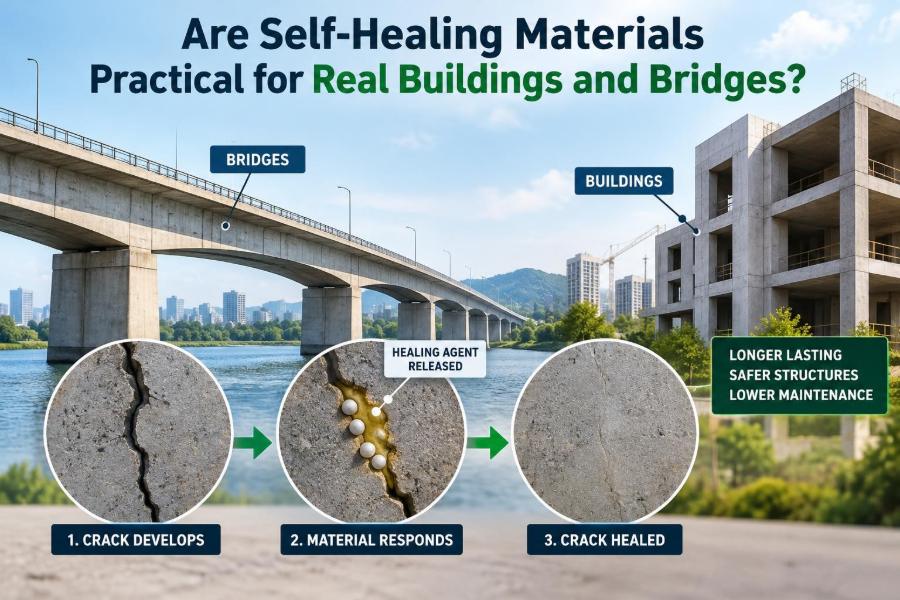
In structural engineering, self-healing does not usually mean that a cracked beam restores itself to its original, undamaged strength. More often, it means a material can close small cracks, reduce permeability, restore a protective barrier, or slow a deterioration process.
The distinction matters. A concrete element may regain water-tightness across a fine crack while still requiring structural assessment if that crack was caused by overload, settlement, fatigue, or reinforcement corrosion.
Self-healing is best understood as a durability feature. It can reduce the consequences of small, expected defects; it is not a substitute for sound structural design.
🔍 Why Small Defects Create Large Maintenance Problems
Concrete, coatings, sealants, asphalt, and protective systems all experience local damage. Thermal movement, drying shrinkage, traffic vibration, restrained deformation, impact, and construction tolerances can produce cracks or gaps.
For reinforced concrete, the critical issue is often not the visible crack itself. It is the movement of water, oxygen, chlorides, sulfates, or carbon dioxide through the crack toward embedded steel.
Once corrosion begins, expanding rust products can crack and spall the surrounding concrete. A fine surface defect can therefore become a reinforcement-loss and repair-access problem years later.
🪄 Why the Idea Is Not Structural Magic
Materials can only heal damage when a mechanism is available, a trigger occurs, and the damage remains within that mechanism’s capacity. A capsule cannot release repair agent if it is never ruptured. Bacteria cannot form mineral deposits without suitable moisture and nutrients.
More importantly, healing a crack does not explain why the crack formed. If a bridge girder cracks because its load demand exceeds its resistance, sealing the surface cannot make that deficiency acceptable.
Healing treats a symptom pathway, not every possible root cause. Engineers still need to identify whether cracking is benign, serviceability-related, durability-related, or a sign of structural distress.
💧 Autogenous Healing in Ordinary Concrete
Concrete already has a limited natural ability to close very fine cracks. This is called autogenous healing. Moisture can support continued hydration of unreacted cement particles, while calcium-containing compounds can precipitate in a crack and partially block it.
This effect is most plausible in narrow, relatively stable cracks exposed to water or repeated wetting. It is not dependable for wide, actively moving, contaminated, or heavily stressed cracks.
Autogenous healing is relevant because it reminds designers that not every crack needs immediate injection. But it must be verified through inspection, rather than assumed from a laboratory demonstration.
🧪 Capsule-Based Healing Systems
One approach embeds small capsules containing a healing liquid within concrete, mortar, coatings, or polymers. When cracking breaks a capsule, the liquid can flow into the crack and react, harden, or bond the crack faces.
The design challenge is delicate. Capsules need to be weak enough to rupture when damage occurs, yet robust enough to survive mixing, pumping, placing, vibration, and years of service.
Capsule systems can be useful where localized crack sealing is valuable, particularly in protective layers. Their main limitation is that each capsule has a finite supply: once activated, it generally cannot heal the same location repeatedly.
🦠 Bacteria-Based Concrete: Useful but Conditional
Bacteria-based systems typically introduce dormant spores and nutrients into concrete. When water enters a crack, suitable conditions may activate the biological process and encourage mineral precipitation that helps fill the void.
The popular description is simple: bacteria “heal” concrete. The engineering reality is more conditional. Survival during mixing, moisture availability, nutrient containment, crack geometry, and the surrounding chemistry all influence performance.
These systems are most logically considered for reducing permeability in small cracks, not for restoring substantial lost section or replacing reinforcement. They also need careful assessment for cost, consistency, and long-term compatibility.
🧴 Polymers and Self-Healing Protective Coatings
Self-healing technology is often more mature in coatings than in primary structural materials. A coating can contain microcapsules, reversible chemical bonds, or mobile compounds that close scratches and restore part of the protective film.
This is particularly relevant for steelwork, where coating damage can expose metal to corrosion before routine maintenance identifies the defect. A coating that reseals a minor scratch may delay the start of localized corrosion.
However, coating healing must not be confused with corrosion elimination. Surface preparation, coating thickness, edge detailing, drainage, and inspection remain decisive parts of steel durability design.
🛣️ Self-Healing Concepts in Asphalt Pavements
Asphalt has a useful place in this discussion because it illustrates a more realistic definition of healing. Bitumen can show limited healing when cracked surfaces are brought back into contact under favorable temperature and rest conditions.
Researchers and practitioners have also explored methods such as induction heating for mixtures containing conductive fibers or additives. The aim is to soften the binder and encourage crack closure before damage grows.
Road pavements are not buildings or bridges, but the lesson transfers: healing works best when damage is detected early and when the material’s environment can be controlled enough for the mechanism to act.
⚙️ Crack Width Is the First Practical Filter
Most self-healing mechanisms are intended for fine cracks, not open fractures. As crack width increases, the required volume of healing material rises, crack faces may no longer align, and water flow can wash out or disrupt the healing process.
Crack movement is equally important. A crack that opens and closes daily with temperature, traffic, or wind may break a newly formed seal. A healed deposit can be useful in a stable crack but ineffective in an active joint-like gap.
Engineers should therefore specify expected crack-width control and movement behavior before choosing a healing technology.
🏋️ Strength Recovery Is Not the Same as Sealing
A material can regain some stiffness across a crack without restoring its original tensile capacity, ductility, fatigue resistance, or bond to reinforcement. These are separate performance questions.
For example, mineral precipitation may reduce water flow through a crack. That does not prove that the member can safely carry a higher bending moment or withstand repeated heavy loading.
Performance claims should state what has been measured: permeability reduction, crack closure, bond recovery, stiffness recovery, corrosion delay, or structural capacity. Vague claims of “healing” are not enough for design decisions.
🌧️ Water Is Often Both the Trigger and the Threat
Many self-healing concrete systems need water to activate hydration, transport ions, or trigger biological activity. Yet water is also the vehicle that carries harmful dissolved salts and enables corrosion.
This creates a design tension. The healing system may benefit from intermittent wetting, while the reinforced concrete structure benefits from limiting prolonged moisture exposure.
Good detailing still comes first: provide drainage, slopes, drip edges, waterproofing where needed, and appropriate cover to reinforcement. Self-healing may provide a second line of defense, not a reason to tolerate poor water management.
❄️ Freeze-Thaw and Marine Exposure Raise the Stakes
In freezing climates, water in cracks can expand during freezing and drive progressive damage. In marine or de-icing salt environments, chloride ingress can turn small cracks into corrosion pathways.
These are environments where crack sealing has genuine value, but they are also the environments where reliability matters most. A system that performs inconsistently may be difficult to justify in a critical splash zone, bridge deck, or exposed parking structure.
Exposure classification, material selection, cover, air entrainment where appropriate, and drainage remain primary durability controls. Healing technologies should be evaluated against those established measures, not instead of them.
🔬 Why Laboratory Success Does Not Automatically Scale Up
Laboratory specimens are often well compacted, carefully cured, deliberately cracked, and exposed to controlled moisture and temperature. Real structures have variable crack patterns, construction joints, reinforcement congestion, uneven curing, and changing environmental conditions.
A bridge also experiences traffic loading, de-icing salts, temperature gradients, and maintenance constraints that are difficult to reproduce fully in a small test specimen.
This does not make laboratory evidence unhelpful. It means the evidence must be translated carefully. Field trials, long-term monitoring, and independent verification are especially valuable before using a novel system in safety-critical work.
🏗️ Construction Quality Still Determines Performance
Self-healing additives cannot compensate for poor batching, excess water, inadequate consolidation, poor curing, honeycombing, or incorrectly placed reinforcement. In some cases, introducing capsules, fibers, bacteria carriers, or special admixtures can make mix design and placement more demanding.
Contract documents should state how the material is stored, mixed, placed, cured, sampled, and accepted. The supplier’s instructions are only part of the quality plan; the contractor and engineer need project-specific controls.
A practical question is simple: can the specified system be installed consistently by the available workforce using the planned equipment and schedule?
📡 Monitoring Turns Healing into an Engineering Strategy
A self-healing material is more useful when paired with inspection and monitoring. Crack mapping, moisture sensors, corrosion monitoring, leak observations, and periodic condition surveys can show whether the intended performance is occurring.
For a difficult-to-access element, monitoring can help distinguish a stable crack that has sealed from a crack that is widening or admitting water. The latter needs investigation regardless of any healing claim.
Monitoring also supports responsible learning. Projects using emerging materials should capture what happened in service, rather than relying solely on commissioning tests.
📐 Design Codes Have a Necessary Caution
Structural codes are built around repeatable design assumptions, validated material properties, safety factors, and established construction practice. Emerging self-healing technologies may not yet have direct code provisions for claiming reduced crack risk or lower durability requirements.
That usually means designers should avoid taking credit for healing in primary strength calculations unless a governing standard, project specification, or rigorous approval pathway clearly allows it.
In practice, self-healing materials are often introduced as an enhancement while conventional code-based requirements for strength, serviceability, cover, crack control, and durability are still met independently.
🕵️ Inspection Cannot Be Designed Away
A common misunderstanding is that a self-healing structure will require no maintenance. Every building and bridge requires inspection because damage can arise from causes the material cannot address: impact, settlement, failed joints, blocked drainage, overload, fire, seismic events, and accidental alterations.
Healing may reduce the frequency or urgency of certain minor repairs. It does not remove the need for access provisions, maintenance records, and trained inspection personnel.
The sensible goal is more resilient maintenance, not maintenance-free infrastructure.
💰 Whole-Life Cost Matters More Than Product Cost
Novel healing systems may increase material cost, testing requirements, procurement complexity, or construction risk. Their economic case depends on whether they prevent expensive future interventions, traffic closures, access work, leakage claims, or early replacement.
The biggest potential value is often in places where repair is disruptive: buried structures, water-retaining elements, tunnels, offshore components, high-rise façades, and heavily used bridge decks.
Cost assessment should include uncertainty. A promising material is not automatically economical if its service performance is difficult to verify or if replacement requires specialized labor.
♻️ Durability Can Improve Sustainability
Concrete and steel repairs consume materials, energy, transport, labor, and sometimes temporary works. Extending service life or delaying repair can therefore reduce a structure’s life-cycle environmental burden.
But sustainability claims need the same discipline as performance claims. An additive or capsule system has its own manufacturing impacts, and a more complex mix may affect sourcing, recyclability, or end-of-life processing.
The strongest environmental case is made through a credible whole-life comparison: does the added material plausibly reduce the amount or frequency of future intervention for this particular asset?
🌡️ Climate Change Makes Exposure Less Predictable
More intense rainfall, wider temperature swings, coastal flooding, and longer heat periods can change how water moves through structures and how materials crack, expand, shrink, or age.
A healing mechanism designed around occasional wetting may behave differently under persistent saturation. Likewise, a temperature-sensitive polymer may be less effective outside its intended thermal range.
Climate resilience requires checking the full exposure envelope, including plausible future conditions. A technology’s trigger conditions should match the asset’s expected environment rather than an idealized average climate.
🧰 Conventional Repair Methods Remain Essential
Established repair methods have a major advantage: engineers understand their capabilities and limitations. Crack injection, routing and sealing, patch repair, cathodic protection, waterproof membranes, overlays, corrosion inhibitors, and replacement each address particular failure mechanisms.
Self-healing does not compete with all of these methods. In many cases, it complements them by reducing the number of small defects that progress to the stage where conventional repair is needed.
When damage is already extensive, conventional diagnosis and repair are usually the right response. Waiting for an experimental healing mechanism to solve an active structural problem is poor asset management.
✅ Where Self-Healing Materials Are Most Practical Today
The most credible applications generally share three characteristics: defects are expected to be small, the required outcome is mainly sealing or durability improvement, and failure of the healing action does not create an immediate safety hazard.
- Water-retaining concrete where leakage control is valuable.
- Precast or repetitive elements where production conditions can be tightly managed.
- Protective coatings on steel and other corrosion-sensitive substrates.
- Hard-to-access components where minor repair would be unusually disruptive.
- Non-primary layers, finishes, or barriers that provide a controlled trial environment.
Suitability still depends on exposure, movement, material compatibility, and inspection access.
⛔ Where Caution Should Be Highest
Caution is warranted where structural safety depends on unverified strength recovery, where cracks may be large or continuously active, or where inspection is impossible and consequences of deterioration are severe.
Examples include heavily loaded members with unexplained cracking, fatigue-sensitive details, prestressed elements, fire-damaged concrete, and locations with severe corrosion exposure but no reliable means of condition assessment.
A self-healing system may still have a role in these projects, but it should not be used to relax conservative structural detailing without robust evidence and an accepted approval route.
📝 How to Write a Better Project Specification
Specifications should describe required performance rather than relying only on a product name or broad marketing term. Define the intended defect type, environmental exposure, acceptable crack range, test method, curing requirements, and evidence required before acceptance.
Useful questions include:
- What is the target: reduced leakage, lower permeability, coating continuity, or partial mechanical recovery?
- Under what moisture, temperature, and movement conditions must the system work?
- How will compatibility with reinforcement, admixtures, membranes, and finishes be checked?
- What happens if the healing function does not perform as intended?
- How will the asset be inspected during service?
Clear wording prevents a durability enhancement from becoming an ambiguous promise.
🤝 Collaboration Must Start Early
Material suppliers, structural engineers, durability specialists, contractors, owners, and maintenance teams each see different risks. A supplier may understand activation chemistry, while the contractor knows whether the mix can be pumped reliably and the owner understands access constraints.
Early collaboration can identify practical conflicts, such as whether a healing additive affects finish quality, whether a special curing regime fits the programme, or whether later repairs will be compatible with the original system.
This is particularly important for pilot projects. A well-documented pilot is more valuable than a large, poorly controlled first use.
⚖️ A Simple Decision Framework for Engineers
Before selecting self-healing materials, work through the problem in order. First, identify the likely damage mechanism. Second, determine whether conventional detailing and construction control can prevent it more simply.
Then ask whether the proposed healing mechanism matches the expected crack size, movement, moisture, temperature, and service life. Finally, decide whether its failure would be acceptable, detectable, and repairable.
If the answer depends on uncertain assumptions, use the technology as a supplementary measure, conduct a trial, and preserve conventional durability provisions. This approach is cautious without dismissing useful innovation.
🎯 The Core Takeaway for Real Structures
Self-healing materials are practical in a growing number of niche and durability-focused applications, especially when their role is clearly defined. They can help seal small cracks, restore protective barriers, and slow the processes that turn minor defects into costly maintenance work.
They are not yet a universal replacement for good design, adequate reinforcement cover, drainage, crack control, sound construction, inspection, or conventional repair. The more safety-critical and difficult to inspect an application becomes, the stronger the evidence and fallback plan should be.
The best use of self-healing technology is therefore not to make structures less engineered. It is to make well-engineered structures more tolerant of the small imperfections that real service inevitably creates.
Self-healing materials are most valuable when they support proven structural design and durability practice, rather than asking them to replace it. Used with realistic expectations, they can become a practical part of longer-lasting buildings and bridges. 🏗️💧🔧