
A conference room table trembles when people walk across the floor above. A pedestrian bridge feels unexpectedly lively as a crowd crosses it. On a windy evening, occupants near the top of a tall building notice gentle motion in hanging lights and window blinds.
These experiences do not automatically mean a structure is unsafe. Buildings, bridges, floors, and towers are designed to move under load. The engineering question is whether that movement is acceptable for the structure, its contents, and—just as importantly—the people using it.
Vibration becomes a problem when it is frequent, uncomfortable, disruptive, or capable of causing damage over time. A floor can be strong enough to carry people and furniture yet still feel unpleasantly springy. A tower can meet strength requirements while producing motion that occupants dislike.
Controlling structural movement requires more than making everything bigger and heavier. Engineers first identify the source, the vibration’s frequency, the path it takes through the structure, and the response it creates. Then they select a solution that changes stiffness, mass, damping, loading, or the connection between them.
🧭 What Excessive Building Vibration Means
Vibration is repeated motion about an equilibrium position. In a structure, it may be vertical, horizontal, twisting, or a combination of all three. It can arise from people, machinery, traffic, wind, seismic activity, or nearby construction.
Excessive does not have one universal definition. The acceptable level depends on use: a warehouse floor, hospital imaging room, residential apartment, footbridge, and office tower have very different performance expectations.
📏 Strength Is Not the Same as Serviceability
Structural design addresses both safety and serviceability. Safety concerns collapse, instability, and structural damage under severe loading. Serviceability concerns how the structure performs in normal use: deflection, cracking, drift, noise, and vibration.
A floor may safely support its design load without being comfortable for walking. That distinction explains why a vibration complaint deserves investigation even when inspections find no obvious distress.
🌊 The Basic Language of Structural Dynamics
Three ideas organize most vibration problems: mass, stiffness, and damping. Mass resists acceleration. Stiffness resists deformation. Damping removes energy from motion, usually by converting a small portion into heat through material behavior, friction, or a purpose-built device.
A simple analogy is a child on a playground swing. The seat and rider provide mass, the chains provide a restoring mechanism, and air resistance plus internal friction provide damping. Push at the right rhythm and the swing moves farther; stop pushing and damping gradually reduces the motion.
🎵 Natural Frequency and Why Rhythm Matters
Every structure or component has one or more natural frequencies: rates at which it prefers to vibrate. A short, stiff element generally has a higher natural frequency than a long, flexible one with similar mass.
Human walking, running, rotating equipment, and wind can all apply repeated forces. Trouble becomes more likely when the forcing frequency lies close to a natural frequency, because each cycle can add energy before prior motion has died away.
🔁 Resonance Is Energy Building Up
Resonance occurs when periodic loading closely matches a natural mode of vibration. It does not require a dramatic external force. Even modest repeated forces can create noticeable response when their timing repeatedly reinforces the motion.
Engineers do not treat resonance as a mysterious defect. They evaluate it as a predictable interaction between load and structure, then break that interaction by shifting frequency, reducing the input, or increasing energy dissipation.
🧩 Mode Shapes Explain Where Movement Appears
A vibration mode is a particular pattern of movement at a natural frequency. In one mode, the center of a floor bay may move strongly while the supports barely move. In another, a tower may sway side-to-side or twist around its vertical axis.
This matters because remedies should be placed where they can affect the mode. Adding material near a point that barely moves may contribute little, while strengthening a critical flexible region can substantially change the response.
👣 Footfall Vibration on Floors
Walking loads are brief but repetitive impacts. On long-span, lightweight, or open-plan floors, each footfall can excite vertical vibration. The response may be felt several meters away, especially where a floor system has low damping.
Offices, fitness spaces, dance studios, laboratories, and residences can all be sensitive, but for different reasons. A person working at a desk may notice monitor shake; precision equipment may lose accuracy long before occupants describe the floor as uncomfortable.
🏋️ Rhythmic Activities Create Stronger Demand
Running, jumping, aerobics, and group exercise impose loads that are more rhythmic and often more energetic than ordinary walking. A floor directly below a gym can receive repeated impacts over a narrow range of frequencies.
Designers should not assume an ordinary office-floor assessment covers these activities. The use of a room, expected class size, exercise equipment, and isolation details may all affect the appropriate structural strategy.
⚙️ Machinery Is a Different Kind of Vibration Source
Fans, pumps, compressors, generators, elevators, and industrial equipment can apply steady rotating or reciprocating forces. A small imbalance in a rotating machine produces a periodic force that increases with operating speed.
The machine, its support frame, its base, and the receiving structure form one dynamic system. Treating only the machine or only the building can miss the path that allows vibration to travel.
🚚 Ground-Borne Vibration Can Enter from Outside
Road traffic, rail lines, pile driving, blasting, demolition, and heavy construction equipment can send waves through the ground. Those waves may enter foundations and reappear as vibration or low-frequency noise within a building.
The soil profile, foundation type, distance, and frequency content all influence the outcome. Conditions can vary sharply from one site to another, so nearby activity is not enough by itself to predict a building’s response.
🌬️ Wind Loads Challenge Tall, Slender Structures
Wind pressure fluctuates rather than remaining perfectly steady. Around tall buildings, gusts and turbulent air can produce across-wind sway, torsional motion, and acceleration that occupants perceive even when the tower remains structurally safe.
Shape matters. Corners, setbacks, openings, and neighboring buildings change airflow. Wind engineering therefore considers both the structural system and aerodynamic behavior, often using specialized analysis or physical testing for particularly sensitive projects.
🌎 Earthquakes Require a Different Objective
Seismic design focuses on limiting dangerous damage and preserving life safety under rare but severe ground motion. The objective is not necessarily to eliminate all movement; a structure may be deliberately detailed to yield in controlled, ductile ways while avoiding collapse.
Devices that help with everyday wind or footfall vibration may also have seismic applications, but their selection and detailing must reflect seismic displacement, force paths, durability, inspection, and code requirements.
👂 Human Perception Often Governs Acceptance
People are sensitive to acceleration, repetition, direction, duration, and context. Motion that is barely noticed in a busy transit concourse can be distracting in a quiet bedroom, executive office, or operating suite.
Expectation also matters. Passengers expect some train movement; office workers usually do not expect their desks to move when a colleague walks by. Good engineering criteria recognize that comfort is a legitimate performance requirement, not merely a subjective complaint to dismiss.
🔍 Start by Diagnosing the Source
Effective mitigation begins with questions: When does the vibration occur? Where is it strongest? Is it tied to footsteps, wind, a machine speed, traffic, or a particular time of day? Has the condition changed after renovation or equipment replacement?
A useful site investigation combines occupant observations with a review of drawings, framing layout, supports, partitions, mechanical systems, and recent changes. The goal is to form testable hypotheses instead of choosing a familiar fix first.
📊 Measuring Motion Turns Complaints into Evidence
Accelerometers measure acceleration; displacement sensors measure relative movement; data acquisition systems record how signals change over time. Frequency analysis can reveal dominant peaks associated with equipment operation, walking rhythms, or structural modes.
Measurements must be planned carefully. Sensor location, orientation, sampling rate, operating conditions, and the duration of monitoring affect what can be concluded. A short measurement taken while the source is inactive may say very little.
🧮 Analytical Models Help Test Solutions Before Construction
Engineers use simplified calculations and finite-element models to estimate frequencies, mode shapes, and response. A model is not a substitute for judgment; it is a representation whose assumptions must be checked against actual geometry, connection behavior, mass distribution, and test data.
For an existing building, measured frequencies can be especially valuable for calibrating the model. If prediction and measurement disagree, the discrepancy may reveal overlooked stiffness, unintended flexibility, or a boundary condition that was assumed incorrectly.
🪵 Increasing Stiffness Changes the Structure’s Response
Adding stiffness is one common solution. For a floor, this may involve deeper framing, added beams, secondary members, a thicker slab, composite action, or better continuity between components. For a lateral system, it may involve braces, walls, frames, or strategically placed outriggers.
Greater stiffness often raises natural frequency and reduces deflection, but it is not automatically the best answer. New members can add load to supports, interfere with services, change force distribution, or shift vibration into another mode.
🧱 Connections Can Be the Hidden Flexible Link
A member may be adequately sized while its connections are too flexible for the intended vibration performance. Slip in bolted joints, flexible seat angles, inadequate diaphragm action, or poorly detailed composite interfaces can reduce the effective stiffness of the assembly.
Connection assessment should include real load paths, construction tolerances, and the possibility of degradation. A retrofit that ignores connection behavior may look strong on drawings but deliver less improvement than expected.
⚖️ Adding Mass Has Benefits and Costs
Additional mass can reduce acceleration for a given applied force and may shift natural frequencies. Concrete topping, ballast, or equipment bases can therefore alter vibration behavior.
However, added mass also increases gravity loads and may lower a natural frequency toward a problematic range. It can increase seismic demand as well. Mass is a design variable, not a universally helpful cure.
🛑 Damping Removes Energy from Motion
Damping limits how long vibration persists and how large resonant motion becomes. Structural materials provide some inherent damping, while finishes, partitions, connections, and nonstructural components may contribute additional energy loss in real buildings.
Because these contributions can be uncertain and may change with occupancy or damage, engineers are cautious about assuming generous damping without evidence. When high performance is required, purpose-designed damping devices offer a more controllable approach.
🔧 Viscous, Friction, and Viscoelastic Dampers
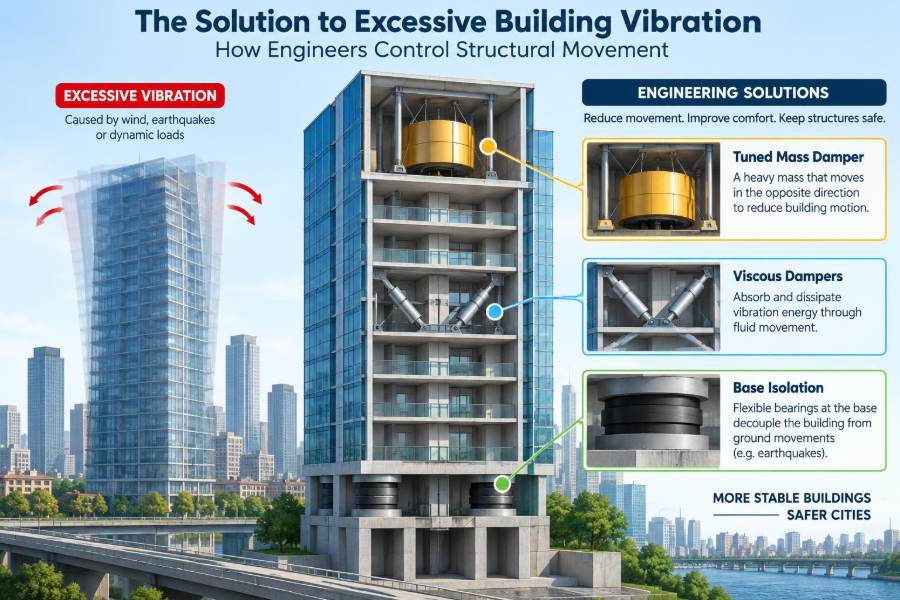
Viscous dampers resist motion through a fluid, much like a shock absorber. Friction dampers dissipate energy through controlled sliding. Viscoelastic materials combine spring-like and energy-absorbing behavior, often within layered or bonded components.
| Device type | Primary behavior | Typical consideration |
|---|---|---|
| Viscous damper | Force related to velocity | Requires suitable anchorage and stroke capacity |
| Friction damper | Energy loss through sliding | Slip force and long-term consistency matter |
| Viscoelastic damper | Combined stiffness and damping | Behavior can depend on temperature and loading rate |
Selection depends on the expected motion, available space, force path, environmental exposure, and maintenance access. A device only works when its supporting structure can transfer its forces safely.
🎯 Tuned Mass Dampers Target a Specific Mode
A tuned mass damper uses a secondary mass connected by springs and dampers. It is adjusted so that, near a target structural frequency, the secondary mass moves in a way that absorbs energy from the main structure.
These systems are well known in tall buildings and long-span structures, but they are not limited to landmark projects. Their practicality depends on available room, the stability of the target frequency, the required performance, and the ability to inspect and maintain the device.
🪨 Base Isolation Changes the Earthquake Interaction
Base isolation places flexible, energy-dissipating elements between a building and its foundation. By lengthening the building’s fundamental period and limiting transmitted acceleration, it can reduce demands on the superstructure for suitable seismic applications.
Isolation is not simply a product installed below a building. It requires space for movement, careful utility connections, separation from adjacent structures, and detailed consideration of soil conditions and extreme displacement demands.
🔩 Isolate Equipment Before It Excites the Building
For machinery-induced problems, resilient mounts, inertia bases, flexible connectors, and properly designed housekeeping pads can reduce transmission at the source. The aim is to interrupt the vibration path between equipment and structure.
Isolation systems are frequency-sensitive. A mount that performs well at normal operating speed may be less effective during startup, shutdown, or low-speed operation. Incorrectly selected mounts can even amplify vibration near their own natural frequency.
🏢 Separate Sensitive Spaces from Active Uses
Planning is often the least expensive vibration-control measure. Place laboratories, recording studios, imaging suites, and quiet residential areas away from gyms, loading docks, mechanical rooms, rail-facing façades, and large open assembly spaces where feasible.
Vertical adjacency deserves attention. A yoga studio over offices creates a different issue from a weight-training room over offices. Early coordination between architects, structural engineers, acoustic consultants, and mechanical engineers prevents costly late-stage compromises.
🧱 Nonstructural Components Also Need Protection
Ceilings, façades, partitions, piping, cable trays, and equipment can be damaged or made noisy by movement even when the primary frame performs well. Rattling panels and clashing pipes can make a modest structural vibration feel much worse.
Clearances, flexible joints, bracing, restraints, and compatible support details help nonstructural systems accommodate expected movement. This work is especially significant in hospitals, data facilities, laboratories, and seismic regions.
🛠️ Retrofit Constraints Shape the Best Solution
Existing buildings present practical limits: low ceiling clearances, occupied spaces, unknown reinforcement, architectural finishes, limited access, and the need to maintain operations. The technically strongest option may not be constructible with acceptable disruption.
A phased retrofit may combine modest strengthening with source isolation and operational changes. For example, relocating a machine, adjusting its speed range, and adding a local support frame can outperform a major building-wide intervention.
🚫 Common Fixes That Miss the Real Problem
Adding random weight, thickening a floor without checking supports, or installing generic rubber pads are tempting responses. They can fail because vibration is dynamic: changes that help one frequency or path may worsen another.
- Assuming “more steel” always solves it: stiffness, mass, and frequency must be evaluated together.
- Ignoring the source: a poorly balanced machine can defeat an expensive structural retrofit.
- Using static deflection alone: a floor can pass a deflection check yet remain vibration-sensitive.
- Overlooking occupants: a technically compliant response may still be unacceptable for the intended use.
📝 Performance Criteria Must Match the Building’s Use
Vibration criteria should be established early and communicated clearly. They may address peak acceleration, frequency range, settling time, equipment function, or qualitative comfort under defined activities.
Criteria are not interchangeable across projects. A criterion appropriate for ordinary offices may be inadequate for electron microscopy, while a highly restrictive laboratory criterion may be unnecessary for storage space. The intended operation should drive the target.
🤝 Coordination Prevents Late Surprises
Structural movement crosses disciplines. Mechanical equipment loads, architectural layouts, façade systems, acoustics, geotechnical conditions, and construction sequencing all influence the result.
Coordination is most valuable before the structural scheme is fixed. Once spans, floor depths, and core locations are locked in, the range of economical vibration-control options narrows considerably.
🔄 Commissioning and Monitoring Close the Loop
After construction, testing can confirm whether equipment isolation, damping devices, and structural modifications perform as intended. Commissioning is particularly valuable when acceptance depends on sensitive equipment or a novel control system.
Long-term monitoring may be appropriate for major structures or changing operational environments. It can help identify shifts in frequency, unexpected equipment behavior, or deterioration before complaints become persistent.
🧠 The Core Principle: Control the Whole Dynamic System
The solution to excessive building vibration is rarely a single material or device. It is a disciplined process: identify the source, understand the structural response, define the required performance, and modify the system at the point where intervention is most effective.
Engineers may increase stiffness, redistribute mass, add damping, isolate a source, change a layout, or combine several measures. The right choice balances performance, constructability, cost, maintenance, and the consequences of getting the response wrong.
Well-controlled structures are not motionless; they move in ways that remain safe, functional, durable, and acceptable to the people and equipment they support. That is the practical standard behind successful vibration design and retrofit work. 🏗️📐🔧