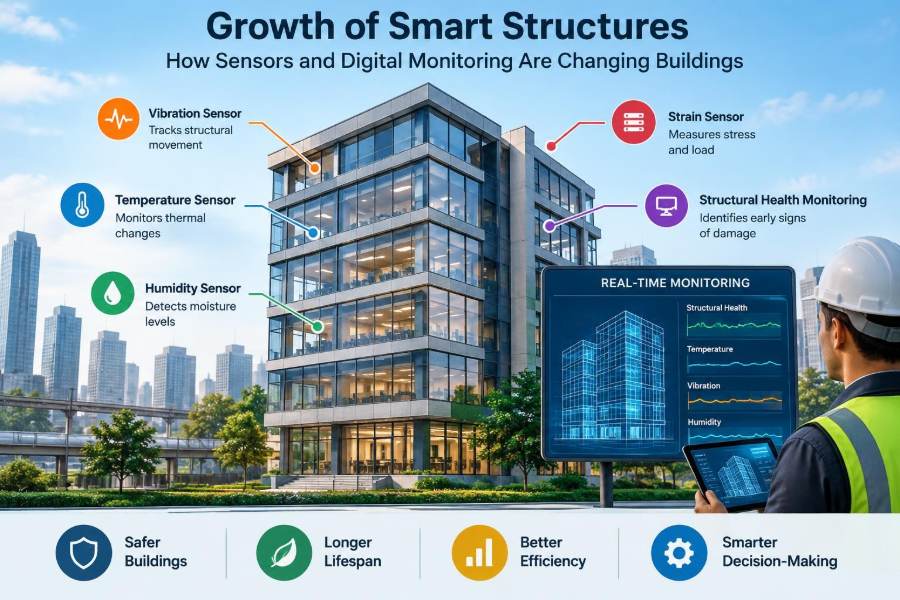

A building can look perfectly ordinary on the outside while carrying information that its occupants never see. A bridge deck expands during a hot afternoon. A hospital floor vibrates when equipment starts. A tower shifts slightly in a strong wind. These movements are often expected, but distinguishing normal behavior from an emerging problem has traditionally required inspections, calculations, and professional judgment at separate points in time.
That approach remains essential. Yet many structures are now gaining a continuous stream of evidence through sensors, connected data systems, and digital models. Instead of asking only, “What did the last inspection find?”, owners and engineers can increasingly ask, “How is the structure behaving right now, and how has that behavior changed?”
This is the practical meaning of a smart structure. It is not a building that makes decisions without people. It is a structure whose condition can be observed more clearly, interpreted more quickly, and managed more deliberately.
For students, this shift expands the structural engineer’s toolkit. For working professionals, it changes how design assumptions can be checked in service, how maintenance is prioritized, and how uncertainty is communicated when the data are incomplete.
🏢 What Makes a Structure “Smart”?
A smart structure combines a physical asset with a system for sensing, transmitting, storing, and interpreting information about its behavior or environment. The asset may be a building, bridge, tunnel, dam, stadium, offshore platform, or temporary works system.
The word “smart” does not require artificial intelligence, automation, or a fully digital twin. At its most useful level, it means that measurements are collected intentionally and linked to an engineering question. A crack gauge on a historic masonry wall can be part of a smart-structure system if it helps an engineer understand whether a crack is stable, seasonal, or progressing.
🧭 Why Periodic Inspection Alone Has Limits
Visual inspection is indispensable, especially for corrosion, leakage, cracking, damaged finishes, and construction defects. But it is a snapshot. An inspector may visit before or after a high-wind event, a heavy truck passage, or a period of unusual settlement without seeing how the structure responded during it.
Many structural changes are also too small, too gradual, or too inaccessible to identify reliably by eye. Digital monitoring fills some of these gaps by recording trends over time. It does not replace inspection; it gives inspections better targets and more context.
📡 Structural Health Monitoring Defined
Structural health monitoring, often abbreviated SHM, is the organized observation of a structure to assess its condition and performance. It usually involves measurements, baseline behavior, data processing, and engineering interpretation.
SHM differs from simply installing sensors. A sensor produces a signal. A monitoring program explains what signal is expected, what changes may matter, who reviews the information, and what action follows. Without those links, a dashboard can become an expensive collection of numbers.
🧱 The Physical Behavior Engineers Want to See
Structures respond to loads and environmental conditions through measurable effects. Common targets include displacement, strain, acceleration, rotation, temperature, humidity, corrosion activity, pore pressure, and crack movement.
For example, a beam under load develops strain: a very small change in length relative to its original length. Strain is related to stress through material behavior, but the relationship is not always simple in an operating structure. Cracking, creep, restraint, temperature gradients, and composite action can all influence what a measured strain means.
📏 Displacement and Deflection Sensors
Displacement sensors measure movement between points, while deflection describes a member’s change in shape under load. On a bridge, engineers may track vertical movement at midspan. In an excavation, they may track lateral movement of a retaining wall.
These measurements are valuable because excessive or unexpected movement can affect finishes, joints, services, bearings, and user comfort before it threatens structural safety. The reference point matters greatly: a sensor fixed to something that also moves can produce misleading results.
🧵 Strain Gauges and Fiber-Optic Sensing
Electrical strain gauges are bonded to a surface and change electrical resistance as the surface deforms. They can provide precise local measurements, but installation quality, temperature effects, moisture protection, and cable durability all influence performance.
Fiber-optic systems can measure strain and temperature at many points along a cable or at discrete locations. Their ability to cover long distances makes them attractive for large bridges, pipelines, tunnels, and extensive concrete elements. They are not automatically superior, however; routing, protection, interrogation equipment, and repair access must be considered from the start.
🌬️ Accelerometers and Structural Vibration
An accelerometer measures acceleration, commonly used to study vibration. In a tall building, sensors may capture sway caused by wind. In a footbridge, they may record vibration from pedestrians. In industrial floors, they can help investigate complaints about sensitive equipment or noticeable motion.
Vibration data can be converted into frequencies and mode shapes, which describe characteristic ways a structure tends to vibrate. Changes in those properties can be informative, but they are not a direct diagnosis of damage. Temperature, occupancy, added equipment, and operational conditions can change vibration behavior too.
🌡️ Temperature Is Not Background Noise
Temperature is one of the most influential and most misunderstood variables in monitoring. Steel and concrete expand and contract. Sunlight can heat one face of a member more than another, creating thermal gradients that cause curvature. Seasonal changes can alter bearing conditions, joint openings, and measured strain.
A strain reading without nearby temperature information may be difficult to interpret. Good programs measure relevant environmental variables and compare like with like: a warm afternoon should usually be compared with similar warm conditions, not with a cold night.
💧 Moisture, Humidity, and Durability Signals
Water is often the route by which durability problems develop. Moisture sensors, relative-humidity probes, leak detection systems, and corrosion-monitoring devices can help identify conditions that support corrosion, mold, freeze-thaw damage, or deterioration of sensitive materials.
These measurements rarely tell the whole story alone. A high humidity reading may be normal in a curing concrete element, a wet service space, or a changing season. Its value comes from location, duration, repetition, and connection to the material and exposure condition being assessed.
🔍 Crack Monitoring Beyond a Single Photograph
A crack is an observation, not a complete explanation. It may result from shrinkage, thermal movement, settlement, overload, reinforcement corrosion, construction sequence, or long-term material behavior. Photographing and mapping it is useful, but a crack gauge can reveal whether the opening changes with temperature, cycles with loading, or steadily increases.
Monitoring must not delay investigation where a crack pattern or associated distress raises immediate concern. In those cases, an engineer needs to assess safety promptly. Sensors can support that assessment, but they should not become an excuse to “wait and see.”
🛰️ Remote Sensing and Survey Technologies
Not every measurement requires a sensor permanently attached to the structure. Robotic total stations, laser scanning, photogrammetry, satellite-based positioning, and radar methods can track geometry and movement over wider areas.
These approaches are especially useful where access is difficult or where settlement affects an entire site. Their limitations include line of sight, weather, surface quality, measurement frequency, and the need for stable control points. A survey is only as trustworthy as its reference framework.
🧠 From Raw Signals to Useful Data
Raw monitoring data often contain electrical noise, missing values, timing errors, drift, and effects from changing environmental conditions. Processing may involve filtering, synchronization, quality checks, and comparison with a baseline.
The central question is not “Can we collect more data?” but “Can we make a defensible decision from it?” A clean plot that ignores sensor faults or operational context can be more dangerous than no plot at all because it creates false confidence.
🗂️ Establishing a Baseline Before Calling Something Abnormal
A baseline describes expected behavior under known conditions. It may be developed from design calculations, construction-stage measurements, controlled load tests, early service data, or a combination of these sources.
For instance, a bridge’s daily deflection pattern may be strongly tied to temperature. A meaningful alert threshold should account for that normal cycle. A single high value is not necessarily abnormal if it occurs under an expected combination of heat and traffic.
🚦 Alerts, Alarms, and Engineering Thresholds
An alert system should distinguish between information, investigation, and urgent response. Thresholds may be based on serviceability criteria, observed baseline variation, design limits, operational needs, or project-specific risk assessments.
| Level | Typical meaning | Appropriate response |
|---|---|---|
| Information | Expected or minor deviation | Record and review trend |
| Alert | Unexpected value or data-quality concern | Check sensor, context, and site condition |
| Alarm | Potentially significant structural or operational change | Escalate to responsible engineer under a defined plan |
Thresholds should be reviewed after commissioning. Limits chosen before the structure experiences real weather and occupancy may need refinement. Changing a threshold without recording why, however, can hide a developing issue.
🏗️ Monitoring During Construction
Construction is often the best time to install sensors because access is open and critical stages can be measured directly. Monitoring can track settlement, temporary bracing forces, concrete temperature, transfer of loads, facade movement, and the effects of excavation or dewatering.
It also tests assumptions about sequence. A design may be sound, yet actual movements can differ if loads are applied in a different order, supports are released earlier than expected, or temporary conditions persist longer. Construction monitoring makes these differences visible.
🏙️ High-Rise Buildings and Wind Response
Slender buildings are designed to move under wind, but occupants may perceive motion long before any structural limit is approached. Accelerometers can help characterize building response and support investigations of comfort complaints.
Engineers must separate structural movement from other sources of sensation, such as mechanical equipment vibration or facade noise. Monitoring may also help assess the performance of damping systems, which reduce vibration by dissipating or counteracting energy.
🌉 Bridges: Repetition, Fatigue, and Environment
Bridges face repeated traffic loads, thermal movement, water exposure, and sometimes difficult inspection access. Monitoring can focus on bearing movement, deck strain, cable forces, vibration, scour-related movement, or expansion-joint behavior.
Fatigue is particularly relevant because damage can accumulate under many load cycles even when individual loads are below a material’s short-term strength. Sensors do not eliminate the need for detailed fatigue assessment; they can provide better evidence about actual load effects and usage patterns.
🏛️ Historic Structures Need a Gentle Approach
Historic buildings often have irregular materials, unknown alterations, and limited tolerance for invasive testing. Monitoring can be a relatively low-impact way to learn how masonry walls, arches, timber roofs, or foundations respond to seasonal conditions and nearby construction.
Interpretation requires patience. Older structures may have survived for decades with visible deformation. The key issue is usually whether behavior is changing, not whether every feature matches a modern ideal of straightness or stiffness.
🏥 Critical Facilities and Continuity of Service
Hospitals, data centers, laboratories, transport hubs, and emergency facilities may require monitoring because service interruption has high consequences. The focus can include vibration-sensitive spaces, water ingress, settlement, equipment-support performance, and post-event assessment.
For these facilities, the monitoring plan should connect to operations. If a threshold is exceeded at night, who receives the notice? Who can enter restricted spaces? What temporary restrictions are feasible? Technical measurements are only useful when the response process works.
🪞 Digital Twins: More Than a 3D Model
A digital twin is often described as a digital representation connected to a physical asset. In structural practice, its useful form may range from a well-organized model linked to inspection records to a more advanced system that combines geometry, sensor data, maintenance history, and analytical models.
A 3D model alone is not a twin. Likewise, a live dashboard is not necessarily a twin. The practical goal is a reliable connection between physical condition, asset information, and decision-making—not an impressive visualization with uncertain data behind it.
🔗 Linking BIM, Models, and Field Measurements
Building information modeling can organize member identities, materials, drawings, locations, and asset records. When linked carefully with monitoring, it can help a user locate a sensor, see its associated element, and review relevant design or inspection information.
Linking does not make field data automatically correct. Sensor naming, coordinate systems, revisions, units, and time stamps must be controlled. A mismatch between the model and the as-built structure can send investigators to the wrong place or lead to flawed comparisons.
🤖 Where Analytics and Machine Learning Fit
Analytics can identify trends, cluster similar operating conditions, detect outliers, and reduce the volume of data requiring human review. Machine-learning methods may be useful when patterns are complex and sufficient representative data are available.
They have limits. A model trained on normal operation may flag a harmless unusual event, while a system trained on limited failure examples may not recognize a new failure mechanism. For safety-relevant decisions, outputs need engineering review, traceable inputs, and a clear understanding of uncertainty.
⚠️ False Positives and False Negatives
A false positive is an alert when no meaningful problem exists. Too many false positives create alarm fatigue: users learn to ignore notifications. A false negative is more serious in a safety context because a relevant condition is missed.
Reducing both errors requires more than tighter thresholds. It requires reliable installation, data validation, environmental context, appropriate sampling rates, and review by people who understand the structure. No monitoring system removes judgment from engineering.
🔌 Power, Connectivity, and Cybersecurity
Sensors need power, communications, and secure data handling. Wired systems can be dependable but difficult to retrofit. Wireless systems reduce cabling yet introduce battery management, signal coverage, interference, and network-security considerations.
Connected building systems should be designed with access control, software updates, backup procedures, and clear ownership of credentials. Cybersecurity is relevant not because every sensor is a target, but because unreliable or manipulated information can affect operational decisions.
🛠️ Sensor Installation Is an Engineering Task
A technically capable sensor can fail as a measurement if it is poorly mounted, exposed to damage, placed where it cannot represent the intended behavior, or left without calibration records. Installation details matter: cable protection, waterproofing, access for replacement, reference locations, and documentation all affect the final result.
Commissioning should include checks that measurements are plausible under known conditions. For example, a temperature sensor should show a reasonable relationship to nearby conditions, and paired displacement sensors should be checked for consistent sign conventions.
💰 Whole-Life Value Instead of Gadget Value
Monitoring has costs beyond procurement: design, installation, communications, software, storage, maintenance, calibration, expert review, and eventual replacement. Its value is highest when it reduces a specific uncertainty or supports a decision that would otherwise be costly, slow, or risky.
A modest system focused on a few high-consequence locations may outperform a large sensor network with no maintenance budget or review process. The right question is not “What can be instrumented?” but “What information changes what we do?”
📋 Designing a Monitoring Plan
A monitoring plan should begin with objectives and credible failure or performance scenarios. It should then define measurements, locations, sampling intervals, data ownership, quality checks, thresholds, reporting, and actions.
- State the engineering question before selecting hardware.
- Identify the behavior that would answer that question.
- Measure key environmental and operational influences.
- Assign responsibility for review and escalation.
- Plan for inspection, recalibration, repair, and system end of life.
This process keeps technology proportionate to the asset and its risks.
👷 Roles for Structural Engineers
Structural engineers are needed at every stage: framing the question, interpreting design intent, selecting meaningful locations, evaluating abnormal behavior, and communicating what the evidence does and does not show. Data specialists and sensor vendors contribute valuable expertise, but they do not replace responsibility for structural judgment.
For early-career engineers, useful skills include instrumentation basics, signal interpretation, programming or data literacy, construction observation, and clear technical reporting. The strongest practitioners can move comfortably between physical behavior and digital evidence.
📚 Questions Clients and Owners Should Ask
Owners do not need to become sensor experts, but they should ask practical questions before approving a system:
- What decision will this monitoring support?
- What normal behavior is expected?
- Who owns the data and who can access it?
- Who responds to an alert, and within what process?
- What happens if a sensor fails or communications stop?
- How will the system be maintained after handover?
These questions expose whether a proposal is an operational tool or simply a technology demonstration.
🚧 Common Mistakes to Avoid
A frequent mistake is collecting data without a hypothesis. Another is treating a sensor reading as a direct measure of safety when it is only one indirect indicator. Teams also underestimate field conditions: moisture, vibration, accidental impact, access restrictions, and changing construction conditions can quickly compromise equipment.
Equally problematic is assuming that more data mean more certainty. Large datasets can amplify confusion if units, timestamps, calibration, and context are poorly controlled. A smaller, well-maintained system with defined decisions is often more defensible.
🌱 Smarter Structures Can Support Lower-Impact Operation
Monitoring can contribute to sustainability when it helps extend service life, target repairs, reduce unnecessary investigations, or verify that existing capacity is being used appropriately. It may also reveal operational inefficiencies, such as recurring water leaks or vibration sources that shorten component life.
The environmental benefit is conditional, not automatic. Electronics, batteries, servers, replacement devices, and communications infrastructure have their own material and energy demands. A system should therefore be justified by durable asset-management value rather than novelty.
🔮 What the Next Phase May Look Like
Future systems will likely be more integrated, with better edge processing near the sensor, more interoperable asset records, and monitoring designed into structures rather than added later. Advances may make certain measurements easier to deploy, but field reliability and interpretation will remain the hard parts.
The most useful change may be cultural: treating real-world performance as feedback for design, construction, operation, and future projects. A structure in service can teach engineers where models were accurate, where assumptions were conservative, and where details need closer attention.
🧩 The Core Principle: Measure With Purpose
Smart structures are not defined by screens, apps, or the number of sensors installed. They are defined by a disciplined loop: identify a question, measure relevant behavior, understand uncertainty, compare results with context, and take proportionate action.
When that loop is in place, digital monitoring can make inspection more focused, maintenance more timely, and engineering decisions better informed. When it is missing, even sophisticated technology can generate noise, cost, and misplaced confidence.
The real growth of smart structures lies in combining sound structural engineering with trustworthy evidence from the structure itself. Sensors help buildings speak, but engineers, owners, and operators still need to ask the right questions and act responsibly on the answers. 🏗️📈🔎