
On a gusty day, the upper floors of a tall building can move enough for occupants to notice. A cup of coffee may ripple, a hanging fixture may sway slightly, or someone near a window may feel a slow, unfamiliar rolling motion.
That movement does not automatically mean the building is unsafe. Tall structures are designed to flex under wind, much as a fishing rod bends rather than snaps. But safe movement can still be uncomfortable, distracting, and disruptive to sensitive equipment.
Structural engineers therefore design not only for strength, but also for serviceability: how a building performs during ordinary use. One of the most visible tools for controlling motion is the tuned mass damper.
Often hidden near the top of a tower, this carefully calibrated system uses mass, stiffness, and damping to make wind-induced motion less noticeable. Its operating principle is elegant, but successful application requires a detailed understanding of structural dynamics.
🌬️ Why Wind Becomes a Tall-Building Design Problem
Wind pressure increases and fluctuates with height, while a tall, slender building presents a large exposed surface. Unlike a short, stocky building, a tower may respond as a flexible vertical cantilever, with the largest horizontal displacements occurring near its top.
The concern is not simply the average wind force. Turbulence, nearby buildings, terrain, and changes in wind speed create time-varying loads. Those variations can excite structural vibration.
🏙️ Strength and Comfort Are Different Requirements
A building may have adequate strength against wind loads while still producing motion that occupants find unpleasant. Strength checks address stresses, stability, and the ability of the structural system to resist extreme loading without unacceptable damage or collapse.
Comfort checks focus on accelerations and perceptible motion during more frequent winds. People are generally more sensitive to acceleration than to slow displacement, particularly when they are seated, resting, or performing precise tasks.
🧭 Understanding Sway, Drift, and Acceleration
Drift is the relative lateral displacement between levels, while overall sway describes the building’s lateral movement as a whole. Drift matters for façades, partitions, elevators, and other nonstructural components.
Acceleration describes how quickly motion changes. A tower can have a modest visible displacement but still feel uncomfortable if its acceleration is sufficiently noticeable. These related measures must be assessed separately.
🎵 Every Building Has Natural Frequencies
When displaced and released, a structure tends to vibrate at one or more preferred rates called natural frequencies. The corresponding vibration patterns are known as mode shapes.
The first lateral mode often resembles a smooth side-to-side bend, with the greatest movement at the roof. Higher modes include more complex shapes, with points along the height moving in different directions or phases.
🔔 Resonance Explains the Need for Tuning
Resonance occurs when repeated forcing contains energy near a system’s natural frequency. A playground swing illustrates the idea: well-timed pushes increase its motion, while poorly timed pushes do little.
Wind is not a single, perfectly repeating push, but its fluctuating energy can overlap with a building’s natural frequencies. A tuned mass damper is designed to respond around a target frequency and reduce the resulting structural response.
🧱 What a Tuned Mass Damper Is
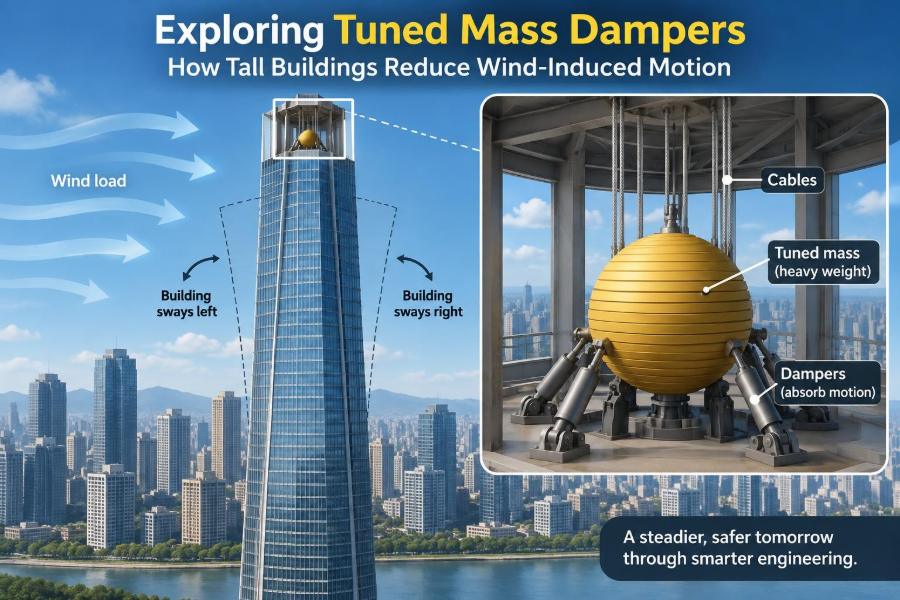
A tuned mass damper, often abbreviated TMD, is an auxiliary vibration-control device attached to a primary structure. It normally includes a substantial moving mass, a restoring mechanism such as springs or pendulum action, and energy-dissipating dampers.
The device is not intended to make the building rigid. Instead, it creates a controlled secondary motion that interacts with the building’s vibration and draws energy from it.
⚙️ The Core Components of a TMD
Although layouts vary, most tuned mass dampers contain the same functional elements:
- Mass: a block, steel assembly, concrete body, or other concentrated weight that can move relative to the structure.
- Restoring system: springs, cables, pendulum geometry, or another arrangement that governs the device’s preferred frequency.
- Damping system: often hydraulic, viscous, frictional, or other mechanisms that dissipate vibration energy.
- Supports and restraints: elements that guide travel, carry gravity loads, and limit motion under unusual conditions.
These components must work as an integrated dynamic system rather than as independent pieces of equipment.
↔️ How Opposing Motion Reduces Response
When a building sways in one direction, the damper mass lags because of inertia. With the device properly tuned, its relative movement produces forces that oppose part of the building’s motion.
It is tempting to say the mass “cancels” building movement, but that is too simple. The TMD changes the coupled dynamic behavior of the building-and-damper system and dissipates energy through its damping mechanism.
🪀 A Simple Physical Analogy
Imagine carrying a tray while someone nudges it rhythmically. If a smaller suspended object is arranged to move at an appropriate rhythm, its motion can reduce the tray’s wobble. If its timing is poor, it may make the behavior worse.
A real TMD is far more sophisticated than this analogy. Engineers model multiple modes, uncertain wind characteristics, structural properties, and physical travel limits before selecting a design.
📐 What “Tuned” Actually Means
Tuning means selecting the damper’s dynamic properties so its effective natural frequency lies near a target building frequency. For a spring-supported mass, stiffness and mass strongly influence that frequency; for a pendulum, the effective pendulum length is a key parameter.
The target is often the first lateral mode because it can dominate wind response in a slender tower. However, the appropriate target depends on the building’s geometry, stiffness distribution, expected loading, and desired performance.
💧 Why Damping Is Essential
A tuned mass alone can exchange energy with the building, but without sufficient damping it may continue oscillating and offer limited practical control. Damping converts a portion of mechanical vibration into heat or otherwise dissipates it.
Too little damping can make the system sharply sensitive to mistuning. Too much can restrict beneficial relative motion. Selecting damping is therefore a balancing exercise, not a matter of maximizing resistance.
📊 Mass Ratio and Practical Effectiveness
The mass ratio compares the damper’s effective mass with the relevant modal mass of the building. In broad terms, a larger ratio can provide greater control authority, but it also demands more floor area, support capacity, cost, and coordination.
Adding mass is not automatically efficient. The location of the mass, its allowable travel, the intended vibration modes, and the damper’s tuning all influence the result. A smaller well-designed system may suit a project better than an impractically large one.
📍 Why Dampers Usually Sit Near the Top
For the fundamental sway mode, displacement is generally greatest near the top of a tower. Installing a TMD high in the building gives the moving mass a larger lever arm relative to the mode shape and can improve its effectiveness.
This placement creates architectural and logistical consequences. The upper mechanical levels may need substantial clear height, strong transfer elements, maintenance access, and carefully planned routes for installing the mass.
🧰 Common Types of Tuned Mass Dampers
| Type | Basic arrangement | Typical design consideration |
|---|---|---|
| Translational TMD | A mass moves horizontally on guides or supports. | Requires sufficient travel path and robust end restraints. |
| Pendulum TMD | A suspended mass swings like a pendulum. | Effective period depends strongly on pendulum geometry. |
| Liquid damper | Liquid sloshes in a tank to absorb energy. | Tank geometry and sloshing behavior require careful analysis. |
| Multiple TMDs | Several smaller units are tuned over a frequency range. | Can improve robustness when frequencies may vary. |
The right type depends on spatial constraints, architectural intent, available mass, target performance, and maintenance strategy.
💦 Tuned Liquid Dampers and Sloshing
A tuned liquid damper uses the motion of water or another liquid within a specially shaped tank. As the structure moves, the liquid sloshes and can dissipate energy through baffles, screens, or fluid motion.
These systems can be attractive where tanks serve another project function, but dual use should never be assumed without analysis. Water-storage requirements, operating levels, and vibration-control requirements may not align.
🧩 Multiple Dampers for Multiple Modes
A single TMD is often optimized near one frequency. Buildings, however, have several modes, and their dynamic properties can shift with temperature, occupancy, fit-out, or long-term changes in stiffness.
Using multiple dampers with slightly different tuning can broaden the effective frequency range. This approach may also help address motion in two horizontal directions or control torsional response.
🌀 Torsion Is More Than Side-to-Side Sway
Wind does not always push through a building’s center of stiffness and mass. When force and resistance are eccentric, the building can twist about its vertical axis, producing torsional vibration.
Occupants near the perimeter may experience torsion more strongly than occupants near the center. A damper strategy should therefore consider translational and torsional modes rather than assuming one horizontal direction tells the full story.
🌪️ Wind Excitation Takes Several Forms
Along-wind response follows the general wind direction and is driven by fluctuating pressure. Across-wind response acts perpendicular to the mean wind direction and can become significant for certain shapes and conditions.
Vortex shedding is one source of across-wind loading. As air passes around a bluff body, alternating vortices may form and create periodic forces. Aerodynamic shaping, wind-tunnel testing, and damping can all play roles in managing this behavior.
🏗️ The Structural System Still Does the Primary Work
A TMD supplements the building’s lateral-force-resisting system; it does not replace it. Cores, shear walls, braced frames, moment frames, outriggers, and perimeter structural systems must provide the fundamental strength and stiffness required by the project.
Relying on a damper to compensate for an under-designed primary structure is poor engineering. The tower must remain safe and stable across the required loading conditions even as auxiliary devices are considered.
🧪 How Engineers Predict Building Motion
Preliminary analysis may use simplified models to estimate periods, mode shapes, and likely response. As projects advance, engineers commonly use detailed finite-element models and dynamic analyses that represent mass, stiffness, damping, and coupling between structural components.
For major wind-sensitive buildings, physical or computational aerodynamic studies may be used to characterize wind effects. The quality of input assumptions matters as much as the sophistication of the software.
🌬️ Why Wind-Tunnel Testing Can Matter
Wind around a high-rise is shaped by regional climate, terrain, neighboring towers, and the building’s own form. A rectangular tower on an isolated site behaves differently from the same tower surrounded by buildings of varied heights.
Boundary-layer wind-tunnel testing can model an atmospheric wind profile and surrounding context. Results may inform structural loading, cladding pressures, pedestrian-level wind conditions, and occupant-comfort assessments.
🛠️ Designing for Stroke and End Stops
The damper mass needs enough stroke, or relative travel, to function during expected motion. If it reaches its physical limit too often, the system cannot behave as intended and may introduce large impact or restraint forces.
Engineers specify stops and buffers for rare or extreme events. Those restraints are safety features, not normal operating components, and their forces must be transferred safely into the surrounding structure.
🔩 Connections and Load Paths Cannot Be an Afterthought
A damper’s forces enter the structure through its support frame, attachments, and anchorage. These components must resist gravity effects, cyclic forces, accidental restraint loads, and construction-stage demands.
The local framing around a rooftop damper can be substantial. Early coordination prevents a common problem: discovering late in design that the architectural plant room cannot accommodate the required beams, clearances, or access routes.
🏭 Fabrication, Delivery, and Construction Sequencing
Some TMD masses are delivered in pieces and assembled high in the building; others may use dense materials or concrete to achieve the required weight. Crane capacity, hoist routes, temporary supports, and site logistics influence the feasible configuration.
Construction sequencing also matters because a partially completed tower has different dynamic properties from the finished building. Temporary wind-response planning should be considered separately from the final damper’s operating role.
📡 Monitoring Turns Design Assumptions into Observations
Accelerometers, displacement sensors, weather instruments, and control-system data can reveal how a completed building and its damper respond over time. Monitoring supports commissioning and can identify whether performance matches expectations.
Measured data are valuable because real buildings contain uncertainties: actual stiffness, nonstructural contributions, damping levels, and occupant-related mass differ from idealized models. Monitoring does not eliminate uncertainty, but it makes it visible.
🔧 Inspection and Maintenance Keep the Device Reliable
TMDs are mechanical systems in a building environment. Bearings, cables, seals, hydraulic components, guides, sensors, and restraints require planned inspection and maintenance.
Maintenance responsibilities should be clear before handover. A device that is inaccessible, poorly documented, or difficult to test can lose much of its practical value despite sound original design.
⚠️ Common Misconceptions About Tuned Mass Dampers
- “They stop all movement.” They reduce selected aspects of response; tall buildings still move.
- “Any heavy rooftop object acts as a damper.” A useful TMD needs controlled relative motion, tuning, damping, and proper connections.
- “They are only for record-height towers.” Their suitability depends on dynamic behavior and performance objectives, not height alone.
- “One device solves every wind problem.” Aerodynamics, stiffness, structural layout, and multiple vibration modes may need separate attention.
💰 When a TMD Is Worth Considering
A TMD may be considered when a building is slender, flexible, or particularly sensitive to wind-induced acceleration. It can also be useful when architectural constraints limit changes to the primary structural system or when a performance target calls for improved occupant comfort.
The decision should compare alternatives early. Changing a tower’s shape, increasing stiffness, adding aerodynamic features, revising structural layout, or using other damping devices may be more appropriate in a given project.
⚖️ Comparing TMDs with Other Response-Control Strategies
Structural modification and aerodynamic refinement reduce response at its source, while a TMD addresses response through a secondary dynamic system. Neither approach is inherently superior; the best solution often combines them.
For example, setbacks, rounded corners, openings, or other form changes can alter wind behavior. Outriggers can increase stiffness. Supplemental damping systems can dissipate energy. Each option affects architecture, cost, constructability, and long-term operation differently.
📚 A Practical Workflow for Engineers
- Establish performance objectives for strength, drift, acceleration, and function.
- Develop a structural model and identify governing modes.
- Characterize wind environment and aerodynamic response at an appropriate level of detail.
- Compare form, stiffness, and damping alternatives before committing to a device.
- Design the selected damper with its support structure, travel limits, controls, and maintenance needs.
- Commission, monitor where appropriate, and document long-term inspection requirements.
This workflow keeps vibration control connected to the whole building rather than treating it as late-stage mechanical equipment.
🎯 The Core Principle: Controlled Motion, Not Perfect Stillness
Tuned mass dampers work because a moving secondary mass can be calibrated to interact constructively with a vibrating structure. Their value lies in reducing targeted response, particularly occupant-perceived acceleration, while the main structural system continues to provide strength and stability.
Successful designs account for the complete chain: wind environment, tower form, natural modes, damping selection, available travel, support framing, construction, monitoring, and maintenance. A TMD is most effective when it is part of that integrated design process.
Tall buildings do not need to be perfectly still; they need to move predictably, safely, and comfortably under the winds they are expected to face. That is the practical purpose of tuned mass damping in structural engineering. 🏗️🌬️⚙️